
Nature Journal Prompts for Adults: 24 Gentle Ways to Notice More Outside
A nature journal does not need a special location, a perfect sketch, or a long entry. You can write from a garden path, a park bench, a balcony, or a window. The aim is simply to notice what is already around you and give one small detail a place on the page.
What is a nature journal?
A nature journal is a simple record of what you notice in the natural world around you. It can hold observations about light, weather, plants, sounds, changing seasons, or one familiar outdoor spot. You do not need drawing skills, species names, or a long entry—just a little time and attention.
How to keep a nature journal in ten quiet minutes
You can use a notebook, a loose sheet of paper, or the printable pages in the Nature Journal Pack. Keep the process small enough to repeat.
- Choose one place. Sit somewhere comfortable outdoors, or look through a window. Stay with the view you have rather than searching for something unusual.
- Pause and notice. Spend a minute looking, listening, and noticing the air. Let your attention settle on one detail.
- Choose one prompt. Pick a question below that fits what is in front of you. You do not need to answer every prompt in one sitting.
- Write a few sentences. Describe what you can observe in your own words. Leave uncertain details uncertain.
- Close with one small moment. Add a detail you would like to remember, then stop when the page feels complete.
Ten minutes is a starting point, not a rule. A short note from a window can be a nature journal entry, too.
24 nature journal prompts for adults
These nature journal prompts are grouped into four gentle themes. Use one at a time, return to a favorite, or keep the list nearby for days when you are not sure what to write.
Looking Closely
- What small detail on the ground or nearby surface do you notice when you pause and look closely?
Stay with one small patch rather than trying to describe the whole view.
- Which shape in the landscape catches your eye, and what makes it interesting to you?
Notice the outline, curve, angle, or pattern that makes the shape stand out.
- What colors can you see in one small patch of the outdoors, and how do they sit beside one another?
Choose two or three colors and describe how they meet.
- How does the light fall across the place you are observing, and what changes where it meets shadow?
Follow one edge of light and note where the shade begins.
- What texture can you notice in a leaf, stone, bark, soil, or another nearby surface?
Compare a nearby surface with another one using your own words.
- What has changed in this view since you last looked at it, even if the change is very small?
A tiny shift in color, position, or growth is enough to record.
Sounds, Smells And Weather
- What sounds are closest to you right now, and which ones sit farther away?
Pause before writing and separate the nearby sounds from the distant ones.
- How would you describe the quietest sound you can hear without trying to name its source?
Describe the sound’s pace, volume, or quality without naming its source.
- What scents are present in the air, and how would you describe them in your own words?
Use simple sensory words, even if the scent is faint or hard to place.
- How does the weather feel on your skin or in the air from where you are sitting?
Record the air as it feels now, not as the forecast describes it.
- What is the wind doing to the leaves, grass, water, clouds, or other things you can see?
Watch one small movement and describe what it touches or changes.
- How does this place feel different when the sky is bright, cloudy, rainy, or changing?
Notice how the same place feels under the sky you have today.
Living Things
- Which living thing draws your attention first, and what do you notice about the way it moves or rests?
Observe posture, movement, or stillness without needing a name.
- What is happening around one plant you can see, from its leaves to the ground beside it?
Look at the plant as part of its surroundings, not on its own.
- What small signs of animal life can you notice without needing to identify the animal?
Record a trace, movement, or sound without guessing which animal made it.
- How do two living things share or use the same small space?
Notice the shared space and the distance or closeness between them.
- What appears to be growing, resting, feeding, moving, or changing in this view?
Write only what you can see happening in this moment.
- What question comes to mind as you watch a living thing for a few quiet moments?
Let the question stay open rather than trying to answer it.
Seasons And Returning
- What signs suggest that the season is changing where you are?
Look for small seasonal clues in light, color, weather, or growth.
- Which part of this place looks different from the last time you visited it?
Compare one familiar detail with how you remember it before.
- What returns to this view again and again, even as other details change?
Notice a recurring sound, shape, visitor, or pattern.
- If you visited this same spot next month, what small change would you be curious to notice?
Choose one detail you would like to check on when you return.
- What would you like to remember about this particular day outdoors?
Keep the memory specific to the place and the day.
- What does returning to this place help you notice that you might otherwise pass by?
Write what you notice now that may have escaped your attention before.
If you enjoy noticing how the outdoors changes through colder months, you may also like these winter journal prompts.
What is included in the free Nature Journal Pack?
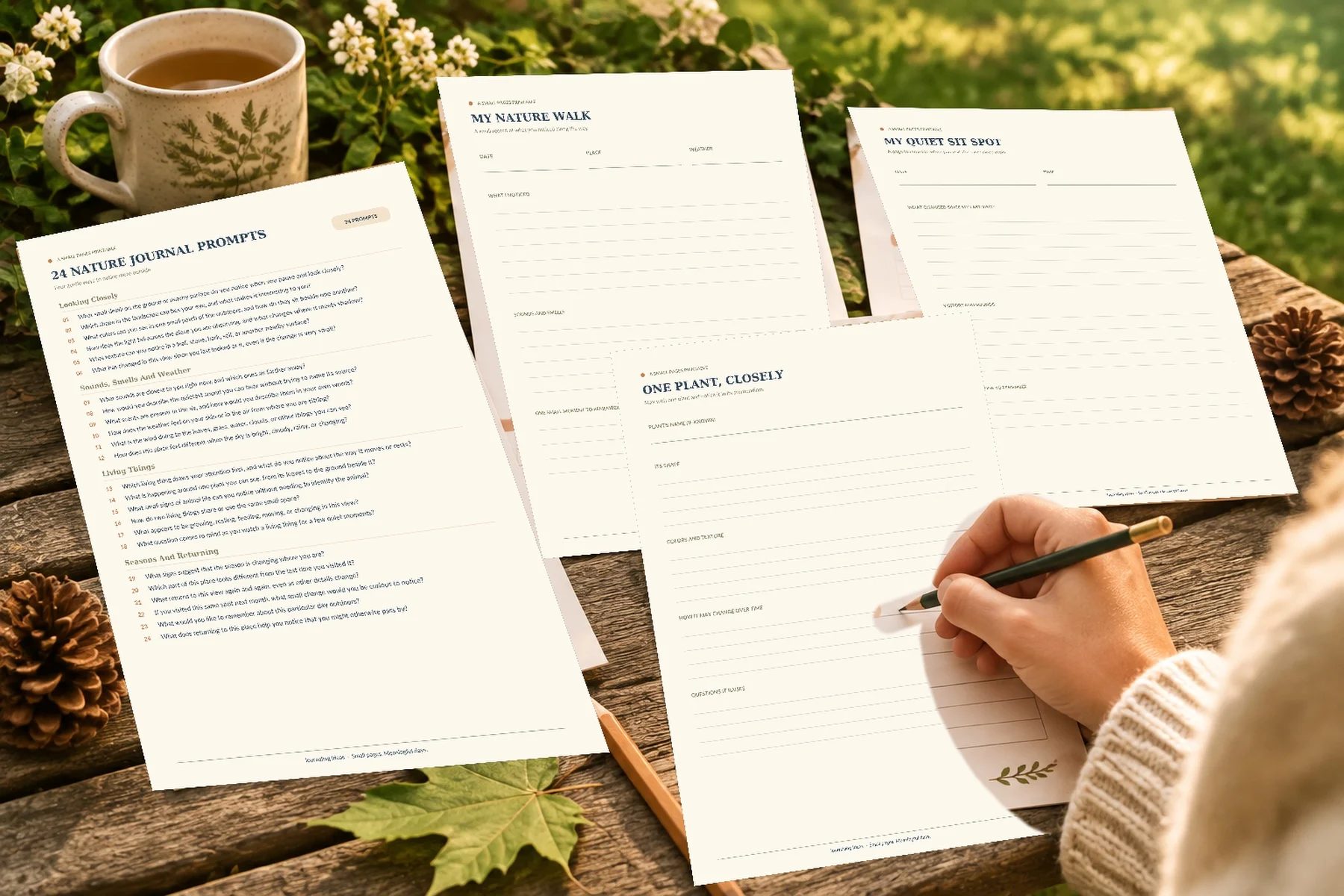
The Nature Journal Pack contains four printable sheets, each supplied as an A4 PDF and a US Letter PDF. The pages are designed for observation and reflection, with open writing space rather than a packed worksheet.


- Sheet 1 — 24 Nature Journal Prompts: the complete list above, in the same four sections and numbering.
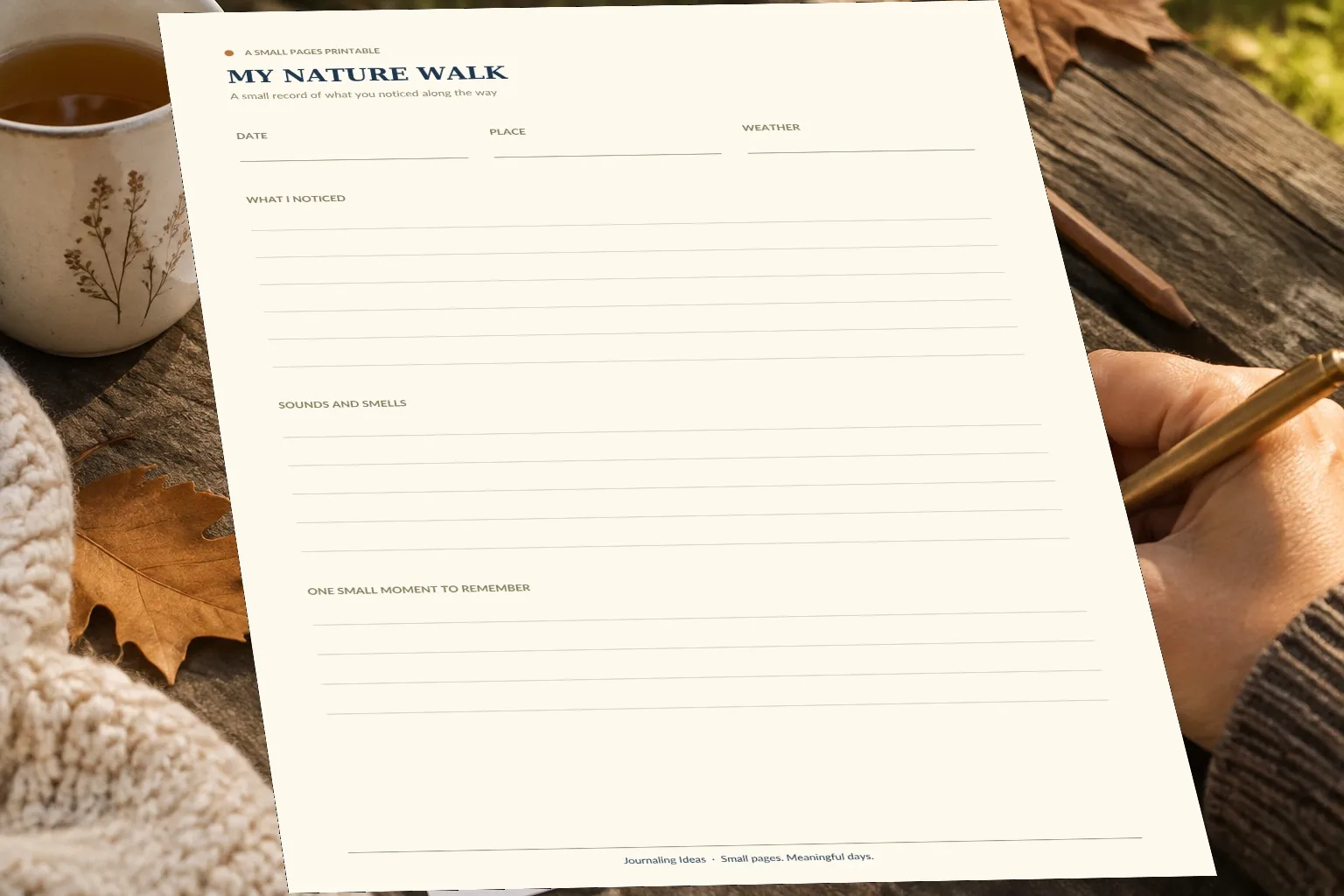
- Sheet 2 — My Nature Walk: spaces for the date, place, and weather, followed by room for what you noticed, sounds and smells, and one small moment to remember.
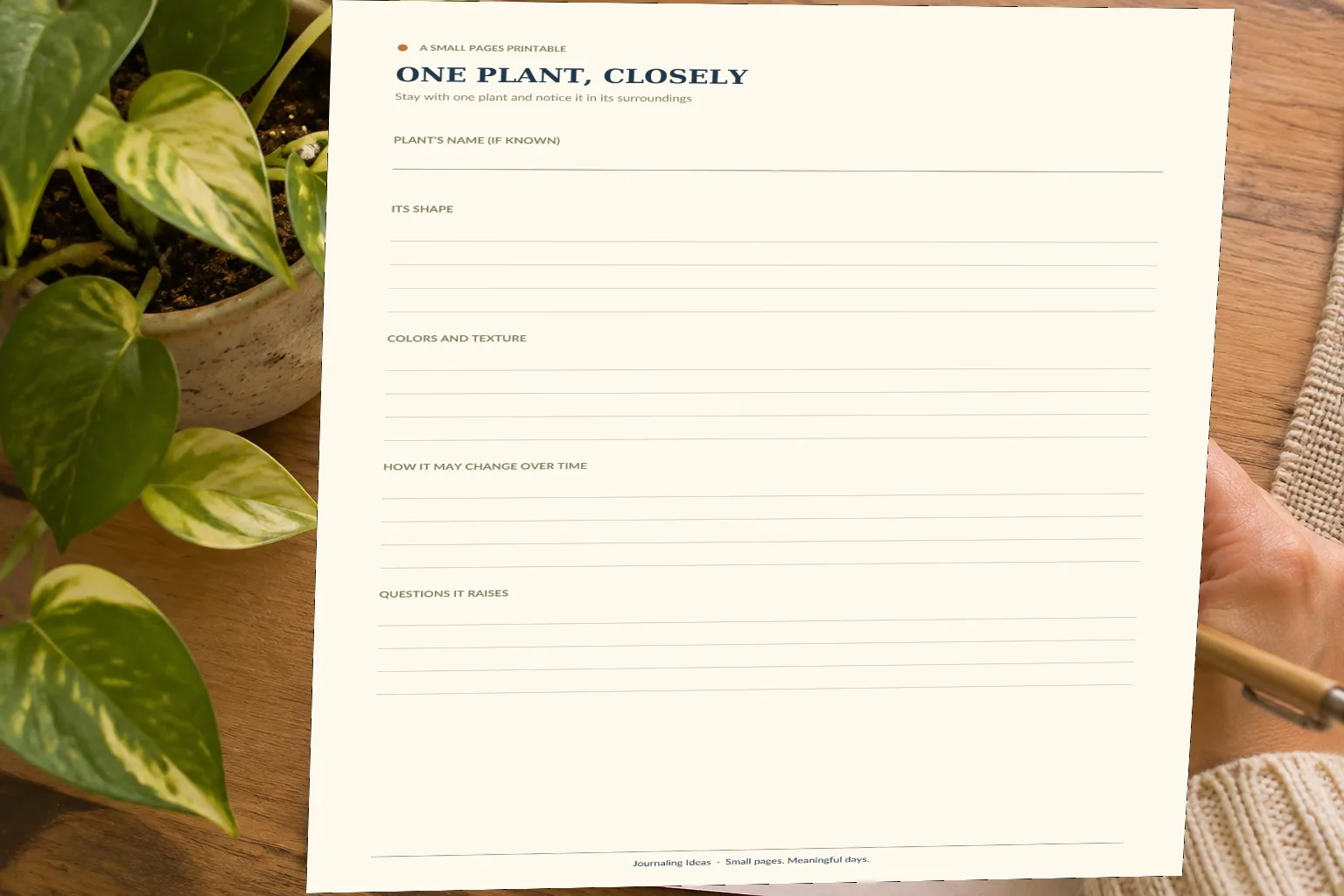
- Sheet 3 — One Plant, Closely: room to note a plant’s name if known, its shape, colors and texture, how it may change over time, and questions it raises.
- Sheet 4 — My Quiet Sit Spot: spaces for the date and time, what changed since your last visit, visitors and sounds, and one line to remember.
The pack is free to access, with no email signup or password. Find all four sheets in The Small Pages Library.
Free download: Sheet 1 — 24 Nature Journal Prompts (A4 PDF · US Letter PDF)
Free download: Sheet 2 — My Nature Walk (A4 PDF · US Letter PDF)
Free download: Sheet 3 — One Plant, Closely (A4 PDF · US Letter PDF)
Free download: Sheet 4 — My Quiet Sit Spot (A4 PDF · US Letter PDF)
How to print the nature journal sheets
- Choose the A4 file or the US Letter file that matches your paper.
- In your printer settings, select Actual Size or 100% when your printer and paper size match the PDF.
- If you are printing on a different paper size, choose Fit to Printable Area so the page stays within the margins.
- Use regular printer paper for everyday notes, or a slightly heavier paper if you prefer a firmer page.
- Print only the sheets you want to use. You can keep Sheet 1 nearby and reprint the observation pages when you need them.
The PDFs are designed with generous margins and writing lines. Printer settings vary, so check the preview before printing a full set.
A small way to keep noticing
A nature journal can stay simple: one familiar place, one detail, and a few honest sentences. You can revisit the same prompt or spot without needing to make each entry different. If a very short record suits you better, a one line a day journal can be another gentle way to keep a small observation.
You do not have to identify everything you see or turn every visit into a project. Let the page hold what you noticed today, and leave room for what you may notice next time.
Small pages. Meaningful days.
— Journaling Ideas Editorial Team
Frequently asked questions
Do I need to know the names of plants, birds, or other living things?
No. You can describe shape, color, movement, sound, or texture without identifying the source. If you are unsure of a name, leave it out.
Can I keep a nature journal from a window?
Yes. A window, balcony, doorstep, or other comfortable place can give you plenty to notice. You can write about weather, light, plants, passing movement, or the view changing over time.
How long should a nature journal entry take?
A few minutes is enough for a short observation. The ten-minute routine is simply a starting point; stay longer when you want to, or finish after one sentence.
What if nothing interesting happens during my nature walk?
You do not need a dramatic event. Look more closely at an ordinary detail, such as the shape of a shadow, a change in the air, or a sound nearby.
Should I visit the same place more than once?
You can. Returning to a familiar spot makes it easier to notice what has changed and what remains. You can also use a different place whenever that suits your day.
Is the Nature Journal Pack really free?
Yes. All four sheets are free in A4 and US Letter PDF formats. There is no email signup or password required to access the pack.




3 Comments