

50 Winter Journal Prompts for Cozy, Quiet Days
A winter journal prompt can help you slow down, notice the small moments, and keep a gentle writing habit through the coldest months. This article offers 50 warm, simple questions in five sections, from cozy days at home to quiet evenings and the first signs of spring. You can use one a day, a few each week, or choose a section that matches your mood. The free Winter Journal Prompts List is open access in The Small Pages Library. It is free, with no signup required.
Free download: The Winter Journal Prompts List — all 50 prompts on two printable sheets (A4 + US Letter), free in The Small Pages Library. No signup needed.
Why can winter be a good time to journal?
Winter often has its own rhythm: shorter daylight, earlier evenings, and more time spent indoors. Those quiet hours can make writing feel calmer and more useful, because there is less pressure to fill every day with plans. You can write for five minutes after a warm drink, or spend a little longer with a candle lit and the world outside turning cold and soft. Journaling does not need tools, habits, or a perfect routine, and it works just as well on a quiet afternoon as it does on a snowy morning.
Writing a few lines can also help you remember what a season felt like. A small snow shower, a meal that warmed the house, and a conversation that made you laugh often feel ordinary while they are happening, but they may be the moments you remember most later. A journal keeps those details close without asking you to record everything, and it gives you a place to return to when you want to slow down. This guide uses 50 prompts in five themes so you can dip in and out as the season unfolds, and it shows you how to use the free printable list if you prefer a simple page beside your journal.
How can you use these winter journal prompts?
A winter prompt is a small, simple question you can answer in a sentence or two. It can be a memory, a feeling, a small detail, or a plan for tomorrow. You can choose one in the morning, in the evening, or whenever you have a quiet moment. There are no rules about order, and there is no need to answer every prompt. You can skip a question, return to one later, or repeat the ones you enjoy most. A short answer is often enough, and you do not need to write a lot to make the prompt useful.
If you like structure, you can use one prompt a day from December through February, which covers most of the season without turning journaling into a task. If you prefer a lighter pace, choose three or four prompts a week, or take one section at a time. It can help to write the date or the prompt number at the top of the page, and to leave a little space after your answer in case another thought arrives later. If you are writing in a paper journal, keep your notebook and pen within easy reach so the habit feels warm and simple rather than formal. If you are using a digital journal, you can copy one question into your notes app or digital pages and write your answer there.
Some prompts will feel easy, and others may lead to longer answers. You can write a paragraph, a short list, or a few words, and a sentence or two is enough on a busy day. It is also fine to answer the same prompt more than once; winter can change how a question feels as the season moves from December to February. If a question brings up something that feels heavy, you do not need to force an answer. You can pause, choose a gentler prompt, and note that you are keeping your journaling simple and kind. You can also skip the question entirely and return to a prompt that feels better on another day.

What are the 50 winter journal prompts?
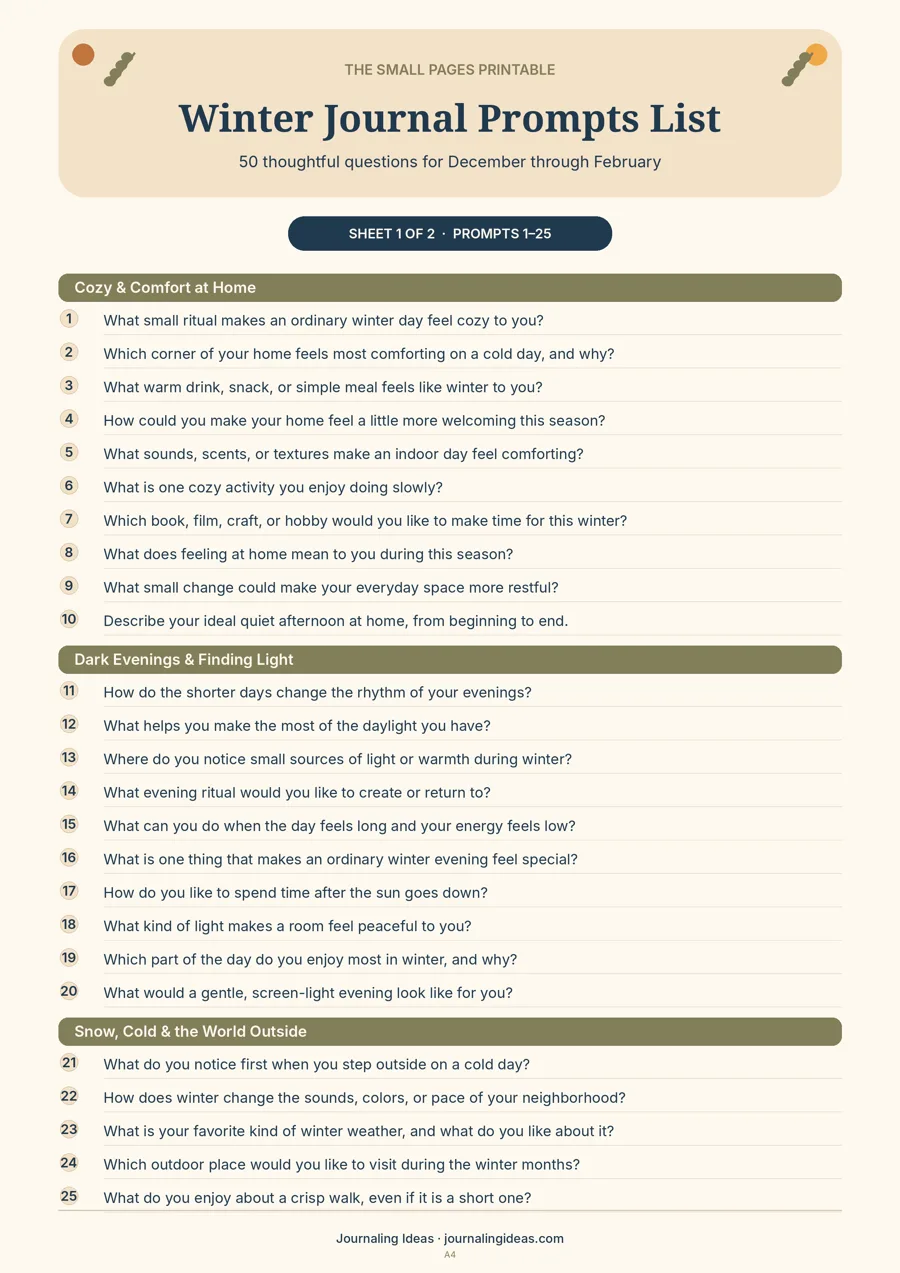
The 50 winter journal prompts are in five sections of ten, following a gentle path through the season. The sections are Cozy & Comfort at Home, Dark Evenings & Finding Light, Snow, Cold & the World Outside, Rest, Slowness & Quiet Days, and Small Joys & Looking Toward Spring.
Cozy & Comfort at Home
- What small ritual makes an ordinary winter day feel cozy to you?
- Which corner of your home feels most comforting on a cold day, and why?
- What warm drink, snack, or simple meal feels like winter to you?
- How could you make your home feel a little more welcoming this season?
- What sounds, scents, or textures make an indoor day feel comforting?
- What is one cozy activity you enjoy doing slowly?
- Which book, film, craft, or hobby would you like to make time for this winter?
- What does feeling at home mean to you during this season?
- What small change could make your everyday space more restful?
- Describe your ideal quiet afternoon at home, from beginning to end.
Dark Evenings & Finding Light
- How do the shorter days change the rhythm of your evenings?
- What helps you make the most of the daylight you have?
- Where do you notice small sources of light or warmth during winter?
- What evening ritual would you like to create or return to?
- What can you do when the day feels long and your energy feels low?
- What is one thing that makes an ordinary winter evening feel special?
- How do you like to spend time after the sun goes down?
- What kind of light makes a room feel peaceful to you?
- Which part of the day do you enjoy most in winter, and why?
- What would a gentle, screen-light evening look like for you?
Snow, Cold & the World Outside
- What do you notice first when you step outside on a cold day?
- How does winter change the sounds, colors, or pace of your neighborhood?
- What is your favorite kind of winter weather, and what do you like about it?
- Which outdoor place would you like to visit during the winter months?
- What do you enjoy about a crisp walk, even if it is a short one?
- What winter detail would you like to photograph, sketch, or remember?
- How does the landscape change where you live between December and February?
- What do you find beautiful about bare trees, frost, rain, or snow?
- What is one small outdoor adventure you could enjoy this winter?
- If you could keep one winter scene in a memory box, what would it be?
Rest, Slowness & Quiet Days
- What does rest look like for you when the days are cold and short?
- Which expectations could you gently set aside this winter?
- What would it mean to give yourself permission to do less?
- What helps you notice when you need a slower day?
- What can you simplify in your routine during this season?
- How do you want to care for your time and attention this winter?
- What is one thing you can leave unfinished without worrying about it?
- What does a peaceful day look like when very little happens?
- What boundary could help protect a little quiet time?
- What would you like to remember about how you treated yourself this winter?
Small Joys & Looking Toward Spring
- What small winter joy have you noticed recently?
- Which ordinary moment would you like to appreciate more often?
- What is something you are looking forward to in the coming weeks?
- What skill, idea, or interest would you like to explore before spring?
- What part of winter do you hope to remember fondly?
- What is one thing you want to carry with you into the next season?
- How have your priorities shifted since the start of winter?
- What tiny sign of changing seasons do you look forward to noticing?
- What is something you feel proud of from these winter months?
- If you could write a short note to yourself at the start of spring, what would it say?

How can you make winter journaling feel manageable?
Keep your journal close and your entries short. A few sentences after a walk or a cup of tea can be enough, and you do not need to fill a page. If a prompt asks for a list, try writing just three items. If a prompt asks for a description, try three sentences. You can set a gentle time limit of five minutes, or keep writing if the words come easily.
If you miss a day, it is not a problem. Winter journaling is not a streak to protect, and no prompt needs to be completed by a certain date. You can simply pick up the next question that appeals to you. It can also help to choose your prompt the night before, so that your writing is ready when you have a quiet moment. Keeping all your prompts on one printable page also means you can see the whole season at a glance, which can make the practice feel calmer instead of overwhelming.
What if winter feels heavy or difficult?
Winter can feel heavy for some people, especially when the days are short and the weather is cold. This article is not a treatment or a plan for mood changes, and the prompts are not meant to replace support from a professional. They are simple journaling questions for personal reflection, and you do not need a reason to use them or a goal to achieve.
If a prompt brings up something difficult, you can pause and choose another one. You can also write a short note about how you feel, keep your answer very short, or stop writing for the day. There is no need to push through a question that does not feel right. You can return to it later or leave it alone entirely. If you need support beyond journaling, speaking to a trusted person or a professional can help you find a next step that feels right for you.
Where can you get the free Winter Journal Prompts List?
The Winter Journal Prompts List is free in The Small Pages Library. It has the same 50 prompts from this article in a printable format on two sheets: Sheet 1 has prompts 1–25 and Sheet 2 has prompts 26–50. Each sheet is available in A4 and US Letter, which means the two-sheet list comes as four PDF files in total. It is free, with no signup required. You can download it directly from The Small Pages Library and print it at home.


How should you print the winter prompt sheets?
Print the two sheets at actual size on A4 or US Letter paper, and choose “Fit to Page” only if your printer trims the edges. Thin paper works for reading and annotating, while thicker paper is better if you like writing with a broad pen or keeping the sheets in a folder through the season. Print the two sheets separately if you want them as reference pages, or keep a set beside your notebook and use them one at a time. You can also highlight or circle prompts you want to return to, and add a small note beside any question that gives you an idea for another entry.
What should you read next?
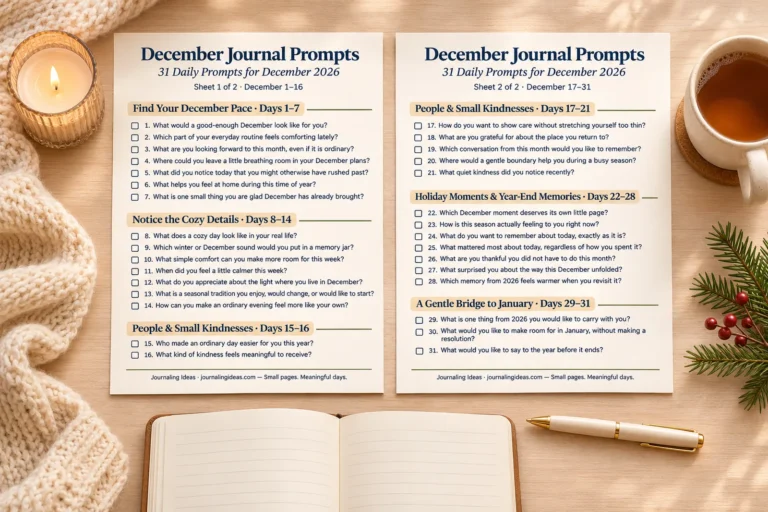
For prompts that are more specific to the month, try our December Journal Prompts and January Journal Prompts articles. The December article gives you 31 daily prompts for the month, while the January article offers 31 days of fresh-start writing. The Winter Journal Prompts article here gives you a broader, season-wide collection of questions, so you can use it from December through February while keeping the December and January lists for month-specific ideas.
Conclusion: How can you make the most of winter journaling?
Winter journaling can be a quiet way to notice the season as it passes, and a few small questions can help you remember what a cold month felt like. You do not need to write every day, and you do not need to complete all 50 prompts. You can choose what feels helpful, skip what does not, and return to a prompt if it calls to you.
If you would like a simple place to start, choose one question from any section and write for five minutes. You can set the notebook down whenever you like, and you can return to it any time. The Winter Journal Prompts List is free in The Small Pages Library, with no signup required, and it can sit beside your journal through the whole season. Small pages. Meaningful days.
If you would like to keep noticing the outdoors beyond the colder months, try these nature journal prompts. The collection includes 24 gentle observation questions about light, weather, living things, and returning to familiar places. There is also a free four-sheet Nature Journal Pack in A4 and US Letter, with no signup required.
After reflecting on the quieter months, you may be ready to notice what is beginning to change. Continue your seasonal journaling with these spring journal prompts: 50 gentle questions about fresh starts, clearing space, growing things, and the small pleasures of spring.
Frequently Asked Questions About Winter Journal Prompts
Q: Do I need to answer all 50 prompts?
A: No. Choose one question at a time and write only what feels helpful. You can return to the list whenever you want a quiet, simple prompt, without needing to finish it.
Q: Can I use it for just one month?
A: Yes. Choose any prompts you like during December or use them across the entire winter. There is no order to follow and no date attached to any question.
Q: Is the Winter Journal Prompts List free?
A: Yes. The Winter Journal Prompts List is open access in The Small Pages Library. It is free, with no signup required.
Q: Can I start the list mid-winter?
A: Yes. Any day in winter is a good day to begin. Pick a prompt that fits today and keep going at a gentle pace.
Q: Can I use these prompts in a digital journal?
A: Yes. The prompts work just as well on paper or in a digital journal. You can copy a question into your notes app or digital pages and write your answer there.
Q: Should I repeat any prompts in the next year?
A: Yes. A repeated prompt can lead to a different answer in another season. You are welcome to return to any question whenever it feels useful.




4 Comments