

March Bullet Journal Ideas: 20 Simple Spreads for a Fresh Spring Start
March bullet journal ideas can help you give the month a little structure without turning your notebook into another project to manage. March 2027 has 31 days and begins on Monday, so you can build a clean monthly log, choose a few useful trackers, and add spring pages that leave room for real life.
This guide walks through 20 simple spreads in a practical order, from a cover page to an end-of-month reflection. You can use all 20, or choose only the pages that make your month easier.
If you are new to the system, our bullet journal for beginners guide explains the basic setup before you add more collections.
March 2027 at a glance
March 2027 has 31 days. March 1 falls on a Monday, and March 31 falls on a Wednesday. St. Patrick’s Day is Wednesday, March 17, and the first day of spring is March 20.
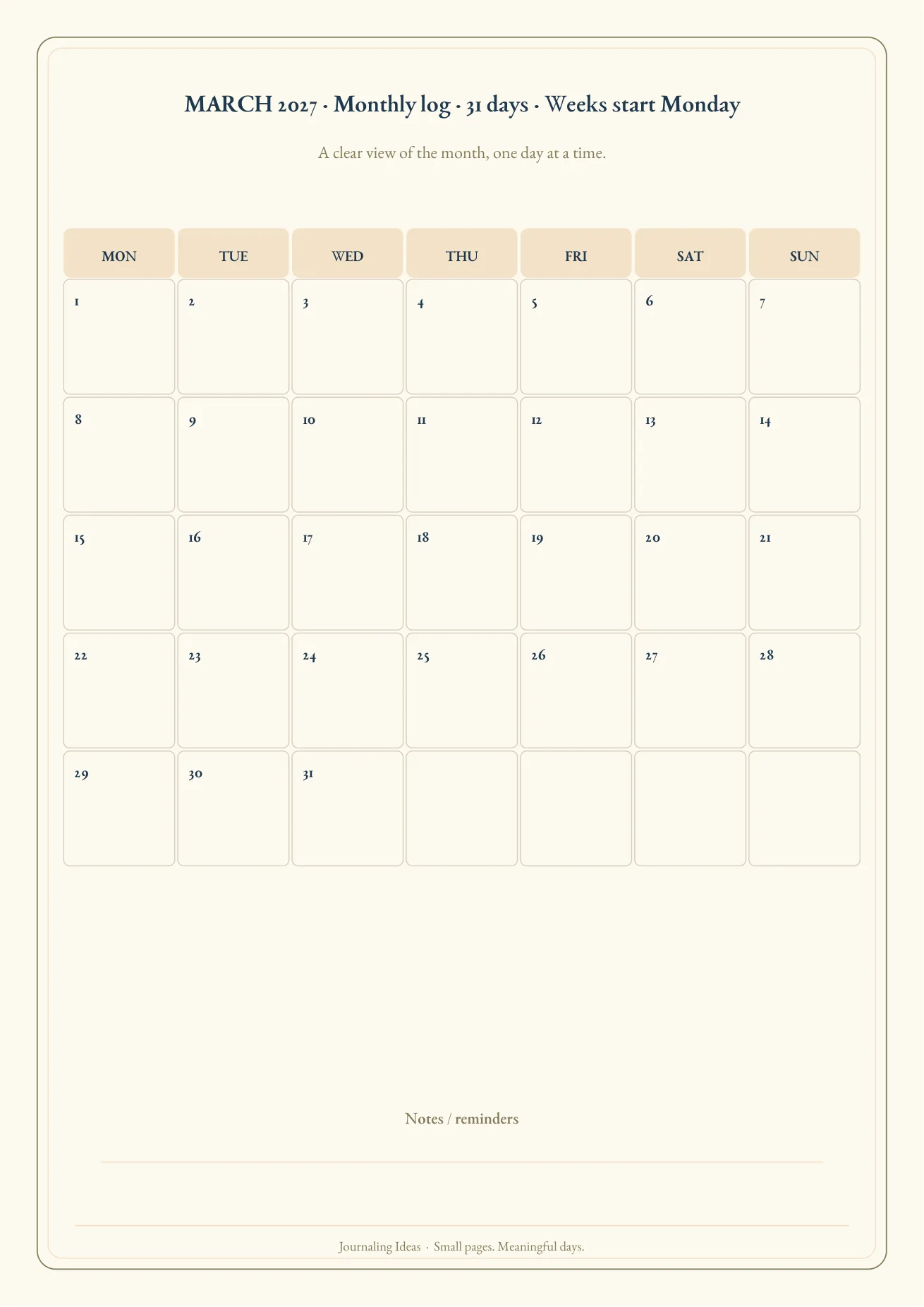
That gives you a Monday-start calendar with five rows: March 1–7, 8–14, 15–21, 22–28, and 29–31. The printable monthly log in the setup pack follows that exact layout.
For the earlier month-by-month pages, you can also browse january bullet journal ideas and february bullet journal ideas.
March Is a Reset Month, Not a Sprint
March changes under your feet. Daylight saving time begins on Sunday, March 14 in the United States, the spring equinox arrives on Saturday, March 20, and the evenings visibly lengthen in the second half of the month. A March journal works best when it expects that shift instead of fighting it: the sleep tracker earns its place in the week the clocks change, and the mood and energy notes many people keep in March tell a clear story by the 31st — the month that starts in winter does not end there. Our spring journal prompts are a good companion once the season turns.
Practically, March is the right month for a gentle goals review rather than a new list of ambitions. Look back at what January promised and February actually delivered, keep the one or two threads still alive, and let the rest go without a guilt page. Thirty-one days, one time change and one season change is plenty for a single notebook to hold.
20 March bullet journal spreads to try
March Bullet Journal Cover Page
What it is: The cover page is the visual opening to your March section. It can be as simple as the month and year with one small spring detail.
Set it up: Write “MARCH · 2027” in the center or near the top. Add a tiny branch, blossom, curved border, or a few leaves in muted olive and warm sand. Leave plenty of open space so the page feels calm rather than crowded.
Practical tip: Pick one motif and repeat it in a small way on one or two later pages. A consistent detail makes the month feel connected without requiring a full theme on every spread.
March Monthly Log
What it is: A monthly log gives you one place to see dates, appointments, deadlines, and plans across all 31 days.
Set it up: Draw seven columns from Monday through Sunday and five weekly rows. Because March 1, 2027 is a Monday, put the number 1 in the first Monday box. Continue in order until 31 sits under Wednesday in the final row.
Practical tip: Keep each date box short. Use a few words for an event and move longer details to your weekly or daily pages.

March Goals Page
What it is: A goals page turns broad hopes into a small number of clear priorities for the month.
Set it up: Divide the page into three sections: “What matters,” “One small step,” and “How I’ll notice progress.” Choose no more than three goals, and write one action beside each.
Practical tip: Include one goal that makes everyday life feel easier, not just one that produces a visible result. A useful goal can be as small as making space for a weekly reading hour.
Spring Intentions Page
What it is: Spring intentions are gentle directions for the season rather than a list of strict targets.
Set it up: Add three prompts: “I want more…,” “I want less…,” and “I want to make room for….” Write a few honest words under each. You can include home, creativity, relationships, rest, or time outdoors.
Practical tip: Choose one intention to revisit each Sunday. It is easier to remember a short phrase than a long list of resolutions.
Spring Theme Page
What it is: A theme page collects the small visual choices that will guide your March pages.
Set it up: Choose a simple spring direction—new leaves, garden notes, wildflowers, rainy afternoons, or fresh starts. Add two or three colors, one small sketch, and a short title. Keep the palette close to your usual notebook supplies.
Practical tip: Let the theme support the writing. If decorating starts taking longer than the page itself, remove a layer and keep going.
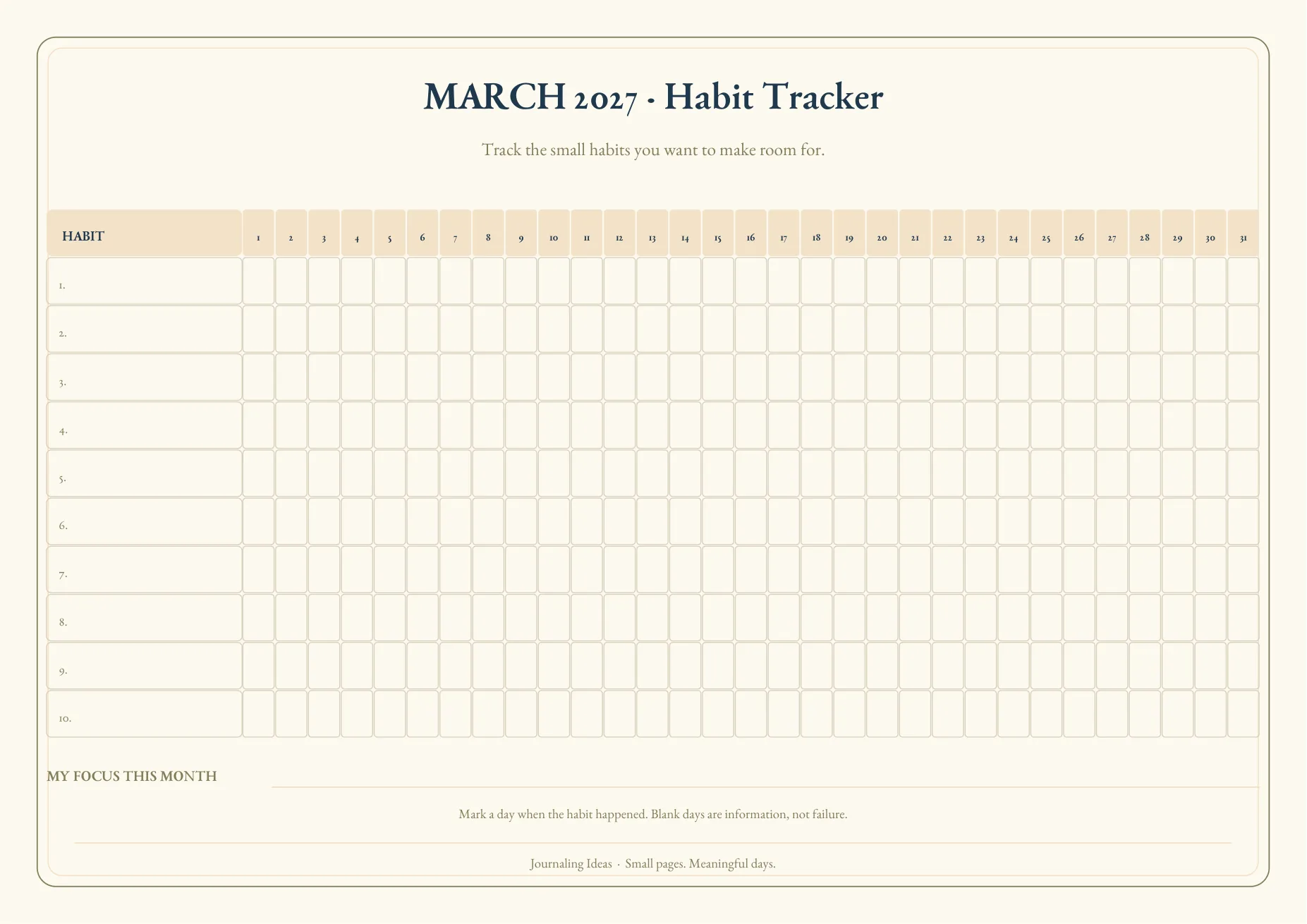
March Habit Tracker
What it is: A habit tracker lets you see which small routines you made time for during the month.
Set it up: Use 31 day columns and write a habit name at the start of each row. Choose a few habits that are genuinely useful, such as reading, stretching, taking a walk, or preparing tomorrow’s page. The landscape printable in the pack has 31 numbered columns and ten blank habit rows.
Practical tip: Start with three habits rather than filling every row. Leave unused rows blank until you have a reason to add something.
March Mood Tracker
What it is: A mood tracker is a simple visual record of how each day felt to you.
Set it up: Draw 31 circles or small spaces, one for each date. Use a five-word key: GREAT, GOOD, OKAY, LOW, and HEAVY. Choose a mark or color for each word and keep the key visible.
Practical tip: Record the word that feels closest, not the word you think you should choose. A neutral or difficult day does not need to be explained on the tracker.
March Weekly Spread
What it is: A weekly spread brings the next seven days into one view, so you can balance plans without rewriting the whole monthly log.
Set it up: Make seven day boxes, Monday through Sunday, and add a separate Notes area. Give each day a little room for appointments, tasks, or one important reminder. The pack’s weekly page uses exactly seven day boxes plus Notes.
Practical tip: Put the most time-sensitive item near the top of its day. Keep the rest as a short list rather than trying to schedule every hour.

March Daily Log
What it is: A daily log is a flexible page for the tasks, notes, and moments that do not fit neatly into a calendar box.
Set it up: Write the date, then use three simple labels: “Today,” “Remember,” and “Later.” Add bullets underneath as the day unfolds. You do not need to prepare a full page in advance.
Practical tip: If you miss a day, write the next date and continue. A daily log is a tool, not a streak to protect.
March Gratitude Log
What it is: A gratitude log helps you notice small things you appreciated during the month, without requiring a long entry every day.
Set it up: Create 31 numbered lines or small boxes. Add one detail for each date: a kind message, a meal, a quiet moment, a helpful person, or something you noticed outside.
Practical tip: Be specific. “A warm cup of tea after a long day” is easier to remember than “good things.”
March Reading Log
What it is: A reading log keeps a simple record of the books and pages you spend time with.
Set it up: Make columns for title, author, start date, finish date, and a short note. If you prefer a more visual page, draw one book spine for each title and color it in when you finish.
Practical tip: Add a one-line note about what you want to remember from the book. You do not need to rate every book or finish a set number.
March Highlights Log
What it is: A highlights log collects the moments you would like to remember when the month is over.
Set it up: Divide the page into six spaces and use these prompts: “A moment I want to remember,” “Something that made me smile,” “A small thing I’m proud of,” “A person or place I appreciated,” “Something new I noticed,” and “One thing I want to carry into April.”
Practical tip: Add a note when a moment happens instead of waiting until March 31. A few words are enough to bring it back later.
Important Dates and Events
What it is: This page gathers the dates that deserve a little extra attention, separate from your everyday tasks.
Set it up: List birthdays, appointments, school or work dates, travel plans, and seasonal events. For March 2027, you may want to mark St. Patrick’s Day on Wednesday, March 17, and the first day of spring on March 20.
Practical tip: Add a small symbol beside dates that need preparation, such as a card, reservation, or reminder. Keep the details on the monthly log.
March Brain Dump
What it is: A brain dump gives loose thoughts, tasks, ideas, and reminders a place to land before you organize them.
Set it up: Fill a page with short notes without sorting them as you write. When the page feels full, group the notes into “Do soon,” “Keep,” and “Can wait.”
Practical tip: Do not turn the brain dump into a second to-do list. Move only the items that need an action to your weekly spread.
Self-Care Tracker
What it is: A self-care tracker is a reminder to make room for small activities that help you feel supported.
Set it up: Choose a short list that fits your own life: time outside, a screen break, reading, calling someone, a quiet cup of tea, or an early night. Use 31 small marks or a simple weekly checklist.
Practical tip: Track what you actually want to make time for, not a perfect routine. Rest can count as a useful choice.
Sleep Tracker
What it is: A sleep tracker is a simple personal note about your sleep routine, not a medical assessment.
Set it up: Record the date, approximate bedtime, wake-up time, and a short note about how rested you felt. Keep the format consistent so you can look back at your own notes without trying to diagnose a pattern.
Practical tip: Keep the entry brief and neutral. A sleep record is a personal journaling aid, not medical advice.
Monthly Spending Log
What it is: A monthly spending log is a simple place to record purchases you want to remember.
Set it up: Use columns for date, item, category, and amount. You can add a small weekly total if that helps you review the month. Keep the categories broad enough that recording a purchase takes only a moment.
Practical tip: Write the entry without judgment. The page is there to help you notice information, not to label a purchase as good or bad.
Spring Cleaning Tracker
What it is: A spring cleaning tracker breaks a large seasonal task into smaller areas you can approach when time allows.
Set it up: List a few zones—entryway, desk, closet, kitchen shelf, or one drawer—and add one manageable action beside each. Leave a checkbox for when you finish.
Practical tip: Choose one small zone at a time. A ten-minute reset is still progress, and you do not need to complete the whole home in one weekend.
Garden and Outdoors Notes
What it is: This page is a place to notice what is changing outside as the season turns.
Set it up: Record garden ideas, plants you want to look up, walks you enjoyed, first blossoms, birds you noticed, or outdoor places you would like to visit. Add the date and a small sketch or note.
Practical tip: Keep it observational. You do not need to know every plant name or make a detailed gardening plan to use the page.
End-of-Month Reflection
What it is: An end-of-month reflection helps you close March with a few useful observations before you start a new month.
Set it up: Answer four prompts: “What worked?”, “What felt difficult?”, “What do I want to remember?”, and “What can I make simpler next month?” Leave space for one small win and one thing you want to carry into April.
Practical tip: Write the first honest answer that comes to mind. A short reflection is more useful than waiting for the perfect summary.
What is included in the free March setup pack?
The March Bullet Journal Setup Pack includes six printable sheets:

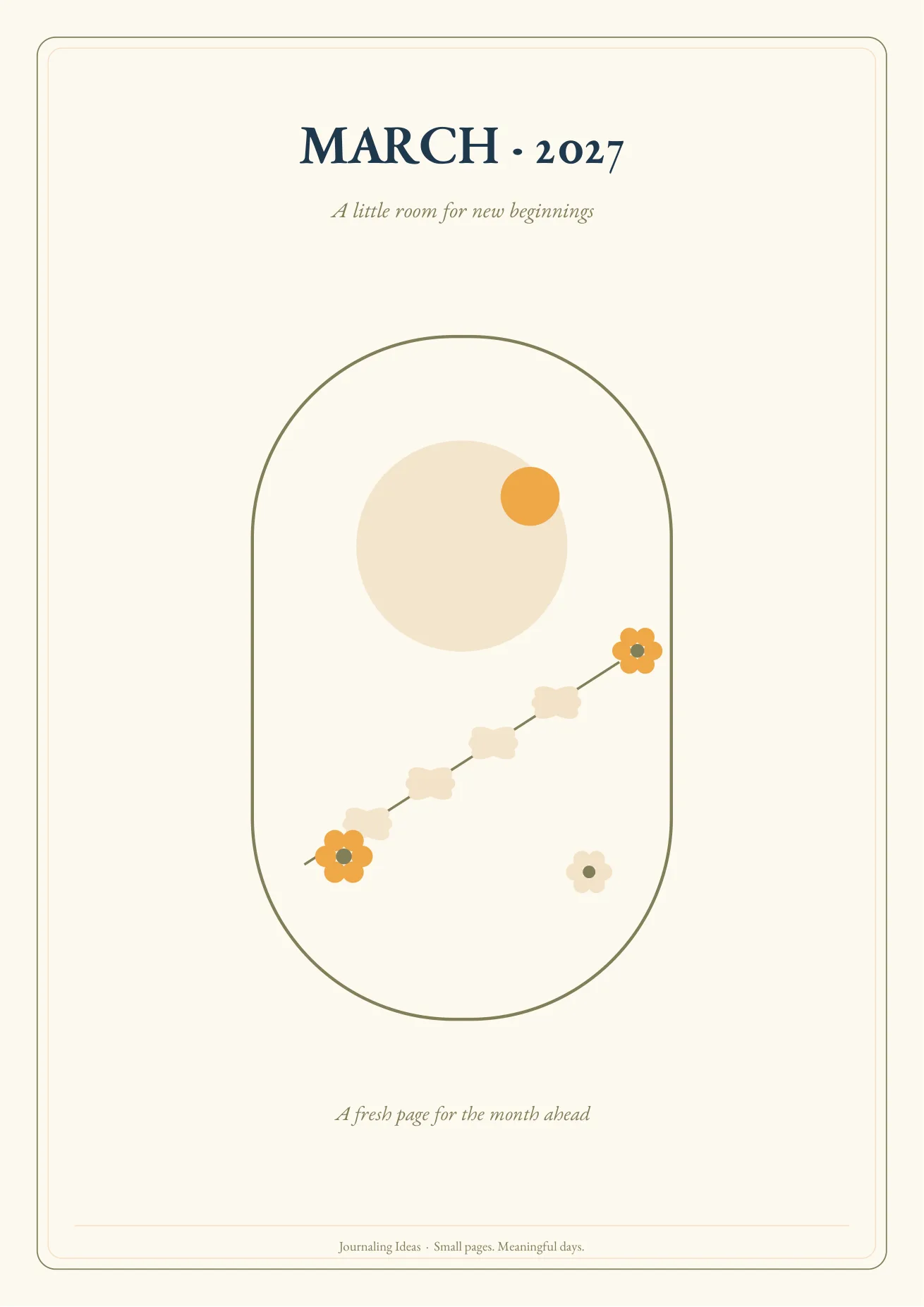


- March cover page
- Monday-start March 2027 monthly log
- Landscape habit tracker with 31 numbered day columns and ten habit rows
- Mood tracker with 31 day markers and the five-word mood key
- Weekly spread with seven day boxes and a Notes area
- Highlights page with six gentle prompts
Each sheet is provided as an A4 PDF and a US Letter PDF. The pack is free, and no email signup or password is required. Find it in The Small Pages Library.
Free download: Sheet 1 — Cover Page (A4 PDF · US Letter PDF)
Free download: Sheet 2 — Monthly Log (A4 PDF · US Letter PDF)
Free download: Sheet 3 — Habit Tracker (A4 PDF · US Letter PDF)
Free download: Sheet 4 — Mood Tracker (A4 PDF · US Letter PDF)
Free download: Sheet 5 — Weekly Spread (A4 PDF · US Letter PDF)
Free download: Sheet 6 — Highlights (A4 PDF · US Letter PDF)
How to print and use the pages
- Choose the A4 file for A4 paper or the US Letter file for 8.5 × 11-inch paper.
- Print at 100% or “Actual Size” when your printer allows it.
- The habit tracker is landscape; the other five sheets are portrait.
- If your printer clips the border, select “Fit to printable area” and check the preview before printing.
- Print only the pages you plan to use. You can add the other spreads to your notebook later.
You can also use the PDFs as a guide and redraw the layouts in your own notebook. Leave the dates and headings in place, then change the small details to suit your routine.
A fresh start, one page at a time
A March bullet journal does not need all 20 spreads to be useful. Start with the monthly log, add one tracker if it helps, and choose a spring page that gives you a little room to reflect. Keep the parts that work and let the rest stay blank.
Small pages. Meaningful days.
— Journaling Ideas Editorial Team
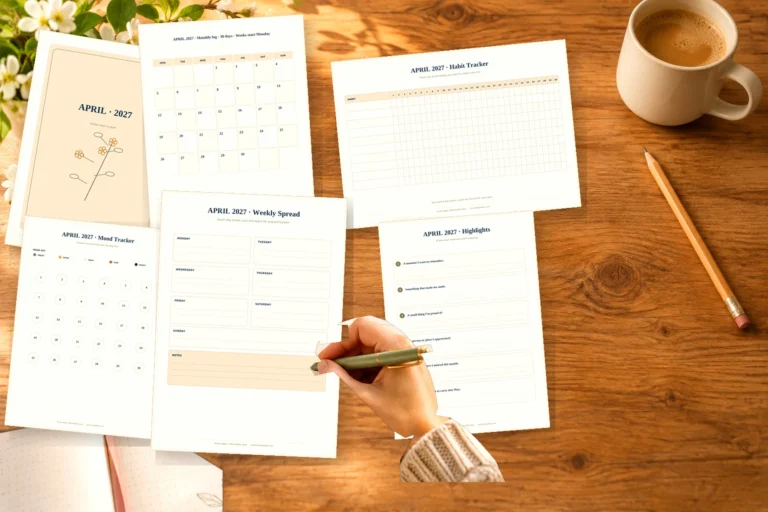
Ready to carry your spring setup into the next month? Explore our april bullet journal ideas for 20 simple spreads, including a Spring Reset Check-In, April trackers, a weekly spread, and an end-of-month reflection. The free six-sheet April Bullet Journal Setup Pack is available in A4 and US Letter, with no signup required.
March Bullet Journal FAQs
How many days are in March 2027?
March 2027 has 31 days. It begins on Monday, March 1, and ends on Wednesday, March 31.
What day does March 2027 start on?
March 1, 2027 is a Monday. A Monday-start monthly log therefore begins with the number 1 in the Monday column.
What are some easy March bullet journal pages for beginners?
Start with a cover page, monthly log, and one tracker. Add a weekly spread if you want more room for plans. You can build the rest only when you have a clear use for it.
Do I need to make all 20 March spreads?
No. The 20 ideas are options, not a checklist. Choose the pages that help you remember dates, plan your week, track a habit, or reflect on the month.
Is the March Bullet Journal Setup Pack available in A4 and US Letter?
Yes. All six designs are provided as A4 PDFs and US Letter PDFs. The habit tracker is landscape; the other sheets are portrait.
When is the first day of spring in 2027?
The first day of spring is March 20, 2027. You can mark it on your monthly log or use it as a prompt for your Spring Intentions Page.



4 Comments