

One Line a Day: A Gentle Five-Year Journal You Can Start Any Day
What if you didn’t have to write a whole page to keep a meaningful record of your life?
A one line a day journal is a dated journal where you write one small sentence, thought, or detail each day. When the same date comes around in later years, you add a new line and can look back at earlier ones. The habit can start any day, and our free printable starter pack gives you the 2027 pages to begin building your own five-year journal.
You don’t need perfect handwriting, a long writing routine, or something important to report every evening. One honest line is enough.
We’ve created a free One Line a Day Starter Pack with 14 sheets, each available in A4 and US Letter. It includes a Start Here guide, 12 monthly pages for 2027, and a gentle year-end review page.
The important distinction: this is a starter, not a complete five-year book. You’ll use the 2027 pages for Year 1, then print a fresh set of month pages for each following year.
Let’s make the idea simple.
What Is a One Line a Day Journal?
A one line a day journal is a simple daily record in which you write just one short entry for each date.
Instead of filling a page with everything that happened, you choose one small thing worth remembering.
It might be:
- Something you noticed.
- A moment that made you smile.
- How you felt that day.
- Something you appreciated.
- A small detail about an ordinary afternoon.
The idea is to keep the writing manageable.
You don’t have to explain the entire day or turn every entry into a thoughtful reflection. Some days your line might be a complete sentence. On others, three or four words might say enough.
Why use the same date over five years?
The interesting part of a five-year journal is returning to the same date in later years.
Imagine opening your January 12 page.
January 12, 2027: You write one line about an ordinary afternoon.
January 12, 2028: You add a new line about that year’s day.
January 12, 2029: You write another small observation.
January 12, 2030: You return to the same date again.
January 12, 2031: You complete the fifth year’s entry.
You can then look at the five entries together.
The date stays the same, but the details of your days change. You may notice different routines, interests, places, people, or little things that matter to you.
That’s the heart of this journaling format.
How Do You Start a One Line a Day Journal in One Minute?
You only need a page, something to write with, and one small detail from your day.
Try this simple routine:
Step 1: Find today’s date.
Open the month page and locate the correct date number.
Step 2: Think of one small detail.
Ask yourself:
- What happened today?
- What did I notice?
- How did I feel?
- What do I want to remember?
Step 3: Write one line.
Write a sentence, a short phrase, or a few words. You don’t need to fill the entire writing space.
Step 4: Close the journal.
You’re finished. There’s no extra page to complete and no need to write more just because you have time.
If you have only a minute, that’s enough to begin.

What’s Included in the Free One Line a Day Starter Pack?
The One Line a Day Starter Pack contains 14 different sheets, each supplied in A4 and US Letter. That’s 28 PDF files in total.
Here’s what’s inside:
Sheet 1 — Start Here
A beginner’s guide explaining the one-line-a-day method, how the five-year system works, and three tiny example entries.
Sheets 2–13 — Monthly Journal Pages
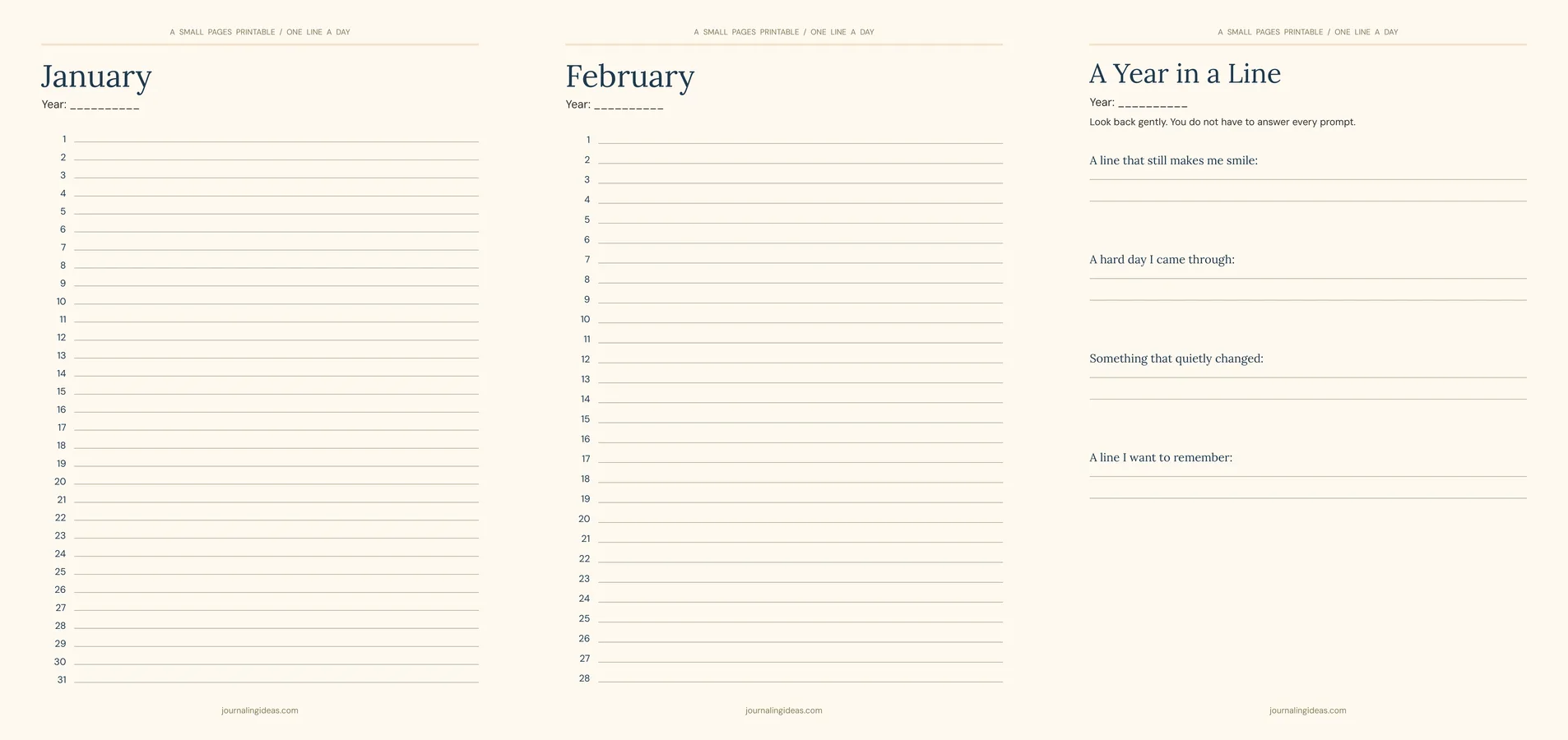
12 individual month pages for January through December 2027, with one numbered writing row per calendar day.
Sheet 14 — A Year in a Line
A gentle review page with four prompts to help you look back over the year.
The monthly pages are deliberately simple. Each page has the month name, a year field, numbered dates, and one clear writing line beside every date. There are no weekday labels to get in the way.
February 2027 has 28 rows because 2027 is not a leap year. The other months have their correct calendar day counts.
Find the free One Line a Day Starter Pack in The Small Pages Library.
How Does the Five-Year Journal System Work?
The printable pack provides the first year. You build the remaining four years by adding new monthly pages as the years pass.
You don’t need to buy or print a complete five-year book at the beginning.
Year 1: Print the 2027 month pages
Start by downloading the 12 monthly pages.
Print one copy of each month and write 2027 in the Year field.
Keep January through December together in a folder, binder, or another place where you can easily find them.
Use the numbered rows to write one line each day.
Year 2: Add a fresh set of pages
When 2028 begins, print another set of monthly pages for that year.
Write 2028 in the Year field on each page.
Place each new month page behind the corresponding 2027 page.
For example: January 2027, then January 2028. Keep February pages together, March pages together, and continue through December.
The new page gives you a fresh writing line for every date.
Years 3, 4 and 5: Continue the same routine
Repeat the process each year.
2029: Add a new set of month pages.
2030: Add another set.
2031: Add your fifth set.
After five years, you’ll have five yearly pages for each month.
You can open January and read the same dates across all five years. Then do the same with February, March, and the remaining months.
One important printing detail: This starter pack contains only the 2027 pages. Future-year pages are not included. Print or prepare a fresh set for each following year, updating February to 29 days when the year is a leap year.
How should you organize the pages?
You can use:
- A small ring binder with January–December dividers.
- A folder with separate month sections.
- A simple document wallet.
- A binder clip for each month’s pages.
The important thing is to keep the same months together and the years in order.
You don’t need a special journal cover or an elaborate storage system.

What Should You Write in One Line a Day?
The easiest way to keep this habit manageable is to stop looking for something extraordinary to write about.
Your line can come from an ordinary moment.
Here are four simple approaches.
1. Write about one small moment
Think of something that happened, even if it seems unimportant.
Examples:
- “The morning light reached my desk.”
- “I found an old photograph.”
- “Lunch took longer than expected.”
- “I heard my favorite song again.”
A small moment can be enough to identify a day.
2. Write about one feeling
Sometimes the most memorable part of a day is how you felt.
Examples:
- “I felt more relaxed after the walk.”
- “Today was a little overwhelming.”
- “I was excited about the weekend.”
- “I needed a quieter evening.”
You don’t need to explain the feeling in detail.
3. Write one thing you’re grateful for
Gratitude can be a simple observation rather than a long list.
Examples:
- “I’m grateful for a warm meal.”
- “A kind message made me smile.”
- “I enjoyed a little time to myself.”
- “The conversation was exactly what I needed.”
4. Write about the weather or an ordinary detail
Not every entry has to be personal or emotional.
You can record the small details that make one day different from another.
Examples:
- “Cold rain and warm socks.”
- “The garden looked greener today.”
- “A very windy afternoon.”
- “The house was unusually quiet.”
These are examples of how short an entry can be. Your own lines can be even shorter.
A few tiny prompts to keep nearby
If you aren’t sure what to write, complete one of these:
- One thing I noticed — Today I noticed…
- One feeling — I felt…
- One small pleasure — I enjoyed…
- One thing I’m grateful for — I’m glad that…
- One ordinary detail — Today was…
You only need one.
If you enjoy having more writing ideas ready, explore our journal prompts for beginners. You can choose a prompt when a blank page feels difficult, then shorten your answer to one line.
What Can You Write on Hard or Blank Days?
Some days are difficult to describe.
You might feel tired, have a lot on your mind, or simply not remember anything you particularly want to record.
You don’t need to force a meaningful entry.
A short, honest line is perfectly fine.
For example:
- “Today was heavy.”
- “I needed some rest.”
- “A quiet day at home.”
- “I made it through today.”
- “Not much to say tonight.”
- “No words today.”
You can also leave the line empty.
A one-line-a-day journal is not a daily writing test. It is a place to keep small records when you want to.
What If You Miss a Day?
Missing a day is normal. You don’t have to catch up.
If you forget to write on Tuesday, you have two simple choices:
Option 1: Leave the line empty.
Move to Wednesday and continue as usual.
Option 2: Add something later if you genuinely remember.
If you remember a real moment from Tuesday, you can write it down when you return to the page.
If you don’t remember, leave it blank.
Don’t invent memories just to fill empty spaces. An unfinished page is more honest than a made-up entry.
You can return to the habit whenever you feel ready.
How Do You Print and Use the Starter Pack?
The One Line a Day Starter Pack comes in two paper sizes: A4 for readers using A4 paper, and US Letter for readers using standard US Letter paper. You can download the format that matches your printer paper.
Printing instructions:
- Open The Small Pages Library.
- Find the One Line a Day Starter Pack.
- Choose A4 or US Letter.
- Download the PDF files.
- Print the Start Here sheet and 12 monthly pages for 2027.
- Write 2027 in the Year field on each monthly page.
- Keep the month pages together in order.
- Place the A Year in a Line page at the back for your year-end reflection.
Choose portrait orientation and print at actual size (100%) where available. Check the first printed page before printing the remaining sheets.
You don’t need to print both paper sizes. Choose whichever fits your paper.
A small suggestion for your first entry
Don’t wait for a perfect moment to begin.
If you’re using the 2027 pages, start with the first date you want to record. If you begin in the middle of the month, leave earlier rows empty.
If you’d like to start before 2027, you can begin today in any ordinary notebook and move to the dated pages when 2027 begins.
The habit doesn’t require a special starting ceremony.
If you keep a one-line-a-day record, your birthday is a lovely opportunity to look back across those small entries and notice the moments you want to remember. Our birthday journal prompts guide offers 30 gentle questions for reviewing the year and setting kind intentions, along with a free four-sheet Birthday Review Pack. It includes a Year in Review page, a 12 Lines page, the complete prompt list, and a letter to your next-year self. The pack is available in A4 and US Letter in The Small Pages Library, with no signup required.
Frequently Asked Questions
Is the One Line a Day Starter Pack really free?
Yes. The One Line a Day Starter Pack is free in The Small Pages Library. It contains 14 sheets in A4 and US Letter, making 28 PDF files in total. No signup is needed.
Do I have to start on January 1?
No. You can start the one-line-a-day habit whenever you like. The printable pages are dated for 2027, but you can begin with today’s date and leave earlier rows empty.
What if I miss days?
Leave the lines empty or write a genuine memory later if you remember it. You don’t have to catch up, and you should never invent memories to fill the gaps.
How is a one line a day journal different from a diary?
A traditional diary often gives you space to describe your day in detail. A one line a day journal focuses on one short observation, thought, feeling, or moment. It’s a smaller daily record.
Can I start mid-year?
Yes. Find the current date on the relevant month page and begin there. Leave earlier dates blank. You don’t have to complete every row to use the journal.
Do I need a special notebook?
No. You can keep the printed pages in a binder, folder, or document wallet. The monthly pages are designed to work as a simple paper journal without special supplies.
A Small Record of Ordinary Days
A five-year journal doesn’t need to begin with a big goal or a complicated writing routine.
It can begin with one sentence about the weather, a small moment at home, something that made you smile, or simply how the day felt.
The first year gives you somewhere to begin. Each following year adds another layer to the same dates, creating a collection of small records you can revisit.
Download the free One Line a Day Starter Pack, print your 2027 pages, and write your first line whenever you’re ready.
You don’t have to write something remarkable. You just have to leave a little space for the day.
Small pages. Meaningful days.

— The Journaling Ideas Editorial Team


4 Comments