

Poetry Journal Prompts
A poetry journal is a notebook where you keep your own poems: unfinished drafts, finished pieces, favorite lines, and the little sparks that started them. It gives your writing a place to grow, without needing to share every page with anyone else.
You don’t need to be talented, experienced, or published to keep one. Whether you write a few lines every Sunday or fill pages whenever inspiration arrives, these 24 poetry journal prompts can help you find your next starting point. The free printable pack includes two prompt sheets, a poem draft page, and a personal poems log.
Why Keep a Poetry Journal?
You Don’t Need to Be a Poet
A poetry journal isn’t something you have to earn the right to use. You don’t need a writing background, a collection of published work, or a particular style. You can write a poem because a certain morning looked beautiful, because a sentence came to mind while making coffee, or because you noticed something ordinary that you wanted to describe. Some days, you might write four lines. Other days, you might fill a page. Both belong in your notebook. Think of your poetry journal as a private creative space where curiosity matters more than getting every word right.
Small Poems Count
Poetry doesn’t have to be long to feel complete. A haiku, a six-word poem, a short list of images, or a few lines about a familiar place can be a finished piece in its own right. Small forms are especially useful when you have a little time but don’t feel ready to write something longer. They also give you room to experiment with rhythm, sound, imagery, and word choice without taking on a large writing project. You might discover that your favorite poem is only three lines long. Let it be three lines. A small poem deserves a place in your collection just as much as a longer one.
Your Poems Stay in One Place
Keeping your poems together makes it easier to revisit your writing. Instead of searching through loose paper, phone notes, and forgotten scraps, you have one place for the lines you want to keep. You can see how your descriptions change, which images you return to, and which unfinished drafts still interest you. Your notebook can hold several versions of the same poem, too. A first attempt doesn’t have to disappear when you write a better version. Keeping both lets you see the small decisions that shaped the finished piece. Over time, your journal becomes a personal collection of words, ideas, and creative experiments.
If you also keep a music journal or a commonplace book, the same one-place habit keeps every collection easy to find.
24 Poetry Journal Prompts
Sometimes the hardest part of writing a poem is deciding how to begin. A blank page can feel full of possibilities, but having one small direction makes it easier to put down the first line.
These 24 prompts are divided into two groups. The first offers opening sentences, scenes, and moments to build a poem around. The second explores sensory details and shorter poetic forms. Choose whichever catches your attention, and feel free to take the poem somewhere the original prompt didn’t expect.
First Lines & Beginnings
Use these prompts when you want a clear starting point. Each one gives you a sentence, image, or small moment that can become the beginning of a longer poem.
- Begin a poem with the sentence, “The kettle clicked, and the whole kitchen seemed to wake.”
- Write the first four lines of a poem about arriving somewhere just as the light changes.
- Start with the image of a coat hanging by the door, still holding the shape of the day.
- Open a poem with a person carrying flowers home on an ordinary afternoon.
- Begin with the line, “There was a little more blue in the sky than I expected.”
- Write a poem that starts at the exact moment a familiar song comes on.
- Start with a close-up of a table after breakfast, before anyone has cleared it.
- Begin a poem with the words, “I almost walked past it.”
- Write the opening lines of a poem set inside a shop just before it closes.
- Start with the first raindrop landing on a windowsill during a quiet afternoon.
- Begin a poem with someone opening a letter they have been meaning to answer.
- Write a poem that opens with the first thing you notice when you step into a room you know well.
You don’t have to follow the scene exactly as written. If the coat in prompt 3 reminds you of a particular afternoon, let that memory shape the poem. If the opening sentence in prompt 5 takes you somewhere unexpected, follow it.
You can also stop after writing the opening lines and return later. Sometimes a good beginning needs a little time before the rest of the poem arrives.
Images, Senses & Small Forms
These prompts give you a different way to approach poetry. Instead of starting with a scene or opening sentence, you’ll work with sounds, colors, smells, familiar objects, and simple poetic structures.
- Write a haiku about the sound of rain touching three different surfaces.
- Create a five-senses poem about making a cup of tea or coffee.
- Write an acrostic poem using the word WINDOW, with each line describing a small detail outside.
- Make a list poem of ten things that carry the color of late afternoon.
- Write a short ode to an everyday object you reach for without thinking.
- Create a six-word poem that captures the feeling of a slow morning.
- Write a two-stanza poem built around the smell of something baking.
- Describe a familiar place using only sounds, without naming the place.
- Write a shape poem in the outline of a leaf, using words about a walk outdoors.
- Make a tiny poem of three lines, each beginning with “I notice”.
- Write a color poem that moves from one shade of blue to another.
- Create a found-style poem by choosing six words from a recipe, menu, or shopping list and arranging them into new lines.
Small forms offer a useful way to play with language. A list poem lets you collect images without worrying about a traditional structure. An acrostic gives every line a starting point. A haiku invites you to pay attention to one small moment.
You can also repeat a form with a different subject. Try a six-word poem about a rainy afternoon, then write another about a quiet breakfast. The structure stays familiar while the images change.
The Free Poetry Journal Pack
To make these prompts easier to use, the free poetry journal pack includes four printable sheets. Each sheet is designed to work as a standalone page, so you can print the prompts, draft your poems, and keep track of finished pieces in one notebook.
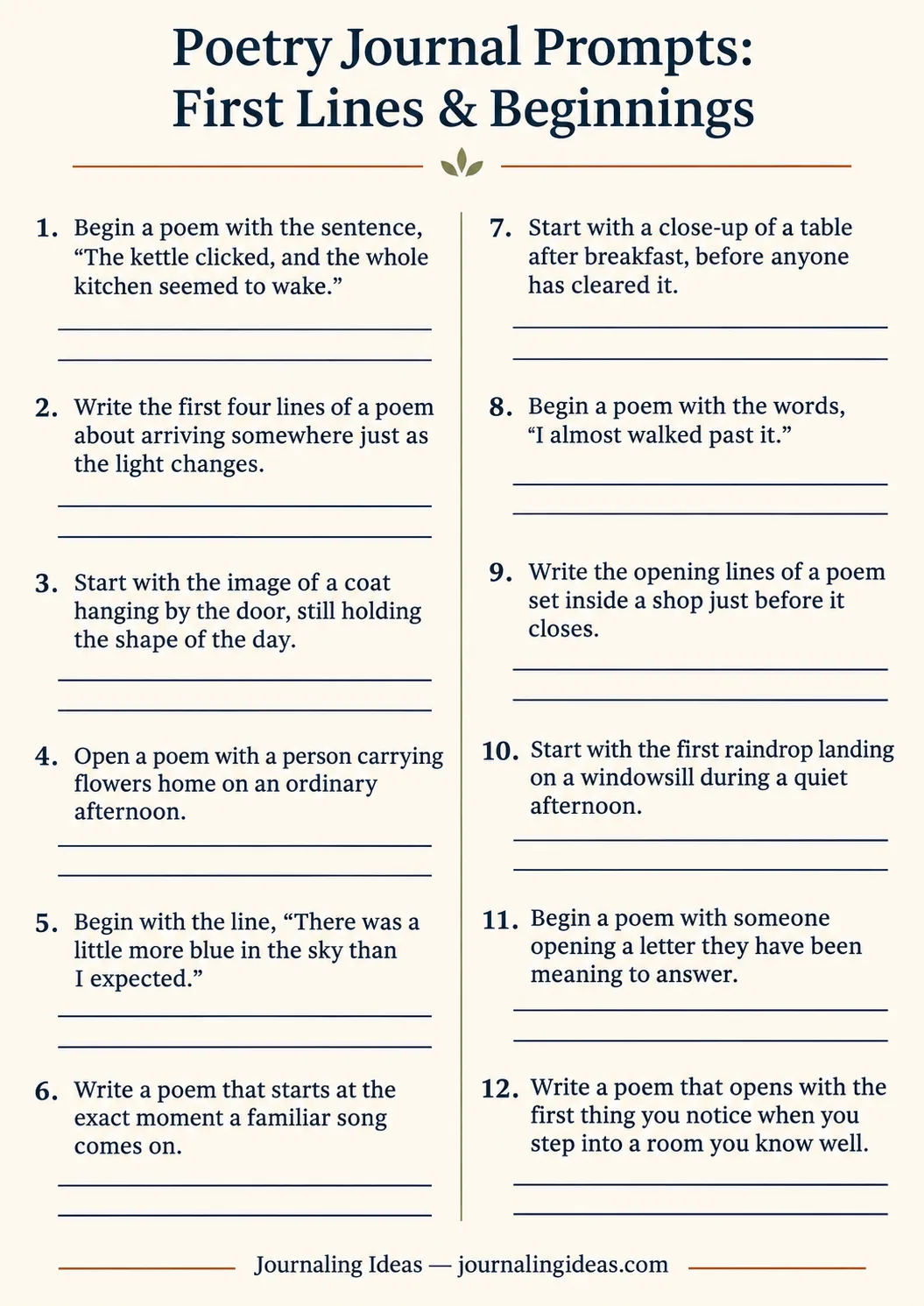
Sheet 1: Poetry Prompts: First Lines & Beginnings
This sheet contains all 12 prompts from the first group, with writing lines beneath each prompt. Use the space to try an opening sentence, develop the first few lines, or collect words you might want to use in a longer poem.
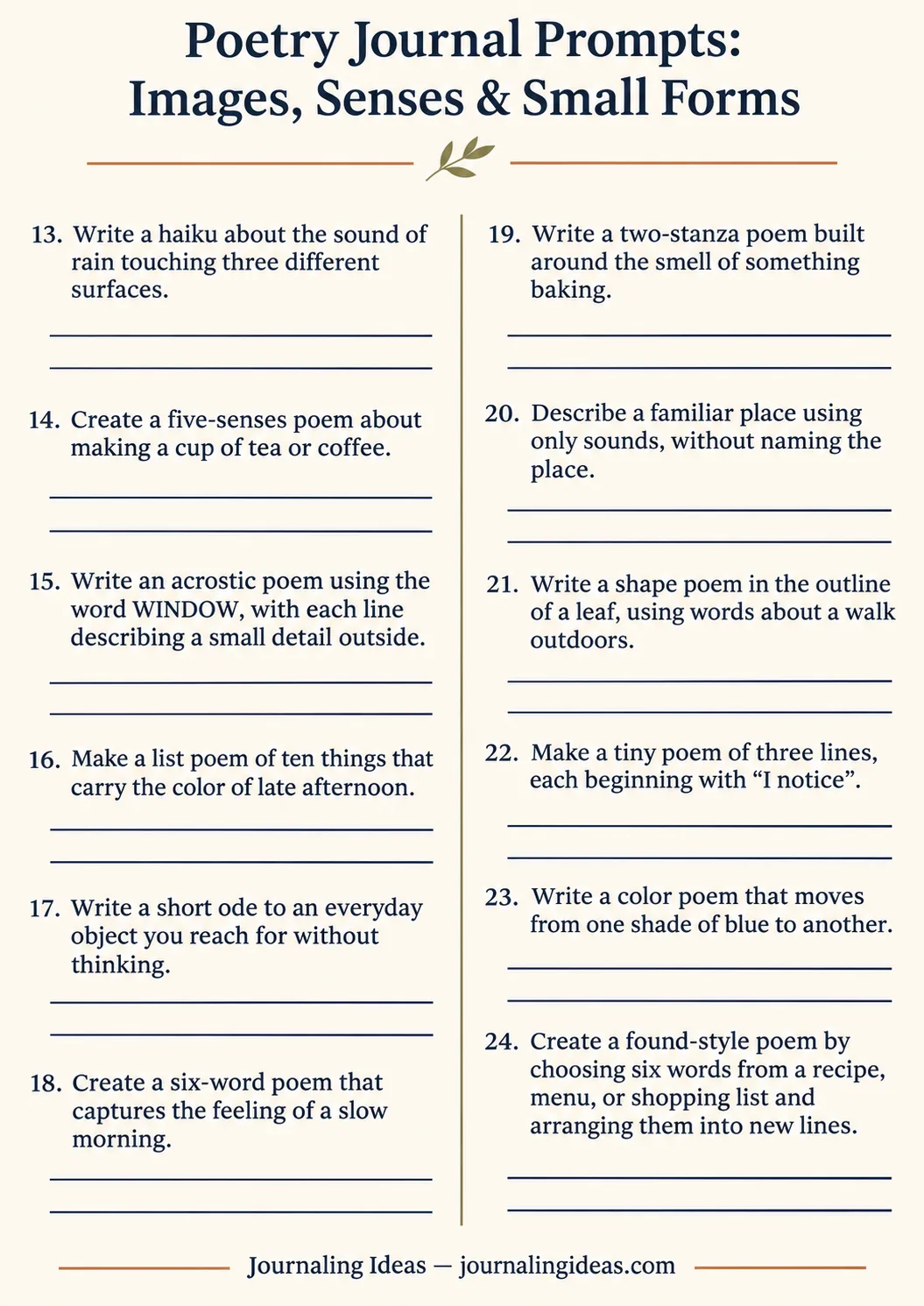
Sheet 2: Poetry Prompts: Images, Senses & Small Forms
The second sheet includes the 12 sensory and small-form prompts, also with writing lines. It’s useful when you want to experiment with a haiku, acrostic, list poem, ode, or another short piece without having to plan a full poem first.

Sheet 3: Poem Draft Page
This page gives you a dedicated space to develop one poem. It includes: Poem Title (a place to name your piece, even if the title changes later) · Date (record when you started writing) · Prompt I Used (keep track of the idea that inspired the poem) · a Lined Draft Area for writing and developing your poem · a “Words I Want to Keep” box for favorite phrases, images, or individual words · and Revision Notes, room to record changes you might make when you return to the draft.
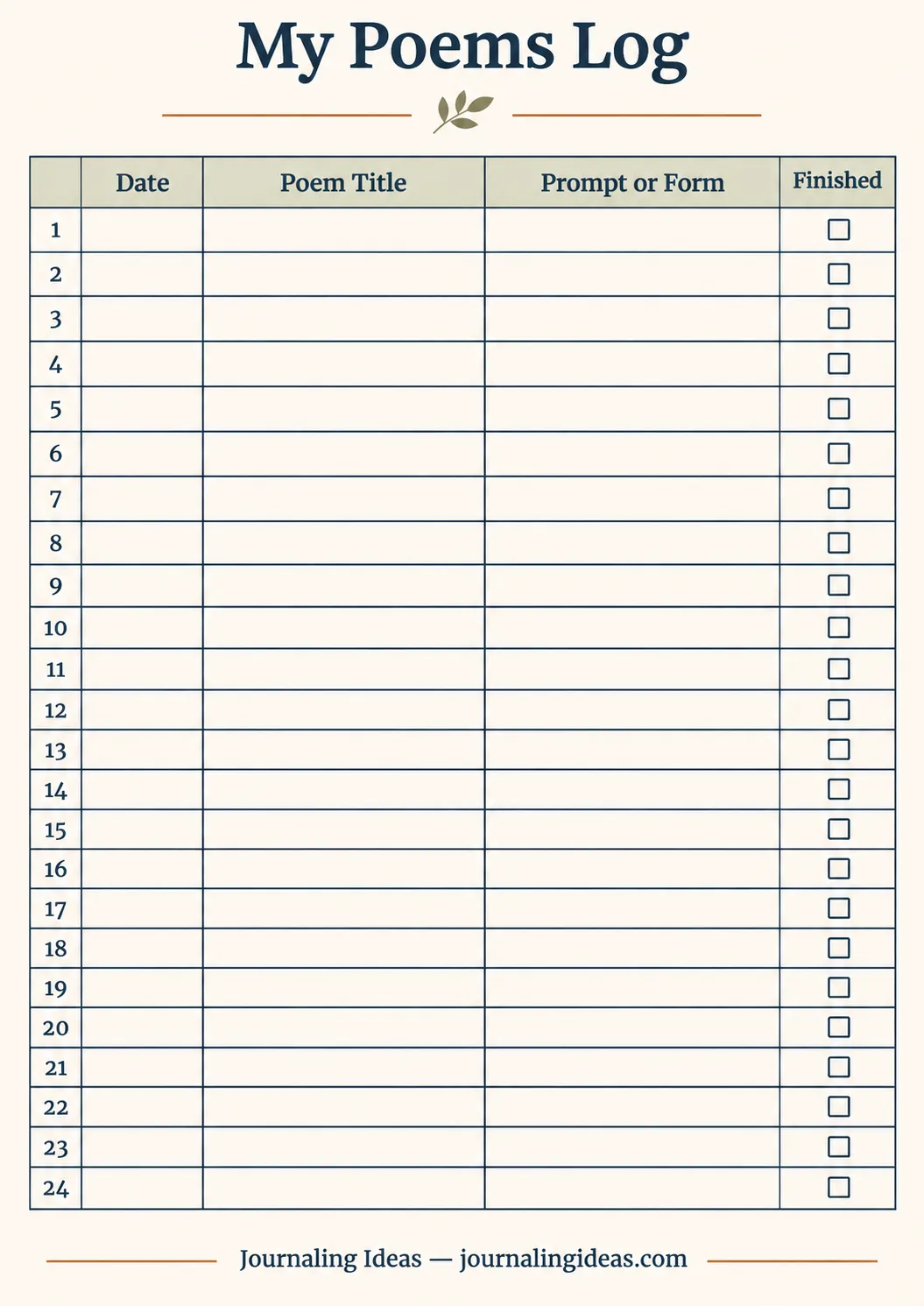
Sheet 4: My Poems Log
The poems log includes 24 rows with four columns: Date, Poem Title, Prompt or Form, and a Finished checkbox. Use it to keep a simple record of your writing and see which prompts and poetic forms you’ve explored.
The complete pack contains four sheets in two paper sizes: A4 and US Letter, giving you eight PDF files altogether. It’s free, with no signup required. Print the pages you want, keep them in a binder, or tuck them into your existing poetry notebook.
What’s included:
- 4 printable poetry journal sheets
- 2 prompt sheets with all 24 prompts
- 1 poem draft page
- 1 poems log with 24 rows
- A4 and US Letter versions
- 8 PDF files in total
The complete pack is free, with no email signup or password required.
Poetry Prompts: First Lines & Beginnings (A4)
Poetry Prompts: First Lines & Beginnings (US Letter)
Poetry Prompts: Images, Senses & Small Forms (A4)
Poetry Prompts: Images, Senses & Small Forms (US Letter)
Poem Draft Page (A4)
Poem Draft Page (US Letter)
My Poems Log (A4)
My Poems Log (US Letter)
Every sheet is also in the Free Printable Library with the rest of our free packs.
How to Use Your Poetry Journal
You don’t need a complicated writing routine to make a poetry journal part of your life. A few simple habits can help you return to your notebook without turning writing into another obligation.
Start With One Prompt a Week
Choose one prompt each week and give yourself a little space to explore it. You might write on a quiet Saturday morning, during a lunch break, or whenever you have a few uninterrupted minutes. Start by reading the prompt and writing whatever comes to mind. If you finish a short poem in ten minutes, that’s enough. If the idea develops into something longer, give it more room. You can also skip between the two prompt sheets depending on what interests you. There is no need to complete all 24 prompts in order or stick to a weekly schedule. The purpose is to have a starting point whenever you want one.
Draft Messy, Keep Everything
Your first version doesn’t need to sound polished. Write the words that arrive, even if the rhythm feels uneven or you aren’t sure where the poem is going. Cross out a phrase, add another, move a line, or leave a gap where a better word might eventually fit. Keep the original draft instead of throwing it away. You may find a useful image or an unexpectedly good line in a version you thought wasn’t working. Your draft page has space for words you want to keep and revision notes, so you can separate the ideas you like from the changes you might make later. Messy counts. Your notebook doesn’t need to look finished to be worth keeping.
Date Every Poem
Adding a date gives each poem a place in your personal writing history. You don’t have to record the time, location, weather, or anything else unless you want to. A simple date is enough to help you remember when a particular piece began. Use the My Poems Log to record the title and prompt or form alongside it. If a poem takes several weeks to finish, you can keep the original starting date on the draft and add a finishing date in your notes. You might also mark unfinished poems so you can return to them later. There is no need to finish everything you start. Some drafts are simply places where a good idea began.
What Does a Filled-In Page Look Like?
A filled-in poetry journal page doesn’t need elaborate handwriting or a perfectly arranged poem. Here’s an invented example of how someone might use the printable draft page.
Example writer: June
Poem Title: Kitchen Window, October
Date: October 12
Prompt I Used: “Begin a poem with the sentence, ‘The kettle clicked, and the whole kitchen seemed to wake.'”
June’s first draft:
The kettle clicked, and the whole kitchen seemed to wake.
October light gathered on the sill.
A sparrow stitched the quiet garden
while tea warmed both my hands.
Revision Notes:
Try replacing “gathered” with another word to describe the afternoon light.
Keep the sparrow image; it gives the poem a gentle movement.
Read the last two lines aloud and see if the rhythm feels natural.
This example is invented, but it shows how a short opening prompt can become a small, complete piece. June has a draft, a title, a date, and a few notes for her next writing session. She doesn’t need to revise the poem immediately. She can leave the page as it is and return whenever she feels ready.
If you like making pages by hand, our art journal prompts for beginners pair words with simple drawing and collage.
Frequently Asked Questions About Poetry Journals
Do I need experience to keep a poetry journal?
No. A poetry journal is for anyone who wants to write poems, whether you’re trying poetry for the first time or have been writing privately for years. Start with a short prompt and see where it takes you.
What is the difference between a poetry journal and a poetry notebook from a store?
A poetry journal describes how you use a notebook, while a poetry notebook from a store is simply a product you can buy. You can use an ordinary lined notebook, a blank sketchbook, or a dedicated poetry journal for the same purpose.
How often should I write?
Write whenever it suits you. Once a week is a comfortable starting point, but you can write every day, once a month, or whenever a line comes to mind. There is no required schedule.
What if my poems are bad?
Keep them anyway. A poem doesn’t have to be your favorite to deserve a place in your notebook. You can revise it later, borrow one useful line for another piece, or simply leave it as a record of an idea you explored.
Can I write poems on my phone instead?
Yes. A notes app or writing document works well if you prefer digital writing. You can also draft on your phone and transfer your favorite pieces into a paper notebook later. Choose the method that makes it easiest to keep your work together.
Is the printable pack free with no signup?
Yes. The poetry journal pack is completely free and requires no email signup. It includes four sheets in both A4 and US Letter sizes, for a total of eight PDF files.
Start With a Single Line
A poetry journal doesn’t need to begin with a beautiful notebook, a daily writing habit, or a collection of finished poems. It can begin with one sentence, one image, or a few words you want to explore. Choose a prompt that catches your attention, open a page, and see what happens.
Keep your drafts, save the lines you love, and give yourself permission to write small poems just because you enjoy them. Your notebook can grow at its own pace, one page at a time.
Small pages. Meaningful days.
— Editorial Team




3 Comments