

Shadow Work Journal Prompts for Beginners: 30 Gentle Questions
Shadow work journaling is a gentle way to notice the parts of yourself you tend to tuck away—small reactions, habits, preferences, and thoughts you rarely say out loud. It is personal reflection, not therapy, diagnosis, or treatment. These 30 beginner-friendly questions stay with everyday moments, so you can choose one, write for five quiet minutes, or skip it altogether.
Sometimes we react to a small comment, avoid saying what we really prefer, or feel embarrassed about something that is perfectly ordinary. We notice the reaction, but rarely give ourselves a quiet moment to understand it.
That is where gentle shadow work journaling can begin.
You do not need a special journal, complicated exercises, or hours of writing. A notebook, a pen, and one question are enough to get started.
In this guide, you will find 30 gentle shadow work journal prompts for beginners, organized into five small sections. There is also a free four-sheet Shadow Work Starter Pack with a prompt list, pattern tracker, private letter page, and grounding page.
A gentle note before you begin
These prompts are for personal reflection only. They are not therapy, diagnosis, or treatment.
You never need to force an answer, explain a reaction, or search for a deeper story. You can skip any prompt, stop at any time, and keep your answers private.
If heavy feelings come up, it is always okay to pause. If you need more support, talk with a trusted person or a professional.
What Is Shadow Work Journaling?
Shadow work journaling is a form of personal reflection that involves noticing parts of yourself you might usually hide, dismiss, or avoid acknowledging.
These parts do not have to be dramatic.
They might include:
- Feeling jealous when someone receives attention.
- Becoming defensive when someone disagrees with you.
- Feeling embarrassed about a harmless preference.
- Avoiding a conversation because it feels awkward.
- Wanting time alone but feeling uncomfortable saying so.
- Repeating a small habit even when it no longer suits you.
Instead of immediately judging these reactions, you give yourself a little space to notice them.
For example, rather than writing, “I should not have been annoyed,” you might write, “I noticed that I became annoyed when the plan changed.”
That small difference makes room for curiosity instead of criticism.
Shadow work journaling does not require you to uncover secrets or find something wrong with yourself. It is simply an opportunity to pay attention to everyday thoughts and reactions.
You can keep the process as light as you like.
What Does Your Shadow Mean Here?
The word shadow can sound intimidating, especially if you have never tried this kind of journaling.
For this beginner-friendly guide, think of it as the parts of yourself you sometimes keep tucked away.
Perhaps you do not like admitting that you feel jealous, impatient, uncertain, awkward, or disappointed. Perhaps you hide a preference because you think other people might find it unusual.
These are ordinary human experiences.
The idea is not to label yourself as good or bad. It is to notice what you might normally brush aside.
A gentle shadow work question gives you an opportunity to ask:
What happened?
What did I notice about my reaction?
What was I telling myself?
Could I look at this a little more kindly?
You do not have to find a perfect explanation.
You can skip any question, stop whenever you want, and keep your reflections private.
Is Shadow Work Journaling the Same as Therapy?
No. Shadow work journaling, as presented here, is a personal reflection activity. It is not therapy, a clinical treatment, or a replacement for professional support.
These questions are deliberately limited to everyday reactions, preferences, habits, and small moments.
They are not designed to explore trauma, abuse, childhood wounds, or painful memories.
You also do not have to turn every uncomfortable feeling into a journaling exercise. Sometimes noticing something and moving on is enough.
If you are looking for a broader collection of questions about your interests, values, preferences, and sense of self, you might also enjoy our journal prompts for self-discovery.
How to Use Shadow Work Journal Prompts as a Beginner

The easiest way to begin is to choose one question and give yourself five quiet minutes.
You do not need to complete all 30 prompts in one sitting.
Try this simple routine:
- Choose one question — Look through the five sections below. Pick a question that feels comfortable and relevant to an ordinary part of your day. You do not need to start at number one.
- Give yourself five quiet minutes — Find a comfortable place, open your notebook, and write for a few minutes. Five minutes is enough for a small reflection. You can stop sooner if you want.
- Write naturally — Use your everyday words. You do not need beautiful handwriting, complete sentences, or a perfectly organized entry. A few honest lines are enough.
- Notice without judging — Try to describe what happened rather than criticizing yourself for your reaction. For example: Instead of: “I am so impatient.” Try: “I noticed I became impatient when I had to wait longer than expected.” The second sentence simply describes what happened.
- Close your journal gently — When you finish, put your pen down. You can write one kind sentence to yourself, close the notebook, and return to your day. There is no requirement to share your writing or explain it to anyone.
Remember: Skip any prompt, stop at any time, and keep your answers private.
30 Gentle Shadow Work Journal Prompts for Beginners
These 30 questions are divided into five small sections.
They move through everyday reactions, the stories we tell ourselves, familiar habits, things we avoid, and a kinder way of looking at ourselves.
Choose one question at a time. You can leave any section unfinished.
Section 1: Noticing My Reactions
Sometimes the smallest moments tell us something about what we are feeling. These questions focus on ordinary reactions without asking you to investigate painful experiences.
- What small comment or moment stayed on my mind longer than I expected today?
- When did I feel irritated by something minor, and what was happening around me?
- What kind of compliment do I find hard to accept?
- What do I tend to do when I feel left out of a conversation?
- Which everyday situation makes me more impatient than I would like?
- When do I notice myself getting defensive about a small preference or opinion?
You can skip any prompt, stop at any time, and keep your answers private.
Section 2: The Stories I Tell Myself
Sometimes we make assumptions before we have all the information. This section helps you notice the little explanations and stories that appear in everyday situations.
- What do I assume a short reply means when someone messages me?
- When a plan changes, what is the first explanation I give myself?
- What do I tell myself after making a small mistake?
- Which harmless preference do I sometimes call silly or unimportant?
- What do I assume other people notice about me in an ordinary group setting?
- When someone disagrees with me, what story do I tell myself about it?
You can skip any prompt, stop at any time, and keep your answers private.
Section 3: Habits and Patterns
Some reactions happen so automatically that we barely notice them. These questions are about small routines and familiar behaviors.
- What do I do automatically when I feel awkward?
- Which small task do I keep putting off even though it would take only a few minutes?
- What habit shows up when I am tired, rushed, or distracted?
- When do I say yes out of habit, even though I would prefer to say maybe or no?
- What small routine do I defend even when it no longer suits me?
- What do I tend to over-explain when a simple answer would do?
You can skip any prompt, stop at any time, and keep your answers private.
Section 4: What I Avoid
Avoiding something does not automatically mean there is a big problem behind it. Sometimes we simply feel awkward, uncertain, or unprepared.
- Which small task or conversation do I keep moving to another day?
- What feeling do I quickly distract myself from during an ordinary day?
- Which preference do I avoid saying out loud because it differs from someone else’s?
- What simple question do I hesitate to ask because I worry it may sound awkward?
- What kind of feedback do I find myself avoiding, even when it is kindly offered?
- Which part of my daily routine do I avoid looking at honestly?
You can skip any prompt, stop at any time, and keep your answers private.
Section 5: Being Kinder to the Parts I Hide
Self-reflection does not have to become self-criticism. These final questions invite you to look at yourself with a little more patience.
- What quality in myself do I downplay because it feels too noticeable?
- What everyday need do I sometimes treat as inconvenient?
- Which small mistake would I respond to more kindly if a friend made it?
- What part of my personality comes out when I feel comfortable?
- What would a kinder explanation of my recent reaction sound like?
- What is one ordinary thing I can accept about myself today without trying to change it?
You can skip any prompt, stop at any time, and keep your answers private.
How to Use the Shadow Work Starter Pack
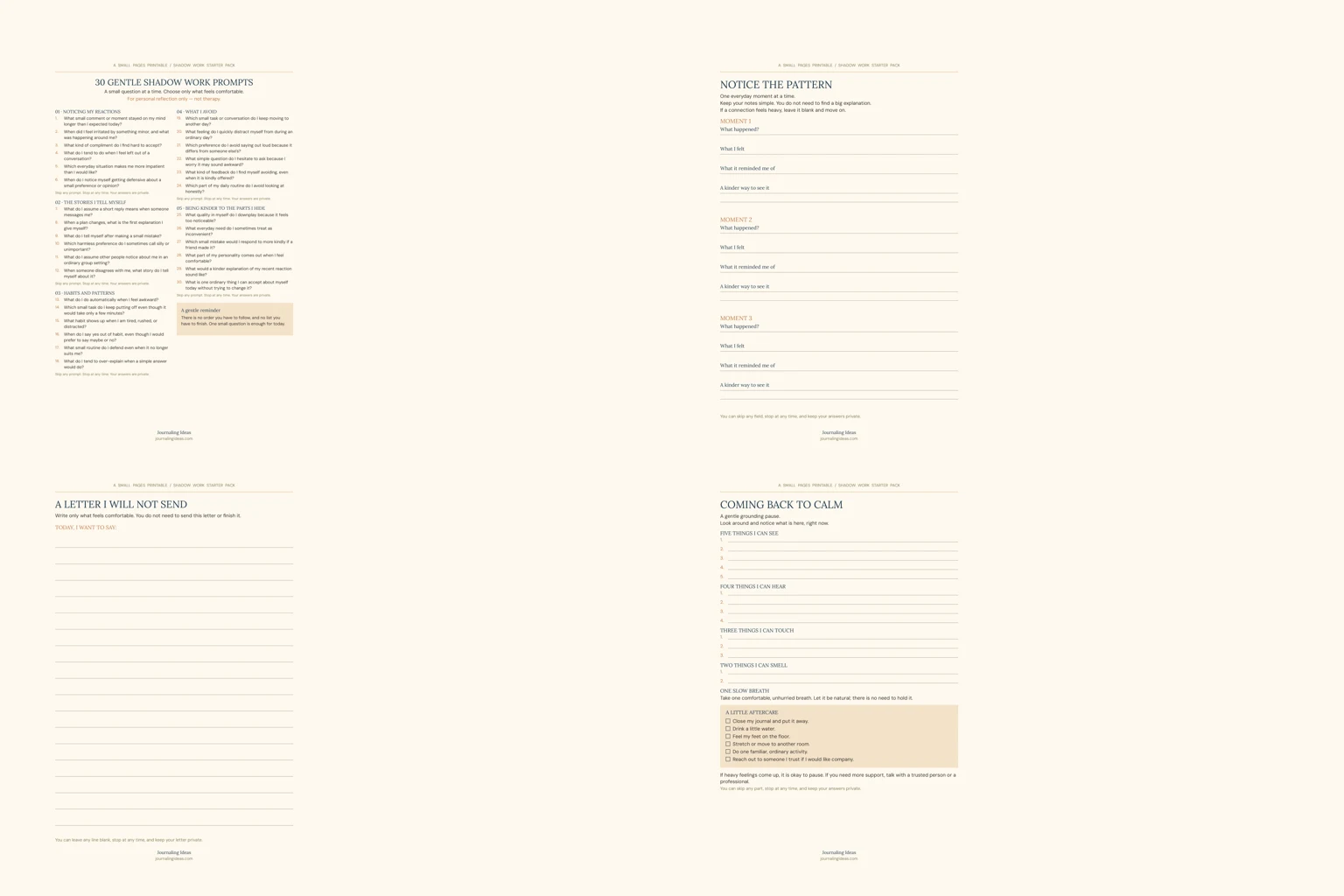
The free Shadow Work Starter Pack includes four printable sheets. Each sheet has a different purpose. You can use them together or choose only the page that feels useful today.
Sheet 1: 30 Gentle Shadow Work Prompts — This is your main question list. It includes all 30 prompts, organized into the five sections above. You can: circle a question you want to explore; choose one question for a short writing session; return to the list another day; leave the questions that do not feel relevant. There is no order you have to follow. You can skip any question, stop at any time, and keep your answers private.
Sheet 2: Notice the Pattern — This page gives you a simple way to record an everyday moment. It has four sections: What happened (briefly describe the situation); What I felt (name the feeling you noticed); What it reminded me of (note an ordinary connection, if one comes to mind); A kinder way to see it (write a less critical explanation). For example, if you felt irritated when a plan changed, you might write down what happened, how you felt, and what you could say to yourself more kindly. You do not need to search for a deeper explanation. If a connection feels uncomfortable, leave it blank. Skip any field, stop at any time, and keep your answers private.
Sheet 3: A Letter I Will Not Send — Sometimes it is easier to put a thought into a letter than to answer a question. This sheet gives you a quiet, lined space to write something you do not intend to send. You could write about: a small thing you wish you had said; a preference you have been keeping to yourself; something you found awkward to express; a thought you simply want to put into words. You do not need to address the letter to anyone. You do not need to finish it or share it. You can skip any part, stop at any time, and keep your letter private.
Sheet 4: Coming Back to Calm — This is the grounding page in your starter pack. It is included so you have a simple way to pause and reconnect with your surroundings if a reflection feels uncomfortable. It uses a gentle five-senses exercise: Five things I can see. Four things I can hear. Three things I can touch. Two things I can smell. One slow breath. The page also includes a short aftercare checklist, with small actions such as putting your journal away, drinking water, and noticing your feet on the floor. You do not have to complete every item. You can skip any part, stop at any time, and keep your answers private.
What Should I Do If a Prompt Feels Heavy?

You never have to push through an uncomfortable journaling session.
If a question feels too personal or brings up feelings you do not want to explore, close your journal.
Here are a few gentle steps:
Stop writing. You do not need to finish the question or complete the page.
Look around. Notice the room and name a few things you can see.
Reconnect with your surroundings. Notice nearby sounds and the feeling of your feet touching the floor.
Take a comfortable breath. Let your breathing return to its natural pace.
Do something ordinary. Have some water, stretch, or move to another comfortable place.
You can use the Coming Back to Calm printable whenever you want a grounding pause. If anxious feelings keep returning, our journal prompts for anxiety offer a gentler everyday starting point.
If heavy feelings come up, it is always okay to pause. If you need more support, talk with a trusted person or a professional.
There is no benefit in forcing yourself to continue.
How to Print the Shadow Work Starter Pack
The Shadow Work Starter Pack contains four sheets, each available in two paper sizes. You receive eight PDF files in total.
A few printing suggestions: Choose A4 for standard A4 paper. Choose US Letter for standard US Letter paper. Print at 100% or Actual Size where possible. If your printer clips the margins, use Fit to Printable Area. Use ordinary printer paper or slightly thicker paper if you prefer. Print only the sheets you want to use. You do not need to print the whole pack at once.
Download the Free Shadow Work Starter Pack
Ready to begin with one small question?
The free Shadow Work Starter Pack includes: 30 Gentle Shadow Work Prompts. Notice the Pattern tracker. A Letter I Will Not Send. Coming Back to Calm grounding page. All four sheets are available in A4 and US Letter, giving you eight PDF files.
Find the complete pack in The Small Pages Library.
Free to access. No signup or password needed.
Choose one page, print it, and keep the rest for another day.
Frequently Asked Questions
Is shadow work journaling therapy?
No. Shadow work journaling in this guide is a personal reflection activity, not therapy, diagnosis, or treatment. It does not replace professional support.
Do I have to answer every shadow work prompt?
No. You can choose one question, skip several, or leave the entire list unfinished. There is no required order or completion target.
What if I feel upset while journaling?
Stop writing and give yourself permission to pause. Try the Coming Back to Calm grounding page or do something familiar and comforting. If you need more support, talk with someone you trust or a professional.
Should anyone read my shadow work journal answers?
Your answers are personal. You do not have to share them with anyone. Keep your notebook or printed pages somewhere private if that feels right to you.
How often should I use shadow work journal prompts?
There is no required schedule. You might choose one question occasionally or return to a prompt when an everyday situation makes you curious about your reaction. Take breaks whenever you want.
Do I need journaling experience to try shadow work?
Not at all. You can begin with a simple notebook, a pen, and one question. You do not need a special journaling method or previous experience.
A Gentle Place to Begin
Shadow work does not have to mean asking yourself difficult questions or searching for something hidden.
It can begin with noticing a small reaction, recognizing a familiar habit, or admitting a preference you usually keep to yourself.
Choose one question. Give yourself five quiet minutes. Leave the rest for another day.
You do not need perfect answers, and you do not need to change anything about yourself today.
Small pages. Meaningful days.
— Journaling Ideas Editorial Team




2 Comments