
Mindfulness Journal Prompts: 30 Questions for Coming Back to the Present Moment
Mindfulness journal prompts are questions that bring your attention back to the one place it rarely stays: the present moment. Instead of reviewing the past or planning the future, they ask what is here right now — what you can see, hear and feel, what your body is doing, which thoughts are passing through. A few honest lines in answer is a complete practice.
The 30 prompts below are grouped into five short practices: arriving through the senses, checking in with the body, watching thoughts pass without chasing them, paying attention inside ordinary moments, and closing the day gently. Each group notes roughly how long its prompts take — most need two to five minutes, because attention is the exercise, not word count. The full set is also in the free printable pack, including a 5-4-3-2-1 grounding page you can keep inside the journal cover.
You do not need to meditate, sit cross-legged, or own a special notebook. If you can notice one sound all the way to its end, you can do every prompt on this page.
Take the practice outside with our nature journal prompts
— small observations, sketched or written, one page at a time.
How to use these prompts
- Notice first, write second. Give the moment ten seconds of actual attention before the pen moves. The writing records the noticing; it does not replace it.
- Describe, do not judge. “The tea is bitter and too hot” is mindfulness. “I always make terrible tea” is a story. Both may end up on the page — learn to spot the difference.
- One prompt is a full session. These are short practices. One prompt answered with real attention beats ten answered on autopilot.
- Return, kindly. Your mind will wander mid-sentence. That is not failure; noticing the wander IS the exercise. Come back without scolding yourself.
Group 1 — Arriving through the senses
Why this group helps: the senses only work in the present tense. You cannot hear yesterday’s sounds. Anchoring attention in what you can see, hear and feel is the fastest way out of a looping head and into the room you are actually in. About 2–3 minutes each.
- Right now, name five things you can see, four you can hear, and three you can feel against your skin. Then describe one of them in full detail.
- Describe the light where you are sitting — its colour, where it falls, and what it touches.
- Pick one ordinary sound you usually ignore. Follow it from its beginning to its end, and write what you noticed.
- Take a drink, or pick up any object near you, and write about its weight, temperature and texture as if describing it to someone who has never held one.
- What is the smallest detail in this room you have never properly looked at? Look now, then write it down.
- Write the weather inside this moment: not outside — the temperature, the air, and the feeling of the exact place you are in.
Group 2 — The body right now
Why this group helps: the body is always in the present, even when the mind is not. A slow scan turns vague “I feel off” into specific, workable information — a tight jaw, held breath, tired eyes — and specific things can be tended to. About 3–5 minutes each.
- Scan slowly from head to feet. Where is there ease, and where is there tension? Give each a colour.
- Follow three full breaths, and write down exactly where you feel each one most.
- What is your body asking for right now — water, movement, rest, air? How do you know?
- Describe one sensation you have been calling “nothing” — a tight jaw, hunched shoulders — as if it were a message being delivered.
- Sit still for one minute. What does your body do when you stop directing it? Write what you noticed, not what you think it means.
- Which part of you feels most awake today, and which part feels most tired? Thank both of them, in writing.

Group 3 — Watching thoughts pass
Why this group helps: a thought written down becomes an object you can look at instead of a room you are trapped in. This group practises the small, radical move of observing your mind — “I am having the thought that…” — instead of obeying it. About 5 minutes each.
- Write down the last three thoughts that crossed your mind, exactly as they arrived — no editing, no judging.
- Which thought keeps returning today? Greet it on paper like a regular visitor: “You again. What do you need?”
- Finish this sentence five ways: “Right now, my mind is busy with…”
- Describe your current worry as weather passing over a landscape. What is the landscape? (You are the landscape, not the weather.)
- What story are you telling yourself about today? Write it out — then write only the facts underneath it.
- Notice one judgment you made in the last hour, of yourself or of someone else. Rewrite it as a plain observation.
A worked example (prompt 16, filled in)
Prompt: Describe your current worry as weather passing over a landscape.
“The worry is the email I have not answered, and as weather it is a low grey cloud that has sat over the valley since Tuesday — not raining, just dimming everything. The landscape is the rest of my life: the garden is still there under it, the dog still wants his walk, dinner still got cooked. The cloud feels permanent from inside it. From the page, it is clearly weather: it arrived on Tuesday, and weather — even slow weather — moves. I will answer the email tomorrow at nine. Until then, I am the valley, not the cloud.”
Group 4 — Mindfulness in ordinary moments
Why this group helps: mindfulness that only works on a cushion is a hobby; mindfulness inside the washing-up is a way of living. This group moves attention into the routines you already have, at half speed and full notice. About 5 minutes each.
- Choose one routine act today — brushing your teeth, washing dishes, walking to the door — and do it at half speed. Write what changed.
- Describe your last meal as a full sensory event: first sight, first smell, first bite, last bite.
- Write about one person you passed today as if they were the main character of a novel, for one paragraph. (Kindly.)
- What did your hands do in the last hour? List it. Our hands live a whole life we rarely notice.
- Pick one colour and find it in five places in your surroundings. Write the five places.
- Describe the exact moment today when you were fully where you were — even if it lasted ten seconds.
Group 5 — Closing the day, gently
Why this group helps: the day ends whether we close it or not; closing it on paper is what lets the mind stop rehearsing it at 2 a.m. These prompts collect the day’s evidence — one kept moment, one thing set down — and then they stop. About 3–5 minutes each.
- What is one moment from today you would press like a flower in this book? Describe it before it fades.
- What did today smell like, sound like, and feel like? Three lines — one per sense.
- Name one thing that is finished for today and can be set down. Write the setting-down.
- What is still humming in your mind as the day ends? Give it one line, a corner of the page, and permission to wait until morning.
- Write a thank-you to one unremarkable thing that carried you today — the chair, the bus, the kettle.
- End with this sentence, completed honestly: “Right now, in this exact moment, I am…”

The free printable pack
The Mindfulness Journal Pack gathers all 30 prompts plus three practice pages: a 5-4-3-2-1 Grounding Page for the loud moments, a Right Now one-minute check-in, and a One Mindful Week tracker that collects one noticed moment per day. Print the pages you need, as often as you need them. Free, no sign-up — like everything in the Small Pages Library.
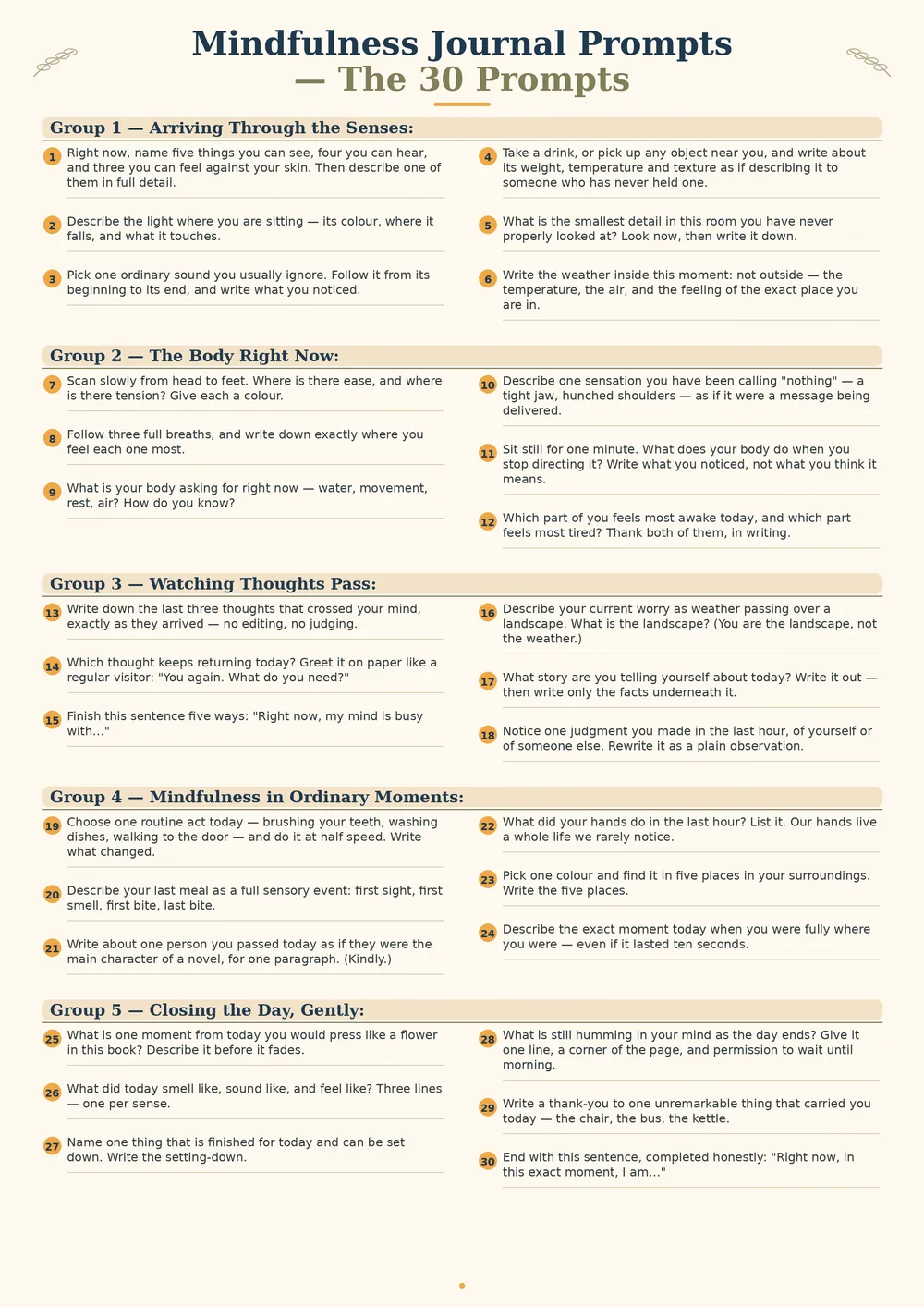
The 30 Prompts list: A4 · US Letter

5-4-3-2-1 Grounding Page: A4 · US Letter
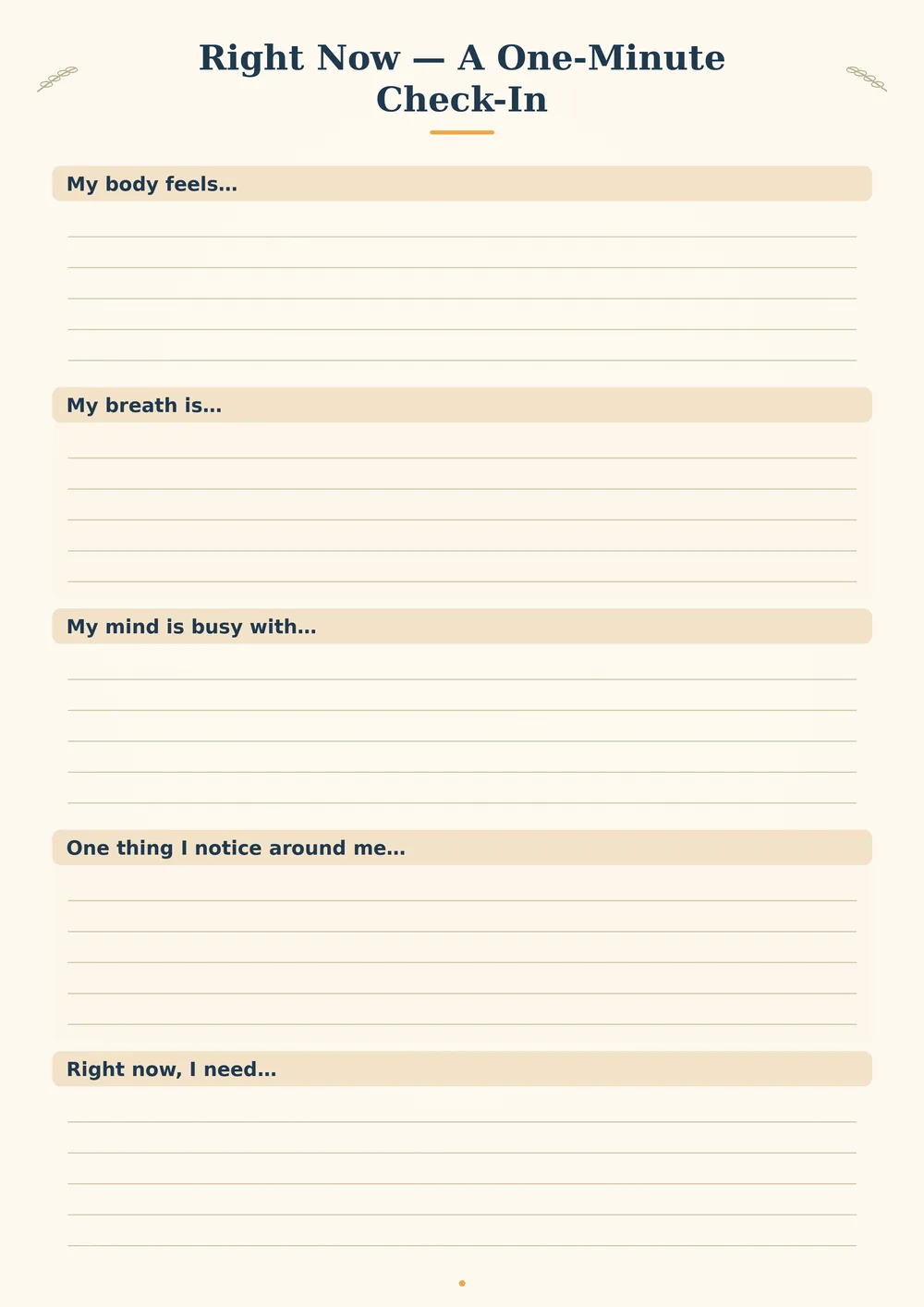
Right Now check-in page: A4 · US Letter
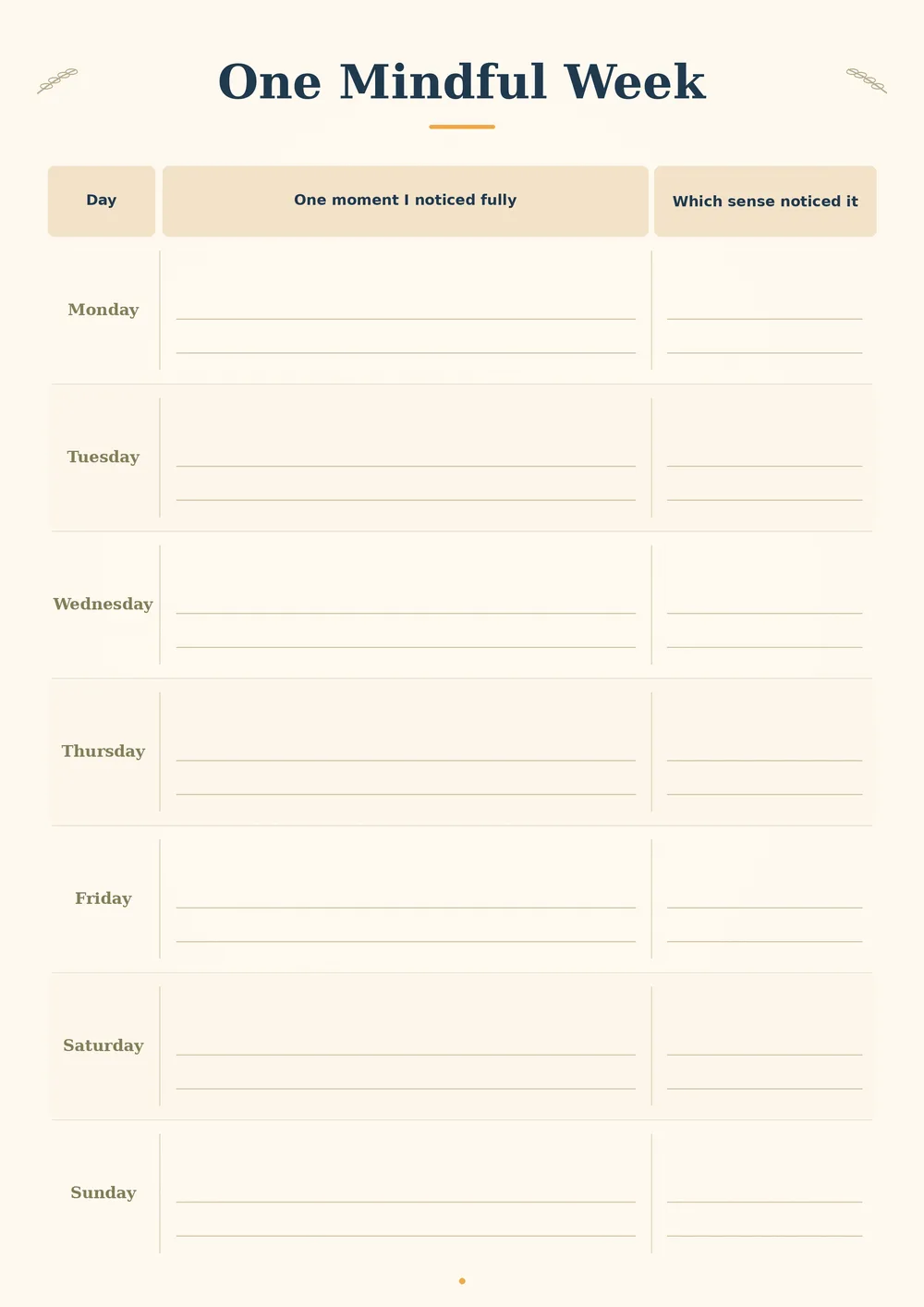
One Mindful Week tracker: A4 · US Letter
On the days when the mind will not slow down at all, our journal prompts for anxiety are built for the spiral itself, and the evening journal prompts turn this same noticing into a wind-down ritual. If what the present moment mostly shows you is how tired you are, start with journal prompts for self-care. And the gratitude journal prompts take one corner of this practice — noticing what is good — and give it a whole page. Every sheet mentioned here also lives in the Small Pages Library.
If your worry runs in loops — the same moment replayed, the same conversation rehearsed — our journal prompts for overthinking were written for exactly that.
Frequently asked questions
What are mindfulness journal prompts?
Mindfulness journal prompts are short questions that anchor your writing in the present moment: what you can see, hear and feel right now, what your body is doing, and which thoughts are passing through. Instead of reviewing the past or planning the future, they practise noticing the present — a few honest lines is a complete entry.
How is mindfulness journaling different from regular journaling?
Regular journaling usually looks backward (what happened) or forward (what I will do). Mindfulness journaling stays with what is here now: sensations, surroundings, and thoughts as they arrive. The goal is not to analyse your life but to notice it while it is happening.
How long should a mindfulness journal entry take?
Most prompts in this set take two to five minutes. Attention is the exercise, not word count — one prompt answered with real noticing is a full session. If you have only one minute, use prompt 1 and stop there.
Do I need to meditate to use these prompts?
No. The prompts are the practice: each one gives your attention a single, concrete job. No experience, special posture or equipment is needed — a notebook and a few quiet minutes are enough.
What is the best time of day for mindfulness journaling?
Any time you will actually do it. The senses and body groups work well in the morning or during a midday reset; the closing group is written for the evening. Many people keep the printed grounding page in the journal and use it whenever the day gets loud.
Is the printable pack really free?
Yes. The Mindfulness Journal Pack — the 30 prompts list, the 5-4-3-2-1 grounding page, the Right Now check-in and the One Mindful Week tracker — is a free download from this page and from the Small Pages Library, in A4 and US Letter. No email address is needed.


3 Comments