
Pen Pal Journal: How to Keep Letters, Memories & Replies Together
A pen pal journal is a simple place to keep the story of your letter-writing in one spot. It helps you remember who you are writing to, what you discussed, and how their last letter made you feel. Writing letters to a pen pal can be a lovely way to slow down, share everyday moments, and build a connection across distance — but letters arrive one at a time, and the details can be easy to forget. A pen pal journal brings those pieces together. You can keep a record of your correspondence while making space for small reflections that turn a simple exchange into a meaningful ritual. This beginner-friendly guide explains how to start a pen pal journal, what to include, how to write your first letter, and how to use the free printable kit to keep your letters and memories organized.

Inside this guide:
- What Is a Pen Pal Journal?
- How Is It Different from Just Having Stationery?
- What Is Included in a Pen Pal Journal Starter Kit?
- How Do You Set Up Your Pen Pal Journal?
- How Can You Find a Pen Pal Safely?
- What Should You Write in Your First Letter?
- How Can You Make Your Letters More Personal?
- What Can You Write About? 24 Letter-Writing Prompts
- How Do You Keep Your Pen Pal Journal Habit Going?
- A Note About Replies and Expectations
- Where Can You Get the Free Pen Pal Journal Starter Kit?
- Frequently Asked Questions About Pen Pal Journals
What Is a Pen Pal Journal?
A pen pal journal is a dedicated place to organize and reflect on your letter-writing correspondence. It is a notebook, binder, or set of printable pages where you can track who you write to, what you send and receive, and what you notice along the way. Instead of keeping everything in separate notebooks, phone notes, or loose pieces of paper, you have one place to return to. A pen pal journal can include:
- Pen pal profiles: Names, birthdays, interests, and important details about each person.
- Letter trackers: Dates of letters sent and received, what you discussed, and whether a reply is needed.
- Happy mail memories: A record of the letters, cards, and little surprises that arrive.
- Writing prompts: Questions and ideas to help you decide what to write next.
- Personal reflections: A few sentences about what a letter meant to you or how receiving it made you feel.
You do not need a complicated journaling system. A few useful pages are enough to get started.
How Is It Different from Just Having Stationery?
Stationery and a pen pal journal serve different purposes. Stationery gives you the materials for writing and sending letters. It includes paper, envelopes, pens, stickers, and washi tape. A pen pal journal helps you remember and reflect on the correspondence itself.
| Stationery | Pen Pal Journal |
|---|---|
| Letter paper and envelopes | Pen pal profiles |
| Decorative stickers | Letter-writing prompts |
| Stamps and washi tape | Sent and received tracker |
| Writing pens | Happy Mail Log |
| Envelope decorations | Personal reflections |
You can enjoy beautiful stationery without keeping a journal, and you can maintain a pen pal journal without fancy stationery. The two work nicely together, but the journal has a different purpose: it keeps the story of your correspondence in one place.
What Is Included in a Pen Pal Journal Starter Kit?
The Pen Pal Journal Starter Kit from The Small Pages Library contains four printable sheets, each available in A4 and US Letter. That makes eight PDF files in total. Each sheet has a different purpose.

1. My Pen Pal Profile — Use one profile page for each person you write to. It gives you a place to remember: their name; where you met or how you started writing; their birthday; things they like; things you want to remember; the date of your first letter. This page is especially helpful when you have more than one pen pal. You can look back at someone’s profile to remember details before writing a reply.
2. Letters Sent & Received Tracker — The correspondence tracker helps you remember the letters that move between you and your pen pals. It includes columns for: date; to / from; what the letter was about; extras included; reply needed? There are 36 rows, giving you three correspondence entries per month across a year. If you write more than one letter a month, you can use extra pages as needed. You can use short descriptions rather than recording every detail of a letter.
3. Happy Mail Log — This is the reflection page of the starter kit. Whenever you receive a letter, card, or another piece of happy mail, record: when it arrived; who sent it; what arrived; what it meant to you or how it made you feel. The last column is important. It turns a simple record of incoming mail into a small journaling practice. You might remember the excitement of opening an envelope, a thoughtful message, or a little detail that made you smile.
4. 24 Letter-Writing Prompts — Sometimes you want to write a letter but cannot think of a starting point. The prompt sheet includes 24 questions divided into four themes: Getting to Know You; Everyday Life, Gently; Memories & Stories; Dreams & Favorites. You can choose one question whenever you need inspiration. There is no need to answer all 24 or follow them in order.
How Do You Set Up Your Pen Pal Journal?
Starting is easier when you build the journal one page at a time. Here is a simple setup routine.
Step 1: Choose Your Paper Size — Download the starter kit in A4 or US Letter, depending on the paper you normally use. Print the pages you need and place them in a folder, binder, or journal. You do not have to print everything at once. Start with the pages you expect to use.
Step 2: Create a Profile for Each Pen Pal — Complete one My Pen Pal Profile page for every person you correspond with. Write down their name, birthday, interests, and how your correspondence began. Keep the information useful and respectful. You do not need to collect private details to maintain a good profile.
Step 3: Record Letters You Send and Receive — Use the Letters Sent & Received Tracker whenever you mail or receive a letter. For example, your entries might look like this:
| Date | To / From | Letter topic | Extras |
|---|---|---|---|
| March 4 | To Maya | Favorite books | Bookmark |
| March 18 | From Maya | Spring plans | Postcard |
| April 2 | To Maya | Everyday routines | Sticker |
These are illustrative entries showing how to use the tracker, not real correspondence records. Keep your notes short. A few words about the subject of a letter are usually enough to help you remember it later.
Step 4: Reflect on Your Happy Mail — When a letter arrives, open your Happy Mail Log. Write down what arrived and add a short reflection. You could ask yourself: What made this letter feel special? Was there a particular sentence I want to remember? Did something in the letter make me smile? What would I like to mention in my next reply? Even one sentence can turn the log into a meaningful record.
Step 5: Keep Your Prompts Nearby — Place the 24 Letter-Writing Prompts sheet somewhere easy to reach. When you are ready to write, choose one question and use it as a starting point. You can answer it directly, tell a related story, or use it to introduce another topic.
How Can You Find a Pen Pal Safely?
Finding a pen pal can begin with a shared interest, a writing community, or a moderated letter-writing service. The important part is to choose a setting where expectations and communication guidelines are clear. A few sensible precautions can help:
- Look for established communities. Prefer spaces with clear participation rules and moderation rather than unverified requests from strangers. Pen pal clubs, letter-writing communities, library programs, and hobby groups are often better places to start.
- Start with shared interests. Books, art, journaling, travel, music, and creative hobbies can provide natural conversation topics.
- Share gradually. Begin with general information about your interests and everyday life. You do not need to disclose private details, such as where you live or work, in your early letters.
- Protect identifying information. Be cautious about sharing your full name, home address, phone number, workplace, school, financial details, or other personal data in letters. Keep your address private, and use a mailing arrangement that feels safe.
- Set comfortable boundaries. You can decide what subjects you want to discuss and how frequently you want to exchange letters.
- Consider a privacy-preserving mailing arrangement. If you decide to exchange physical letters, consider whether a post office box or another suitable arrangement could help protect your privacy.
A small privacy reminder: Only share information you are comfortable sharing. Never publish anyone’s address or private correspondence without permission. If someone pressures you to share personal information, move conversations elsewhere, or ignore your boundaries, trust your judgment and step away.
What Should You Write in Your First Letter?

The first letter does not need to be perfect, lengthy, or especially creative. Its purpose is to introduce yourself and give the other person a few easy ways to respond. You can organize your first letter into five simple parts.
- Start with a friendly greeting. Use their name if you know it.
- Introduce yourself. Share a little about your interests, hobbies, and the things you enjoy.
- Explain why you wanted to write. Mention the shared interest or reason that made you interested in exchanging letters.
- Share a small piece of everyday life. Talk about something you recently read, watched, cooked, learned, or noticed. You do not need to share anything deeply personal.
- Ask a couple of friendly questions. Give your pen pal something easy to respond to.
For example: What have you been reading lately? What is your favorite way to spend a relaxing weekend? Is there a hobby you would like to try? Finish with a friendly closing and your name or preferred signature. Remember that a first letter is an introduction, not an interview. Leave space for the friendship to grow.
How Can You Make Your Letters More Personal?
A thoughtful letter does not need expensive stationery or elaborate decorations. Small details can make it feel personal. You could:
- Include a small drawing or handwritten note.
- Share a book, film, or song recommendation.
- Add a photograph or a small paper keepsake when appropriate.
- Use a question from the prompt sheet.
- Mention something your pen pal told you in an earlier letter.
- Decorate the envelope with a few stickers or pieces of washi tape.
If you enjoy collecting tickets, paper scraps, labels, and little keepsakes, you can borrow ideas from our junk journal guide. However, decoration is optional. The words and thought behind your letter matter more than making every page look perfect.
What Can You Write About? 24 Letter-Writing Prompts
Not every letter needs a big story or an important announcement. Everyday observations, favorite memories, small discoveries, and future plans can all become interesting topics. Here are 24 original prompts to help you get started.
Getting to Know You
- What is something small that always makes you smile?
- Which place feels most like home to you, and why?
- What is a skill or hobby you would love to learn?
- What kind of day leaves you feeling most like yourself?
- What is one thing you wish more people asked you about?
- What is a favorite way to spend time with someone you care about?
Everyday Life, Gently
- What has been the nicest part of an ordinary day lately?
- Is there a small routine you look forward to?
- What is something you noticed recently that you might usually overlook?
- What does a cozy or restful evening look like for you?
- What is one thing you are looking forward to this week?
- What has made you laugh lately?
Memories & Stories
- What is a childhood memory you still think about fondly?
- Who taught you something you still use today?
- What is a family or friendship tradition you would like to keep?
- Tell me about a day that turned out differently than expected.
- What is a place from your past you would love to visit again?
- What object do you keep because it carries a memory?
Dreams & Favorites
- What is a dream you hope to make room for someday?
- If you could spend a month anywhere, where would you go?
- What book, film, song, or story has stayed with you?
- What would your perfect slow Saturday include?
- What is something new you would like to try this year?
- What is a little thing you hope to experience in the future?
You can use these questions in your first letter, save them for future replies, or simply choose whichever one feels easiest today. If you enjoy having more ideas for personal writing, explore our journal prompts for beginners guide, too.
How Do You Keep Your Pen Pal Journal Habit Going?
The easiest way to maintain a pen pal journal is to connect it to something you already do. You do not need to create a separate journaling routine every day. Try these simple habits:
- Record correspondence when it happens. Add a short entry to your tracker when you send or receive a letter.
- Update profiles when you learn something new. If your pen pal mentions a new interest or an upcoming birthday, add a note to their profile.
- Reflect when mail arrives. Use the Happy Mail Log to capture one small feeling or memory.
- Choose prompts when you feel stuck. You do not have to invent a new topic for every letter.
- Review your journal before replying. Looking back at your previous notes can help you remember conversations and ask thoughtful follow-up questions.
You can also set a gentle monthly reminder to review your correspondence. And if you miss a month, simply continue when you are ready. Your journal should make letter-writing feel lighter, not another task.
A Note About Replies and Expectations
Not every pen pal will write back at the same pace. People have different schedules, interests, and circumstances. Some correspondence becomes regular, while other exchanges naturally slow down. A pen pal journal can help you organize your side of the correspondence, but it cannot guarantee a reply. Enjoy the letters you send and receive without measuring the value of the experience by how quickly or often someone responds.
Where Can You Get the Free Pen Pal Journal Starter Kit?
The Pen Pal Journal Starter Kit is available in The Small Pages Library. The free bundle includes: My Pen Pal Profile; Letters Sent & Received Tracker; Happy Mail Log; 24 Letter-Writing Prompts. All four sheets are available in A4 and US Letter, giving you eight PDF files altogether. Free. No signup. You can access the printable kit through The Small Pages Library. Choose your preferred paper size, print the pages you need, and start building your own pen pal journal.
Conclusion
A pen pal journal gives your letters somewhere to belong beyond the envelope. It helps you remember the people you write to, keep track of conversations, and appreciate the little moments that letters carry. Start with one profile, one tracker, and one reflection. Add more pages as your correspondence grows. You do not need perfect handwriting, elaborate stationery, or a complicated routine. Small pages. Meaningful days. Find your free Pen Pal Journal Starter Kit in The Small Pages Library and give your letter-writing more space to grow.
Journaling Ideas Editorial Team
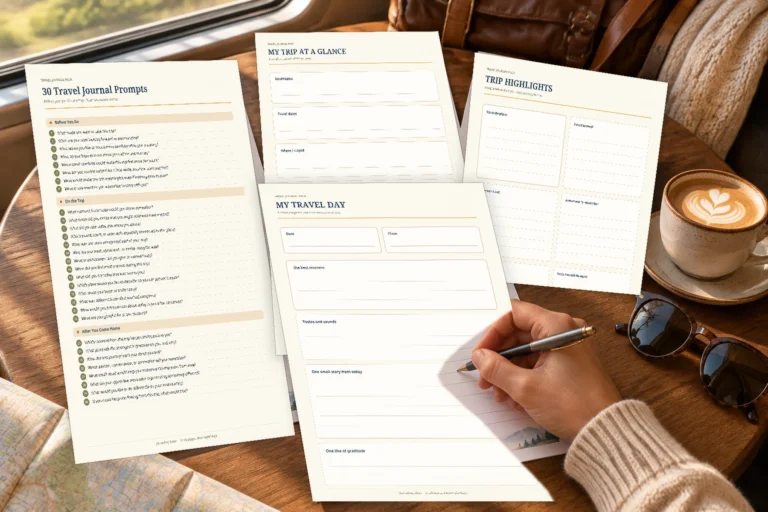
If your next trip has you thinking about the details you want to remember, explore these travel journal prompts. The article includes 30 gentle questions for before, during, and after a journey, plus a free four-sheet Travel Journal Pack in A4 and US Letter. It is a simple way to keep trip notes, small stories, and highlights together—no signup required.
Frequently Asked Questions About Pen Pal Journals
- What should I include in a pen pal journal? Start with a profile for each pen pal, a tracker for letters sent and received, a log for incoming happy mail, and a few prompts to help you write your next letter.
- Do I need a separate journal for every pen pal? No. You can keep individual profile pages for each person and use one shared correspondence tracker.
- How often should I update my pen pal journal? Update it whenever you send or receive a letter. You can also review your notes once a month. There is no fixed schedule — choose what works for you.
- What should I write in my first pen pal letter? Introduce yourself, mention a few interests, share a small detail about your everyday life, and ask a couple of friendly questions.
- How can I find a pen pal safely? Look for established, moderated writing communities with clear guidelines. Share information gradually and keep your home address private.
- What if my pen pal does not write back? A reply is never guaranteed. People may become busy, change interests, or stop corresponding. Give the correspondence time, and enjoy the letters you do receive.

3 Comments