Journal Prompts for Healing: 30 Gentle Questions for Hard Seasons
Journal prompts for healing are gentle, open questions that help you put a hard season into words — a loss, a heartbreak, burnout, an illness, or a version of your life that no longer fits. They are not a test and they have no right answers. You take one at a time, write honestly for a few minutes, and let the page hold what you do not want to carry around in your head all day.
The 30 prompts below are grouped into five stages, from naming where you are to looking forward softly. Each group notes roughly how long its prompts take, because on a hard day the difference between a two-minute question and a ten-minute letter is the difference between writing and not writing. The full set is also in the free printable pack, so you can work on paper away from a screen.
A note before you start: journaling is a self-care practice, not therapy or medical care. It sits happily alongside professional support, and if what you are carrying involves trauma or pain that is not easing, a licensed professional can offer something a page cannot. Nothing here replaces that.

How to use these prompts (without making it another job)
- One prompt, not thirty. Pick the one that pulls at you today. Healing writing is slow writing.
- Skip freely. If a prompt feels like too much today, it is the wrong prompt today. Move on or stop.
- Keep it private. Write like nobody will ever read it, because nobody has to. Tear a page out if that is what honesty needs.
- Short counts. Three honest lines are a complete entry. The time labels are a guide, not a quota.
Stage 1 — Naming where you are
Why this stage helps: healing is hard to tend to while it stays vague. Naming the season — plainly, in one sentence — turns a fog into something with edges, and things with edges are easier to carry. Shapes: mostly 2-minute one-liners and short lists.
- In one sentence, what are you healing from? You do not have to soften it or explain it.
- Where does this season feel heaviest in an ordinary day — mornings, work, evenings, or somewhere else?
- What emotion visits most often lately? Write to it like a guest, not an enemy.
- What has been harder than you expected? Name one thing, plainly.
- On a scale you invent yourself, where are you today — and what would one step up look like?
- What do you wish the people around you understood without you having to say it?
Stage 2 — Making room for what happened
Why this stage helps: unfinished stories loop. Writing what happened — facts first, verdicts later — gives the loop somewhere to live besides your head at 3 a.m. Shapes: a 10-minute story, the rest 5-minute paragraphs.
- Tell the story of what happened in five sentences or fewer. Facts only, no verdicts.
- What part of it still feels unfinished? What would “finished” even mean?
- What did you need at the time that you did not get? Write it without blaming anyone, including yourself.
- What is one thing that was not your fault, even if it still feels like it was?
- If the hardest moment could be set down on the table in front of you, what would you say to it?
- What have you been carrying that actually belongs to someone else?

Stage 3 — Being gentle with yourself
Why this stage helps: most people heal in the voice of their harshest critic. This stage practises the other voice — the one you would use on a friend — until it gets easier to find. Shapes: short and kind, 2–5 minutes each.
- Write the kindest true sentence you can say to yourself today.
- What would you say to a close friend in your exact situation? Write it to them, then read it back as yours.
- What is one small comfort that still works — a drink, a place, a song, a routine?
- What can wait? List three things that do not have to be fixed this week.
- Describe a version of rest that is not sleep: what does your mind do when it is off duty?
- What boundary would protect the healing you have already done? One is enough.
Stage 4 — Small signs of mending
Why this stage helps: progress in a hard season is quiet and easy to miss. This stage collects the evidence — the ordinary things returning — so the season is not the only story you have about yourself. Shapes: lists and short scenes, 5 minutes each.
- What can you do now that you could not do at the start of this season?
- When did you last laugh or feel light for a moment? What was happening?
- Who or what has quietly helped? Write them a thank-you you may never send.
- What is one ordinary thing you have started enjoying again?
- What strength did this season show you that you did not know you had?
- If healing had a weather report this week, what would it say?
A worked example (prompt 19, filled in)
Prompt: What can you do now that you could not do at the start of this season?
“Six weeks ago I could not walk into the supermarket on our old street without rehearsing what I would say if I ran into anyone who knew. Yesterday I went in for milk and came out with milk, bananas, and a conversation about the weather that I did not think about afterwards. That is the whole entry. It is not a triumph. It is a Tuesday. But at the start of this season, a Tuesday like that was not available to me, and now it is.”
That is all a healing entry needs to be: one true observation, written down while it is still small enough to doubt.
Stage 5 — Looking forward, softly
Why this stage helps: forward is not the same as fixed or finished. This stage lets you want things again at a pace the season can bear. Shapes: the letter (prompt 29) deserves 10 quiet minutes; the rest are 5-minute paragraphs.
- What does “forward” look like for you — not fixed, not finished, just forward?
- What are you ready to release? What are you not ready to release? Both answers are allowed.
- What is one small thing tomorrow could hold that supports the person you are becoming?
- A year from now, what do you hope feels different — and what do you hope stays the same?
- Write a letter to yourself one year from now. Seal it in the journal and set a date to open it.
- Finish this sentence three ways: “I am still here, and…”

The free printable pack
The Healing Journal Pack gathers all 30 prompts plus three working pages: a Where I Am Now check-in page, a Letter I Won’t Send page with room to say the unsayable, and a Small Steps Forward four-week tracker that records evidence, not streaks. Print the pages you need, as often as you need them. Free, no sign-up — like everything in the Small Pages Library.

The 30 Prompts list: A4 · US Letter
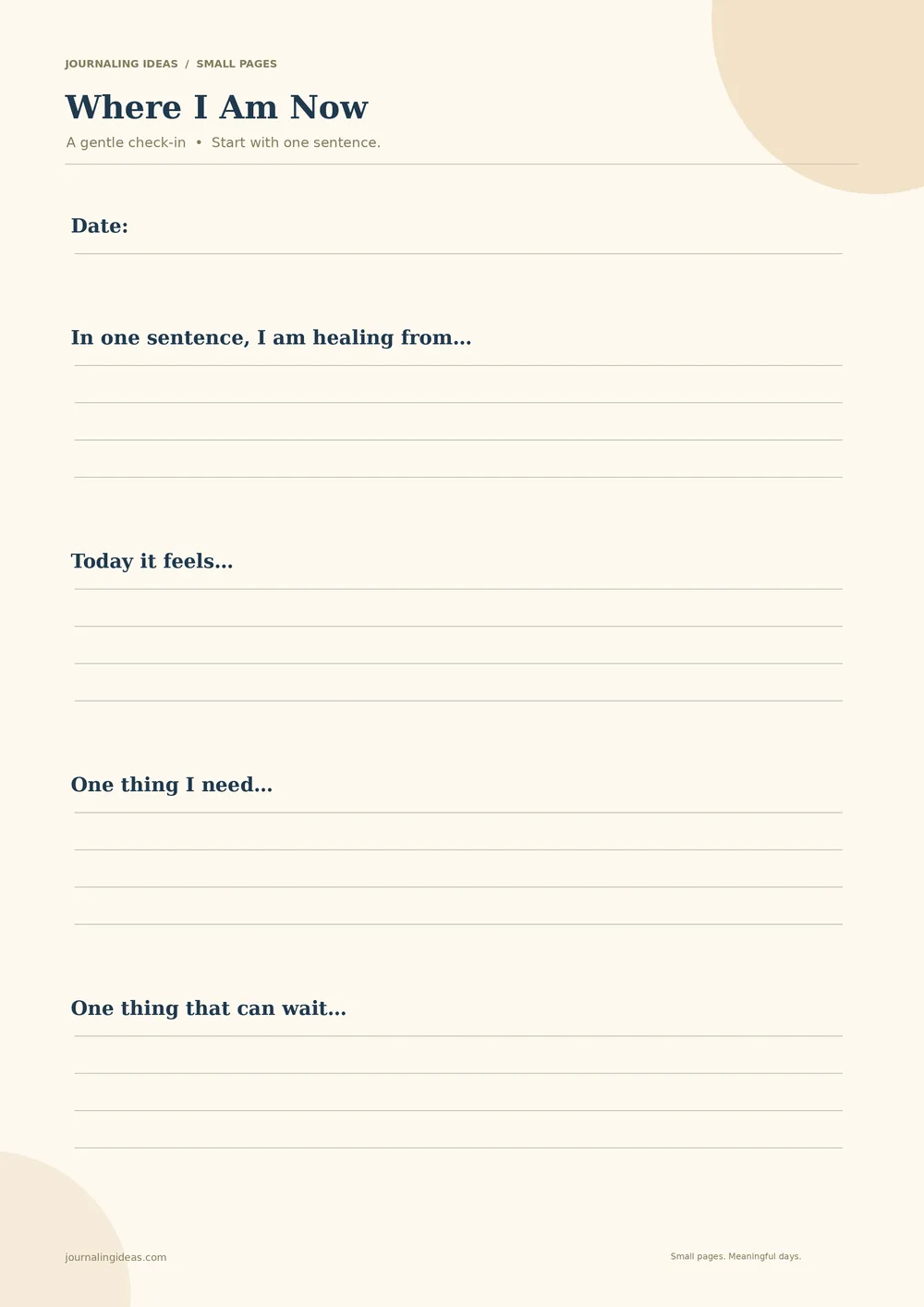
Where I Am Now check-in page: A4 · US Letter

A Letter I Won’t Send page: A4 · US Letter

Small Steps Forward tracker: A4 · US Letter
If this season is anxious as much as it is heavy, our journal prompts for anxiety are written for the in-the-moment days, and the shadow work prompts for beginners go gently into the patterns underneath. On the days when you simply need looking after, start with journal prompts for self-care. Every sheet on this page also lives in the Small Pages Library.
Frequently asked questions
What are journal prompts for healing?
Journal prompts for healing are gentle, open questions that help you write through a hard season — a loss, a heartbreak, burnout, an illness or a big change. They give the season words and edges, one short entry at a time. They are a self-care practice, not therapy or medical care.
How often should I use healing journal prompts?
Whenever writing would help — for many people that is a few times a week, one prompt at a time. There is no schedule to keep and no streak to protect. Missing a week does not undo anything; the notebook will be where you left it.
Do I have to write the prompts in order?
No. The five stages follow the shape healing often takes, but you can start anywhere and skip freely. If a prompt feels like too much today, it is the wrong prompt today — choose another, or rest.
Can journaling replace therapy or professional help?
No. Journaling is a self-care practice that can sit alongside professional support; it is not treatment, diagnosis or medical advice. If what you are carrying involves trauma, or pain that is not easing, please reach out to a licensed professional or a trusted support service in your country.
What if a prompt brings up more than I expected?
Stop writing, close the notebook, and do something ordinary and grounding — make tea, step outside, wash your hands in cool water. You never owe a page a finished entry. You can return to the prompt another day, or never; both are fine.
Is the printable pack really free?
Yes. The Healing Journal Pack — the 30 prompts list, the check-in page, the letter page and the tracker — is a free download from this page and from the Small Pages Library, in A4 and US Letter. No email address is needed.