

30 Evening Journal Prompts for a Gentle 10-Minute Wind-Down
Evening journal prompts are short questions that help you look back on the day, notice what mattered, and set down thoughts that are still following you. A few minutes with a notebook can give the day a clear ending and help you choose one small, kind focus for tomorrow—without turning bedtime into another task.
You don’t need to write a full diary entry or answer every question. Choose one to three prompts, write honestly, and let that be enough.
This guide includes 30 evening journal prompts across four simple sections, a gentle 10-minute routine, and a free four-sheet Evening Pages Pack you can print at home.
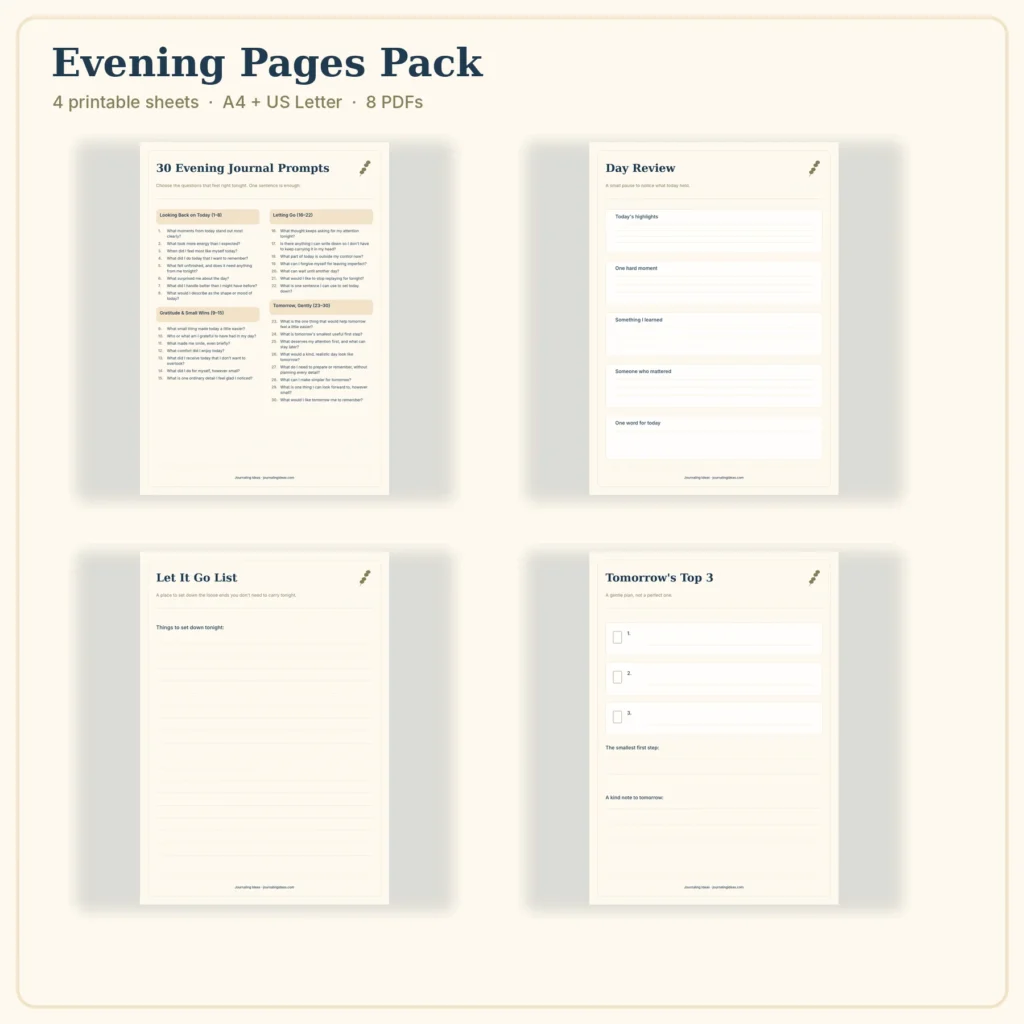
Free download: The Evening Pages Pack — 30 prompts list, day review, let it go list and tomorrow’s top 3 pages (A4 + US Letter), free in The Small Pages Library. No signup needed.
End the day with a song instead: our music journal turns the tracks you love into prompts, playlists and memories.
What Are Evening Journal Prompts?
Evening journal prompts are reflective questions designed for the end of the day. They give you a starting point when you want to write but aren’t sure what to say.
They are different from morning pages or free writing. Morning writing often looks forward or starts the day; evening prompts look back at what actually happened.
Prompts work well when you are tired because they remove the question of what to write about. Instead of facing a blank page, you simply answer one small question.
- They help you remember what your day actually contained, not just what still needs doing.
- They give loose ends somewhere to go, instead of letting them follow you into the night.
- They keep journaling short and easy, which makes it more likely you will return to it.
Why Is the End of the Day a Good Time to Journal?
The evening offers a natural pause between today’s activities and tomorrow’s plans.
During the day, you might move from one responsibility to another without stopping to consider what happened. Sitting down with a notebook gives you a chance to look back at the bigger picture.
For many people, the evening is also a good time to write honestly. The day has already happened, and the day’s expectations have mostly lifted. You don’t need to write anything polished. A few sentences can be enough.
Some people like to pair their journaling with a cup of tea or lampside light. Others prefer to write just before setting the next day’s plans. The simple idea is to give yourself a moment of reflection before the day fades.
30 Evening Journal Prompts to Close the Day
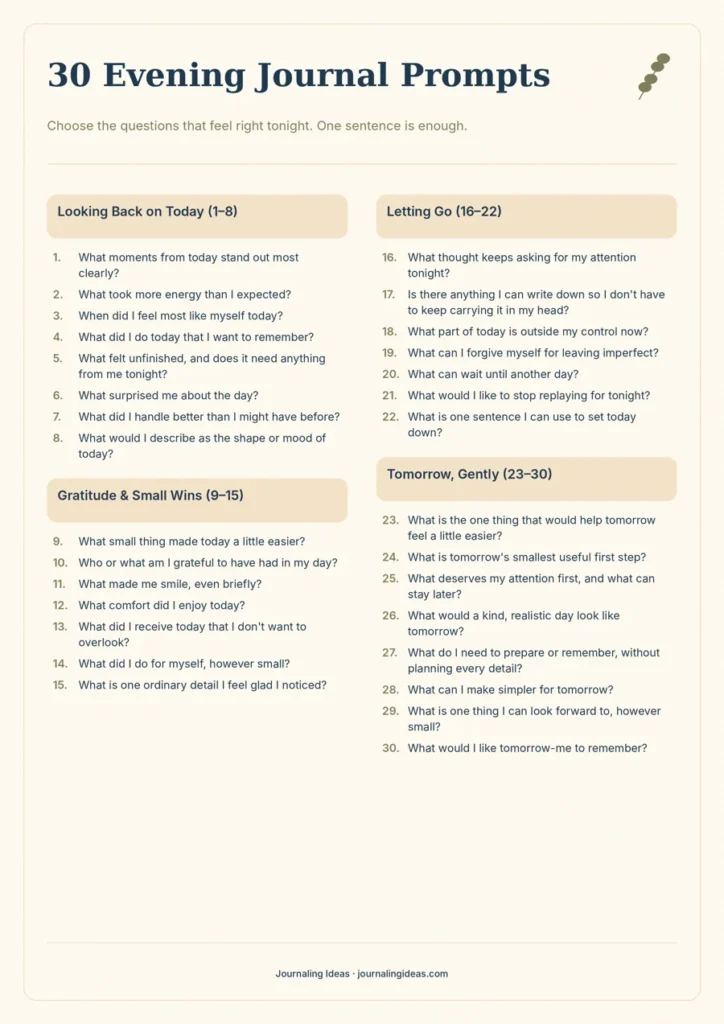
These 30 evening journal prompts are organized into four sections so you can choose according to what you need from your writing time. You don’t have to follow the numbers in order. Start with whichever question feels right.
Looking Back on Today (1–8)
Use these questions to revisit the day without judging whether it was productive, successful, or perfect.
- What moments from today stand out most clearly?
- What took more energy than I expected?
- When did I feel most like myself today?
- What did I do today that I want to remember?
- What felt unfinished, and does it need anything from me tonight?
- What surprised me about the day?
- What did I handle better than I might have before?
- What would I describe as the shape or mood of today?
You don’t need an exciting event to answer these questions. A familiar conversation, a quiet afternoon, or a small accomplishment can be worth remembering.
Gratitude & Small Wins (9–15)
Gratitude doesn’t have to mean pretending everything was wonderful. These questions simply invite you to notice something good, helpful, or meaningful alongside everything else.
- What small thing made today a little easier?
- Who or what am I grateful to have had in my day?
- What made me smile, even briefly?
- What comfort did I enjoy today?
- What did I receive today that I don’t want to overlook?
- What did I do for myself, however small?
- What is one ordinary detail I feel glad I noticed?
Your answers can be very ordinary. Perhaps someone remembered something important to you, you enjoyed a favorite drink, or you had a few minutes to yourself. Small details count.
Letting Go (16–22)
Some thoughts follow us through the day. This section gives you a place to write down loose ends without requiring yourself to solve everything immediately. A helpful way to approach this section is to separate what needs an action from what simply needs to be acknowledged.
- What thought keeps asking for my attention tonight?
- Is there anything I can write down so I don’t have to keep carrying it in my head?
- What part of today is outside my control now?
- What can I forgive myself for leaving imperfect?
- What can wait until another day?
- What would I like to stop replaying for tonight?
- What is one sentence I can use to set today down?
You can write these down without finding an answer to every one of them.
Tomorrow, Gently (23–30)
The final section helps you turn your attention toward tomorrow without creating a long list of expectations.
- What is the one thing that would help tomorrow feel a little easier?
- What is tomorrow’s smallest useful first step?
- What deserves my attention first, and what can stay later?
- What would a kind, realistic day look like tomorrow?
- What do I need to prepare or remember, without planning every detail?
- What can I make simpler for tomorrow?
- What is one thing I can look forward to, however small?
- What would I like tomorrow-me to remember?
You might finish with just one sentence: Tomorrow, I will start with __________. That is enough of a plan for one evening.
A Simple 10-Minute Wind-Down Routine
This routine takes about ten minutes. It works best when it’s gentle, not rigid.
Step 1 — Settle in. Find a comfortable place to write. Soften the lighting, put your phone aside if you can, and open your notebook. You don’t need a special journaling setup. A pen, a few minutes, and a little space are enough. Take a moment to consider: What is still on my mind from today? Don’t try to answer everything immediately. Just notice where your thoughts are.

Step 2 — Choose your prompts. Look through the 30 questions and choose the ones that feel relevant. You might choose one question from Looking Back on Today, one from Gratitude & Small Wins, and one from Letting Go. Write a few sentences for each. If a question doesn’t connect with your day, skip it. You can also use the same prompt several evenings in a row. Repeating a question is perfectly fine.
Step 3 — Choose one small thing for tomorrow. Before closing your notebook, choose one small action that could make tomorrow a little easier. For example: reply to a message you’ve been meaning to answer; set out what you need for the morning; write down one gentle intention for tomorrow. Give yourself permission to keep tomorrow’s plan simple. Write your choice down, then close the notebook. The purpose isn’t to organize every hour of tomorrow. It’s simply to give yourself a starting point.
What If You’re Busy or Tired?
Some evenings won’t leave much room for journaling. You might be tired, occupied with responsibilities, or simply not interested in writing.
Keep the routine flexible. One sentence is enough. One prompt is enough. A single word for the day is enough. You don’t need to force yourself to finish a page.
If writing makes an evening feel more difficult, put the notebook away and try another time. A journaling routine should remain optional, not another responsibility.
The Evening Pages Pack (Free Printable)
The Evening Pages Pack is a set of four printable sheets that support the article’s routine. Each sheet is available in A4 and US Letter, so the full pack is eight printable PDF files.
Sheet 1 — 30 Evening Journal Prompts: all 30 prompts from this article, printed as a simple list so you can keep them beside your journal.
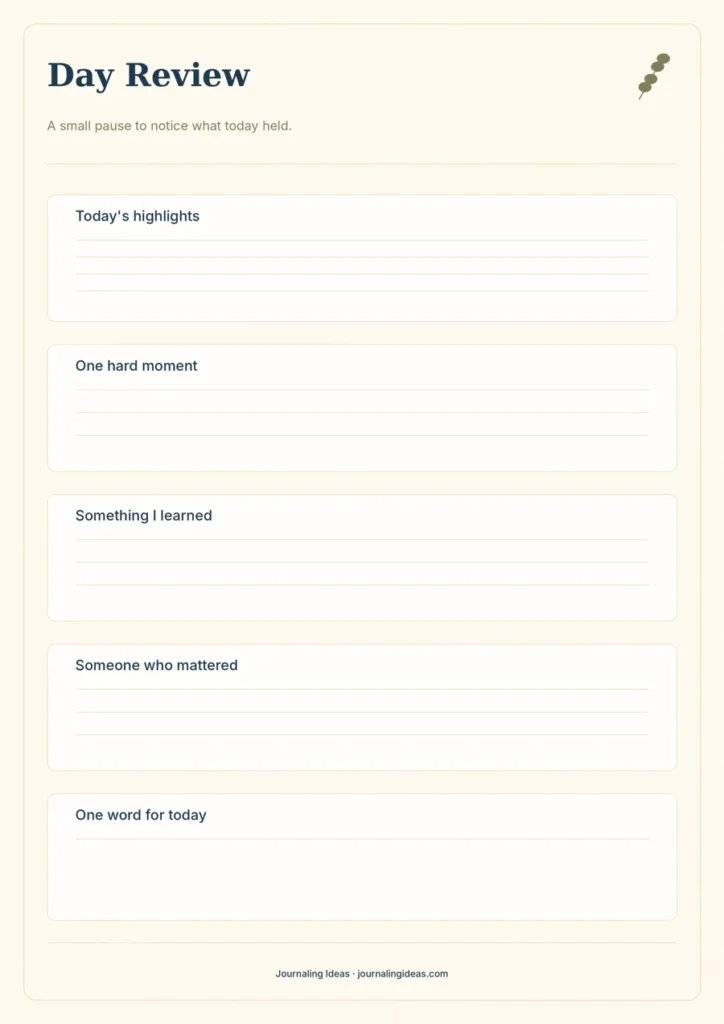
Sheet 2 — Day Review: fields for today’s highlights, one hard moment, something you learned, someone who mattered, and one word for today. If you enjoy this kind of quick daily record, our tracking journal ideas show more simple things you can keep track of in the same way.
Sheet 3 — Let It Go List: a lined page headed “Things to set down tonight:” for writing down loose ends.
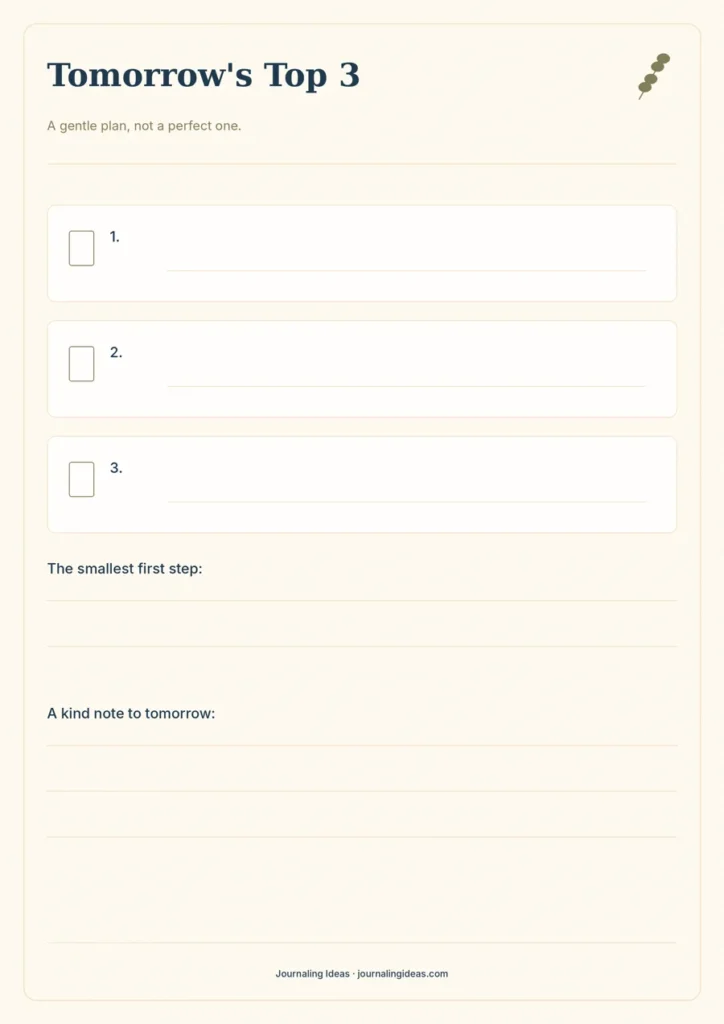
Sheet 4 — Tomorrow’s Top 3: three priority boxes (one for each of your top three priorities tomorrow), a line for the smallest first step, and a short space for a kind note to tomorrow.
You don’t have to turn every entry into an action plan.

How Do You Print the Evening Pages Pack?
- Download the sheets from The Small Pages Library.
- Choose A4 or US Letter to match your printer.
- Print one sheet at a time or print the whole pack.
- Use plain paper, or a slightly heavier paper if you prefer a nicer feel.
- Keep the sheets with your journal, or clip them together and keep them beside your bed.
You can print the pages again whenever you need another copy.
The Small Pages Library now contains 503 free PDF files across 70 bundles, including this new Evening Pages Pack. You don’t need to join an email list or enter a password to access the pack.
If you enjoy winding down with a few lines at night, try our morning journal prompts when the next day begins. The article offers 30 gentle questions for clearing your mind, noticing small good things, and choosing an intention. There is also a free four-sheet Morning Journal Starter Pack in A4 and US Letter, so you can keep your morning and evening routines simple.
Frequently Asked Questions About Evening Journal Prompts
What are evening journal prompts?
Evening journal prompts are short, gentle questions that help you reflect on the day before bed. They give you a starting point so you don’t have to face a blank page, and they keep the writing short — usually a few sentences per question.
How long should evening journaling take?
About ten minutes is enough for most people. Choose one to three prompts, write a few sentences for each, and end with one small intention for tomorrow. If you only have two minutes, one sentence still counts.
What should I write about in the evening?
Write about what happened today, what mattered, and what is still on your mind. You might describe a small moment, something you are grateful for, a loose end you want to set down, or one kind thing you want to do tomorrow.
Is it better to journal in the morning or the evening?
Neither is better — they simply serve different purposes. Morning writing often looks ahead, while evening writing looks back at what happened. Try both if you like, or choose the time that fits your day.
Do I need a special journal for evening journaling?
No. Any notebook and pen will work, and the free Evening Pages Pack gives you four printable sheets if you prefer a little structure: the 30 prompts, a Day Review, a Let It Go List, and Tomorrow’s Top 3.
What if I don’t know what to write?
Start with the simplest question: what happened today? Or pick any prompt from the list and write the first honest sentence that comes to mind. There are no wrong answers, and you can skip any prompt that doesn’t fit your day.
What Should You Remember About Evening Journaling?
Evening journaling is a gentle way to close the day.
Choose one to three prompts. Write honestly. Set down what is still on your mind. Choose one small, kind thing for tomorrow. And once a week, the same close-down works at a bigger scale in our sunday reset journal.
There is no requirement to write every night. Some evenings will offer plenty to reflect on, while others may call for just one sentence.
A few quiet lines at the end of the day can be enough.
For the same noticing in the middle of the day — not just at the end of it — our mindfulness journal prompts practise coming back to the present moment in two to five minutes.
Small pages. Meaningful days.
— Journaling Ideas Editorial Team



6 Comments