
Easter Journal Prompts: 30 Gentle Ideas for New Beginnings, Memories, and Hope
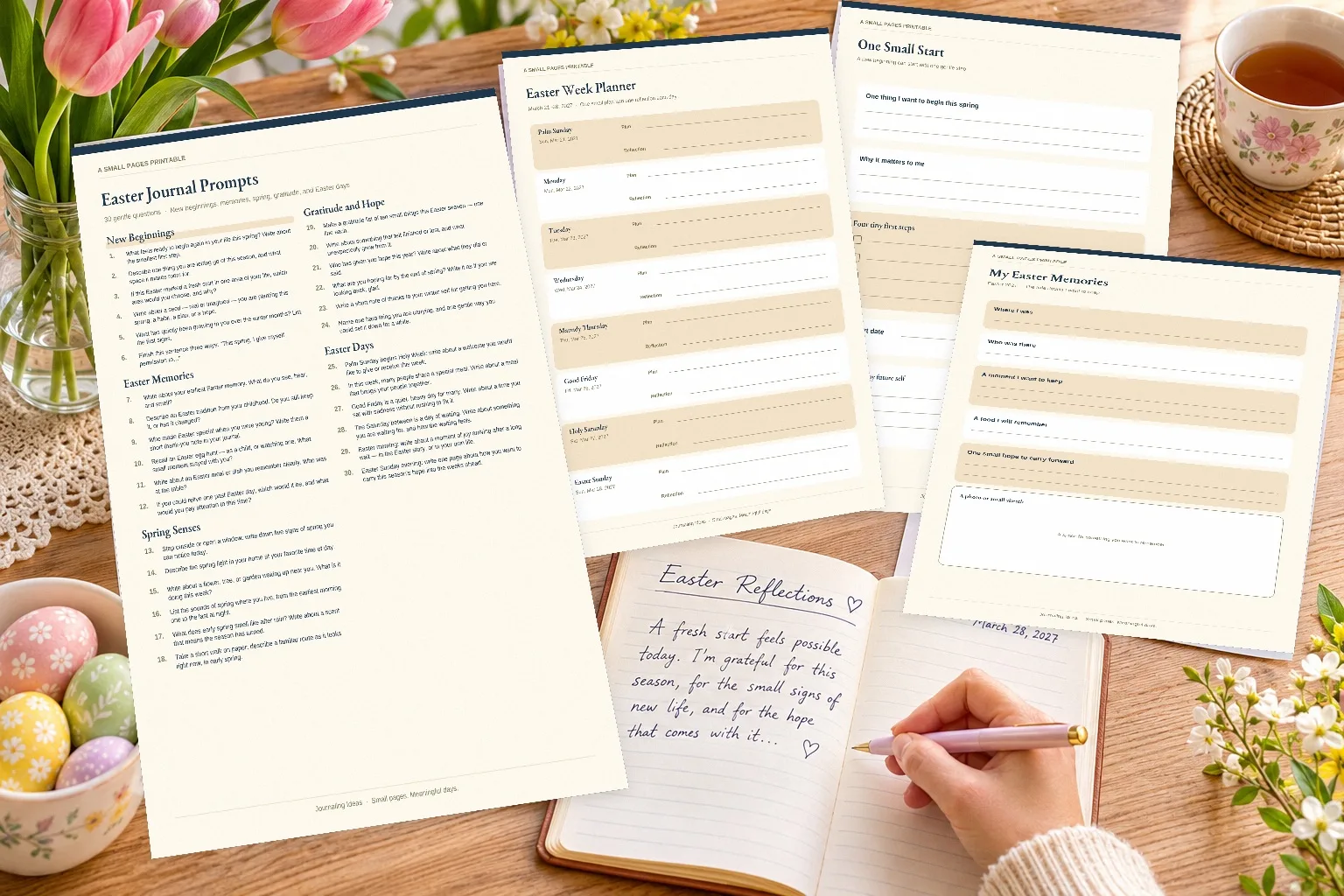
Easter journal prompts are gentle writing questions for reflecting on renewal, memories, gratitude, hope, and the arrival of spring. These 30 ideas invite you to write a few honest lines, whether you celebrate Easter as a religious holiday, gather with family, or simply notice a new season. A free four-sheet printable pack helps you begin.
Easter can hold many things at once: first flowers, familiar dishes, meaningful services, family gatherings, and quiet memories. You do not need to fit them all into one story.
These 30 Easter journal prompts come in five sets of six, from new beginnings and memories to spring senses, gratitude, and Holy Week. Choose any question and write a sentence or two. The free four-sheet Easter Journal Pack comes in A4 and US Letter.
What Are Easter Journal Prompts?
Easter journal prompts offer a starting point for seasonal writing. A memory, a morning sound, someone you appreciate, or a hope for spring can become a first sentence.
Some cover meals and egg hunts; others follow Holy Week. Many also suit a personal or seasonal celebration. Use what fits, and skip the rest.
This is a gentle personal reflection practice for the season, not therapy. You do not need to follow any religious observance to use these prompts, and you never need to write about something that feels too private or difficult. Your notebook is allowed to be a quiet place without a particular outcome.
When Is Easter in 2027?
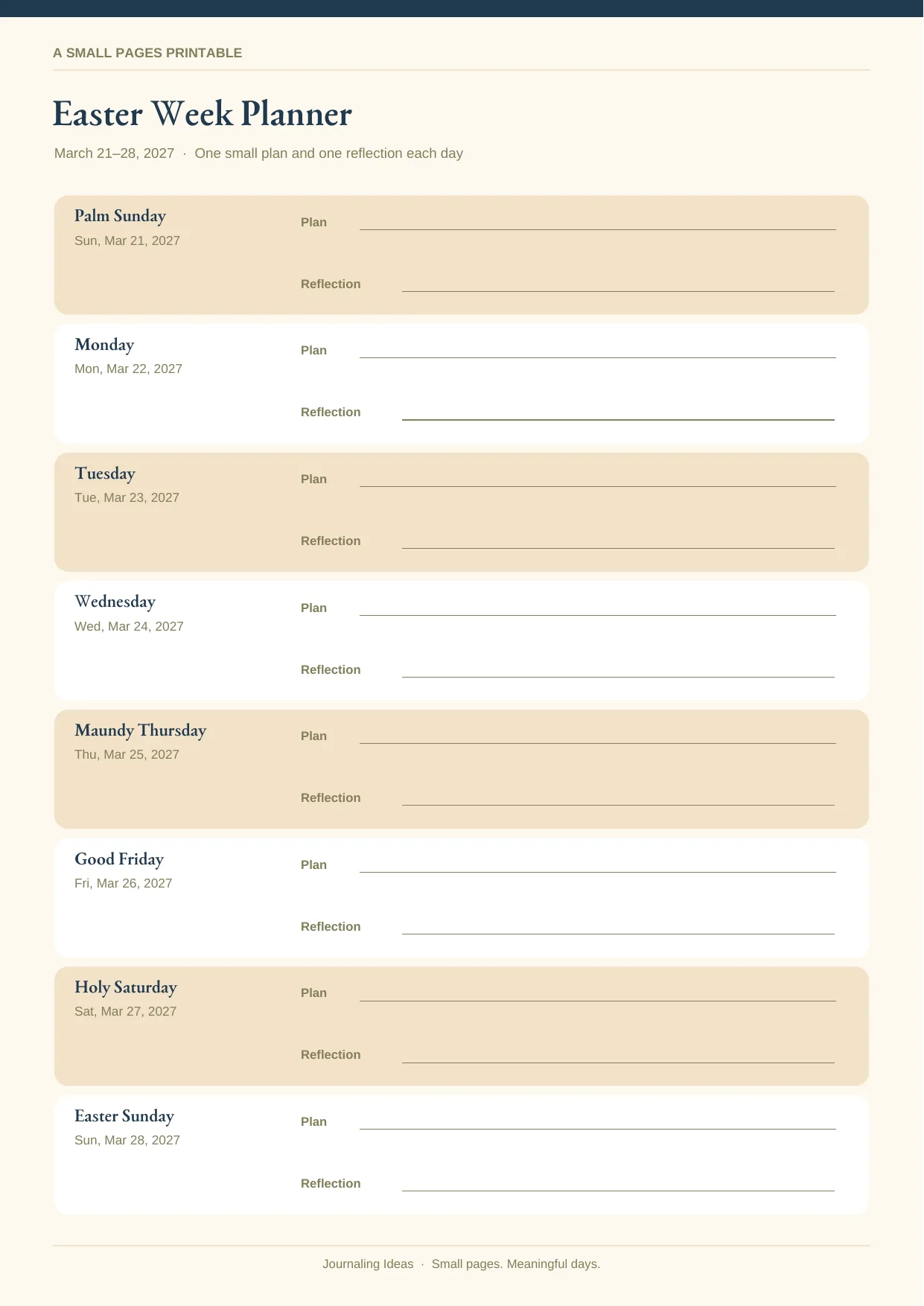
Easter Sunday in 2027 is Sunday, March 28. Holy Week runs from Sunday, March 21, through Sunday, March 28, 2027. Palm Sunday is March 21, Maundy Thursday is March 25, Good Friday is March 26, Holy Saturday is March 27, and Easter Sunday is March 28.
The Easter Week Planner offers a plan line and a reflection line for every day. Start before Palm Sunday, on Easter morning, or in the quieter week afterward.
Easter falls in March in 2027, so you may also like our March journal prompts for another way to notice the month as it unfolds.
How to Use These Easter Journal Prompts
Begin anywhere. These are not tasks to finish in order. Choose memory, spring, or hope according to your mood. The numbering only helps you find your place; skipping is fine.
Write for a few minutes. Three to five minutes can be enough. A sentence, a list, or a sketch with a caption counts. Follow a longer story only if you want to.
Use the page you have. A notebook or scrap paper works. Add a date if you like, then revisit the question later to see what changed.
Make it your own. These inclusive prompts work whether Easter means faith, family, or spring to you. Adapt a question or choose another if it does not fit your experience. Messy counts.
30 Easter Journal Prompts to Try This Spring
These are the exact questions from the printable list. Each includes a small nudge to help you begin; you do not have to answer all 30.
New Beginnings
New beginnings do not need to be dramatic. A small shift in what you notice, a decision you are curious about, or a tiny habit can all belong on the first spring page. These questions are for beginnings that feel possible rather than impressive.
1. What feels ready to begin again in your life this spring? Write about the smallest first step.
Gentle nudge: You might begin with something as ordinary as clearing one small corner or sending one message.
2. Describe one thing you are letting go of this season, and what space it makes room for.
Gentle nudge: You do not have to make a grand declaration. Notice the room that one quiet change creates.
3. If this Easter marked a fresh start in one area of your life, which area would you choose, and why?
Gentle nudge: Choose an area that matters to you, rather than the one you think you should improve.
4. Write about a seed — real or imagined — you are planting this spring: a habit, a plan, or a hope.
Gentle nudge: Give that seed a name. A small, specific beginning is enough for this page.
5. What has quietly been growing in you over the winter months? List the first signs.
Gentle nudge: Look for small changes in attention, energy, or the way you speak to yourself.
6. Finish this sentence three ways: “This spring, I give myself permission to…”
Gentle nudge: Let each ending be different. There is no need to choose a favorite.
Easter Memories
Easter memories often live in little details: a familiar meal, the feel of the weather, the people around a table, or the excitement of looking for eggs. Your memories might be joyful, complicated, or very ordinary. Write what is true for you.
7. Write about your earliest Easter memory. What do you see, hear, and smell?
Gentle nudge: Start with one detail before you try to tell the whole story.
8. Describe an Easter tradition from your childhood. Do you still keep it, or has it changed?
Gentle nudge: A tradition can change shape and still matter. Write about both versions if you like.
9. Who made Easter special when you were young? Write them a short thank-you note in your journal.
Gentle nudge: Your note can stay private. Try naming one thing they gave you.
10. Recall an Easter egg hunt — as a child, or watching one. What small moment stayed with you?
Gentle nudge: If egg hunts were not part of your life, describe one you witnessed or imagined.
11. Write about an Easter meal or dish you remember clearly. Who was at the table?
Gentle nudge: A smell, a chair, or a familiar voice might bring the scene into focus.
12. If you could relive one past Easter day, which would it be, and what would you pay attention to this time?
Gentle nudge: Consider an ordinary detail you did not understand was important at the time.
Spring Senses
There is no single picture of spring. Some places still feel cold around Easter; others are already warm and green. These prompts encourage you to describe the season you actually see, hear, and smell, instead of one from a greeting card.
13. Step outside or open a window: write down five signs of spring you can notice today.
Gentle nudge: Do not worry if your spring looks different from the pictures. Notice what is truly there.
14. Describe the spring light in your home at your favorite time of day.
Gentle nudge: Watch where a patch of light lands and how it changes through the day.
15. Write about a flower, tree, or garden waking up near you. What is it doing this week?
Gentle nudge: You can follow one bud, branch, or patch of grass instead of a whole garden.
16. List the sounds of spring where you live, from the earliest morning one to the last at night.
Gentle nudge: Listen for birds, rain, traffic, people, or the quiet between them.
17. What does early spring smell like after rain? Write about a scent that means the season has turned.
Gentle nudge: If it has not rained recently, write from a memory of that first fresh smell.
18. Take a short walk on paper: describe a familiar route as it looks right now, in early spring.
Gentle nudge: Stay with the real route, even if you only travel it in your imagination today.
Gratitude and Hope
Hope and gratitude can share a page without asking you to pretend that everything is easy. You can appreciate a small comfort and still name a difficult day. Let these six questions hold both realities gently.
19. Make a gratitude list of ten small things this Easter season — one line each.
Gentle nudge: Everyday comforts count. Give each one its own line.
20. Write about something that felt finished or lost, and what unexpectedly grew from it.
Gentle nudge: You do not have to call the difficult thing good to notice what came afterward.
21. Who has given you hope this year? Write about what they did or said.
Gentle nudge: This may be someone close to you, a stranger, or a person whose words you read.
22. What are you hoping for by the end of spring? Write it as if you are looking back, glad.
Gentle nudge: Imagine one possible good outcome, without asking yourself to guarantee it.
23. Write a short note of thanks to your winter self for getting you here.
Gentle nudge: Thank yourself for one specific ordinary effort that carried you through.
24. Name one hard thing you are carrying, and one gentle way you could set it down for a while.
Gentle nudge: Make the gesture small enough to try today, even for a few minutes.
Easter Days
For many Christians, Holy Week follows a meaningful path from Palm Sunday to Easter Sunday. These questions reflect its themes of welcome, shared meals, sorrow, waiting, and joy, but you can answer them through your own experience whether or not you practice the faith.
25. Palm Sunday begins Holy Week: write about a welcome you would like to give or receive this week.
Gentle nudge: Think of a doorway, message, invitation, or simple act of making room.
26. In this week, many people share a special meal. Write about a meal that brings your people together.
Gentle nudge: It could be a holiday table or a regular meal that feels like home.
27. Good Friday is a quiet, heavy day for many. Write about a time you sat with sadness without rushing to fix it.
Gentle nudge: Only write what feels safe to share with your page; a few words are enough.
28. The Saturday between is a day of waiting. Write about something you are waiting for, and how the waiting feels.
Gentle nudge: There is no need to turn waiting into a lesson. Describe what it is like.
29. Easter morning: write about a moment of joy arriving after a long wait — in the Easter story, or in your own life.
Gentle nudge: You can write from faith, memory, or a personal experience of relief.
30. Easter Sunday evening: write one page about how you want to carry this season’s hope into the weeks ahead.
Gentle nudge: Choose one hope you can bring into an ordinary day after the holiday.

How to Use the Free Easter Journal Pack
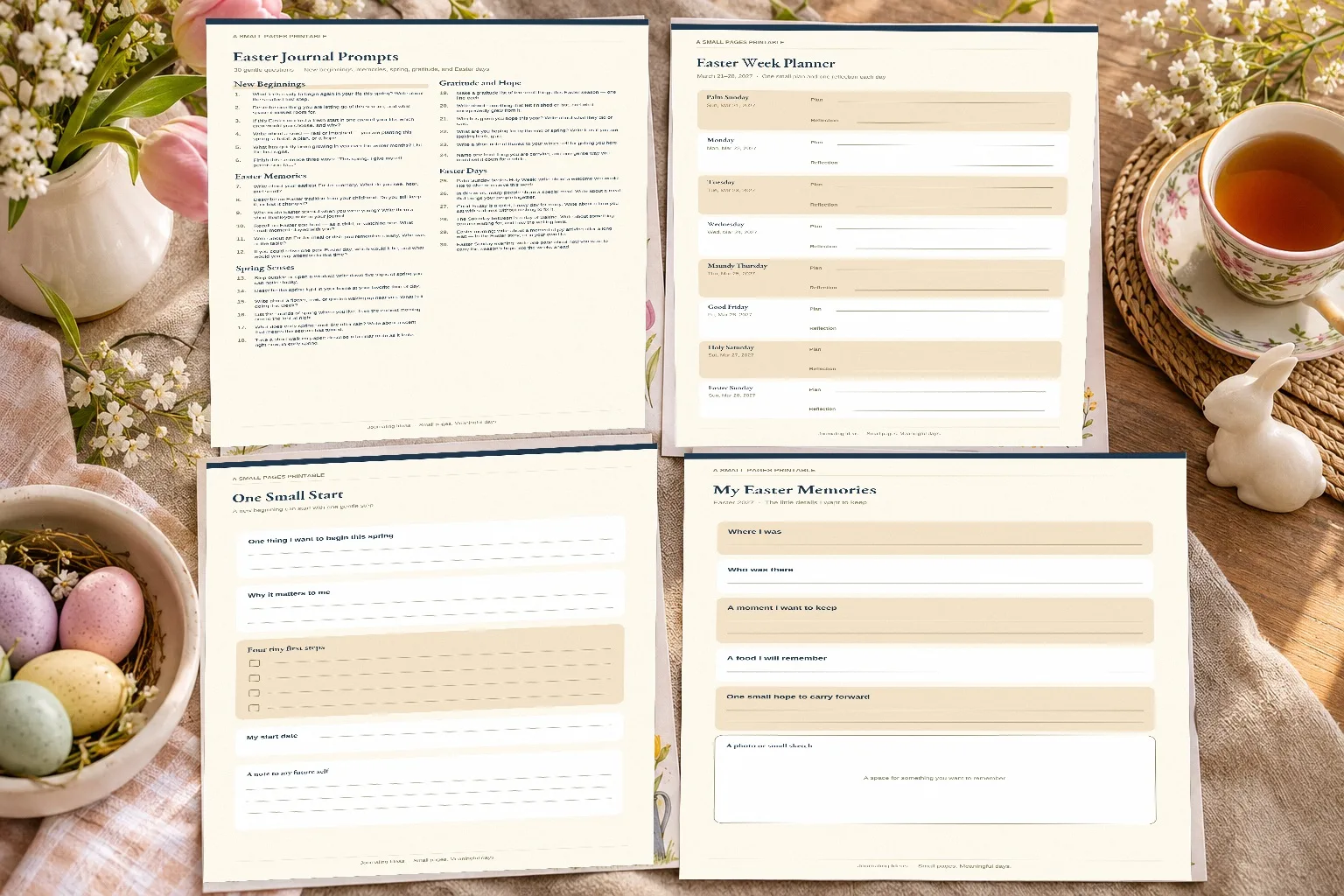
The Easter Journal Pack gives these reflections a simple home on paper. It includes four different sheets, with each design available as an A4 PDF and a US Letter PDF: eight files in total. The pack is free in The Small Pages Library, with no signup or password needed. You can choose only the sheet you want or print all four together.
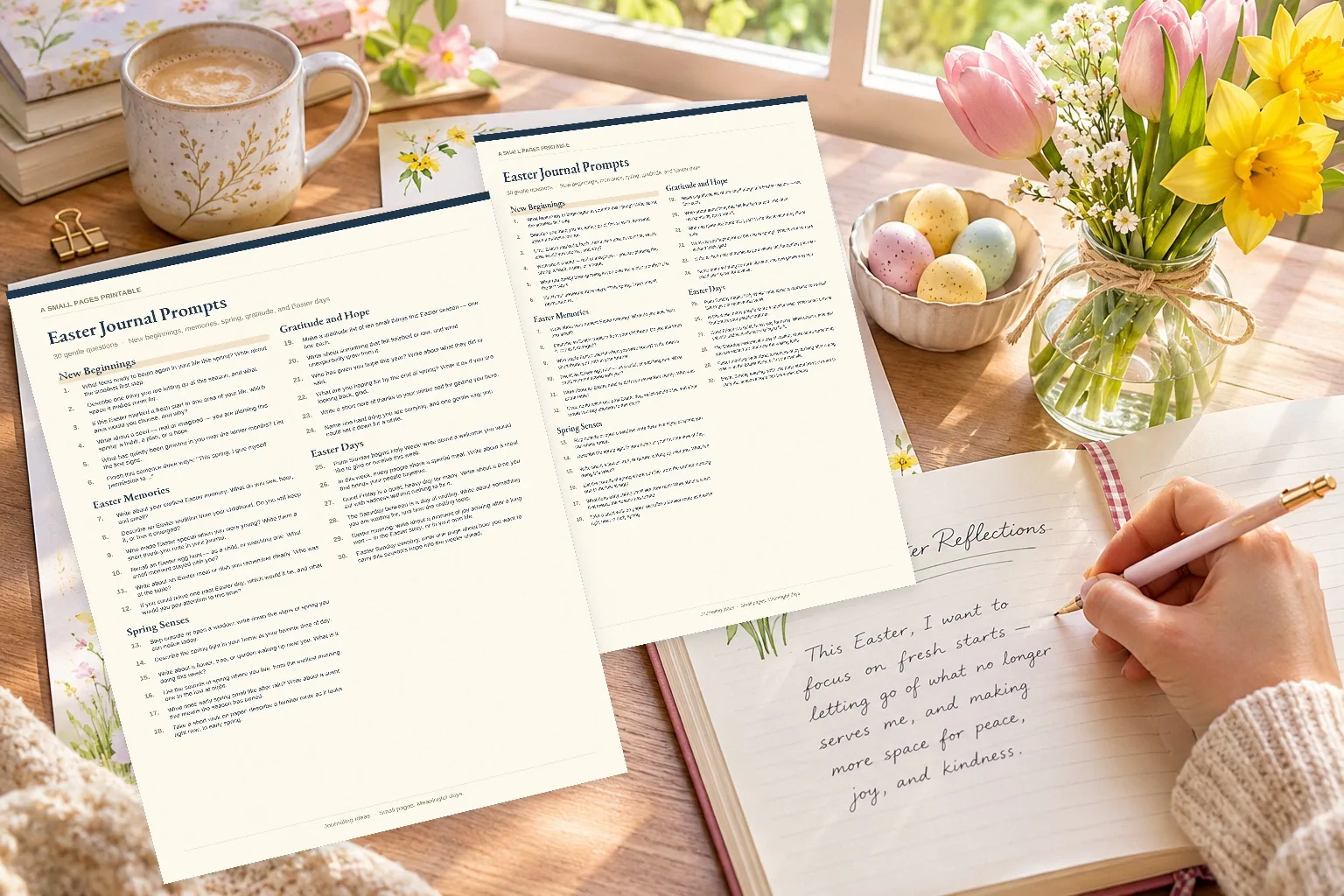
Sheet 1 — Easter Journal Prompts. The 30 questions appear in their five themed groups. Keep the page beside your journal, circle a question, or return whenever you need a starting point. There is no required order.
Sheet 2 — Easter Week Planner. Eight rows run from Palm Sunday, March 21, to Easter Sunday, March 28, 2027. Add one plan and one reflection each day. The plan might be a visit, meal, service, or quiet writing time. Save one detail from the day in the reflection line.
Sheet 3 — One Small Start. Name a beginning, explain why it matters, write four tiny first steps, pick a start date, and leave a note to your future self. A step may be as simple as opening a notebook. You can begin with just one.
Sheet 4 — My Easter Memories. Record where you were, who was there, one moment, a food you remember, and a hope to carry forward. The framed area holds a photo or small sketch. A quiet holiday is worth remembering too.



- Sheet 1 — A4 (PDF)
- Sheet 1 — US Letter (PDF)
- Sheet 2 — A4 (PDF)
- Sheet 2 — US Letter (PDF)
- Sheet 3 — A4 (PDF)
- Sheet 3 — US Letter (PDF)
- Sheet 4 — A4 (PDF)
- Sheet 4 — US Letter (PDF)
Print the prompts ahead of time, use the planner during Holy Week, and fill in the memory page afterward—or use only one sheet this year.
If you enjoy journaling alongside the season beyond Easter, our spring journal prompts offer more ways to notice changes outside and within. For another gentle writing direction, the gratitude journal prompts can help you give ordinary good things a little space.
How to Print Your Easter Journal Pages
Choose US Letter (8.5 × 11 inches) for most home printers in the United States or A4 (210 × 297 mm) if that is your usual paper size. Each sheet is designed as a separate, single-page PDF. Open the version that matches your paper, select that size in the print dialog, and use Actual size / 100% when possible. If your printer has a particularly narrow printable area, use its fit-to-printable-area option instead and check the preview first.
Plain paper and any pen or pencil are enough. Keep pages loose or in a folder. Print in color for the warm details, or grayscale to save ink.
Print the list once, then add only the pages you expect to use. If family members join you, each can write or draw in their own way.
Frequently Asked Questions
When is Easter in 2027?
Easter Sunday is March 28, 2027. Holy Week runs from Palm Sunday, March 21, through Easter Sunday, March 28. Good Friday falls on March 26. If you are journaling by day, the Easter Week Planner gives you all eight dates in order.
What are Easter journal prompts?
They are writing questions about the Easter season. These 30 prompts cover fresh starts, remembered Easter celebrations, springtime details, gratitude, hope, and moments connected with Holy Week. You can answer them in a notebook or use the printable prompt list to choose a question.
Do Easter journal prompts have to be religious?
No. Easter has religious meaning for many people, and some prompts acknowledge Holy Week, but the collection can also be used for family memories or a spring reflection practice. Choose questions that fit your life. There is no need to follow a religious observance to write.
When should I start Easter journaling?
Whenever it feels useful. You can begin before Holy Week, write one line a day from March 21 to March 28, or reflect afterward. You are welcome to start with just one Easter memory or one question about a new beginning. Nothing needs to be completed on time.
What do I need to start an Easter journal?
Just something to write on and something to write with. A notebook and pen are enough. If you prefer a little structure, print the prompt list and use the week planner, new-beginnings worksheet, or memories page. Decorations and special supplies are optional.
Is the Easter Journal Pack free?
Yes. All four sheets are free, each in A4 and US Letter, making eight downloadable PDFs. The pack is available with no email signup or password. You can print one sheet or the complete set for your own journaling.
One Small Page for the Season Ahead
You do not need a beautifully filled notebook. A line about a flower, a remembered voice, or one hope may be enough. Return whenever you like.
Choose one question that caught your attention, or print a page from the free pack and begin there. Let the season be as full or as quiet as it actually is.
Small pages. Meaningful days.
— Journaling Ideas Editorial Team



One Comment