
Journal Prompts for Self-Care: 40 Gentle Questions to Check In With Yourself
Journal prompts for self care are simple questions that help you notice how you feel, what is draining or restoring you, and what support you need today. This collection offers 40 gentle questions in four groups: checking in, resting and refilling, kinder self-talk, and boundaries. Choose one prompt; you do not need to answer all 40.
Some days, you might know exactly what you need. Other days, it can help to slow down and put a few thoughts on paper.
These questions are designed to give you a starting point without making self-care feel like another task on your list.

How to Use These Journal Prompts for Self-Care
You don’t need a special journal, a perfect routine, or a lot of free time. A notebook and a few quiet minutes are enough.
Here is a simple way to begin:
Choose one prompt. Pick a question from the group that feels closest to what you need today.
Set aside 5–10 minutes. Give yourself a little uninterrupted time, if possible.
Write honestly. Use complete sentences, short phrases, or a simple list. There is no required format.
Skip what doesn’t fit. You are not expected to answer every question or write about something you would rather leave alone.
Finish when you’re ready. You can close your journal without finding a solution to everything.
You can return to the same question on another day and notice whether your answer has changed.
40 Journal Prompts for Self-Care
The prompts below are divided into four groups. Start with whichever section feels most relevant to your day.
1. Check In With Yourself
Before deciding what you need to change, give yourself a moment to notice where you are. These questions are about being honest with yourself, naming what is on your mind, and recognizing how today actually feels.
- What feeling has been closest to the surface today, and when did you first notice it?
- What has taken up the most space in your thoughts this week?
- Which part of today feels manageable, and which part feels heavier?
- What have you been telling yourself is “fine” that deserves a more honest look?
- What do you need more of in this moment: quiet, company, movement, clarity, or something else?
- Where in your day have you felt most like yourself?
- What is one thing you have been carrying that you have not said out loud?
- What is your body asking you to notice right now—tension, hunger, tiredness, or ease?
- What would you like someone to understand about how today has felt?
- If you could describe your current season in three honest words, what would they be, and why?
2. Rest and Refill
Self-care isn’t always about adding another activity to your routine. Sometimes it means recognizing when you need a pause, noticing what uses your energy, and making room for ordinary things that help you feel settled.
- What kind of tired are you feeling today: physical, mental, emotional, or a mix?
- Which small pause would make the next hour feel gentler?
- What activity leaves you feeling steadier rather than simply busier?
- When did you last rest without trying to earn it first?
- What can you postpone, simplify, or leave unfinished today?
- Which ordinary comfort helps you feel settled—fresh air, a warm drink, music, or something else?
- What usually drains your energy more than you expect?
- What is one realistic way to make room for rest in the next 24 hours?
- What do you enjoy doing slowly, without needing a result?
- If your energy had a weather forecast today, what would it be telling you to plan for?

3. Kinder Self-Talk
The way you speak to yourself matters when you are having a difficult day or making mistakes. These questions help you notice your inner voice, acknowledge your efforts, and consider a kinder response without pretending everything is perfect.
- What would you say to a friend who was facing the same situation?
- Which effort have you made recently that you have barely acknowledged?
- What mistake can you look at as information rather than proof that you failed?
- What expectation could you soften without giving up what matters?
- What is one thing you handled in a way that deserves some credit?
- When your inner voice gets sharp, what kinder and more accurate words could replace it?
- What part of yourself have you been comparing with someone else’s highlight reel?
- What would it look like to let “good enough” be enough for this one task?
- Which quality has helped you through a difficult or ordinary day?
- What are you learning to accept about being human?
4. Boundaries and Needs
Looking after yourself can also mean recognizing your limits. These questions explore where you might need to say no, ask for help, communicate more clearly, or protect some time for yourself.
- Where have you said yes when you wanted to pause or say no?
- What request or task needs a clearer limit around your time or energy?
- What would you like to ask for but have found hard to put into words?
- Which responsibility is yours to carry, and which part belongs to someone else?
- What is one kind way to say no without giving a long explanation?
- What time or space would you like to protect this week?
- Who could you ask for practical help, and what specific help would you request?
- What do you need others to know about your availability right now?
- Which boundary would make one part of your day feel more manageable?
- What is one small choice you can make today that respects what you need?
How Can You Make Self-Care Journaling a Gentle Habit?
You don’t have to write every morning or fill several journal pages to make this practice part of your routine.
Try one of these simple approaches:
A morning check-in: Choose a question from the Check In With Yourself group before starting your day.
An afternoon pause: Use a Rest and Refill question when you want to slow down and notice your energy.
An evening reflection: Choose a Kinder Self-Talk question to acknowledge your efforts and experiences.
A weekly boundary check: Use one of the Boundaries and Needs questions when planning the days ahead.
You can also keep the printable somewhere visible and choose a different question whenever you feel like writing.
The important thing is to keep the practice flexible. Missing a day doesn’t mean you have failed or need to catch up.
Some days, even a small self-care routine can feel like too much. If you would rather begin with one question, our journal prompts for anxiety offer 30 gentle ideas for grounding, self-compassion, and taking small steps. There is also a free two-sheet printable list in A4 and US Letter, so you can choose a question whenever you want to write.
Common Mistakes to Avoid When Journaling for Self-Care
A few small adjustments can make journaling feel more comfortable.
Trying to answer every prompt: The list is a collection of choices, not a 40-question assignment. One question is enough for a short session.
Waiting for the perfect words: You can write fragments, unfinished thoughts, or a few honest sentences. Your journal doesn’t need to sound polished.
Forcing yourself to be positive: Not every day feels good. You can acknowledge disappointment, tiredness, frustration, or uncertainty without trying to turn every experience into a lesson.
Turning reflection into another responsibility: If writing starts feeling like something you must complete, take a break. You can return when it feels useful.
Ignoring your limits: You don’t have to answer a question that feels uncomfortable or too personal. Skipping a prompt is perfectly fine.
A Gentle Note About Journaling and Emotional Well-Being
Journaling is a personal reflection practice. It can provide a space to put thoughts into words, but it is not medical care or mental-health treatment, and it cannot replace professional support.
If you are struggling, experiencing ongoing emotional distress, or finding daily life difficult to manage, consider talking with a qualified mental-health professional.
You can also stop writing whenever a question feels too difficult. Your well-being matters more than completing a journal exercise.
Frequently Asked Questions
How many self-care journal prompts should I answer at once?
One prompt is enough. You can choose another if you have more time, but there is no requirement to complete all 40 questions.
How long should I spend answering a journal prompt?
Start with 5–10 minutes. You can write for less time if that is what works for you. The aim is to give yourself a little space to reflect, not to meet a writing target.
What if I don’t know what to write?
Read the question again and begin with whatever comes to mind. A few words or an unfinished sentence are perfectly acceptable. You can also choose a different prompt.
Can I use these prompts in a digital journal?
Yes. You can type your answers into a digital journal, notes app, or document. The questions work just as well without a printed notebook.
Do I need to answer all four groups?
No. The groups are organized by different areas of self-care so you can find a relevant question more easily. Use the sections that feel useful and leave the others for another day.
Can journaling replace therapy or professional mental-health support?
No. Journaling is a personal reflection activity, not a substitute for professional assessment, advice, or treatment. If you are struggling, speak with a qualified professional.
Download the Free Self-Care Journal Prompts Printable
Want to keep all 40 questions somewhere easy to find?
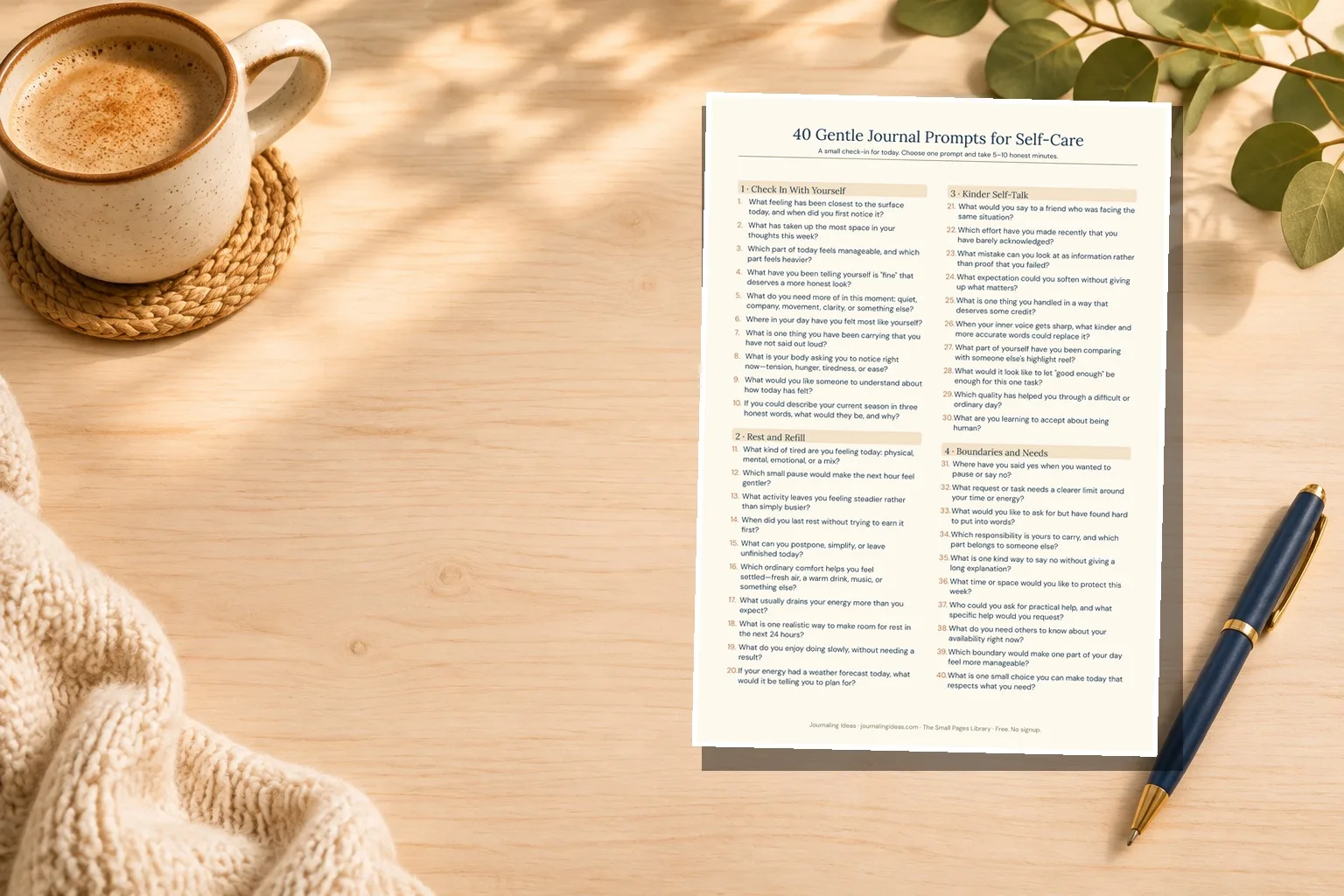
The one-page 40 Journal Prompts for Self-Care printable brings all four groups together: Check In With Yourself, Rest and Refill, Kinder Self-Talk, and Boundaries and Needs.
You’ll find both A4 and US Letter PDF versions in The Small Pages Library.
It’s completely free. No signup. Simply visit the library and choose the printable.
You can print the page, keep it beside your journal, or use it as a reference when you need a question to get started.
If you’re looking for another gentle reflection practice, you can also explore our gratitude journal prompts.
A little time spent listening to yourself is enough for one page today. You don’t need a perfect routine or perfect words.
For a heavier season — after a loss, a heartbreak or burnout — our journal prompts for healing take it one gentle stage at a time.
Small pages. Meaningful days.



4 Comments