
Journal Prompts for Anxiety: 30 Gentle Questions
Journaling prompts for anxiety are gentle questions that help you put a few words around what is happening, notice the present moment, and consider one small next step. You do not have to explain every feeling or fill a whole page. Choose one question, write what you can, and stop whenever you like.
Some days, your thoughts feel louder than the room around you. You might be thinking about tomorrow, replaying a conversation, or feeling unsettled without knowing exactly why. On days like these, even deciding what to write can feel like another thing to do.
This collection offers 30 gentle journal prompts for anxiety, grouped into six small sections. Some invite you to notice what is around you. Others offer space for difficult feelings, kinder self-talk, everyday worries, and manageable next steps. There is also a free two-sheet printable prompt list, available in A4 and US Letter, so you can keep the questions nearby without searching for them again. You do not need to use all 30. One question might be enough for today.
How can you start journaling when you feel anxious? Begin with something small and familiar. Open a notebook, choose a question that feels comfortable, and write one or two sentences. You can start with what is happening around you rather than describing your worries. If the first question does not fit, choose another. If words feel difficult, a short list or a single word is fine. The point is not to produce a beautiful page or force yourself to feel differently. It is simply to give yourself a little room to write.
A gentle note: These prompts are intended for personal reflection, not as medical advice, diagnosis, or treatment. Journaling is not a substitute for professional mental health support. If anxiety is making everyday life difficult, a qualified health professional can help you explore appropriate support. And if a prompt feels upsetting or uncomfortable, you can always skip it or close the notebook.


What grounding journal prompts can you try when your thoughts feel busy?
These first five questions focus on ordinary details in the present. You do not need to work through the past or think about tomorrow.
1. What is one ordinary thing I can see around me right now?
Look for something simple, such as a mug, a window, or a book. Describe its color, shape, or position without giving it a deeper meaning.
2. Which sound feels neutral or familiar in this moment?
You might notice a fan, distant traffic, rain, or the quiet of your room. A familiar sound is enough; it does not have to feel especially peaceful.
3. What is supporting me physically where I am sitting or standing?
You could write about a chair, the floor, or a cushion. If noticing physical sensations does not feel comfortable, move to another question.
4. What small detail in this space deserves a little attention?
Perhaps there is a pattern on the wall or a patch of afternoon light. Let yourself describe one detail without turning it into a task.
5. What is true about this present moment, without predicting the next one?
Keep your answer close to what you know. For example, you might be sitting at your desk, holding a pen, or taking a brief pause.
What can you write when your feelings are hard to explain?
You do not have to understand every feeling before you write about it. These questions offer a way to acknowledge what is present without demanding an explanation.
6. If today’s feelings had a few simple words, what would they be?
Choose words that seem close enough, even if they do not describe everything. Tired, restless, uncertain, and hopeful can all belong on the same page.
7. What seems to be asking for my attention today?
Name one concern, thought, or feeling. You do not need to make a complete list of everything on your mind.
8. What can I acknowledge without needing to explain or fix it?
You might write, “This feels difficult today,” and leave it there. Some thoughts do not need a solution on the same page.
9. What feels uncertain, and what do I actually know so far?
Try making two short lines: one for the uncertainty and one for what you know. It is fine if the second line is brief.
10. What feeling could I name and then leave unfinished for now?
Choose a feeling you can gently recognize without exploring its whole story. The page can end before the feeling changes.

What self-compassion journal prompts can you use on difficult days?
When you are already carrying a lot, it can be easy to add more pressure with thoughts about what you should be doing. These five prompts are invitations to speak to yourself with a little more kindness.
11. If I spoke to myself as I would to someone I care about, what might I say?
Write one sentence you might offer someone having a difficult day. It can be plain and practical rather than cheerful.
12. Which expectation could I soften for today?
Consider something that does not need to be done perfectly. Perhaps a shorter version, a later time, or a simpler approach would be enough.
13. What have I been doing that deserves credit, even if it seems small?
This could be showing up, asking a question, making a meal, or getting through an ordinary responsibility. You do not have to turn it into a big achievement.
14. What can remain unfinished without changing my worth?
Think of a task, decision, or plan you have been using to measure yourself. An unfinished item does not have to become a judgment about you.
15. What permission would I like to give myself this afternoon or evening?
Maybe you would like permission to rest, be quiet, change your plans, or not explain everything. Write the permission in your own words.
If you would like more everyday reflection ideas around rest, boundaries, and caring for yourself, explore our journal prompts for self-care.
How can you journal about worries without trying to solve everything?
Not every worry has an answer today. Some involve a practical decision; others involve uncertainty that cannot be resolved right now. The next five questions invite you to notice that difference without working through every possible outcome.
16. Which worry is closest to the surface right now?
Choose just one. A sentence is enough to name it, and you do not need to write down every possible thing that could happen.
17. Is there a practical part of this worry I can respond to today?
Perhaps there is a message to send or a detail to check. If there is nothing useful to do today, “not right now” is a complete answer.
18. What part of this situation is not mine to decide today?
Think about what depends on another person, future information, or circumstances beyond your immediate choices. You can recognize those limits without approving of the uncertainty.
19. What information would I need before deciding anything?
List only the information that would genuinely matter. You do not have to find it immediately or keep researching until you feel certain.
20. Where could I set this question down until I have more clarity?
You might leave a note for another day, write a reminder, or simply close the page. Not every open question needs to stay in front of you.
What small-step journal prompts can make a busy day feel more manageable?
When several things need attention, you may not have room to think about the entire day at once. These questions are about choosing a smaller piece, including the option to do less.
21. What is one manageable task I could make smaller?
Think of something on your list and imagine the simplest useful version. It might be opening a document rather than finishing it.
22. What would the very first minute of that task look like?
Describe one beginning. You are not promising to finish the task by writing this answer.
23. What could I postpone, delegate, or take off today’s list?
Look for something that does not need your attention now. It is okay if removing one item is your only decision.
24. What gentle choice might make the next hour a little easier?
Perhaps you would like a drink, a quieter place, a short break, or fewer things competing for your attention. Choose what fits your circumstances.
25. What would be enough for today, even if it looks different from my original plan?
Write a realistic ending point for the day. You can adjust it without having to justify the change.
What can you write when you need rest, comfort, or support?
You do not have to finish a journaling session with a plan. Sometimes the most useful ending is to notice what feels familiar, what kind of support you might want, or what you would like to leave on the page.
26. Where or with whom do I usually feel able to be myself?
This might be a familiar place, a person, a pet, or a quiet activity. If nothing comes to mind today, you can leave the question unanswered.
27. What kind of support could I ask for, if I wanted it?
Consider a small, specific request, such as company, help with an errand, or someone to listen. There is no requirement to make the request immediately.
28. Which familiar activity feels comforting or simply neutral right now?
It could be reading, folding laundry, listening to music, or sitting somewhere familiar. Neutral is a perfectly acceptable answer.
29. How would I like to close this journal page today?
You might write one final word, draw a small shape, add the date, or leave some white space. The page does not need a conclusion.
30. What is one kind thing I can carry into the next part of my day?
Choose a thought, a gentle intention, or a reminder that feels believable to you. It does not have to be positive or inspiring.
How to Use These Journal Prompts: A Five-Minute Routine
You can make this a short, flexible practice rather than another daily obligation.
- Find a place to write. Use a notebook, a loose piece of paper, or a notes app. You do not need a special journal.
- Choose one question. If your thoughts feel particularly busy, a present-moment question from prompts 1–5 may be an easier place to begin.
- Write for a few minutes. Try one to three sentences, a list, or a few words. You can pause naturally; there is no need to follow a special breathing pattern.
- Notice whether you want to continue. If another thought feels worth writing, add it. Otherwise, stop. A short entry is still an entry.
- Put the page aside. You can return to it later or leave it as it is. You do not have to reread, analyze, or fix anything.
Five minutes is an optional starting point, not a rule. Some days you might write for thirty seconds. On other days, you may not want to write at all.
For broader questions about your values, preferences, and what matters to you, our journal prompts for self-discovery offer another direction to explore whenever you feel ready.
Where Can You Get the Free Journal Prompts for Anxiety Printable?
If you would rather choose a question from a printed page, we have put all 30 prompts into a free two-sheet printable list.
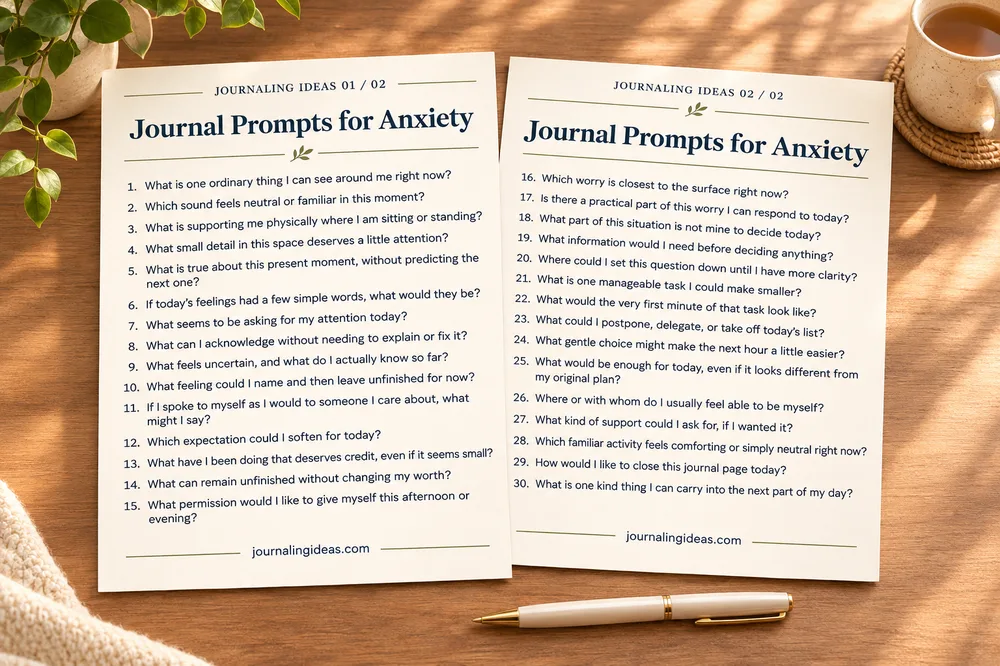
Free Printable — 30 Journal Prompts for Anxiety. The printable includes: Sheet 1: Questions 1–15; Sheet 2: Questions 16–30; A4 format for A4 paper; US Letter format for 8.5 × 11-inch paper; The same questions as the article, without the extra guidance.
You can find the printable in The Small Pages Library. It is free, with no email signup or password required. You can print both sheets, keep one nearby, or return to the list digitally whenever you want a question to begin with.
Or download the sheets directly:
Sheet 1 — Questions 1–15 (A4)
Sheet 1 — Questions 1–15 (US Letter)
Sheet 2 — Questions 16–30 (A4)
Sheet 2 — Questions 16–30 (US Letter)
How to Print the Two-Sheet List
The two-sheet list is designed to be easy to print and keep in a folder, journal, or notebook. Open The Small Pages Library and choose the Journal Prompts for Anxiety pack. Select either the A4 or US Letter PDF. Open the file and select Print. Choose portrait orientation and check the page preview. Use Actual Size or 100% if the whole design fits. If anything is clipped, choose Fit to Printable Area instead. Print the two pages on ordinary paper. You can also leave the PDF on your phone or computer and write your answers somewhere else. There is no need for decorative supplies or a matching notebook. A plain page is enough.
If your worry runs in loops — the same moment replayed, the same conversation rehearsed — our journal prompts for overthinking were written for exactly that.
Frequently Asked Questions About Journal Prompts for Anxiety
What if I can only write one word?
One word is enough. You might write “uncertain,” “tired,” or “rest.” There is no minimum length and no need to explain your answer.
Do I have to use the 30 prompts in order?
No. Choose the question that feels most approachable. You can repeat favorite prompts, skip entire sections, or use the list in any order.
Do I need to write about what is making me anxious?
Not necessarily. You can write about a neutral object, a familiar activity, or a small practical choice instead. You get to decide what belongs on the page.
Can I use these prompts on days when I feel okay?
Yes. They are not limited to difficult days. You might use one to reflect on ordinary life, notice your preferences, or think about the week ahead.
What if a journaling question makes me feel more unsettled?
You can stop immediately, skip the question, or choose something more neutral. There is no benefit in forcing yourself to finish an uncomfortable entry.
Can I use these prompts on my phone instead of printing them?
Yes. You can read the list on your phone and type your answers into a notes app. The printable is an optional paper version, not a requirement.
A final thought: You don’t have to finish every thought. A journal can hold an unfinished sentence. It can hold uncertainty, a small observation, or a question you are not ready to answer. You do not need to turn an anxious day into a lesson. You do not have to make every page hopeful. If one question feels manageable, begin there. If you only write the date, that counts too. Keep the free printable close for the days when choosing a place to begin feels difficult.
If the anxious days are part of a longer, heavier season, our journal prompts for healing work through it in five gentle stages.
Small pages. Meaningful days.
— Journaling Ideas Editorial Team




4 Comments