
January Journal Prompts: 31 Days of Fresh-Start Writing
January can feel like a fresh page, but it can also feel cold, dark, and a little slow. These 31 January journal prompts give you one dated writing question for every day of January 2027, from Friday, January 1, to Sunday, January 31. Follow five gentle movements through fresh beginnings, quiet winter days, everyday rhythms, small possibilities, and a final Sunday review.
You do not need a resolution list, a perfect journal, or a completely different life to begin. You only need a little time and somewhere to write.
The January Reset Path — free, step by step
Five free pieces that fit together into one calm January. Do them in order, or start wherever you are.
- Set up your journal — January Bullet Journal Ideas: the 2027 setup pack with checklists and trackers.
- Write a little every day — January Journal Prompts: 31 dated prompts, one for each morning.
- Set goals you can keep — 2027 Goal Setting Worksheet: one page for the year, broken into gentle steps.
- Track the days — Habit Tracker Printable: six layouts to mark the habits that matter.
- Read along — 2027 Reading Challenge: 24 prompts and a book log for the year.
Prefer everything in one file? The January Reset Pack gathers the printable pieces into a single download — find it in the Free Printable Library.
In this guide: What these prompts are · How to use them · How they are built · The 31 prompts · Movement 1: A Fresh Start · Movement 2: Quiet Winter · Movement 3: Building a Rhythm · Movement 4: Looking Forward · Movement 5: Closing the Month · Make them your own · If you don’t know what to write · Get the free printable
What Are These 31 January Journal Prompts?
These are 31 date-specific journal prompts designed to follow the actual month of January 2027. Each day has its own question, so you can open your notebook, find today’s date, and start writing without deciding what to write about.
The five movements give the month a natural progression:
- Days 1–7: A Fresh Start — Notice the beginning without turning it into a list of expectations.
- Days 8–14: Quiet Winter — Pay attention to cold weather, early evenings, winter light, and the small comforts of the season.
- Days 15–21: Building a Rhythm — Explore the ordinary routines and little pauses that make up your days.
- Days 22–28: Looking Forward — Consider small things to look forward to as January draws to a close.
- Days 29–31: Closing the Month — Gather a few memories and finish with a Sunday review on January 31.
This is a month-long writing companion rather than a resolution challenge. The questions are about the month you are actually living, not an idealized version of January.
How to Use the 31 Daily Journal Prompts
The simplest way to use this collection is to answer one question on its assigned date. You can write in a notebook, a bullet journal, a diary, or on the free printable list.
Here is a gentle way to approach it.
1. Start with today’s date
January 1, 2027, falls on a Friday. January 31 falls on a Sunday. The prompts follow those dates in order.
If you begin on January 6, start with Day 6. There is no need to go back and complete the first five questions before you can continue.
2. Give yourself a little writing space
You might write for five minutes, fill half a page, or continue for longer when a question interests you. There is no required word count.
Some questions may lead to a detailed memory. Others might need only three sentences. Both are useful ways to keep a journal.
3. Answer the question honestly
You do not need to make every answer positive or turn an ordinary experience into an important lesson.
If the day was cold, inconvenient, uneventful, or tiring, you can write that down. If something made you smile, include that too. The purpose is to notice what is there rather than manufacture a particular feeling.
4. Add details that make the answer yours
A date, a place, a conversation, a sound, or a small object can make an entry more memorable.
Instead of writing only that the day was cold, describe the frost on the window, the coat you reached for, or the way the afternoon light changed in your room.
5. Let the next date wait
When you finish, close your notebook. You do not have to prepare tomorrow’s answer in advance or decide what you will write for the rest of the month.
One question at a time is enough.
What if you miss a day?
Nothing needs to be repaired. Leave the missed date empty and move to the next prompt, or answer two questions on a later day if you genuinely want to.
The dates are there to make the list easy to follow, not to measure how well you are doing. An unfinished page is still part of your journal.
How These January Prompts Are Built
Most January prompt lists pretend the month is a clean slate. It is not — it is a tired month that follows the busiest weeks of the year, and these 31 prompts are sequenced with that honesty. The first week looks back and closes the old year properly. The middle of the month turns to intentions, but small ones: a word, a habit, one corner of life at a time. The final days ask what January actually taught you, which is a more useful question than what you achieved. January 1, 2027 is a Friday, so the list starts just before the first weekend — start gently, on purpose.
Use one prompt a day, in order, and let short answers count. A three-line entry on a dark evening is worth more than a skipped day and a guilty gap. If you also keep a planner, the matching January bullet journal ideas carry the same unhurried approach into your monthly spreads.
The 31 January Journal Prompts for 2027
The prompts below are arranged in five movements. Each one includes the exact date and a little direction to help you begin.
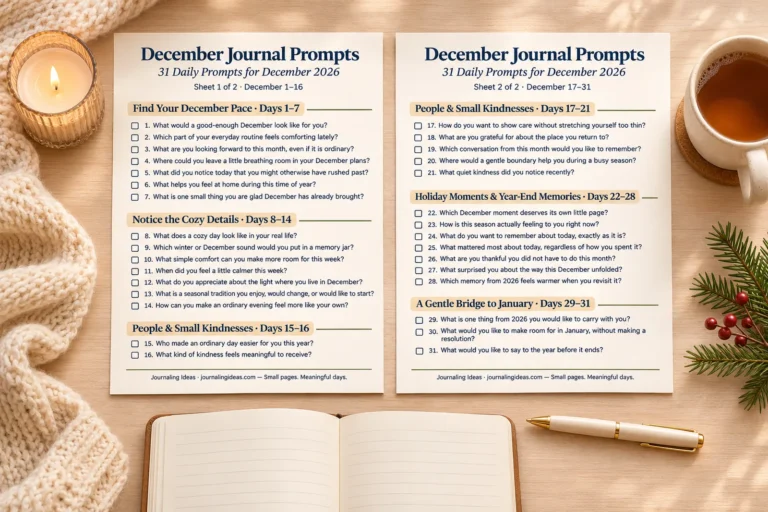
If you would like a gentler lead-in to January, our December journal prompts offer 31 daily questions for the final month of 2026. They move through cozy everyday moments, gratitude, holiday memories, and a quiet goodbye to the year. There is also a free two-sheet printable list in A4 and US Letter, with no signup required.
Movement 1: Days 1–7 — A Fresh Start
January 1–7, 2027
A new month can bring a lot of noise about changing everything, becoming more organized, or making the most of the year. This first week takes a quieter approach.
Instead of asking you to plan twelve months of your life, these questions bring your attention to the first few days in front of you. Notice your surroundings, the way your ordinary routines feel, and what a gentle beginning might mean in real life.
Day 1 — Friday, January 1
Prompt: What did the first morning of January look and feel like where you were?
Describe the room, the weather, the light, and the sounds around you. Were you somewhere familiar or somewhere different? Record a few real details rather than trying to make the first day sound special. Ordinary beginnings deserve a place on the page too.
Day 2 — Saturday, January 2
Prompt: Which ordinary part of your day would you like to notice more closely this month?
Think about something you usually do without paying much attention: making breakfast, getting ready, traveling somewhere, or sitting down in the evening. Write about what happens during that small part of your day and what you might notice if you slowed down.
Day 3 — Sunday, January 3
Prompt: What would a fresh start look like if it asked nothing of you?
Imagine a beginning without a checklist, deadline, or expectation to improve. It might mean having a quiet morning, making time for something enjoyable, or simply allowing an ordinary day to be ordinary. Describe the kind of beginning that feels comfortable rather than demanding.
Day 4 — Monday, January 4
Prompt: What is one object in your everyday surroundings that tells a small story about your life?
Choose something you see regularly: a mug, a photograph, a well-used bag, a book, or an item on your bedside table. Describe it and explain why it has become part of your daily surroundings. Small objects can hold surprisingly specific memories.
Day 5 — Tuesday, January 5
Prompt: Which part of your usual day feels crowded, and what could give it a little breathing room?
Consider the moments when several small things seem to happen together. You do not have to redesign your schedule. Write about one simple adjustment, even if it is just leaving a few minutes between activities.
Day 6 — Wednesday, January 6
Prompt: What small comfort makes a cold January day feel more welcoming?
It could be warm socks, a favorite meal, a lamp switched on in the afternoon, a familiar television program, or a comfortable chair. Describe the comfort in detail and explain what makes it part of your winter day.
Day 7 — Thursday, January 7
Prompt: If the first week of January had a title, what would you call it, and why?
Look back only at these seven days. Perhaps the week was quiet, busy, unexpected, or much like any other week. Give it a short title and write a few sentences about the moments that made that description fit.
Movement 2: Days 8–14 — Quiet Winter
January 8–14, 2027
By the second week, the excitement surrounding a new calendar year may have become quieter. The weather is still winter weather. In many parts of the United States and the United Kingdom, mornings can be cold, afternoons can feel short, and evenings arrive while there is still plenty left to do.
This movement is an invitation to write about the season as it really is. You do not have to pretend to love every dark evening or snowy morning. You can notice what feels beautiful, what feels inconvenient, and what makes a winter day your own.
Day 8 — Friday, January 8
Prompt: Where does the winter light fall in your home at this time of day?
Look at the light coming through a window or across a familiar room. Describe its color, direction, and how it changes the appearance of the space. If it is cloudy or already dark, write about that instead. There is no particular kind of winter day you need to find.
Day 9 — Saturday, January 9
Prompt: What sounds stand out when the evening gets quiet early?
Think about the sounds you hear around home or outside: rain against a window, a heating system, footsteps, traffic, a kettle, or a television in another room. Write a small sound portrait of an ordinary January evening.
Day 10 — Sunday, January 10
Prompt: Which winter color have you noticed most often this month?
Look beyond the usual seasonal decorations. Perhaps you keep seeing gray skies, dark green leaves, brown branches, warm amber lights, or the color of a favorite coat. Describe where you see that color and why it has caught your attention.
Day 11 — Monday, January 11
Prompt: What do you naturally reach for when the weather makes staying indoors appealing?
Write about a book, a warm drink, a hobby, a blanket, a familiar recipe, or something else that belongs to your indoor winter routine. Describe what you do with it and when it usually becomes part of your day.
Day 12 — Tuesday, January 12
Prompt: Which ordinary winter task feels different when you slow it down?
Choose a task such as preparing a meal, putting on outdoor clothes, making a drink, or walking to a nearby place. Describe the steps and details you usually overlook. You may discover that an everyday activity offers more to write about than you expected.
Day 13 — Wednesday, January 13
Prompt: What does your favorite winter corner contain, and what makes it inviting?
Think of a chair, a window seat, a place at the kitchen table, or a corner where you spend time. Describe its light, colors, objects, and surroundings. If you do not have a favorite corner yet, describe the one you would enjoy creating.
Day 14 — Thursday, January 14
Prompt: What would you like to remember about an ordinary winter day that might otherwise pass unnoticed?
Choose one small detail from today. It might be a conversation, a meal, a view, a sound, or a moment when you stopped to look outside. Write it as if you were leaving a note for yourself to read later.
Movement 3: Days 15–21 — Building a Rhythm
January 15–21, 2027
The middle of January is a useful time to notice the shape of everyday life. The month is no longer brand new, but it is not nearly over either.
This week is not about building a perfect morning routine or filling every hour with productive activities. Instead, look at the rhythms that already exist. Some routines are helpful, some are simply familiar, and some may need a little more flexibility.
You can write about what fits naturally into your day without promising to repeat it perfectly.
Day 15 — Friday, January 15
Prompt: Which moment in your day already offers a natural pause?
Perhaps it is the time after breakfast, a short break in the afternoon, the journey home, or the few minutes before bed. Describe what usually happens during that pause and how you could make a little room for writing or quiet observation.
Day 16 — Saturday, January 16
Prompt: What simple cue could remind you to open your journal without making it another obligation?
Consider something that already happens every day: finishing a drink, sitting at your desk, switching on a bedside lamp, or putting your phone away for the evening. Write about a natural connection between that moment and a few minutes of writing.
Day 17 — Sunday, January 17
Prompt: Which small ritual would fit naturally beside something you already do?
A ritual does not need special equipment or a long preparation. It could be writing one sentence after breakfast, noting the day’s date before bed, or spending a moment with your notebook on Sunday afternoon. Describe a version that feels easy to return to.
Day 18 — Monday, January 18
Prompt: What helps you move gently from one part of your day to the next?
Think about the transition between work and home, morning and afternoon, or daytime activities and evening. Perhaps a short walk, putting things away, changing clothes, or sitting quietly gives that transition a shape. Describe what works in your ordinary circumstances.
Day 19 — Tuesday, January 19
Prompt: Which part of your morning or evening would you like to make a little more spacious?
Choose one small window of time. Rather than planning a completely different schedule, consider what could be moved, shortened, or left for another time. Write about what a less hurried version of that moment might look like.
Day 20 — Wednesday, January 20
Prompt: What could a realistic midweek pause look like in ten quiet minutes?
Imagine having ten minutes with your notebook during an ordinary Wednesday. Would you write about the day so far, list a few things on your mind, or describe something you noticed? Keep the answer realistic for a busy week, not an ideal schedule.
Day 21 — Thursday, January 21
Prompt: What is one rhythm that has changed naturally as January has moved along?
Perhaps you have started eating at a different time, spending more evenings indoors, reading before bed, or taking a different route. Notice the change without judging it as good or bad. Describe how it has become part of the month.
Movement 4: Days 22–28 — Looking Forward
January 22–28, 2027
The final full week of January gives you a chance to look a little ahead without making the next month carry a long list of expectations.
Looking forward can be as simple as choosing something to read, preparing for an ordinary day, or finding a place you would like to visit. These questions are about near-future possibilities and small things that make everyday life interesting.
There is no need to make a large plan. A small point of curiosity is enough.
Day 22 — Friday, January 22
Prompt: What is one small thing you are curious about before January ends?
It could be a recipe, a book, a creative activity, a local place, or a subject you have been meaning to explore. Write about what interests you and what a simple first step might look like. Keep the idea small enough to enjoy.
Day 23 — Saturday, January 23
Prompt: What would you like to make room for on one ordinary day next week?
Choose something that does not need a special occasion: reading, preparing a favorite meal, spending time outdoors, calling someone, or enjoying an unhurried afternoon. Describe when you might fit it in and what would make the time feel worthwhile.
Day 24 — Sunday, January 24
Prompt: What could make a coming cold day feel easier to meet?
Think about a practical comfort you can prepare in advance. It might be having a book nearby, planning a simple dinner, setting out warm clothes, or choosing something enjoyable for the evening. Write about one small preparation that suits your real circumstances.
Day 25 — Monday, January 25
Prompt: What is something you would like to read, watch, make, cook, or explore before the month is over?
Give yourself a little space to follow your curiosity. It does not need to be a major project or a new commitment. Describe what has caught your attention and what you would enjoy about spending some time with it.
Day 26 — Tuesday, January 26
Prompt: Which nearby place would you like to see in a different way, even if only for a short visit?
It could be a park, a familiar street, a local shop, a library, or a place you pass regularly. Write about what you might notice if you visited without rushing. If the weather keeps you indoors, describe a place you would like to revisit when it suits you.
Day 27 — Wednesday, January 27
Prompt: What is one practical detail you could prepare now to make a future day less hurried?
Consider something small: putting an item where you can find it, writing down an appointment, choosing a meal, or gathering what you need for an activity. Describe the preparation and the specific day or situation it might help with.
Day 28 — Thursday, January 28
Prompt: What question would you like to keep asking yourself as February approaches?
Choose a question that feels useful or interesting rather than demanding. It might be about what you enjoy, how you spend an ordinary afternoon, or what you want to pay attention to. Write why this question deserves a little more space on your pages.
Movement 5: Days 29–31 — Closing the Month
January 29–31, 2027
The final three days bring the month to a close. Rather than treating January as a test of how much you achieved, use these questions to collect a few details from the days that have passed.
January 31, 2027, is a Sunday, which makes it a natural day to sit down for a gentle month-end review. You can look back at your entries, revisit a favorite question, and decide what deserves another page in February.
Day 29 — Friday, January 29
Prompt: Which small January detail would you like to keep as a written memory?
Look for something specific rather than a summary of the entire month. Perhaps it was a particular meal, an afternoon view, a funny exchange, or a quiet moment at home. Give that detail enough description that you can picture it again when you reread the entry.
Day 30 — Saturday, January 30
Prompt: What did you return to more than once this month — a place, activity, comfort, or idea?
Think about the things that appeared repeatedly in your January days. Maybe you kept returning to a certain book, a familiar walking route, a favorite meal, or a particular corner of your home. Write about what made it worth returning to.
Day 31 — Sunday, January 31
Prompt: As January closes, what felt most like your real life this month, and what would you like to make space for in February?
Read back through a few of your January entries before answering. Notice what genuinely mattered, including the small and unplanned moments. Finish by writing one thing you would enjoy making room for next month. It does not have to become a resolution.
Make These January Journal Prompts Your Own
A dated prompt list is a starting point, not a set of rules. You can use all 31 questions in order, but there are other ways to make the collection fit your notebook and your everyday life.
Skip a question that does not suit you
If a prompt feels irrelevant, leave it blank. You do not have to explain why or replace it immediately. Your journal does not need to contain an answer to every question.
Swap the dates when needed
If you prefer to write on weekends, move a weekday question to Saturday or Sunday. You can also use a question that interests you today, even if it belongs to a later date.
Repeat your favorite prompts
Some questions will naturally lead to more writing than others. If you enjoy describing winter surroundings, repeat a seasonal question later in the month. If you like recording small everyday details, use that approach more than once.
Change the length of your answers
One prompt might need a few sentences. Another might fill two pages. You can write a paragraph, make a short list, or add a small sketch beside your answer.
The point is to make the page useful to you, not to make every entry look the same.
What If You Do Not Know What to Write?
Sometimes a question looks easy until you sit down with your notebook. That is normal. You do not need to produce an interesting answer immediately.
Start by copying the question and writing the first detail that comes to mind. If the prompt asks about winter light, describe the window. If it asks about a daily routine, write what happened first, next, and last.
You can also begin with one of these simple sentence starters:
- Today, I noticed…
- One small detail I remember is…
- The part I want to describe is…
- I did not expect…
- If I had to choose one thing, it would be…
If you still have nothing to say, leave the page and return another time. A journal should give you somewhere to write, not another reason to feel behind.
Get the Free January Journal Prompts Printable
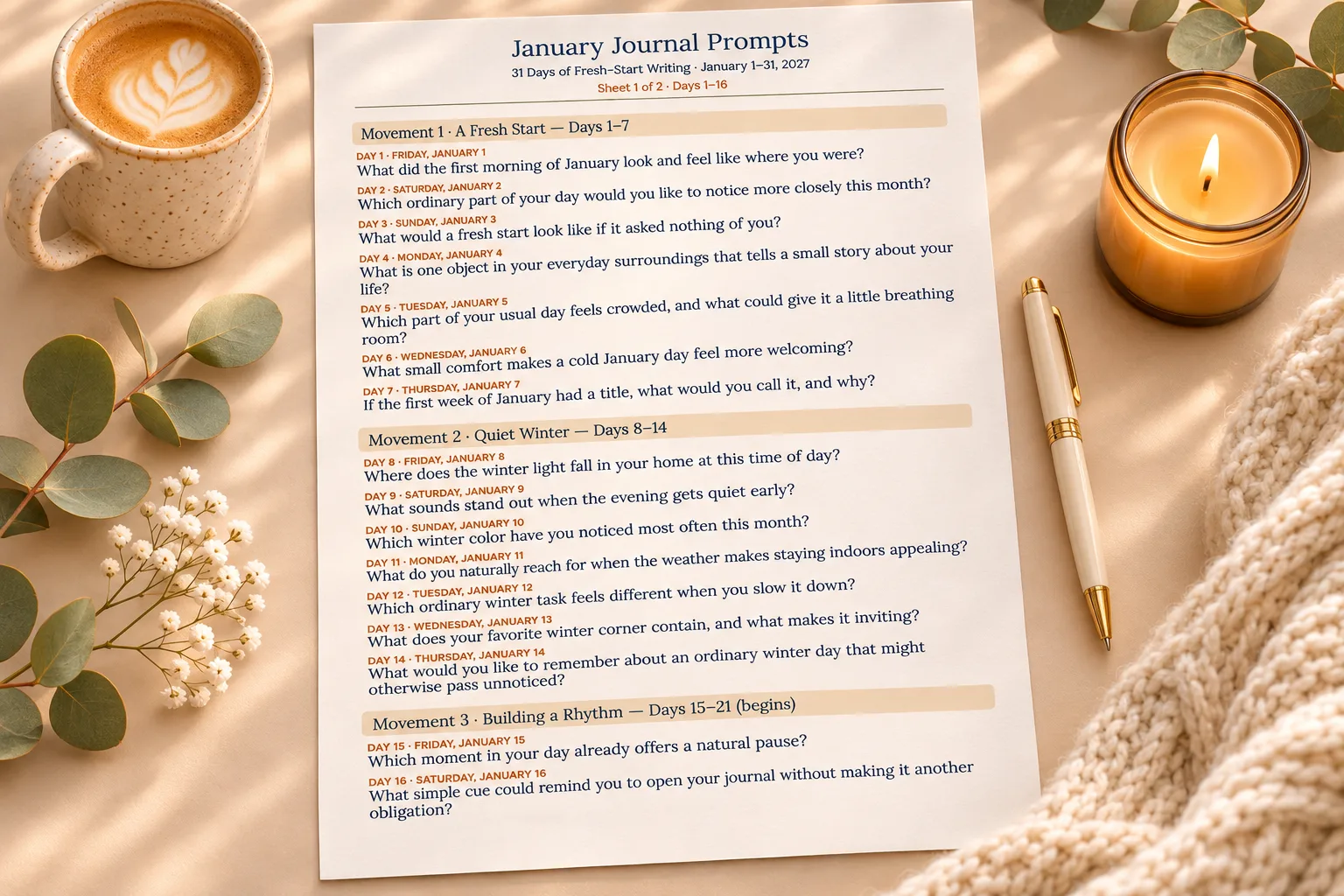
Free download: the January Journal Prompts List (two sheets, A4 + US Letter) is free in The Small Pages Library. Free. No signup. → the free January Journal Prompts List
Prefer having your prompts beside you instead of returning to a webpage every day?
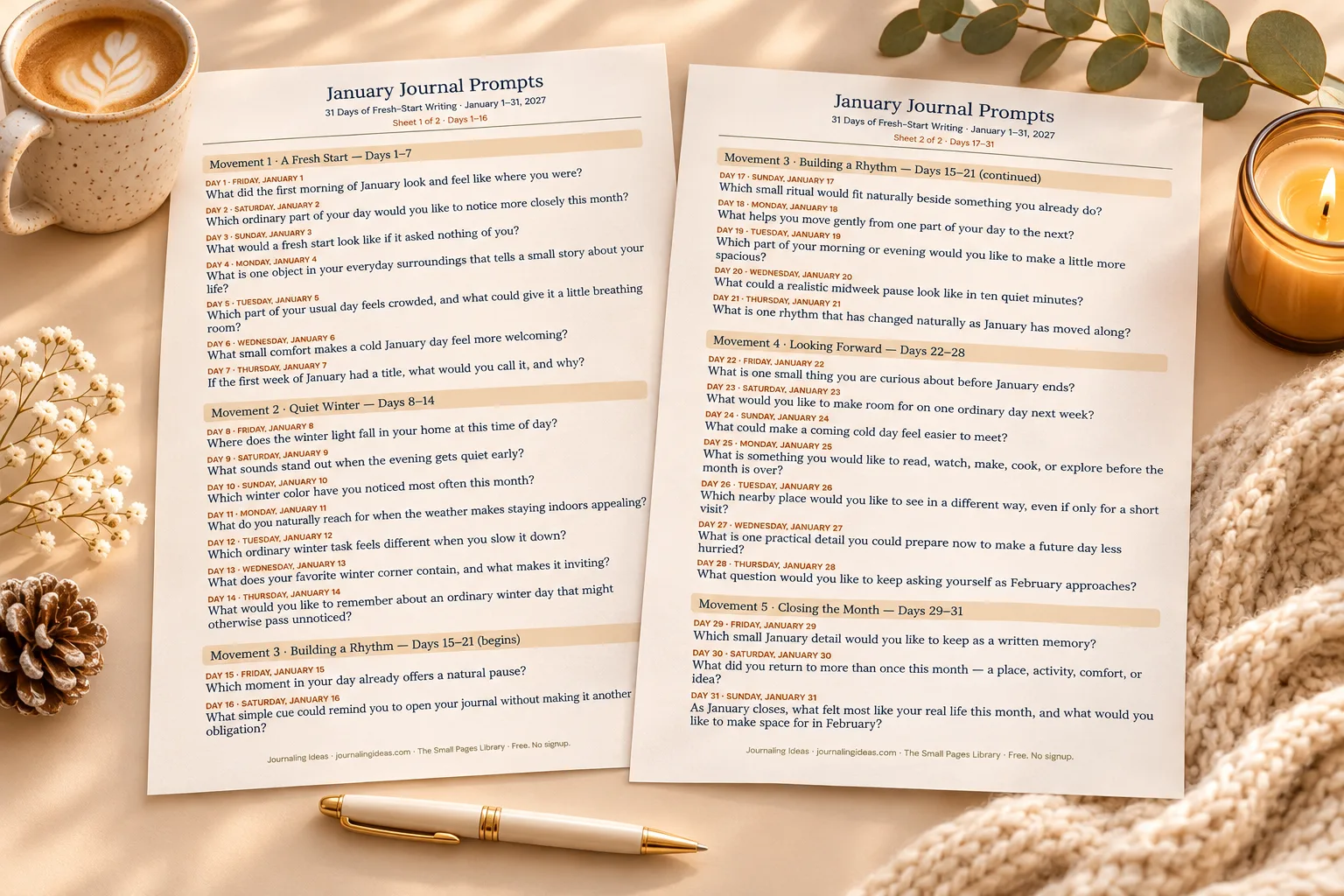
The January Journal Prompts List is a two-sheet printable containing all 31 dated questions, arranged in the same five movements as this article.
The printable is organized as follows:
- Sheet 1: Days 1–16, covering A Fresh Start, Quiet Winter, and the beginning of Building a Rhythm.
- Sheet 2: Days 17–31, completing Building a Rhythm, Looking Forward, and Closing the Month.
Both sheets are available in A4 and US Letter sizes, making them convenient for readers in the United Kingdom and the United States.
You can print the pages and keep them inside your journal, place them on your desk, or save the PDFs to use on a digital device.
The January Journal Prompts List is free in The Small Pages Library. Free. No signup.
Choose the printable, download the PDF, and begin with the date that suits you. There is no need to finish the whole list in one sitting.

Want a guided plan for daily writing beyond a seasonal prompt list? Try our 30-day journaling challenge: 30 gentle prompts, one for each day, plus an undated tracker you can start on January 1 or any day of the year. The two-sheet pack is free in The Small Pages Library, with no signup required. It’s a simple companion to these January journal prompts when you want a guided month of writing.
If you’ve finished the January list, you can keep the gentle daily rhythm going with february journal prompts. February gives you one short question for each of its 28 days, from fresh starts and everyday kindness to late-winter light and early signs of spring. The free two-page printable list keeps the same dated questions in the same order, so you can start on February 1 or choose any prompt that feels useful.
Frequently Asked Questions
Are these January journal prompts dated for 2027?
Yes. The 31 questions follow January 1–31, 2027. January 1 is a Friday, and January 31 is a Sunday. Each prompt is labeled with its date and weekday.
What should I do if I miss a day?
Simply continue with the next date or return to a missed question later. You do not have to catch up or complete multiple entries to stay on track.
Can I start these prompts after January 1?
Yes. Start with the current date or choose any question that interests you. Although the list follows the January 2027 calendar, the questions can also be used independently.
Are these prompts specifically about winter?
Several prompts explore winter light, cold weather, early evenings, indoor comforts, and seasonal surroundings. Others focus on everyday routines, personal observations, and the transition from January into February.
How much should I write for each prompt?
There is no required length. A few sentences may be enough, while a question that brings a specific memory to mind might fill a page or more. Write as much as feels natural.
Is the January Journal Prompts printable free?
Yes. The two-sheet January Journal Prompts List is free in The Small Pages Library, with A4 and US Letter PDF versions. No email signup or payment is required.
If you enjoy working through January journal prompts but want a smaller daily habit, try our one line a day journal. The free One Line a Day Starter Pack includes 12 monthly pages for 2027, a beginner-friendly Start Here guide, and a year-end reflection sheet in A4 and US Letter. It’s a Year 1 starter, not a complete five-year book: print a fresh set for each following year and keep each month together to build your own five-year journal.
A Small Page for Every January Day
January does not have to be a month of dramatic changes. It can be a collection of ordinary mornings, cold afternoons, familiar routines, small comforts, and moments you might otherwise forget.
These 31 questions give you a gentle place to begin. Follow the dates, choose the questions that interest you, and let your answers reflect the month you actually experience.
Download the free list, keep it close to your journal, and take the month one page at a time.
Small pages. Meaningful days.



9 Comments