

50 New Year Journal Prompts to Plan 2027
A new year does not need a brand-new personality. Sometimes it needs a quiet page, a clear look at the year behind you, and a few choices that fit the life you actually have. These 50 New Year journal prompts help you reflect on 2026, imagine 2027, and choose practical next steps. Write a sentence or a page; both count.
You can use the questions on your phone, in a notebook, or with the free 50 New Year Journal Prompts — Printable List in A4 and US Letter. The list follows the exact same numbered questions below. Start with the topic that feels most useful today.
The January Reset Path — free, step by step
Five free pieces that fit together into one calm January. Do them in order, or start wherever you are.
- Set up your journal — January Bullet Journal Ideas: the 2027 setup pack with checklists and trackers.
- Write a little every day — January Journal Prompts: 31 dated prompts, one for each morning.
- Set goals you can keep — 2027 Goal Setting Worksheet: one page for the year, broken into gentle steps.
- Track the days — Habit Tracker Printable: six layouts to mark the habits that matter.
- Read along — 2027 Reading Challenge: 24 prompts and a book log for the year.
Prefer everything in one file? The January Reset Pack gathers the printable pieces into a single download — find it in the Free Printable Library.
What are good New Year journal prompts?
Good New Year journal prompts help you look back honestly, notice what matters now, and decide what deserves space in the year ahead. The most useful questions are specific enough to answer in a few sentences. Try reflecting on real moments, releasing unnecessary commitments, imagining possibilities, and choosing one next action.
A question such as “What do I want?” can feel enormous. “Which part of my week needs more breathing room?” gives you something you can picture. The prompts here move from concrete memories to decisions about time, routines, relationships, and enjoyable experiences. They do not require a perfect plan or a dramatic resolution.
Start anywhere. If you want a broad introduction to reflective writing before beginning this list, explore these 150 journal prompts for beginners. They offer plenty of other entry points for ordinary days, not just January.
For a quick first page, write the date, pick a question, and answer with three lines: what happened, why it matters, and what you might do next. If you only know the first line, that is still a useful start. You can revisit a question later and answer it differently; your journal is a place to think, not a contract.
Why can New Year journaling help you plan 2027?
New Year journaling can make planning more personal by giving you a place to compare what you hoped for with what actually happened. Writing down examples may reveal priorities, limits, and opportunities you might otherwise overlook. It does not guarantee change, but it can help you make clearer, more grounded choices.
A calendar can tell you when something happened; a journal can help you explain why it mattered to you. Maybe you discovered that a weekly walk was easier to maintain than a complicated fitness schedule, or that a quiet Sunday afternoon was more valuable than another commitment. Those details can shape a realistic 2027 plan.
Reflection also makes room for mixed feelings. You can be proud of a project and tired of the pace it required. You can appreciate a friendship and wish you saw that person more often. You can be thankful for a busy season without wanting to repeat it. None of these answers needs to be turned into a goal.
Treat your answers as observations, not evidence that you have succeeded or failed. A journal can hold things you want to keep, things you want to change, and things that are simply true right now. That is enough to make the next planning page more useful.
For a bigger picture of how a planner, notebook, and tracker can work together without becoming one giant project, see the 2027 Journal Ecosystem guide. You can borrow just one part of that setup if it suits you.
How do I reflect on 2026 before planning 2027?
To reflect on 2026, begin with what actually happened rather than judging the whole year as good or bad. Look at your calendar, photos, notes, or messages for reminders. Then answer a few questions about memorable moments, worthwhile choices, unexpected changes, and patterns you would like to understand better.
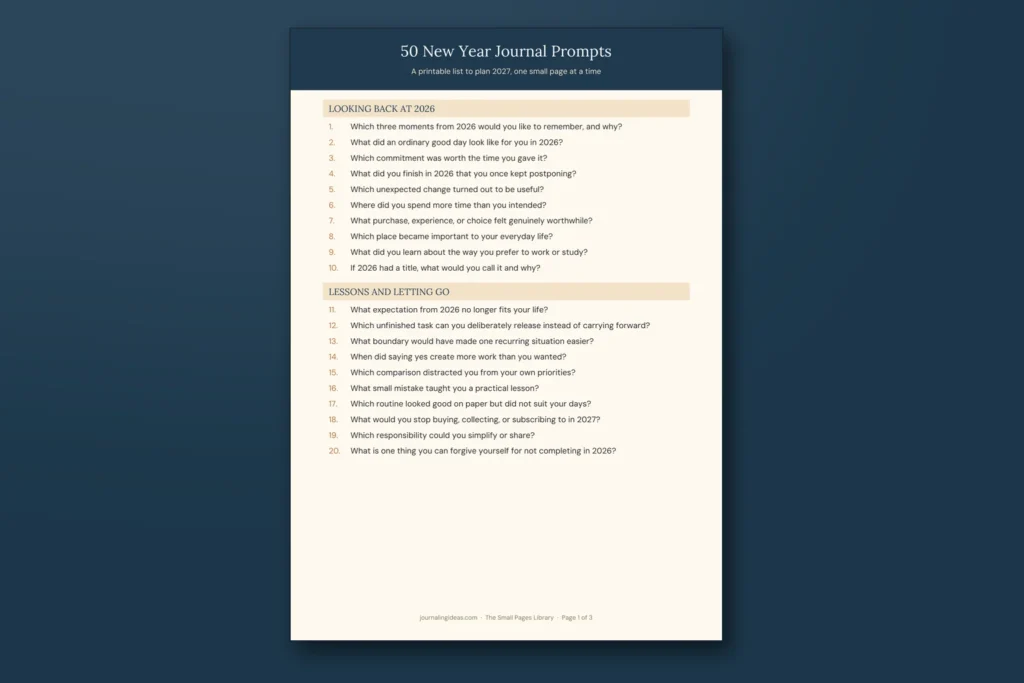
You do not need to reconstruct every month. Choose three moments you remember clearly and describe them in ordinary language. What were you doing? Who was there? What made the moment matter? A tiny memory—tea with a friend, finishing a book, finally organizing a drawer—can be as meaningful as a major event.
If your year was crowded, try a quick month-by-month scan. Write one phrase beside each month, leaving blanks where nothing comes to mind. If your year was quiet, focus on recurring days instead. A useful reflection is not a competition to find the most exciting highlight.
You can also divide a page into “keep,” “change,” and “leave behind.” Put observations in those columns without deciding what they mean yet. The following first two groups of prompts help you build that picture before you begin making plans.
Looking Back at 2026
- Which three moments from 2026 would you like to remember, and why?
- What did an ordinary good day look like for you in 2026?
- Which commitment was worth the time you gave it?
- What did you finish in 2026 that you once kept postponing?
- Which unexpected change turned out to be useful?
- Where did you spend more time than you intended?
- What purchase, experience, or choice felt genuinely worthwhile?
- Which place became important to your everyday life?
- What did you learn about the way you prefer to work or study?
- If 2026 had a title, what would you call it and why?
Choose two questions that bring up a clear memory. Add one detail you might otherwise forget: a place, a date, a conversation, or a small decision. You do not need to answer all ten in order. If a question feels unhelpful, skip it and move to the next one.
Lessons and Letting Go
- What expectation from 2026 no longer fits your life?
- Which unfinished task can you deliberately release instead of carrying forward?
- What boundary would have made one recurring situation easier?
- When did saying yes create more work than you wanted?
- Which comparison distracted you from your own priorities?
- What small mistake taught you a practical lesson?
- Which routine looked good on paper but did not suit your days?
- What would you stop buying, collecting, or subscribing to in 2027?
- Which responsibility could you simplify or share?
- What is one thing you can forgive yourself for not completing in 2026?
Notice the difference between something you can change and something you cannot. You might write one practical adjustment beside an answer, or simply acknowledge that an old expectation no longer belongs in your plans. Leaving something unfinished can be a deliberate choice.
How do I choose what matters most for 2027?
Choose what matters most for 2027 by naming a few values and experiences you want to make room for, then checking whether they fit your actual time and responsibilities. You can dream widely before narrowing your list. A meaningful direction might be creative, practical, social, financial, or simply more spacious.

Imagine a normal Tuesday in 2027, not just a perfect holiday or a big celebration. What would you like to be different about the hours before work or school? What would you like to do after dinner? Who would you like to see? Those ordinary details help a future vision feel usable.
Try two columns: “more of” and “less of.” Under “more of,” you might write cooking with friends, reading before bed, or keeping weekends less scheduled. Under “less of,” you might write last-minute errands or saying yes automatically. You are identifying directions, not promising to change everything at once.
If you enjoy collecting ideas, make a small inspiration page with three words and three actions. For example: “curiosity” could become visiting a new local museum; “connection” could become inviting a friend for coffee; “simplicity” could become planning lunches once a week. Each word earns its place by pointing to something you can actually try.
Dreaming Big for 2027
- What would make December 2027 feel like a year well spent?
- Which skill would you love to practice consistently this year?
- What place would you like to visit or explore, even close to home?
- What creative project would you start if it could be imperfect?
- What experience would you like to save money or time for?
- What would you like your home or workspace to make easier?
- Which personal value do you want your calendar to reflect?
- What is one brave but manageable conversation you want to have?
- What new tradition could make 2027 feel more like yours?
- If you chose one word to guide 2027, what would it mean in practice?
Let the first answers be generous. You are not committing to every idea. Circle the ones you would still care about if nobody else saw your plans. Then add a smaller version beside each ambitious thought. A creative project could begin with a single page; a trip could begin with checking dates and costs.
Once you’ve used these New Year journal prompts to notice what you’d like more of in 2027, you might like a practical next step. Our 2027 goal setting worksheet gives your goal its own page, plus a second sheet for three small action steps. You can print the A4 or US Letter version for free, with no signup needed.
What New Year journal prompts help with habits and everyday routines?
The best New Year prompts for habits ask about the small details of your real days: timing, effort, reminders, and what happens when plans slip. Instead of writing “be more organized,” consider a particular task you can repeat. A useful routine should be simple enough to restart without a fresh overhaul.

A habit is easier to describe when you give it a place in your day. “Read more” is vague; “read two pages while the kettle boils” is specific. “Keep track of money” becomes “check my spending on Sunday afternoon.” Choose a cue you already notice rather than building an entirely new schedule around one intention.
Also plan for busy days. A full version might be twenty minutes of journaling, while a small version is one sentence. A full tidy-up might be an hour, while a small version is clearing the desk. The small version is not cheating; it keeps the action available when life changes.
If checking boxes is helpful, you can pair a chosen routine with the free habit tracker printable. Tracking is optional. Use it to notice what happens, not to turn every missed day into a problem.
Habits and Daily Life
- What five-minute habit would make mornings simpler?
- Which evening task could you prepare earlier in the day?
- What recurring appointment or deadline needs a better reminder?
- Which part of your week needs more breathing room?
- What is one realistic way to make room for reading or writing?
- Which digital notification could you turn off without missing anything important?
- What household task could follow a simpler repeatable schedule?
- When during the week could you review your spending or plans?
- What would a low-effort version of your ideal routine look like?
- How will you restart a habit after missing several days?
After answering, underline any habit that depends on a time or place you already have. If your plan needs a perfect morning, an empty calendar, and a lot of extra energy, make a smaller version. A good daily-life plan leaves room for interruptions and for days when you simply want to rest.
How can I include people, gratitude, and joy in my 2027 plans?
Include people, gratitude, and joy by asking who you want to spend time with, what you appreciated this year, and which small pleasures deserve a place in your calendar. Not every New Year intention needs to improve a skill or complete a task. Relationships and enjoyable moments can be worthwhile priorities on their own.
Write down names rather than only general wishes. “See friends more” can become “ask Maya if she wants to take a walk next weekend.” “Be grateful” can become “send a short thank-you message to the neighbor who helped me.” A specific gesture is easier to remember and more personal than a grand declaration.
Make room for enjoyment that does not need a special budget. A library visit, a homemade breakfast, an afternoon drawing, or a familiar walking route may be enough. If you want more ideas for noticing ordinary good things, these gratitude journal prompts offer another place to begin.
Some relationships may be complicated, distant, or changing. You do not have to force a positive answer to every question. Choose the people and activities that genuinely fit your life, and let the rest of the page stay open.
People, Gratitude and Joy
- Who made an ordinary day better in 2026, and how?
- Which friendship would you like to give more attention in 2027?
- What kind of invitation would you like to say yes to more often?
- How could you show appreciation to someone in a specific way?
- Which shared activity would you like to plan with family or friends?
- What inexpensive pleasure would you like to enjoy more regularly?
- Who could you ask for practical help with a goal?
- What personal milestone deserves a simple celebration?
- Which community, club, or group would you like to explore?
- What would you like to thank your future self for doing this January?
Pick one answer that could become a calendar entry this month. A quick message, a planned meal, or a small celebration may be enough. If you cannot act on it now, write a reminder for later. The point is to make room for the people and moments you value, not to fill every weekend.
How should I use these 50 New Year journal prompts?
You can use these 50 prompts one per day, in a longer New Year’s Eve writing session, or across a quiet week in January. There is no required order or schedule. Pick a method that fits your attention and available time, and skip any question that does not feel useful.
Option one: one prompt a day. Start with question one and write for five minutes, or select a question based on what you are thinking about. Fifty prompts do not have to mean fifty consecutive days. You can take weekends off, repeat a favorite, or finish in February.
Option two: a New Year’s Eve session. Make a drink, put your phone aside if you want, and choose two questions from each of the five groups. Ten answers are plenty for one sitting. Spend the first half looking back and the second half thinking about what comes next. Finish by writing one small action for the first week of January.
Option three: a quiet January week. Try one group each day over five days. On day six, reread your answers and mark any ideas that still matter. On day seven, make a short plan. If you only have ten minutes, choose a single question from each group instead.
You might write in complete sentences, bullet points, or a mix of both. A page can be messy, crossed out, or unfinished. If you share a home or workspace, choose a private place for personal reflections; you never need to show anyone your answers.
For a simple writing format, copy the question, write “My answer,” and then add “One thing I might try.” That final line is optional. Some reflections are worth keeping without turning them into a task.
A 15-Minute Year-End Exercise: Review 2026, Choose One First Step
Short on time? You do not need to answer all 50 prompts. Set a timer and try this shorter version instead — six questions, about fifteen minutes, one page in your notebook.
Minutes 1–8: Review 2026
- What is one moment from 2026 you want to remember exactly as it happened?
- What did 2026 teach you that you did not expect to learn?
- What are you ready to leave behind in 2026?
Minutes 9–15: Your First Step for 2027
- What would make 2027 feel well spent, in one sentence?
- What is one small step you can take in the first week of January?
- Who or what will help you keep that step?
When you finish, turn your last two answers into a plan on the free 2027 goal setting worksheet — one goal, three small steps, on two printable pages.
How do I turn New Year prompts into three to five realistic goals?
Turn your journal answers into three to five realistic goals by looking for repeated themes, choosing what you can influence, and making each goal specific. Give every goal a small first step, a workable time frame, and a way to check progress. You do not need to turn every reflection into a project.
First, reread your answers and highlight phrases that appear more than once. Maybe you keep mentioning friends, creative time, less clutter, or more predictable finances. Those repetitions can point to priorities, but you can choose differently if something matters even though you mentioned it only once.
Second, shortlist three to five goals, not fifty. If five already feels crowded, choose three. You can also select one main goal and two supporting habits. Make sure the goals reflect your circumstances rather than somebody else’s idea of a successful year.
Third, turn each direction into an action you can describe. “Be creative” might become “finish one small sketch each month.” “Spend more time with friends” might become “invite someone to meet once a month.” “Be prepared” might become “review upcoming appointments every Sunday.” Your goal does not need a dramatic number attached to it.
Fourth, write the first step so it could fit into the next seven days. “Open a blank sketchbook,” “send one invitation,” and “put a calendar reminder on my phone” are all valid. If the step depends on money, other people, or a deadline, note that dependency rather than pretending it does not exist.
Finally, decide when you will review your goals. A short check at the end of each month is enough for many people. Ask: What did I try? What worked? What got in the way? What should I adjust? Goals are allowed to change when your circumstances change.
Here is a simple example. Reflection: “I missed reading because evenings felt crowded.” Goal: “Make room for a little reading.” First step: “Put a book beside the chair and try ten minutes on Tuesday.” Review: “At the end of January, decide whether Tuesday is the right time.” The goal is useful because it tells you what to try, not because it guarantees a result.
If you use several notebooks, you can put the goals on one reference page and leave the original answers in your reflection journal. This keeps the planning page short while preserving the reasons behind each choice.
What should I do if I start my New Year journal late in January?
If you start your New Year journal late in January, begin with the date you actually have. You have not missed the chance to reflect or plan. Choose five questions, write what you know now, and pick one small next step. A useful plan does not need a January 1 start date.
You can begin on January 12, January 29, or even in February. The first weeks of a year sometimes reveal what your calendar and energy really look like. That information can make your plans more realistic than a rushed resolution written before you know your schedule.
Try a fifteen-minute late-start page. Write one thing you appreciated about 2026, one thing you want less of, one thing you hope for in 2027, one habit you could try, and one person you want to connect with. Then choose only one action for the coming week.
Do not try to “catch up” by writing a month’s worth of entries in one evening unless you genuinely enjoy it. A blank page is available whenever you are. Your first entry can simply say, “I’m starting here.”
Where can I get the free 50 New Year Journal Prompts printable list?
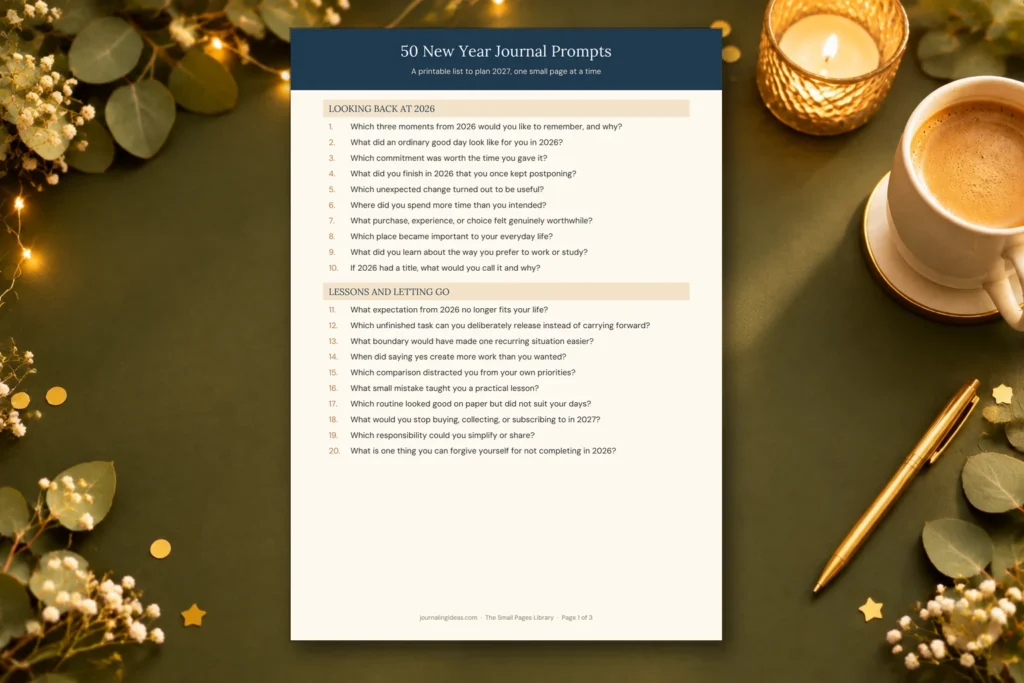
The free 50 New Year Journal Prompts — Printable List includes the same 50 numbered questions shown in this article, in the same order and five groups. It comes in A4 and US Letter sizes. You can find it in The Small Pages Library, which is open access without signup or a password.
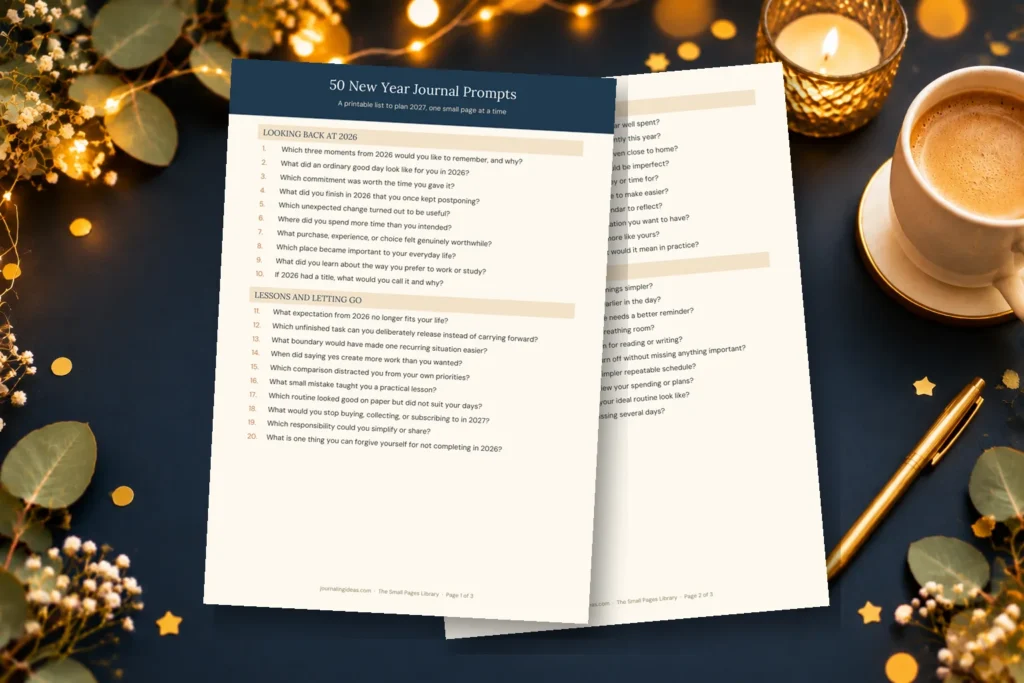
Visit The Small Pages Library and look for 50 New Year Journal Prompts — Printable List. Choose A4 or US Letter based on the paper you use. Print at actual size or 100% if your printer settings allow it; if your printer requires a different fit setting, check the preview before printing.
The printable is a question list, not a filled-in journal or a planner with daily dated boxes. Use a separate notebook, loose paper, or your favorite writing app for answers. You can circle the questions you want to revisit or keep the list tucked into your journal as a reference.
You do not need to download anything to use the prompts. All fifty are here in the article. The printable simply makes it easier to keep the questions beside you while writing away from a screen.
If you are still organizing end-of-year tasks before settling into your January pages, the Christmas Planner Printable can help keep seasonal plans separate from your personal reflection. That way, a to-do list does not have to take over your New Year journal.
What can I write on my first page for 2027?
For your first 2027 journal page, write the date, one honest sentence about where you are now, and one intention for the coming weeks. Add a small action you can take soon. You do not need a decorative cover, a perfect quote, or a complete plan before you begin.
A first page could be as simple as this: “January 2027. I want more unhurried time with people I care about. This week, I will invite a friend for coffee.” You can leave the rest of the page empty, or write a few lines about why the intention matters.
Another approach is to divide the page into four small spaces: “Remember,” “Release,” “Try,” and “Enjoy.” Put one sentence in each. For example, remember a kind gesture, release an unnecessary commitment, try a shorter evening routine, and enjoy a favorite walk. Those four lines can become a gentle map for the first month.
You can return at the end of January and add what changed. Maybe your first plan was too ambitious. Maybe an unexpected opportunity appeared. Maybe nothing major happened. A journal is still useful when it records ordinary life rather than a transformation story.
If you prefer lists, write three things to keep, two things to change, and one thing to look forward to. If you prefer free writing, begin with “Right now, I notice…” and keep going for five minutes. Both approaches belong here.
If you would like to continue journaling beyond the New Year reflections, try our january journal prompts. This collection has 31 dated questions, one for every day of January 2027, covering fresh beginnings, quiet winter days, everyday rhythms, and looking ahead to February. It also includes a free two-sheet printable in A4 and US Letter. No signup is needed — just download the list and take January one page at a time.
Your birthday deserves the same pause — our birthday journal prompts look back at your year and set up the next one.
Frequently asked questions about New Year journal prompts
These frequently asked questions cover when to begin, how much to write, whether to complete every prompt, and how to use the printable. There is no fixed schedule or minimum word count. You can adjust your answers and goals as the year changes, and the free list remains a simple reference.
Are New Year journal prompts only for January?
No. Use them in December, January, or whenever you want to review your direction. The questions work even if the calendar has already moved on.
Do I have to answer all 50 prompts?
No. Choose the questions that are useful to you. Five thoughtful answers can be more practical than fifty rushed ones.
How long should each journal answer be?
A few sentences are enough. You can write more when a question brings up something you want to explore.
Can beginners use these New Year journal prompts?
Yes. You only need paper or a writing app. Begin with a specific question and write in your own words.
Is the New Year journal prompts printable really free?
Yes. The A4 and US Letter prompt-list PDFs are free in the open-access library, with no signup or password.
What if my goals change during 2027?
Change them. Review what still fits your time, responsibilities, and interests, then choose a new next step.
Small pages. Meaningful days.


6 Comments