2027 Reading Challenge: 24 Prompts for the Year
The 2027 Reading Challenge is a year-long reading plan with 24 prompts: choose one book for each prompt, or roughly two books a month. The prompts explore different formats, genres, settings, and moods across four seasons. Join with a notebook, your reading journal, or the free two-sheet printable pack — no signup needed.
A new reading year is a lovely opportunity to explore books you might not normally choose. Perhaps you want to try a different genre, revisit an old favorite, borrow more books from the library, or finally read something that has been sitting on your shelf.
This challenge gives you a little direction without turning reading into another demanding goal. There are 24 prompts, six for each season, and plenty of room to choose books that genuinely interest you.
You can follow the prompts in order, jump around, or adapt the challenge to fit your reading time.
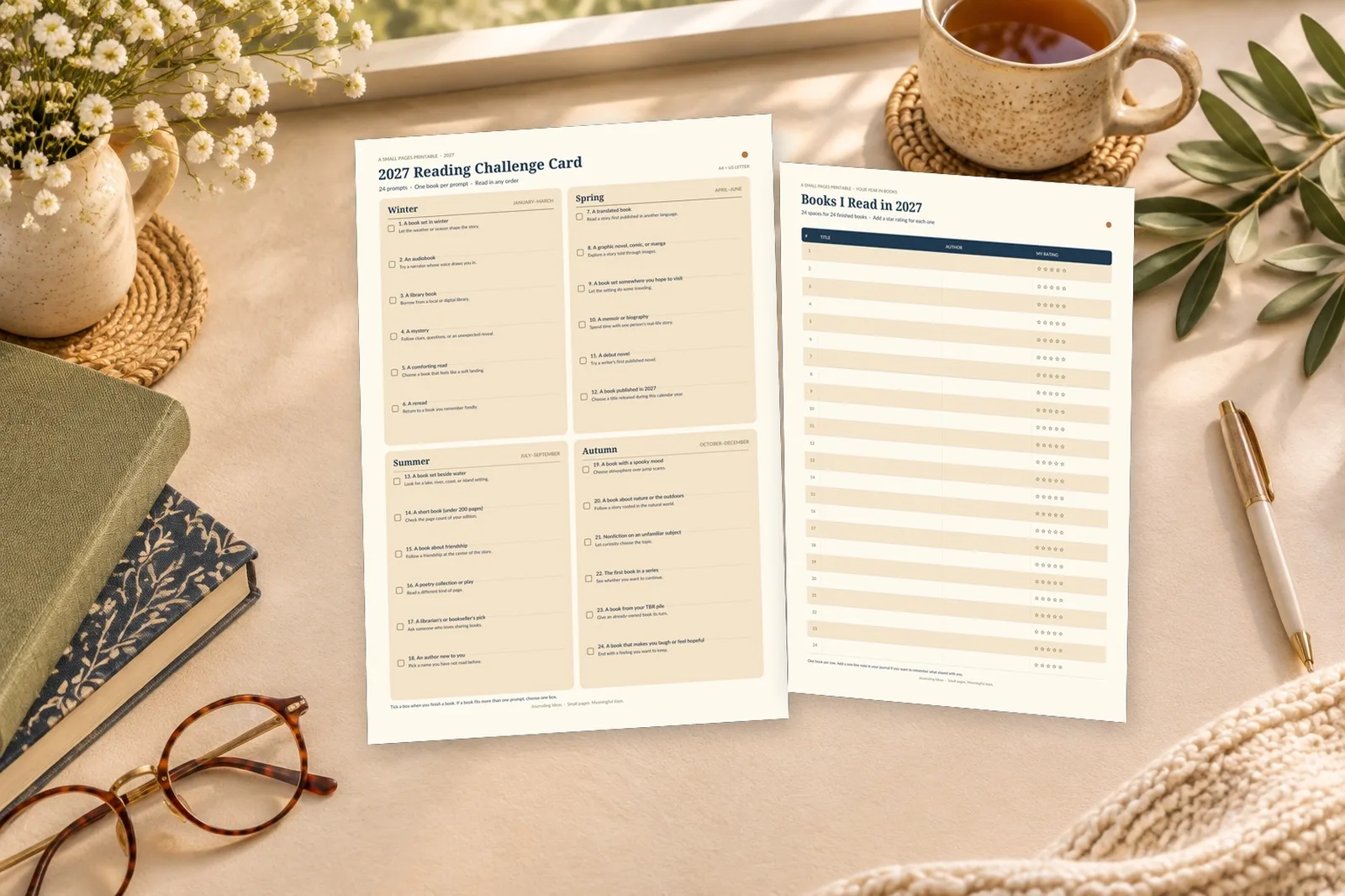
Get the free printable: The 2027 Reading Challenge Pack includes a 24-prompt challenge card and a matching 24-book reading log. Both sheets are available in A4 and US Letter in The Small Pages Library, free with no signup.
Why Choose 24 Reading Prompts for 2027?
Twenty-four books across twelve months works out to roughly two books per month. It is a manageable way to give your reading some variety without committing to a new book every week.
A 24-prompt challenge also gives you more than a simple number to reach. Each prompt encourages a different reading experience. You might:
- Try an audiobook instead of reading a printed copy.
- Discover a writer whose work is new to you.
- Read a book translated from another language.
- Choose something from your local library.
- Revisit a book you loved years ago.
- Explore a genre you rarely pick up.
- Read a book released during 2027.
The aim is not to finish every book as quickly as possible. It is to make space for different stories and keep a small record of what you read.
There are no prizes, deadlines, or penalties for taking a break. If you finish fewer books during a busy month, simply continue when you are ready.
How Does the 2027 Reading Challenge Work?
The challenge follows four seasonal groups, with six prompts in each group:
| Season | Months | Prompts |
|---|---|---|
| Winter | January–March | 1–6 |
| Spring | April–June | 7–12 |
| Summer | July–September | 13–18 |
| Autumn | October–December | 19–24 |
Here is a simple way to participate:
- Choose a prompt. Start with whichever idea makes you curious. You do not have to begin with prompt 1.
- Find a suitable book. Check your own shelves, browse your library, or look for an ebook or audiobook.
- Read at your own pace. There is no requirement to finish a book within a particular week.
- Tick off the prompt. Once you finish the book, mark its challenge box.
- Record the book. Add its title, author, and your personal star rating to the reading log.
Try to use one different book for each prompt. If a book could fit several categories, choose the prompt that describes it best and save the other boxes for different books.
The 24 Reading Challenge Prompts for 2027
The prompts below are arranged by season to give your reading year a little structure. You can complete them in any order, and you do not need to choose all 24 books in advance.
Winter Reading Challenge: January–March
Winter is a good time to explore atmospheric stories, comforting reads, and books that fit quieter reading moments.
- A book set in winter — Let the weather or season shape the story. Look for snowy settings, cold landscapes, or a story that takes place during winter.
- An audiobook — Try a narrator whose voice draws you in. Choose a story that works well for listening during a walk, a journey, or a quiet evening.
- A library book — Borrow from a local or digital library. Choose something you have been meaning to read rather than feeling you need to buy another book.
- A mystery — Follow clues, questions, or an unexpected reveal. It can be a classic detective story, a modern mystery, or a psychological puzzle.
- A comforting read — Choose a book that feels like a soft landing. It could be a familiar favorite, a gentle romance, or a story with a setting you enjoy.
- A reread — Return to a book you remember fondly. Notice whether you respond to its characters, themes, or ending differently this time.
Spring Reading Challenge: April–June
Spring brings six opportunities to discover different voices, places, and storytelling formats.
- A translated book — Read a story first published in another language. Explore a different literary tradition through a translation you find interesting.
- A graphic novel, comic, or manga — Explore a story told through images. Choose a format you enjoy or one you have not tried before.
- A book set somewhere you hope to visit — Let the setting do some traveling. Choose a place you would love to explore, whether it is a real city, a coastal town, or a distant landscape.
- A memoir or biography — Spend time with one person’s real-life story. Choose someone whose experiences, work, or perspective you would like to understand.
- A debut novel — Try a writer’s first published novel. It is a chance to discover an author whose other books you may want to explore later.
- A book published in 2027 — Choose a title released during this calendar year. You can leave this prompt open until a new release catches your attention. Publication dates may differ between countries and editions.
Summer Reading Challenge: July–September
These prompts invite you to explore different settings, shorter reads, and books that introduce you to something new.
- A book set beside water — Look for a lake, river, coast, or island setting. Let the location become part of the reading experience.
- A short book (under 200 pages) — Check the page count of your edition. Choose a shorter read that you can enjoy without making a large time commitment.
- A book about friendship — Follow a friendship at the center of the story. It could explore an old friendship, a new connection, or a relationship that changes over time.
- A poetry collection or play — Read a different kind of page. Choose a collection of poems or a play and enjoy the change in structure and storytelling.
- A librarian’s or bookseller’s pick — Ask someone who loves sharing books. Choose a recommendation from a librarian or bookseller whose suggestions interest you.
- An author new to you — Pick a name you have not read before. You might discover a new favorite writer or find a style you want to explore further.
Autumn Reading Challenge: October–December
Finish the year with a mix of atmospheric stories, curiosity-led nonfiction, and books you have been meaning to read.
- A book with a spooky mood — Choose atmosphere over jump scares. It could be a gothic novel, a mysterious story, or a book with an unsettling setting.
- A book about nature or the outdoors — Follow a story rooted in the natural world. Choose a book about wildlife, forests, landscapes, or the relationship between people and nature.
- Nonfiction on an unfamiliar subject — Let curiosity choose the topic. Pick something you know very little about, whether it is history, science, art, culture, or another subject.
- The first book in a series — See whether you want to continue. Start with the first installment of a series that has caught your attention.
- A book from your TBR pile — Give an already-owned book its turn. Choose something you bought, borrowed, or saved for later but have not started yet.
- A book that makes you laugh or feel hopeful — End with a feeling you want to keep. Choose a book that leaves you smiling, encouraged, or looking at something differently.
A small reminder: You do not need to complete the seasonal groups at the exact times shown. They are simply a way to organize the challenge. Move prompts around whenever your reading plans change.
How Can You Adapt the Challenge to 12 or 52 Books?
The 24-prompt version is the main challenge, but it can be adjusted to suit different reading goals.
The 12-Book Version: One Book Each Month
If 24 books feels like too much, choose just three prompts from each seasonal group. That gives you 12 books across the year, with one prompt guiding each month. Choose the prompts you find most interesting rather than trying to select the easiest ones.
The 52-Book Version: One Book Each Week
If you prefer a bigger reading goal, keep the 24 prompted books as your challenge books and add 28 free-choice books. That gives you 52 books in total, with room for any genre or subject you want to read. The printable log has 24 rows, so it is designed for the main challenge rather than a complete 52-book record. For the extra books, print another log page or use additional pages in your reading journal.
How to Track the 2027 Reading Challenge in a Reading Journal
A reading challenge becomes easier to look back on when you keep the prompts and finished books together. You do not need a complicated reading journal. Two simple pages and a little space for notes are enough.
1. Keep the Challenge Card as Your Overview
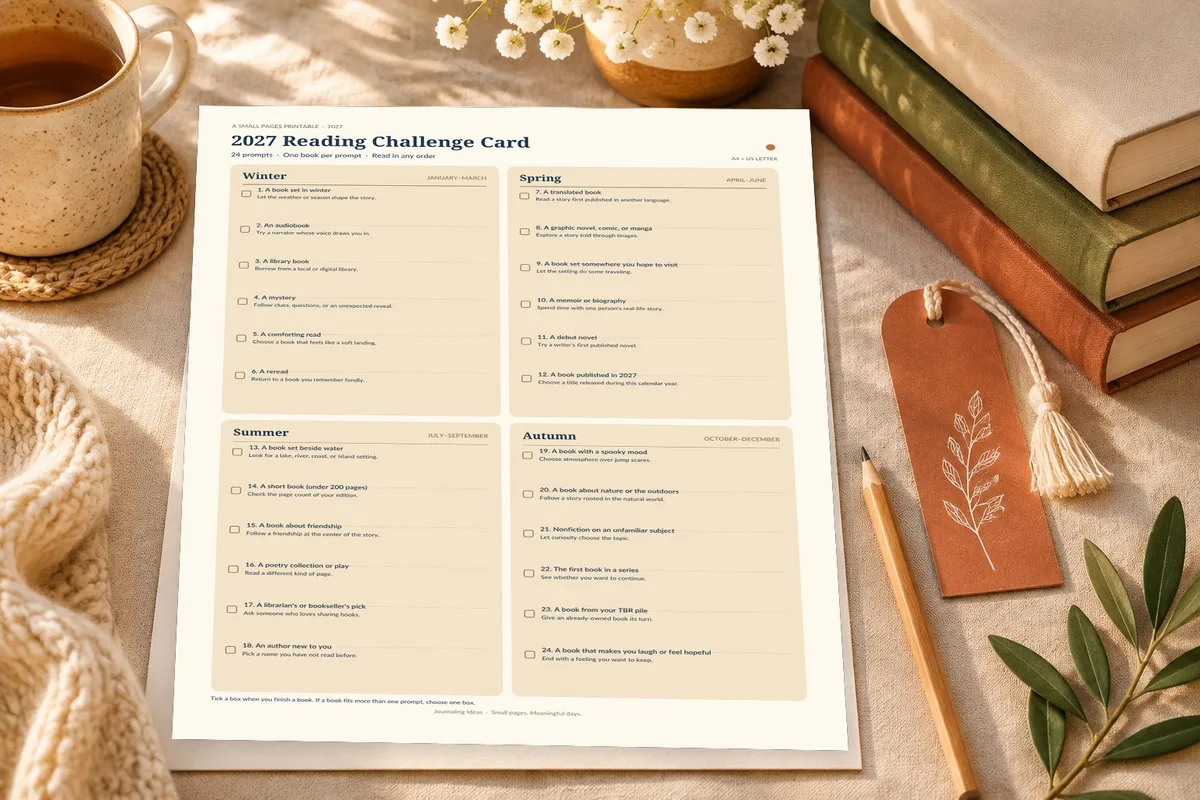
Print the 2027 Reading Challenge Card and place it at the beginning of your reading journal. It contains all 24 prompts, arranged into four seasonal groups, with a checkbox beside each one. When you finish a suitable book, tick its prompt. You can see which reading experiences you have completed and which ones are still waiting.
2. Record One Book on Each Log Row
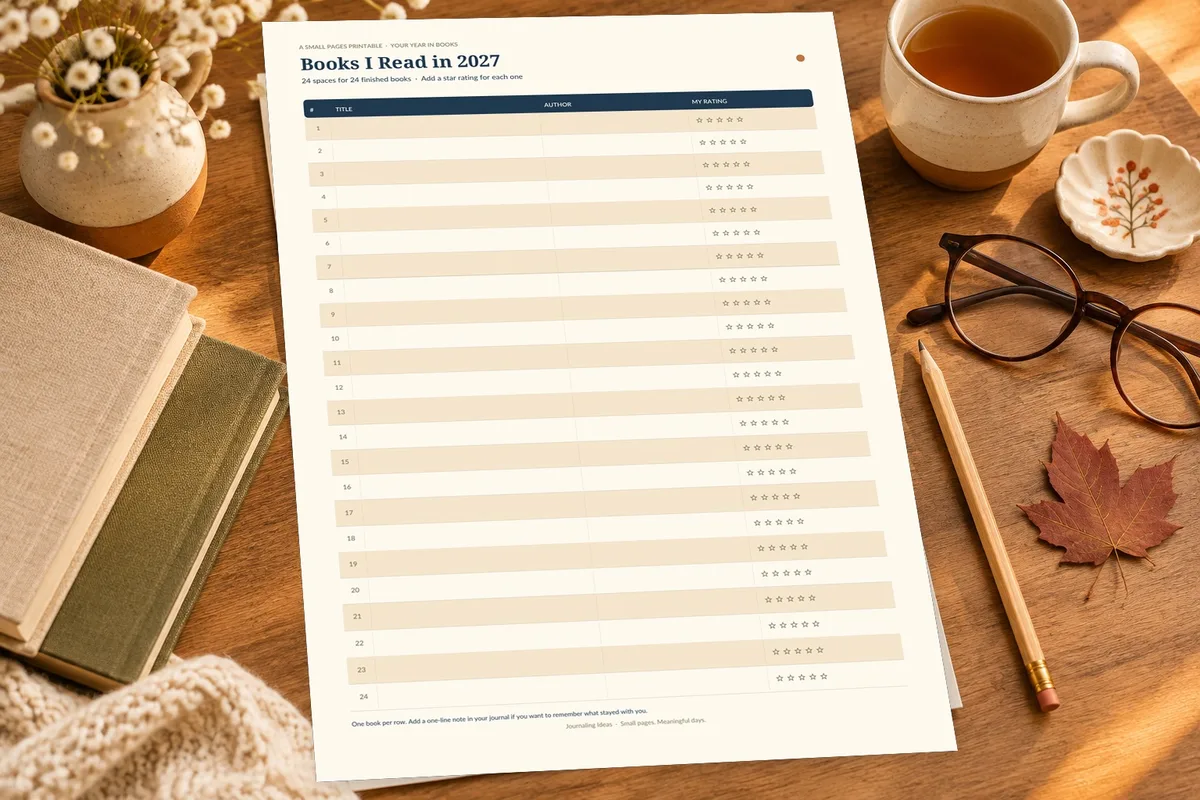
Use the matching Books I Read in 2027 page to record your finished books. Each of its 24 rows includes the book’s title, the author’s name, and five small stars for your personal rating. Keep the entry simple. The purpose is to create a record you can understand when you revisit it at the end of the year.
3. Add a Tiny Star Rating
A five-star rating is a quick way to remember how you felt about a book. You can use a simple personal scale: 1 star — Not for me. 2 stars — Some parts worked for me. 3 stars — An enjoyable or worthwhile read. 4 stars — A book I really liked. 5 stars — A personal favorite. These ratings are entirely subjective. You do not need to explain or justify them.
4. Write a One-Line Note
If you have a little more space, add one short sentence in your journal about what stayed with you. For example: The setting was my favorite part. I loved the main character’s development. The ending made me think. I would recommend this to a friend. A single sentence is enough. You can always write a longer review when you feel like it.
If you want to build a more detailed book-by-book system, our Reading Journal guide explores ways to organize your reading pages and keep track of the books you finish.
Want the two pages ready to print? The free 2027 Reading Challenge Pack in The Small Pages Library includes the challenge card and matching book log in A4 and US Letter.
What Does a Filled-In 2027 Reading Challenge Card Look Like?
Here is the challenge a few weeks in. Seven of the 24 prompt boxes are ticked — a little ahead of the two-books-a-month pace — and the book log beside the card carries the part the card cannot: the titles, Pride and Prejudice, The Great Gatsby and Little Women, each with its star rating.
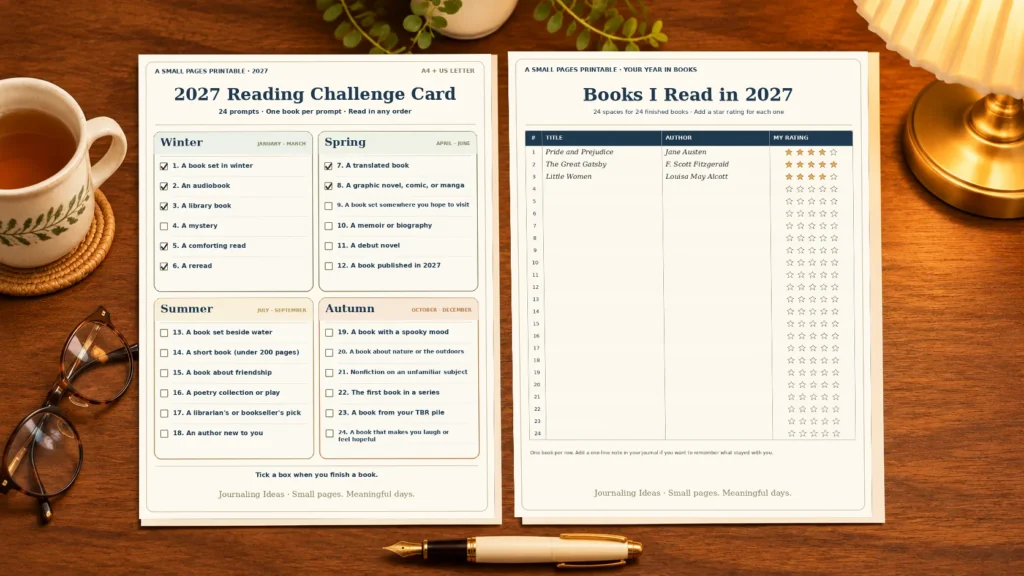
That pairing is the whole method. The card shows progress at a glance and keeps the year feeling possible; the log keeps the record you will actually want in December. Tick the box the day you finish a book, write the log row the same day, and the challenge mostly runs itself.
What Should You Review at Each Quarterly Check-In?
Every three months, take a few minutes to look back at your reading. The end of March, June, September, and December gives you four natural opportunities to review your progress. You can use these questions in a small journal entry:
- Which prompts have I completed? Look at the boxes you have ticked.
- Which books did I enjoy most? Revisit your star ratings.
- What surprised me? Think about an unexpected favorite, genre, or format.
- What would I like to read next? Choose one or two prompts for the coming months.
You can also look for patterns. Perhaps you discovered that you enjoy audiobooks more than expected. Maybe you found yourself choosing mysteries, reading more nonfiction, or borrowing books from the library. There is no need to change your reading habits just because the challenge suggests something different. If you are enjoying the books you choose, the challenge is doing its job.
Get the Free 2027 Reading Challenge Pack
Ready to start planning your reading year? The 2027 Reading Challenge Pack contains two printable sheets:
- 2027 Reading Challenge Card — All 24 reading prompts, six prompts for each season, a checkbox beside every prompt, a simple overview of the year. Download: A4 / US Letter
- Books I Read in 2027 — 24 numbered rows, space for each book’s title and the author’s name, and a five-star personal rating area. Download: A4 / US Letter
Both sheets are available in A4 and US Letter PDF. The pack is completely free, with no email signup or password required. Get the free 2027 Reading Challenge Pack in The Small Pages Library.
Printing Tips
For the best result:
- Select A4 or US Letter to match your paper.
- Choose Actual Size or 100% when the selected paper size matches the PDF.
- Check the print preview before printing.
- Use a slightly heavier paper if you want to keep the challenge card in your journal throughout the year.
You can print both sheets once and keep them together, or print another copy if you need extra room for your own reading notes.
Frequently Asked Questions
- What is the 2027 Reading Challenge? The 2027 Reading Challenge is a year-long reading activity with 24 prompts. Choose one different book for each prompt, giving you roughly two books to read each month. The prompts cover different genres, formats, settings, and moods.
- Do I have to read all 24 books? No. Twenty-four books is the main challenge, but you can adapt it to 12 books by choosing three prompts from each season. If you prefer 52 books, add 28 free-choice books to the original 24.
- Can I complete the reading prompts in any order or start after January? Yes. You can complete the prompts in any order and start at any point during 2027. The seasonal groups are there to organize the challenge, not to create deadlines.
- Do audiobooks, ebooks, and library books count? Yes. The challenge is about the books you choose, not the format. Printed books, ebooks, audiobooks, and books borrowed from a library can all count.
- Can one book count for more than one reading prompt? For this challenge, it is best to use one different book for each prompt. If a book fits several categories, choose the prompt that describes it best and save the other boxes for different books.
- Is the 2027 Reading Challenge printable free, and do I need to sign up? Yes. The free pack includes a 24-prompt challenge card and a matching 24-row reading log. Both are available in A4 and US Letter PDF formats in The Small Pages Library, with no email signup or password required.
A Year of Reading, One Book at a Time
A reading challenge should give you ideas, not another reason to feel behind. Choose a prompt, find a book that interests you, and record a little about what you read. Some months may bring several finished books; other months may bring just one. The important thing is that your reading year reflects the books you actually wanted to explore. Start with one prompt. Let the next book find its way to you.
Small pages. Meaningful days. — Journaling Ideas Editorial Team


4 Comments