Art Journal Prompts for Beginners: 24 Easy Ideas to Fill Your First Pages
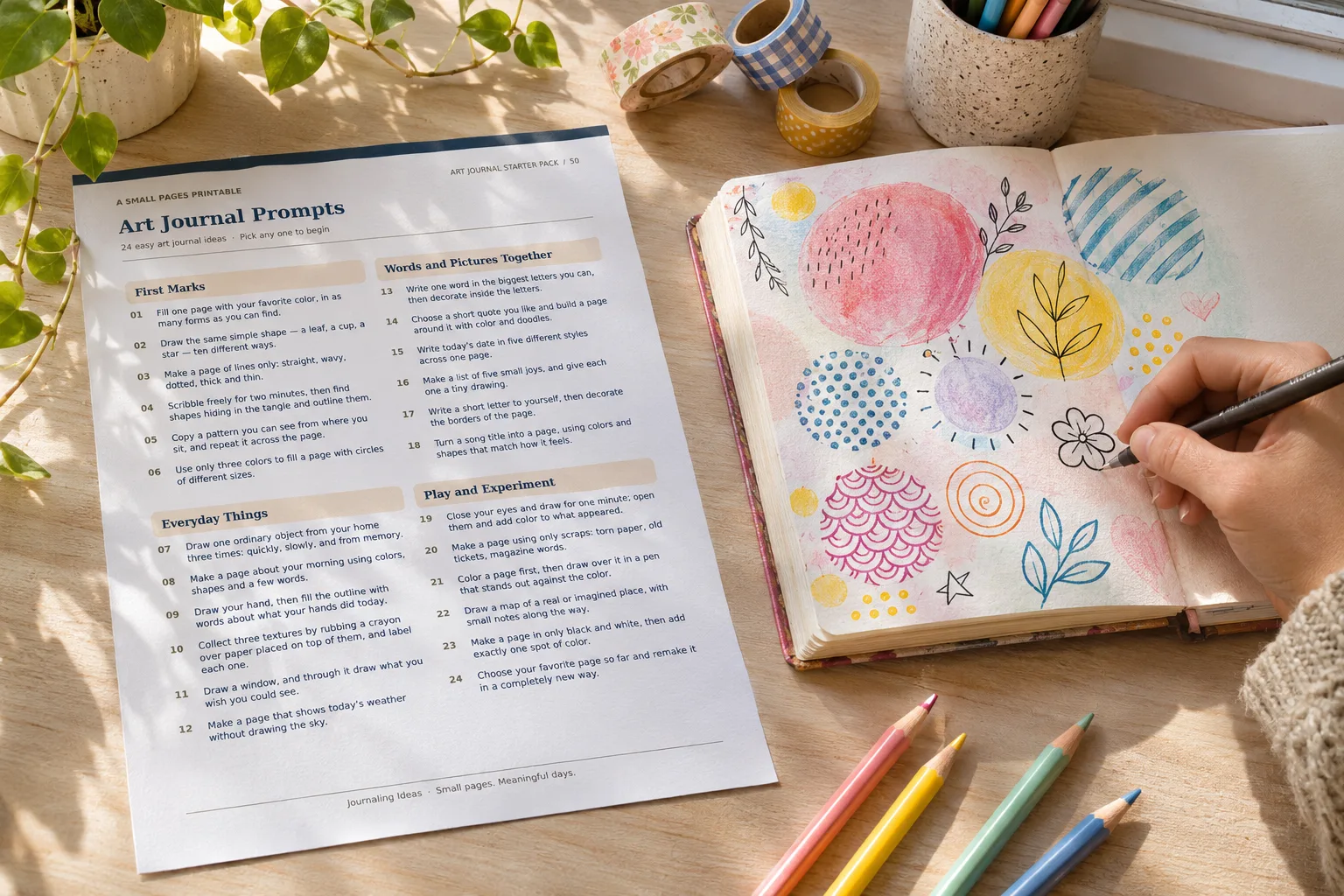
Art journal prompts for beginners are small drawing, color, collage, and lettering ideas that help you fill a page without needing to know how to draw. Begin with one shape, one color, or one ordinary object. The 24 prompts below offer four easy ways in, plus a free printable starter pack in A4 and US Letter.
These ideas begin with simple marks, move into things you can see around you, pair pictures with words, and finish with small experiments. Choose the page that sounds easiest, not the one that looks most impressive. You can work out of order, stop halfway through, or make one prompt stretch over several days.
What Is an Art Journal?
An art journal is a notebook or collection of pages where you explore ideas with pictures, color, textures, lettering, and sometimes words. Unlike a sketchbook devoted to drawing practice, an art journal can mix writing, collage, patterns, rubbings, and rough experiments on the same page. There is no required layout or finished style.
One page might hold three colored circles and a sentence. Another might be a torn-paper collage of a walk you took. A third could be nothing but thick and thin lines. If you made it to notice, explore, or express an idea, it belongs.
Art journaling is a playful personal creative practice, not art therapy or a substitute for professional mental health support. Its value here is simple: a gentle way to make something with the materials and time you have.
What Do You Need to Start an Art Journal?
You probably own enough to start already. A notebook, copy paper, or a few sheets folded together will hold a first page. Any pen or pencil can make the marks. If you have crayons, markers, or colored pencils, bring one or two; a full supply collection is unnecessary.
A few useful choices are:
- A surface: a blank notebook, mixed-media pad, scrap paper, or a printed practice sheet. Smooth paper is fine for dry materials.
- Something that makes marks: a pencil, ballpoint pen, crayon, highlighter, or colored pencil.
- Optional color: a small marker set, watercolor, or the leftover colored pens in a drawer. Test wet media on spare paper first.
- Optional collage pieces: clean packaging, ticket stubs, old magazine paper, tape, and glue stick.
- Something underneath: a scrap sheet or piece of cardboard to protect your table when using markers, glue, or rubbings.
Start with dry supplies if the paper is thin. Markers may bleed through; wet paint may buckle ordinary notebook paper. Neither means you used the journal incorrectly. Slip scrap paper behind your working page, or use thicker paper next time.
If collected scraps and layered ephemera appeal to you, our junk journal guide explores that related approach. An art journal can overlap with it, but you do not need to collect anything to begin.
How Can Beginners Use These Art Journal Prompts?
Pick just one prompt and give yourself permission to make a practice page. Five or ten minutes is enough to test an idea. You do not have to complete one prompt every day or make the pages in order.
Try this simple start:
- Choose one prompt. Select the easiest idea for the time and materials available.
- Put down a first mark. A dot, line, square, or patch of color removes the pressure of an untouched page.
- Repeat or change one thing. Make the shape smaller, switch a color, or add a tiny word.
- Stop when you want. Date the page if you like. A partly filled page is still a page you made.
Prefer writing first? The 150 journal prompts for beginners collection offers words-first starting points. For the list below, pictures and marks can do most of the work.
24 Art Journal Prompts for Beginners

First Marks
- Fill one page with your favorite color, in as many forms as you can find.
A gentle start: Try colored pencil, marker, torn paper, and a tiny label in that same color. Don’t worry about matching shades. - Draw the same simple shape — a leaf, a cup, a star — ten different ways.
A gentle start: Repeat the shape small, large, upside down, or with one continuous line. The differences are the point. - Make a page of lines only: straight, wavy, dotted, thick and thin.
A gentle start: Change your pressure and spacing as you go. A ruler is optional; wobbly lines still count. - Scribble freely for two minutes, then find shapes hiding in the tangle and outline them.
A gentle start: Circle a face, flower, animal, or completely imaginary outline. Let the marks suggest what comes next. - Copy a pattern you can see from where you sit, and repeat it across the page.
A gentle start: Look at a fabric, mug, notebook cover, or floor tile. Start with one repeat and keep going. - Use only three colors to fill a page with circles of different sizes.
A gentle start: Overlap the circles, leave some open, and color others in. Put your favorite combination in one corner.
Everyday Things
- Draw one ordinary object from your home three times: quickly, slowly, and from memory.
A gentle start: A spoon, shoe, or key will do. Notice what changes when you stop looking at the object. - Make a page about your morning using colors, shapes and a few words.
A gentle start: Choose the colors of your breakfast, commute, or quiet first moment. A few labels are enough. - Draw your hand, then fill the outline with words about what your hands did today.
A gentle start: Trace your non-drawing hand if that feels easier. Add verbs, tiny moments, or a single word in each finger. - Collect three textures by rubbing a crayon over paper placed on top of them, and label each one.
A gentle start: Try a coin, textured fabric, and a leaf. Use light pressure, and avoid delicate or uneven surfaces. - Draw a window, and through it draw what you wish you could see.
A gentle start: It can be a real place, a dream location, or a scene you invent. Add one small detail outside the frame. - Make a page that shows today’s weather without drawing the sky.
A gentle start: Think temperature, movement, and sound: sharp lines, soft patches, or drifting dots can all show weather.
Words and Pictures Together
- Write one word in the biggest letters you can, then decorate inside the letters.
A gentle start: Pick a word such as HOME, REST, or TODAY. Stripes and dots inside the letters make an easy start. - Choose a short quote you like and build a page around it with color and doodles.
A gentle start: Use a quote you own or are allowed to reproduce. You can copy a few meaningful words just for your journal. - Write today’s date in five different styles across one page.
A gentle start: Make the date tall, tiny, blocky, dotted, or handwritten. Treat the page like a lettering playground. - Make a list of five small joys, and give each one a tiny drawing.
A gentle start: Keep each illustration to a few strokes. A cup of tea can simply be a little oval and a handle. - Write a short letter to yourself, then decorate the borders of the page.
A gentle start: Write what you need to hear today. You can keep it private beneath a fold or a simple border. - Turn a song title into a page, using colors and shapes that match how it feels.
A gentle start: Use the title only, not the lyrics. A soft song might become curved shapes; a lively one, bold zigzags.
Play and Experiment
- Close your eyes and draw for one minute; open them and add color to what appeared.
A gentle start: Use a pencil or pen in a clear area. When you open your eyes, look for a line worth following. - Make a page using only scraps: torn paper, old tickets, magazine words.
A gentle start: Make sure your scraps are clean and dry. Layer them with tape or glue, then add one date or word. - Color a page first, then draw over it in a pen that stands out against the color.
A gentle start: Try a pencil wash or marker patch first. Once it dries, add stars, leaves, or a repeating black line. - Draw a map of a real or imagined place, with small notes along the way.
A gentle start: Map a favorite walking route or an invented tiny town. Mark a place to pause along the way. - Make a page in only black and white, then add exactly one spot of color.
A gentle start: Finish your black-and-white pattern before choosing the accent. One colored leaf or dot is plenty. - Choose your favorite page so far and remake it in a completely new way.
A gentle start: Change the size, palette, materials, or point of view. Remaking is practice, not a correction.
What If an Art Journal Page Goes Wrong?
A marker bleeds through. The colors clash. Your carefully drawn leaf looks like a potato. None of that has to end the page. There is no single correct result to protect, and learning what your supplies do is part of making art.
If you dislike a page, try one of these small repairs:
- Work over it. Add a new border, another layer of colored pencil, or a contrasting pattern. Let the earlier marks show through.
- Turn it into a collage base. Cover one area with a clean scrap of paper and draw or write on top.
- Cut out a part you like. Move a tiny pattern or color block to another page if your notebook allows it.
- Label the experiment. Write “I tried…” and note what happened. That turns an awkward result into a record of learning.
- Leave it alone. Some pages become easier to appreciate later; others simply remain practice.
If the medium physically damages your notebook, adjust the tools rather than blaming yourself. Let wet pages dry fully, put scrap paper beneath markers, and test glue or paint on an offcut. A page that crinkles can still be kept. Messy counts.
How to Use the Free Art Journal Starter Pack
The Art Journal Starter Pack is a free four-sheet Small Pages printable. There are eight PDF files in total: each sheet comes in A4 and US Letter. Pick the paper size you use at home, and print just the sheets that will help today. No signup or password is needed.
The four sheets work together, but none depends on the others:



- Sheet 1 — A4 (PDF)
- Sheet 1 — US Letter (PDF)
- Sheet 2 — A4 (PDF)
- Sheet 2 — US Letter (PDF)
- Sheet 3 — A4 (PDF)
- Sheet 3 — US Letter (PDF)
- Sheet 4 — A4 (PDF)
- Sheet 4 — US Letter (PDF)
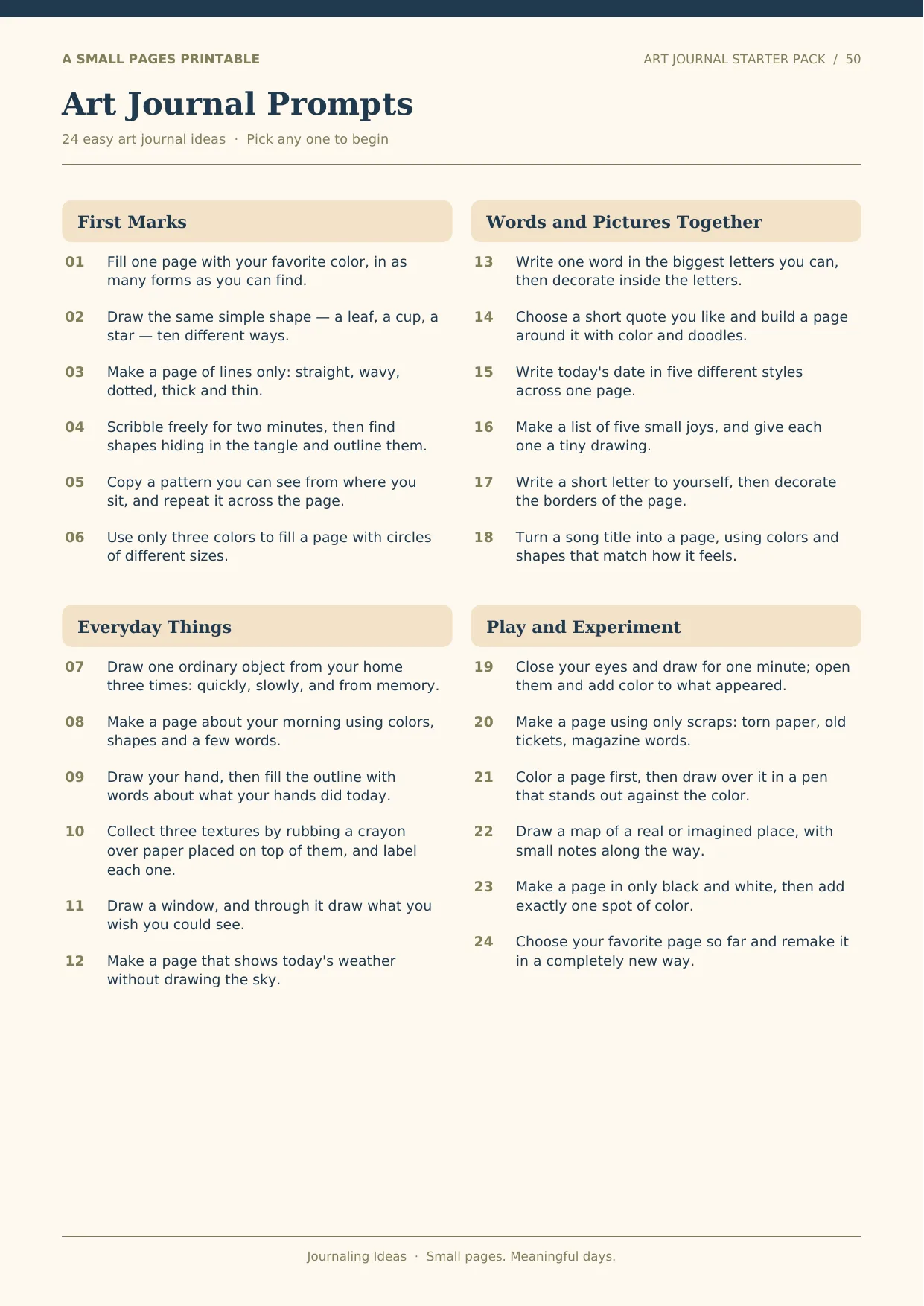
Sheet 1: Art Journal Prompts
The full list of 24 prompts appears in four groups: First Marks, Everyday Things, Words and Pictures Together, and Play and Experiment. Keep it beside your notebook, highlight a prompt you want to try, or choose one at random. You can repeat a prompt with different materials whenever it feels interesting.
Sheet 2: Color Play Page
Twelve empty swatch boxes leave room to test color combinations. Put a single color or a mix in each box, then use the small notes line under it to record the pen, pencil, shade, or idea you want to remember. This is useful if you are curious about colors but do not want to plan a whole page.
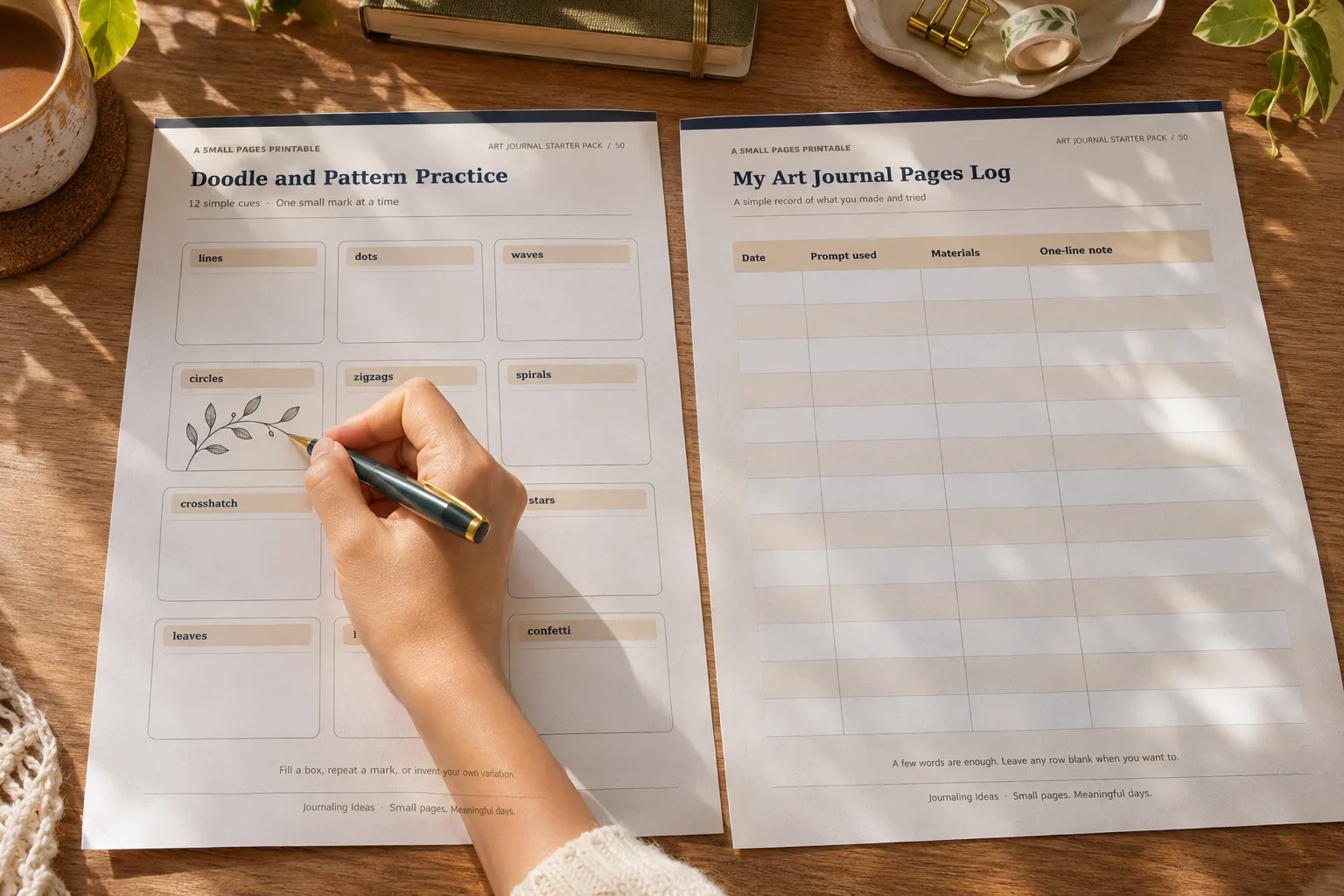
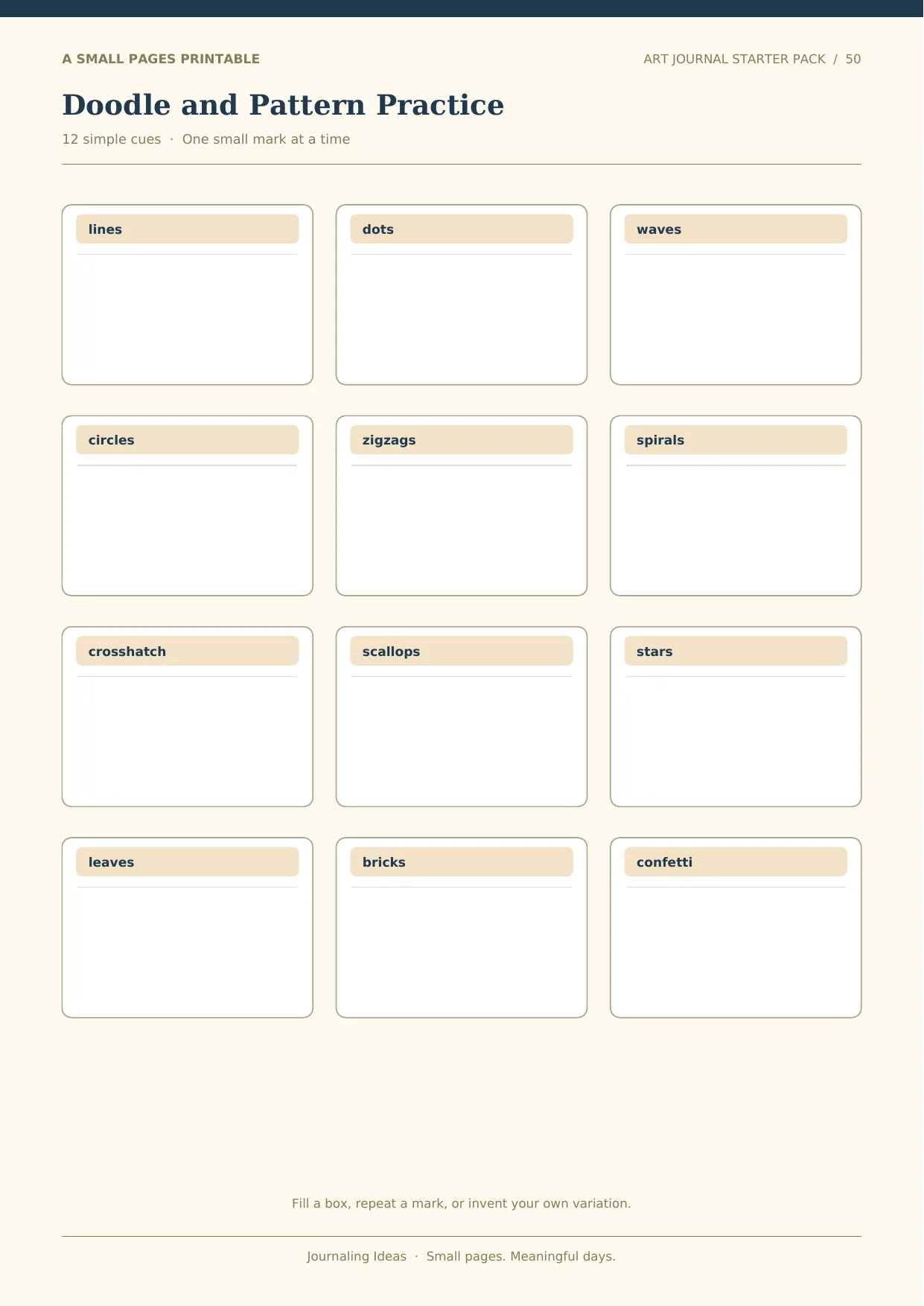
Sheet 3: Doodle and Pattern Practice
Twelve framed boxes each have a tiny starter cue: lines, dots, waves, circles, zigzags, spirals, crosshatch, scallops, stars, leaves, bricks, and confetti. Copy the idea, fill the square with variations, or use the cue as a suggestion and make something else. One box is enough for a quick sitting.
Sheet 4: My Art Journal Pages Log
Use the log if you like remembering what you made. There is a space for the date, prompt used, materials, and a one-line note. You might write “three crayons, loved the circles” or “pen was too dark.” Skip it if tracking makes the activity feel like homework.
Get the free pack: Visit The Small Pages Library and find Art Journal Starter Pack (bundle #50). Choose A4 or US Letter for each of the four sheets. The files are free to download, with no signup.
How Do You Print the Starter Pack?
Open the PDF for your paper size before printing. US Letter is 8.5 × 11 inches; A4 is 210 × 297 mm. Use the matching paper in the tray. In your printer dialog, choose Actual Size or 100% when the page preview fits your paper correctly, rather than allowing automatic enlargement or cropping.
Print a single test page first. The prompts list uses smaller type to keep all 24 items together, so a clear standard-quality print helps. If the type looks too small for you, zoom into the PDF on screen or print from a PDF reader that can enlarge it onto more than one sheet. The practice and log sheets have generous writing space.
Prefer words to pictures on some days? Our poetry journal prompts keep it just as low-pressure — short poems count, and nobody has to read them.
Frequently Asked Questions
What is an art journal?
An art journal is a place to explore ideas through doodles, color, collage, lettering, and writing. It can be a simple notebook, loose paper in a folder, or a collection of mixed-media pages. It does not have to look like a finished sketchbook.
Do I need to know how to draw to start an art journal?
No. Many of the prompts use repeated shapes, lines, color patches, simple lettering, or scraps. You can trace your hand, draw circles, or fill a box with dots. The point is to play with materials, not to prove drawing skill.
What supplies do I need for art journaling?
Paper plus any pencil or pen is enough. Add colored pencils, crayons, tape, or a glue stick if you already have them. More supplies are optional. Use a backing sheet and test wet materials if your notebook paper is thin.
How often should I make an art journal page?
As often as you enjoy. A few minutes once a week, a small page after work, or an occasional longer session all count. Repeating the same easy prompt can be more inviting than planning a daily challenge.
What if I ruin a page in my art journal?
You can layer over it, collage across it, cut out a favorite piece, or leave it as an experiment. If the paper tears or paint bleeds, try different paper or gentler supplies next time. One frustrating page does not spoil the journal.
Is the Art Journal Starter Pack free?
Yes. It includes four different sheets, each available in A4 and US Letter, for eight free PDFs in all. There is no email signup or password to download them from the Library.
Begin with One Small Page
You do not need to pick the perfect prompt or buy better supplies. Choose a color, make six circles, or sketch the cup on your desk. If a page ends halfway filled, leave it that way. You can always return, or start somewhere else tomorrow.
If you enjoy saving interesting sentences and quotations alongside images, a commonplace book is another gentle place to collect them. For now, the simplest next step is a single mark on paper — and the free starter sheets are there whenever you want a little structure.
Small pages. Meaningful days.
— Journaling Ideas Editorial Team
2 Comments