
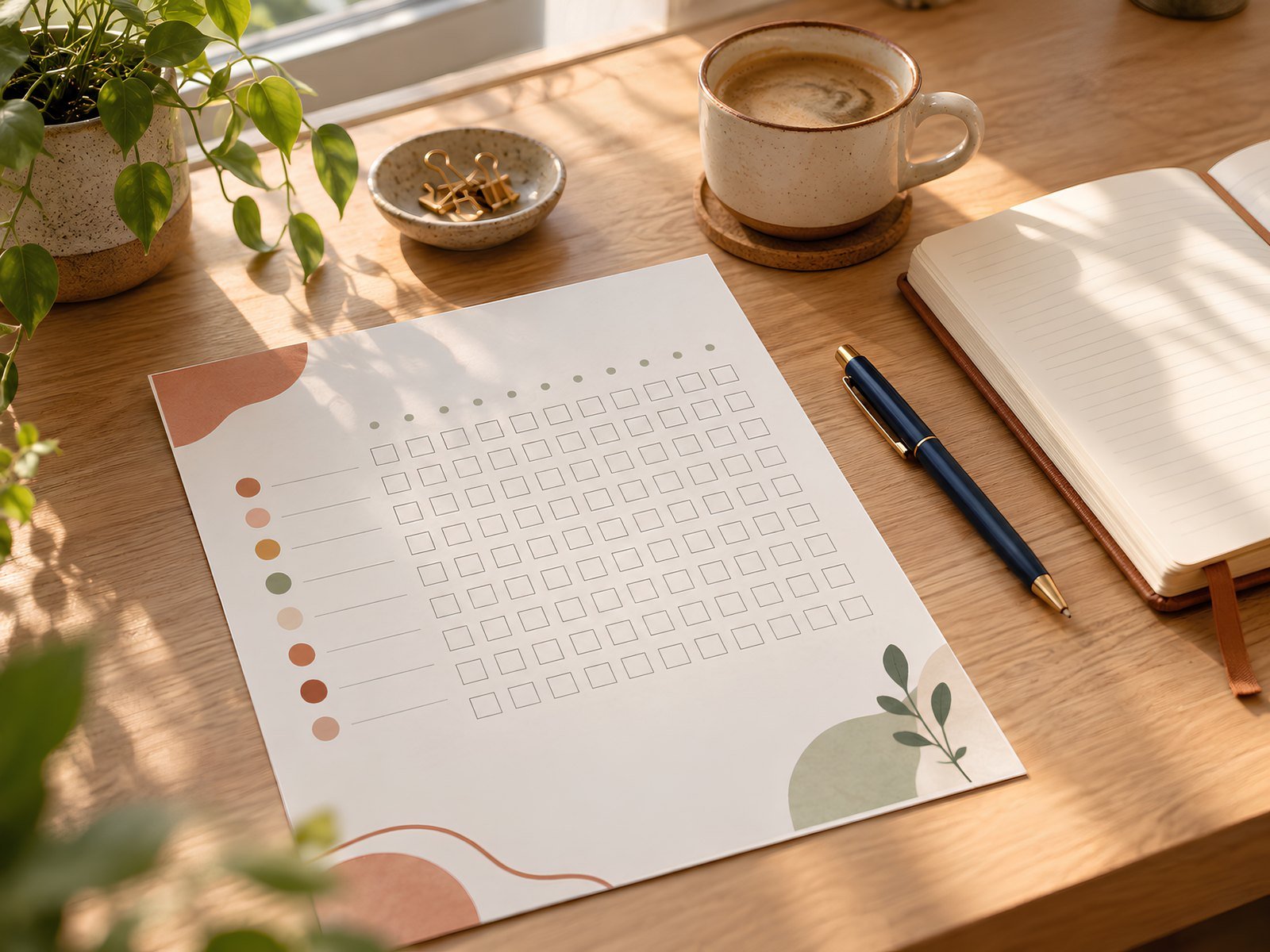
Free Habit Tracker Printable: 6 Layouts in A4 & US Letter
A habit tracker printable is a simple page for recording whether you completed a habit on a given day. Choose a monthly grid for an overview, a weekly page for a closer check-in, a daily page for today’s habits and priorities, or a focused 30-day or kids’ tracker. All six layouts below are free PDFs — five tracker types, with the weekly tracker in Monday-start and Sunday-start versions in A4 and US Letter — the Monthly tracker downloads instantly, and the rest live free in The Small Pages Library.
Busy weeks do not always need a complicated planning system. A simple tracker can give your intentions a visible place on paper without turning every day into a test. Start with the layout that fits your routine, then use the practical guide below to choose habits, print your page, and make tracking manageable.
Jump to: Compare the templates · Download the monthly trackers · Printing tips · FAQs
Get all 12 trackers free — in The Small Pages Library
The library is open — every tracker below, plus new printables every month, free in The Small Pages Library, no signup needed.
Choose Your Free Habit Tracker Printable
- Monthly Habit Tracker: Track up to 12 habits across one month.
- Weekly Habit Tracker: Track up to 10 habits on one page, with a weekly review box.
- Daily Habit Tracker: Bring today’s habits, top three priorities, and notes together.
- 30-Day Habit Challenge Tracker: Focus on one habit with milestones at days 7, 14, 21, and 30.
- Habit Tracker for Kids: Give children a simple seven-day chart with large boxes to mark.
In short: 5 tracker types, 6 layouts (the weekly tracker comes in Monday-start and Sunday-start), 12 PDF files — every layout in A4 and US Letter.
Every template is available as a free PDF in A4 and US Letter. The Monthly tracker below downloads instantly. The full set of 12 is free in The Small Pages Library — no signup needed.
Which Habit Tracker Template Should You Pick?
| Template | Best for | What it includes |
|---|---|---|
| Monthly | A month-at-a-glance view | One month grid, up to 12 habits, A4 + US Letter |
| Weekly | Short-term tracking and reflection | One week per page, up to 10 habits, weekly review |
| Daily | Planning one day at a time | Today’s habits, top three priorities, notes |
| 30-day challenge | One focused habit | 30 days, milestones at days 7, 14, 21, 30 |
| Kids’ tracker | Children’s routines | Seven days, friendly design, large boxes |
Not sure which one to choose? Start with the weekly habit tracker if you want to review and adjust your routine regularly. Choose the monthly version if seeing the whole month helps you stay organized. If one habit is your main focus, the 30-day challenge is a straightforward place to begin. You can change templates as your needs change. There is no requirement to use the same format indefinitely.
1. Monthly Habit Tracker
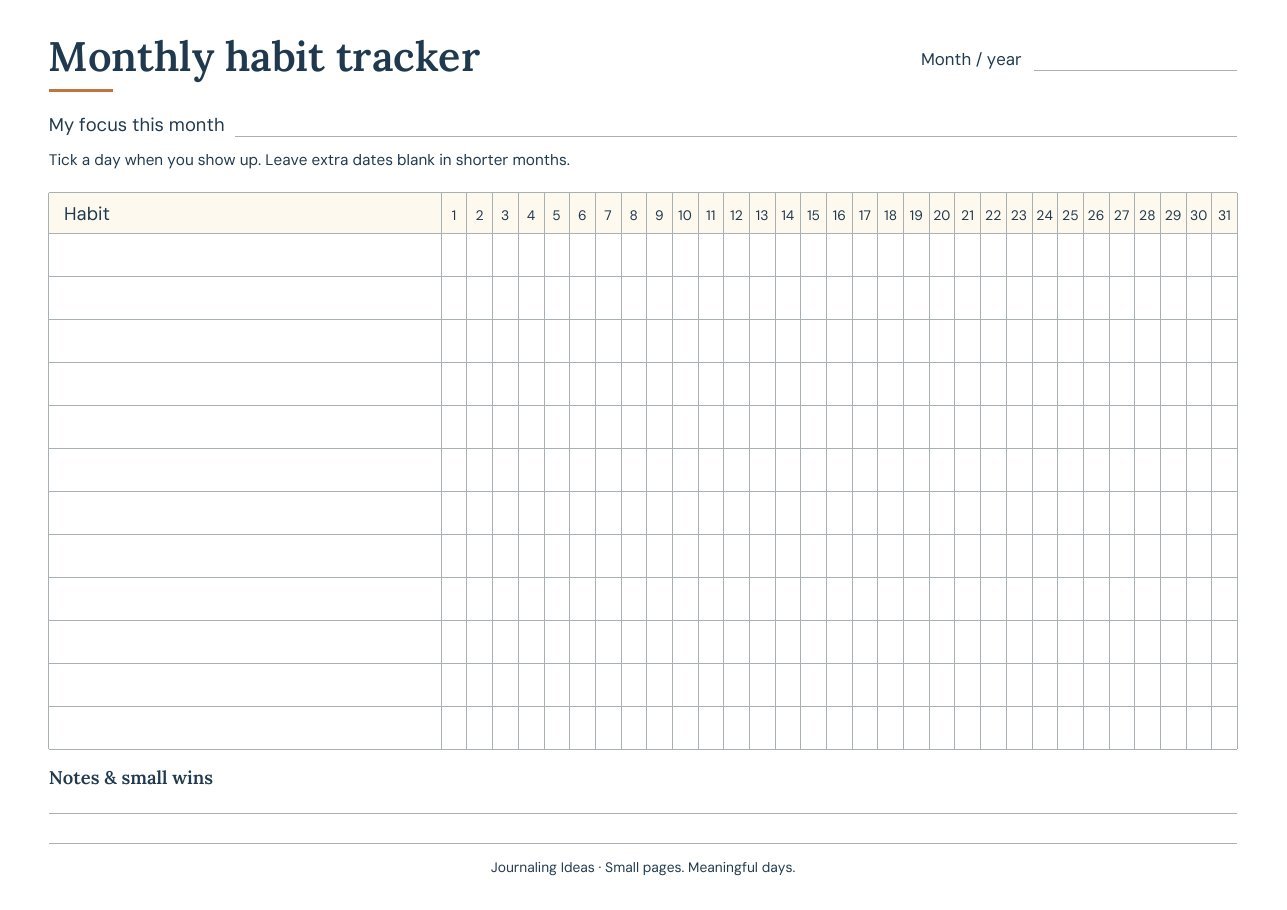
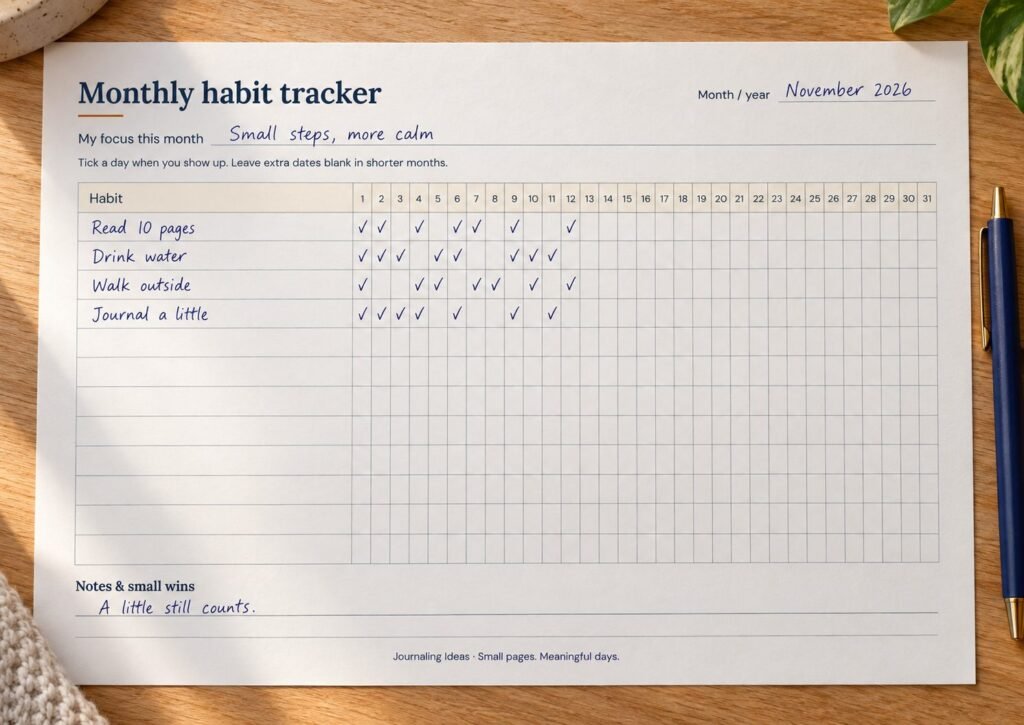
The monthly habit tracker gives you one month at a glance, with space for up to 12 habits. One landscape design works for any month: the dates are numbered 1 to 31 with no weekdays printed, so it fits whichever day your month starts.
Write your selected habits in the designated spaces and mark the corresponding day when you complete each one. At the end of the month, you can review the page to see which routines were consistent and which may need adjusting.
Best for: a full-month view, several simple daily habits on one page, and a reusable routine you can keep in a planner or journal.
Free PDF downloads: Monthly Habit Tracker (A4 PDF · 47 KB) · Monthly Habit Tracker (US Letter PDF · 47 KB)
2. Weekly Habit Tracker
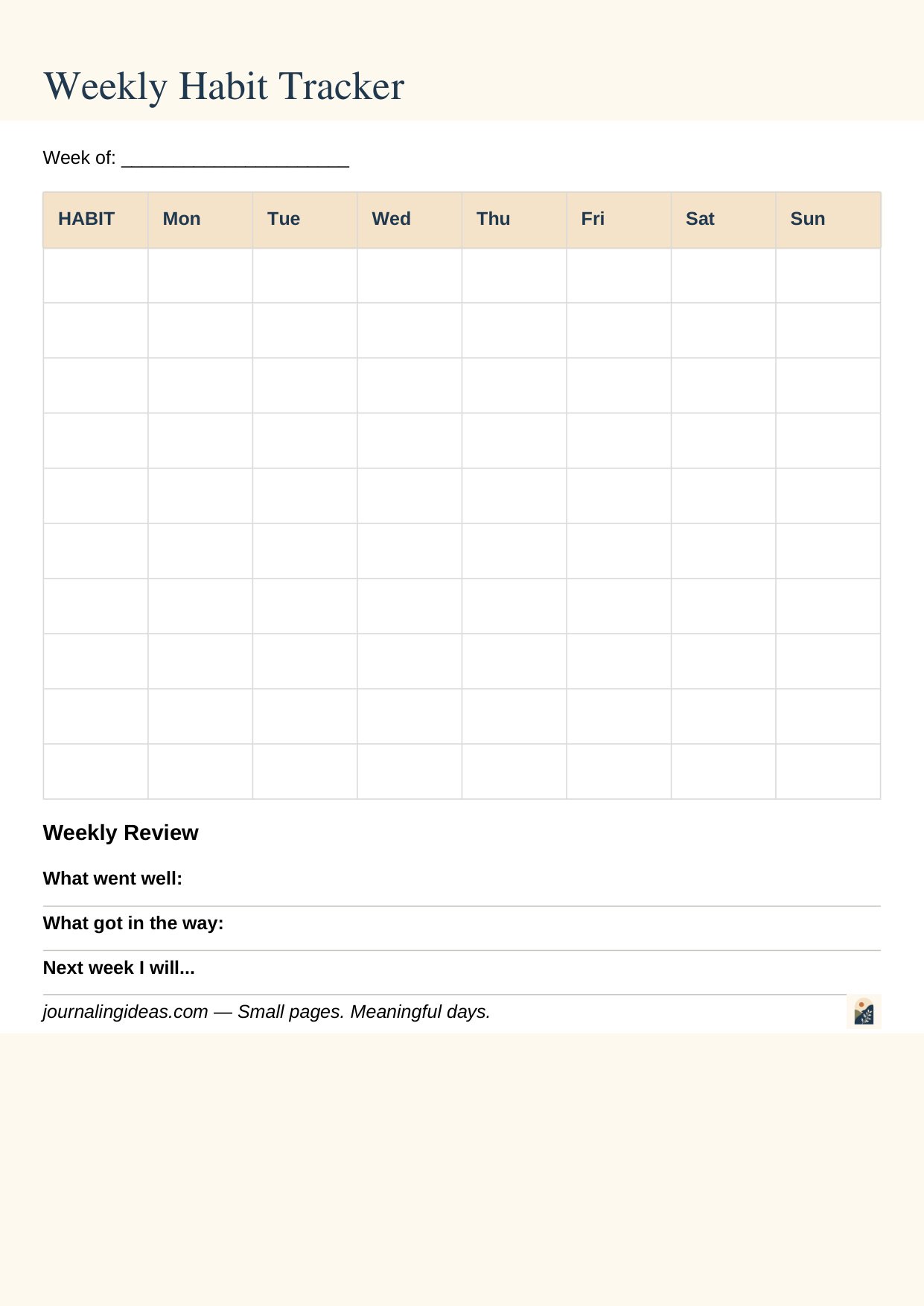
A weekly habit tracker gives you one week per page, space for up to 10 habits, and a dedicated weekly review box. It lets you focus on a shorter period instead of looking at an entire month.
Use the review box to note what went well, what interrupted your routine, and what you would like to change next week. A brief review is often more useful than simply counting completed boxes. For example, if you planned to read every evening but repeatedly forgot, you might place your book beside your bed or connect reading to your existing bedtime routine.
Best for: reviewing your routine every week, trying a new schedule, and reflecting on obstacles when a full monthly grid feels hard to maintain.
Choose a Monday-start or Sunday-start version according to your preferred weekly layout.
Available free in The Small Pages Library →
3. Daily Habit Tracker
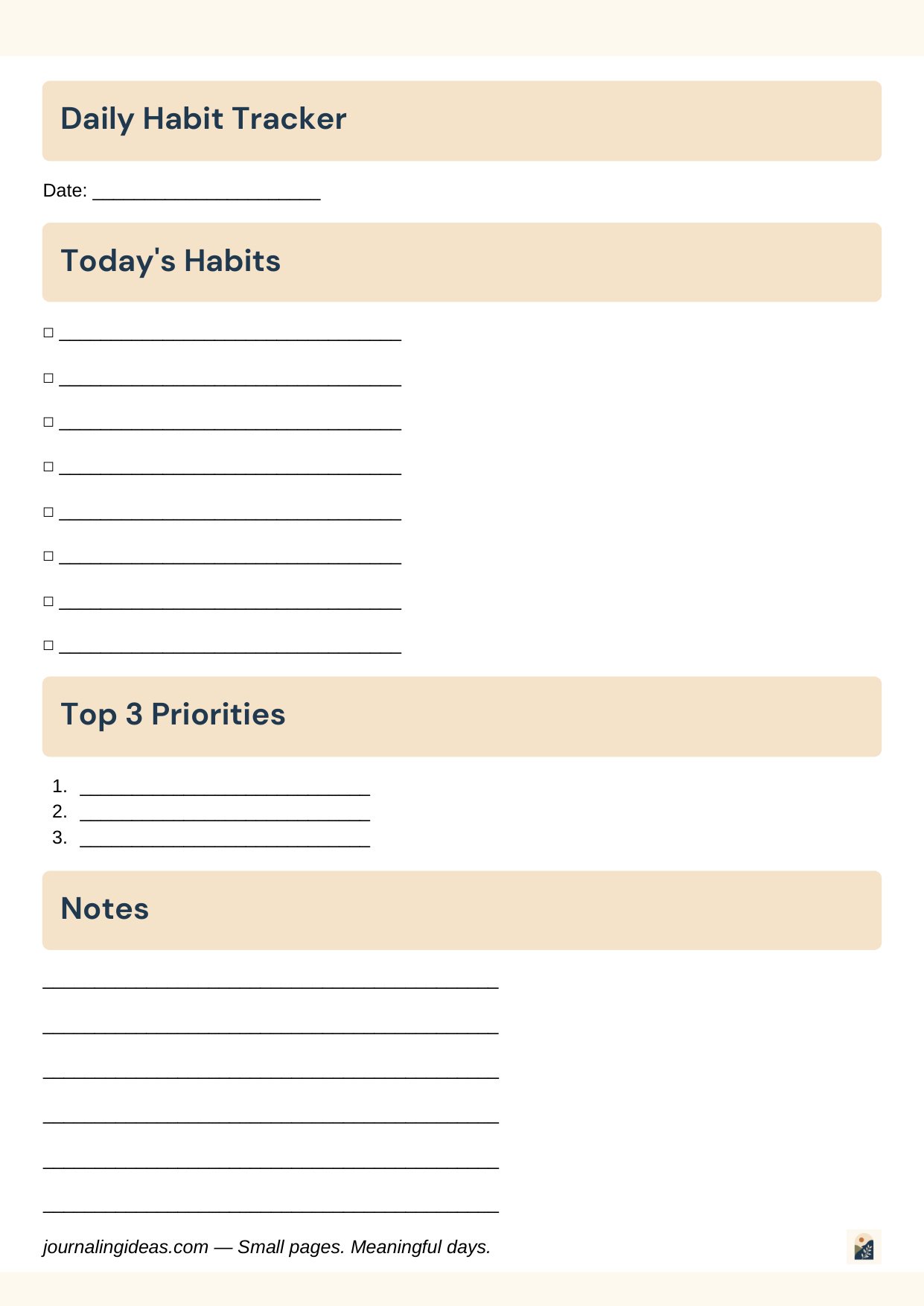
Sometimes a full month of boxes is more information than you need. The daily habit tracker focuses on one day at a time, with space for today’s habits, your top three priorities, and additional notes.
This layout brings habit tracking and daily planning together. You can decide which habits you want to practice, identify the most important tasks for the day, and leave yourself a short note about anything worth remembering. For example, your daily habits might include stretching, reading a few pages, or preparing tomorrow’s lunch. Your top three priorities can then hold the specific tasks that need attention that day.
Best for: a fresh daily plan, combining habits with your main priorities, and a little space for reflection when focusing on today beats facing a whole month.
Available free in The Small Pages Library →
4. 30-Day Habit Challenge Tracker
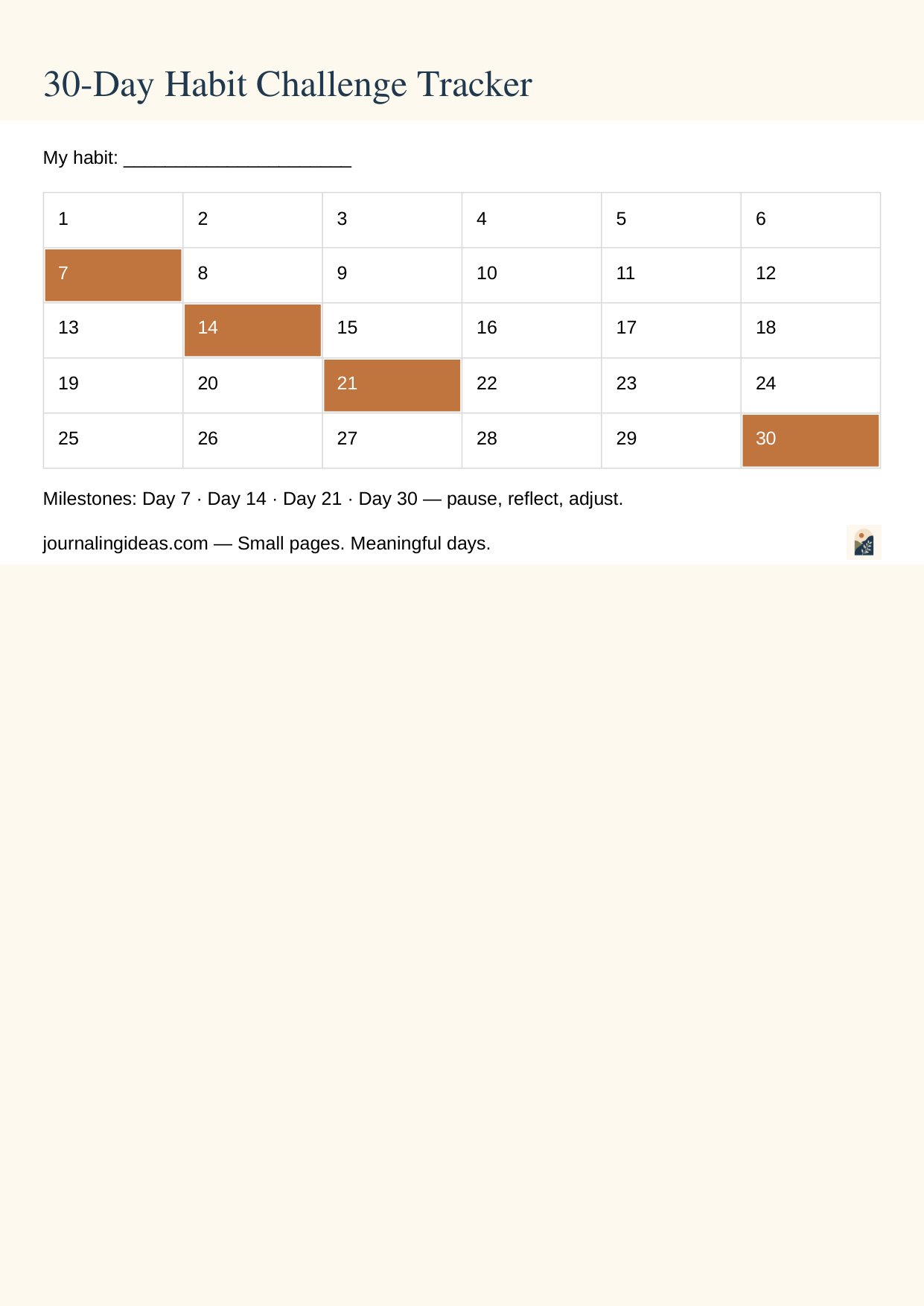
The 30-day habit challenge tracker is designed for one habit and 30 days of practice. Instead of dividing your attention between several routines, you can give one specific behavior your focus.
The template includes milestone markers at days 7, 14, 21, and 30. Use these checkpoints to pause and reflect on your experience rather than treating them as deadlines for achieving a particular result. For example, you might choose to read for ten minutes each day, write one journal entry, or spend a few minutes practicing a language.
At each milestone, ask yourself three simple questions:
- Is the habit small enough to fit into my normal day?
- What has made it easier or harder to complete?
- Is there anything I should change for the remaining days?
Thirty days is a useful tracking period, but it is not a guarantee that a habit will become automatic within that time. You can continue tracking after the challenge if the routine still needs attention. In a University College London study (Lally and colleagues, 2010), people took anywhere from 18 to 254 days for a new behaviour to feel automatic; among the participants whose results could be modelled, the middle estimate was about 66 days. A tracker does not create the habit — it makes your progress visible while you build it.
Best for: focusing on one specific habit, working toward a clear short-term milestone, and reviewing your experience at regular intervals on a dedicated challenge page.
Available free in The Small Pages Library →
5. Habit Tracker for Kids
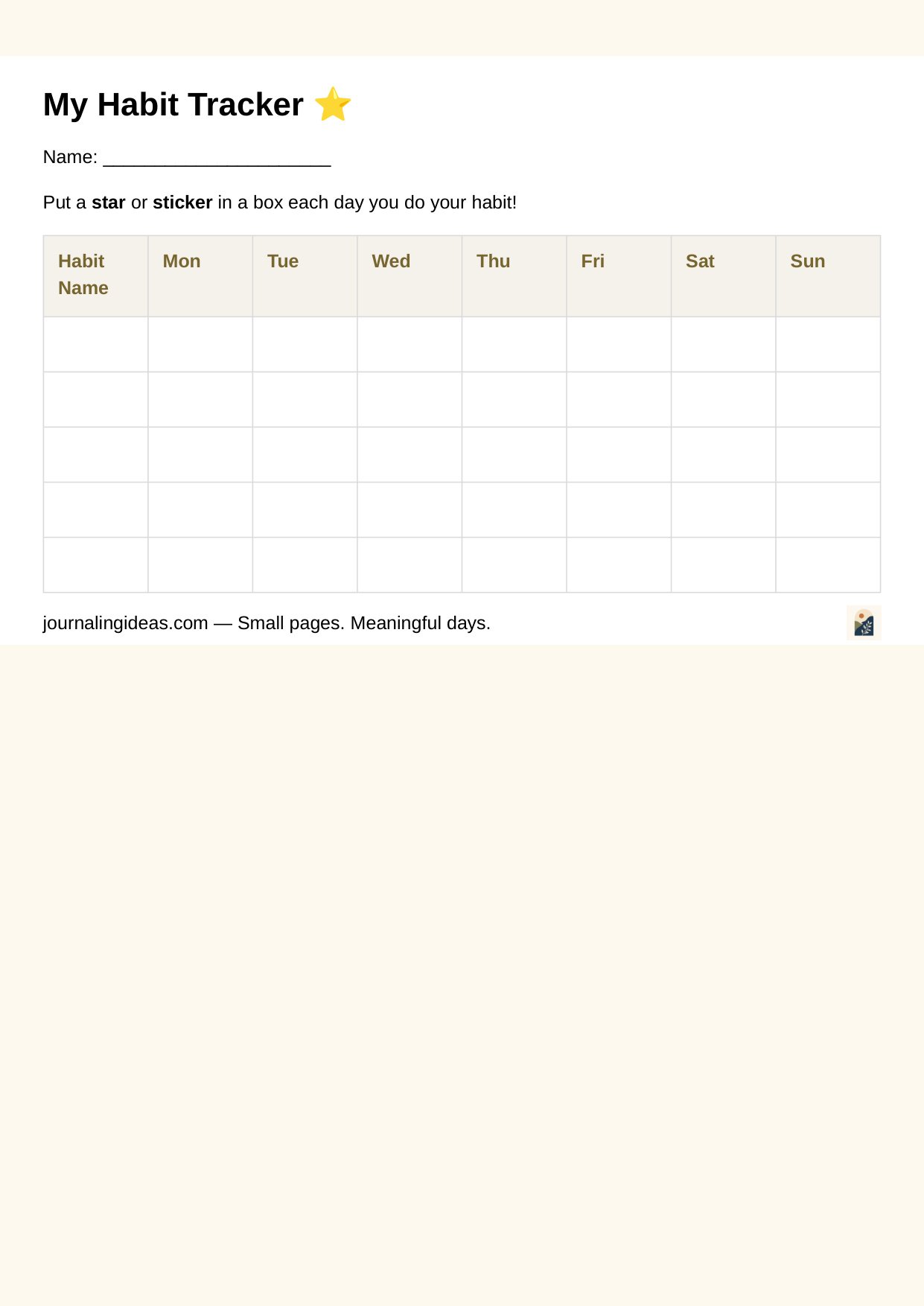
The kids’ habit tracker is a friendly seven-day chart with large boxes that are easy for children to mark. Parents can print the page and introduce it as a simple way to practice a routine throughout the week.
Choose one or two age-appropriate habits to begin with. Depending on the child and family routine, these might include putting toys away, choosing clothes for tomorrow, reading together, or placing school items in a backpack.
Keep the activity encouraging and practical. Explain what counts as completing the habit, let your child help choose a suitable routine, and recognize effort without expecting every box to be filled.
Best for: making a daily routine visible to a child, simple home-routine charts, and large marking spaces that parents can introduce and review with children.
Available free in The Small Pages Library →
What Is a Habit Tracker?
A habit tracker is a simple record of whether you completed a particular behavior over a chosen period. It might be a monthly grid, a weekly checklist, a daily page, or a dedicated challenge sheet.
You choose the habit, decide what counts as completing it, and record the result. Over time, the page can help you notice patterns in your routine. For example, a tracker might show that you regularly read on weekday evenings but rarely find time on weekends. That observation gives you something practical to work with: perhaps you need a different time, a smaller target, or a more realistic weekend plan.
A habit tracker is not a measure of your worth or a guarantee of success. Its purpose is to help you record what happened and decide what to do next.
What Habits Should You Track?
The most useful habit tracker ideas are specific enough to recognize when you have completed them. Rather than writing a broad goal such as “be healthier,” choose a small action that fits into your daily life. Here are ideas organized into five categories.
Health and Well-Being
Take a short walk · Stretch for five minutes · Fill your water bottle · Follow a consistent bedtime routine · Prepare a balanced lunch · Spend a few minutes outdoors. Choose habits that fit your circumstances and abilities. You do not need to track every aspect of your health on one page.
Home and Household
Spend ten minutes tidying one area · Put away items before bed · Reset the kitchen after dinner · Prepare tomorrow’s bag · Complete one small laundry task · Clear your desk before starting work. Household habits work well when you define a manageable action instead of trying to track an entire cleaning routine at once.
Mindfulness and Reflection
Write one sentence in a journal · Record one thing you appreciated today · Take a short breathing break · Spend a few minutes without your phone · Write down a thought you want to revisit · Reflect on one thing that went well. If you already enjoy journaling, a habit tracker can sit alongside your regular journal prompts and reflections.
Money and Personal Finances
Record today’s spending · Review your budget · Check upcoming bills · Review one recurring subscription · Transfer a planned amount to savings · Have a no-spend day when appropriate for your budget. Choose actions you can control. Tracking whether you reviewed your budget is different from tracking an outcome, such as whether an unexpected expense occurred.
Learning and Personal Growth
Read five pages · Practice a language for ten minutes · Complete one lesson · Review flashcards · Practice an instrument · Spend a few minutes learning a new skill. Keep the target clear and realistic. “Read five pages” is easier to record consistently than “become a better reader.”
How to Use a Habit Tracker Printable
Step 1: Choose a Small Number of Habits. Begin with one to three new habits if you are unsure where to start. This is a practical starting suggestion, not a universal rule. Choose routines that matter to you and fit your current schedule. You can add more later if the process feels manageable.
Step 2: Define What Counts as Done. Make each habit specific enough that you can answer yes or no. Instead of “exercise more,” write “take a 10-minute walk.” Instead of “journal regularly,” write “write three sentences.” Instead of “keep the house clean,” write “tidy the kitchen counter.” A clear definition makes it easier to mark your tracker honestly.
Step 3: Connect the Habit to a Routine. Think about when and where the habit could happen. You might read after breakfast, stretch after brushing your teeth, or review your spending after dinner. Connecting a new action to an existing routine can make it easier to remember. Choose a cue that fits your actual schedule rather than an ideal version of your day.
Step 4: Select the Right Template. Use the monthly tracker for a broad overview, the weekly tracker for regular reviews, or the daily page when you want to combine habits and priorities. Choose the 30-day challenge for one focused habit. For children, use the simple seven-day tracker with large boxes.
Step 5: Put the Page Somewhere Visible. Keep your printable where you are likely to notice it: inside your planner, on your desk, beside your journal, or in another convenient place. A tracker that stays tucked away may be easy to forget.
Step 6: Record Your Progress. Mark the appropriate box when you complete the habit. A check mark, dot, or small colored mark is enough. You do not need elaborate decorations or a perfect streak. Make the tracking process as simple as possible.
Step 7: Review and Adjust. At the end of the week or month, look for patterns. Which habits were easiest to complete? When did I tend to miss them? Was my target realistic? Would a different time or reminder help? Should I keep, adjust, or pause a habit? Use your answers to improve the next week or month. The goal is to create a routine that works in real life, not just one that looks attractive on paper.
Printing Tips: A4 and US Letter
The free habit tracker PDFs are available in A4 and US Letter sizes. Choose the version that matches the paper you normally use.
Paper choice: Standard printer paper is suitable for everyday tracking. Slightly heavier paper is useful if you prefer a sturdier page for a binder or frequent handling. Cardstock suits a children’s chart you want to display, provided your printer supports it.
Before printing: Download the correct A4 or US Letter PDF · Open the file in a PDF viewer and check the page preview · Select the matching paper size in your printer settings · Print at the document’s intended size when your printer’s printable area allows it · If content is clipped, check the margins and use an appropriate fit-to-page setting · Print one test page before printing multiple copies.
You can use a pen, pencil, highlighter, or colored markers to record progress. If you want to save ink, choose a black-and-white printing option when available. For monthly and weekly templates, keep the page somewhere you can access it easily. If you use a binder or planner, store completed pages together so you can look back at previous weeks or months.
Common Habit Tracking Mistakes to Avoid
Tracking Too Many Habits at Once. A page with room for 12 habits does not mean you need to fill every row. Start with a manageable selection and add habits only when you are ready.
Choosing Vague Habits. A goal such as “improve my life” is difficult to mark as complete. Choose a small action that has a clear definition.
Expecting a Perfect Streak. Missing a day does not mean you have to abandon the routine. Leave the box blank, consider what happened, and continue at the next opportunity.
Tracking Outcomes You Cannot Fully Control. Some results depend on circumstances outside your control. Track the action you can take, such as preparing for a task or practicing a skill, rather than treating every outcome as a pass-or-fail measure.
Making the System Too Complicated. If filling in your tracker takes longer than doing the habit, simplify it. A basic check mark can be enough.
Never Reviewing the Page. Tracking without reflection can become a repetitive task. Use the weekly review box or a few lines in your journal to decide what to keep or change.
Giving Up When the Layout Does Not Fit. If a monthly grid feels crowded, try a weekly or daily format. If a daily page feels like too much paperwork, switch to a simpler grid. The template should support your routine rather than become another obligation.
Frequently Asked Questions
How many habits should I track at once?
If you are new to habit tracking, start with one to three habits and see how manageable they feel. You can add more once you have a comfortable routine. The best number depends on your schedule, the habits you choose, and how much tracking you want to do.
What should I do if I miss a day?
Leave the box blank and resume at the next opportunity. You do not need to restart the entire month or challenge. If you repeatedly miss the same habit, consider making it smaller or changing when you do it.
Is a paper habit tracker better than a digital tracker?
Neither format is best for everyone. Paper is useful if you enjoy writing by hand and want a visible page in your planner or on your desk. A digital tracker may suit you better if you want phone reminders, automatic counts, or access across devices. Choose the format you are most likely to use.
Can I use a monthly habit tracker for different habits each month?
Yes. You can choose a new set of habits whenever you begin a new tracking period. Reviewing the previous month before changing your list can help you decide what to continue, simplify, or replace.
Are these habit tracker printables free?
Yes — every tracker is free. The monthly tracker (A4 and US Letter) downloads instantly with no email; the rest are free in The Small Pages Library, no signup needed.
Can I print a habit tracker for my child?
Yes. The kids’ habit tracker is designed as a simple seven-day chart with large boxes. Parents can choose an age-appropriate routine, explain what counts as completion, and use the chart as an encouraging visual reminder.
Does a 30-day habit challenge guarantee that a habit will stick?
No. Thirty days is a tracking period, not a guarantee of habit formation. Some routines take longer to become familiar or automatic. Use the milestone markers to reflect on your experience and continue tracking if the habit still needs practice.
Make Your Habit Tracker Work for You
The best habit tracker printable is the one that fits your routine and is simple enough to use consistently. A monthly grid offers a broad overview, a weekly tracker makes reflection easier, a daily page combines habits with priorities, and a 30-day challenge focuses on one behavior. The kids’ version offers a simpler starting point for family routines.
Choose one of the six free layouts, print it in A4 or US Letter, and begin with a small, specific habit. Review your progress when it is useful, make adjustments without judgment, and let the page support your routine rather than dictate it.
Explore the free printable library for more pages to print. If you are new here, start with our journaling and planning guide.
Ready to start? Download the free habit tracker printable that suits you, or save this guide for your next planning session.
Get all 12 trackers free — in The Small Pages Library
The library is open — every tracker above, plus new printables every month, free in The Small Pages Library, no signup needed.
You’ll also love
📌 Save this post to your Habit Tracker Printables board on Pinterest so you can find it every month.
3 Comments