
Journal Prompts for Self-Discovery: 40 Questions to Know Yourself Better
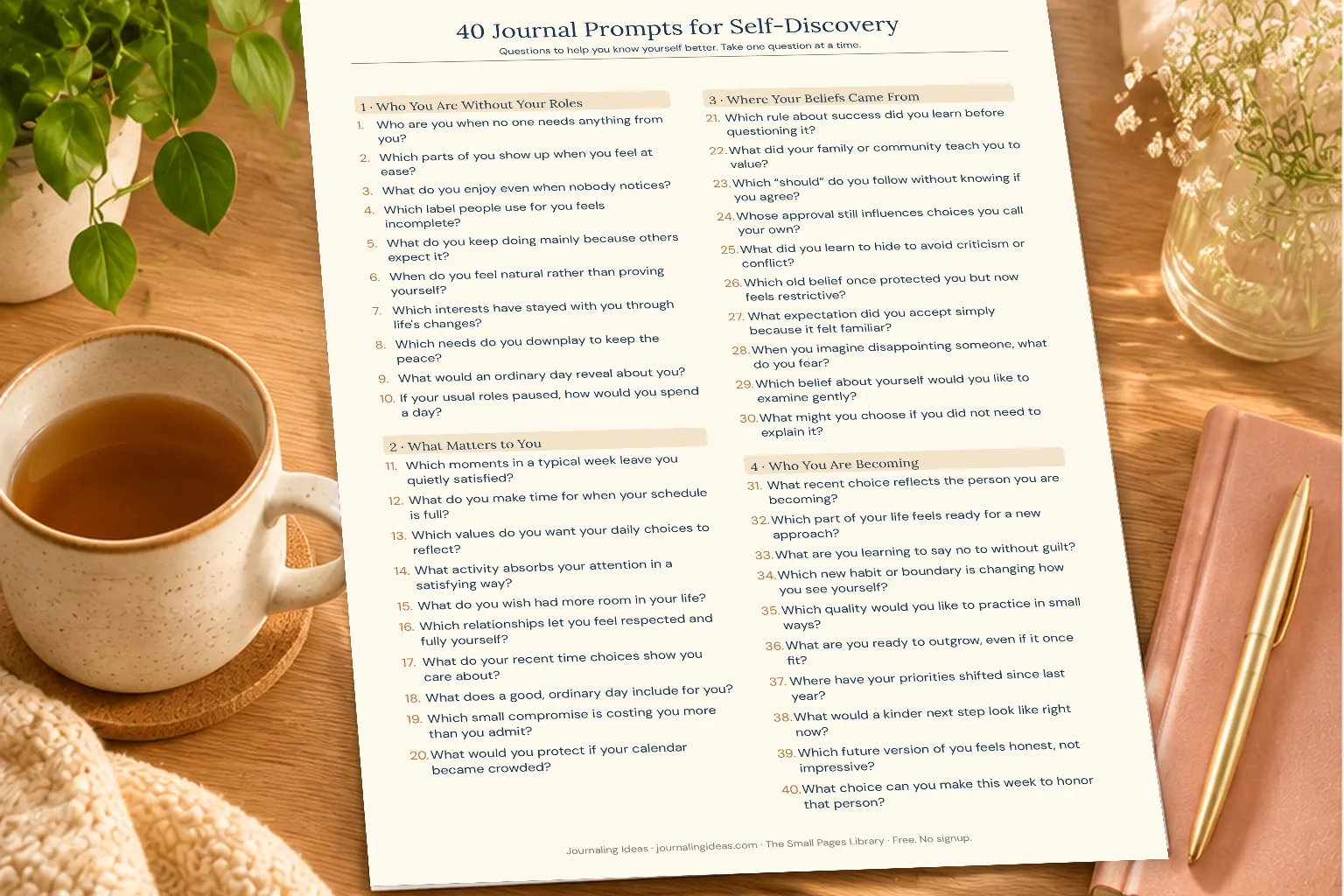
Journal prompts for self-discovery are focused questions about your identity, values, beliefs, and changing priorities. This list brings together 40 original questions in four groups, so you can start with one area and write at your own pace. A free one-page printable is available in A4 and US Letter.
Sometimes, knowing yourself better starts with asking different questions.
You might know what you do every day, what other people expect from you, and which responsibilities fill your schedule. But how often do you stop to consider what you actually want, what matters to you, or which beliefs are genuinely your own?
Self-discovery journaling gives you a little space to explore those things.
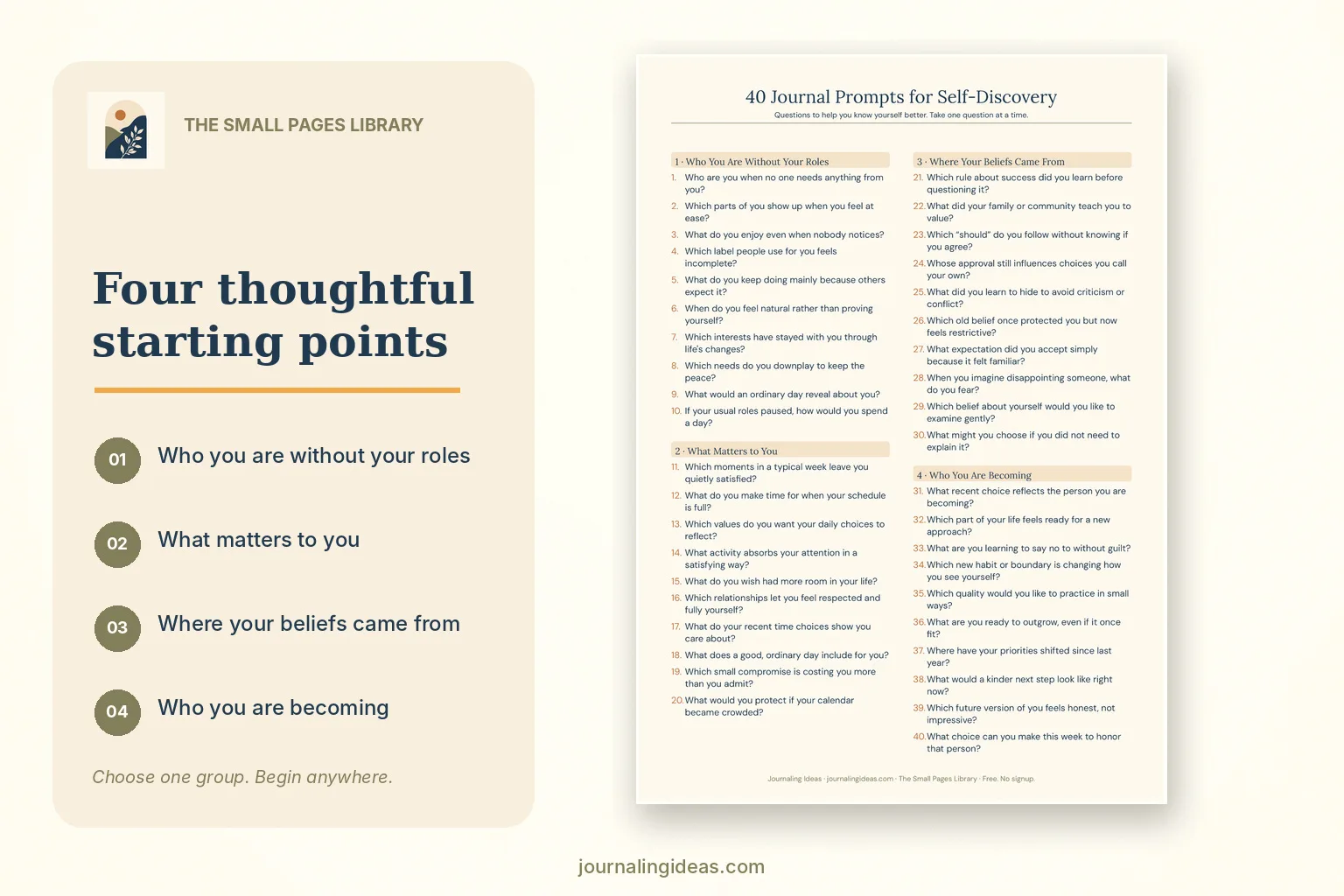
These 40 questions are organized into four areas:
Who You Are Without Your Roles: Look beyond jobs, labels, and other people’s expectations.
What Matters to You: Explore your values, interests, and priorities.
Where Your Beliefs Came From: Examine old stories, inherited expectations, and the rules you follow.
Who You Are Becoming: Reflect on personal changes and the direction of your recent choices.
You do not need to answer everything in one sitting. Start with one question that feels relevant today.
How to Use These Journal Prompts for Self-Discovery
You do not need a special journal, an elaborate routine, or a perfect answer. A notebook and a little quiet time are enough.
Try this simple approach:
1. Choose one question. Read through the four groups and select a question that catches your attention. You do not have to begin with number one.
2. Give yourself 5–10 minutes. Write honestly rather than trying to produce an impressive or perfectly organized answer. Include specific experiences, everyday decisions, and things you have not previously put into words.
3. Let the answer develop. Your first thought might not be your complete answer. If something else comes to mind, keep writing.
4. Allow uncertainty. You might not know what you want, how you feel, or why a particular expectation influences you. That is okay. Not reaching a clear answer is useful information too.
You can write “I don’t know yet” and return to the question another day.
A gentle note: These questions are for personal reflection, not therapy. They are not a diagnosis or a substitute for professional care. Skip anything that feels too personal, pause when you need to, and seek appropriate professional support if you are dealing with something that requires more than journaling.
40 Journal Prompts for Self-Discovery
The following questions are arranged in four groups. Each group explores a different part of understanding yourself, so you can choose the area that feels most useful.
1. Who You Are Without Your Roles
Our roles can be useful, but they do not tell the whole story. These questions look at what you enjoy, what feels natural, and which parts of yourself are easy to overlook when you are busy meeting expectations.
- Who are you when no one needs anything from you?
- Which parts of you show up when you feel at ease?
- What do you enjoy even when nobody notices?
- Which label people use for you feels incomplete?
- What do you keep doing mainly because others expect it?
- When do you feel natural rather than proving yourself?
- Which interests have stayed with you through life’s changes?
- Which needs do you downplay to keep the peace?
- What would an ordinary day reveal about you?
- If your usual roles paused, how would you spend a day?
2. What Matters to You
Your values can become easier to recognize when you look at ordinary choices rather than ideals. Notice where your time goes, what leaves you satisfied, and what you wish you had more room to do.
- Which moments in a typical week leave you quietly satisfied?
- What do you make time for when your schedule is full?
- Which values do you want your daily choices to reflect?
- What activity absorbs your attention in a satisfying way?
- What do you wish had more room in your life?
- Which relationships let you feel respected and fully yourself?
- What do your recent time choices show you care about?
- What does a good, ordinary day include for you?
- Which small compromise is costing you more than you admit?
- What would you protect if your calendar became crowded?
3. Where Your Beliefs Came From
Some expectations arrive so early that they can feel like facts. These questions invite you to notice which rules and assumptions you inherited, which still fit, and which deserve a second look.
- Which rule about success did you learn before questioning it?
- What did your family or community teach you to value?
- Which “should” do you follow without knowing if you agree?
- Whose approval still influences choices you call your own?
- What did you learn to hide to avoid criticism or conflict?
- Which old belief once protected you but now feels restrictive?
- What expectation did you accept simply because it felt familiar?
- When you imagine disappointing someone, what do you fear?
- Which belief about yourself would you like to examine gently?
- What might you choose if you did not need to explain it?
4. Who You Are Becoming
You do not need a fixed picture of your future self. These questions focus on small choices, changing priorities, and the qualities you want to practice in the life you are already living.
- What recent choice reflects the person you are becoming?
- Which part of your life feels ready for a new approach?
- What are you learning to say no to without guilt?
- Which new habit or boundary is changing how you see yourself?
- Which quality would you like to practice in small ways?
- What are you ready to outgrow, even if it once fit?
- Where have your priorities shifted since last year?
- What would a kinder next step look like right now?
- Which future version of you feels honest, not impressive?
- What choice can you make this week to honor that person?
How to Make Sense of Your Answers
Answering a question is one part of reflection. Taking a little time to look back at what you wrote can help you organize your thoughts.
You do not need to turn every entry into a lesson or a decision. Instead, try these simple approaches.
Look for repeated ideas. When you read several entries together, notice words, situations, or preferences that appear more than once. Perhaps you repeatedly mention wanting more quiet time, feeling comfortable around certain people, or wishing you had more time for a particular interest. Treat these observations as things to explore, not permanent descriptions of who you are.
Notice the difference between what you want and what you feel expected to want. For example, you might write about a goal you have been pursuing and realize that the reason behind it is mostly an expectation you have carried for a long time. You do not have to abandon that goal. Simply noticing the difference is a worthwhile starting point.
Choose one small thing to act on. If your answers suggest something you would like to change, consider one manageable step. That might mean protecting a little time for an interest, reconsidering a commitment, or making room for an activity you have been postponing. You do not need to redesign your entire life after one journaling session.
Let your answers change. Your priorities, circumstances, and interests can change over time. An answer that feels right today does not have to become a permanent rule. You can return to the same question in a few weeks and see whether your perspective has shifted.

Get the Free Self-Discovery Journal Prompts Printable
Want to keep all 40 questions somewhere you can return to?
The complete list is available as a one-page Small Pages printable, with all four groups and all 40 questions together.
The printable comes in A4 PDF and US Letter PDF.
Keep it inside your journal, print another copy when you need one, or choose a different question whenever you want a fresh starting point.
Find the complete list in The Small Pages Library.
Free. No signup.
If you have been using the forty prompts in this article to explore who you are, you might enjoy giving those discoveries somewhere to live. A vision board journal for 2027 turns what you have learned about yourself into images, words and small actions, organized across eight life areas. You can build it one page at a time, with twenty-four prompts and a monthly check-in to keep it honest. The Vision Board Journal Pack is free in The Small Pages Library, complete with four printable pages, in A4 and US Letter. Free. No signup.
If you’re exploring who you are and what you want to make room for next, you might also enjoy our 2027 rebrand journal guide. It takes self-discovery a step further with 24 gentle prompts to reflect on where you are, let go of what no longer fits, describe who you are becoming, and collect small daily proof. The free four-sheet printable kit includes the 24-prompt list, a More Of / Less Of page, a My 2027 Identity page, and a 90-Day Rebrand Tracker.
Frequently Asked Questions
How many self-discovery prompts should I answer at once?
Start with one question. You can explore several if you have more time, but there is no need to complete all 40 in one sitting. One thoughtful answer can be enough for a journaling session.
How long should I spend answering each question?
Try 5–10 minutes per question. Write until you feel you have explored the thought enough for now. You can always return to it later.
What if I cannot think of an answer?
Do not force one. Write what comes to mind, even if it is simply “I’m not sure yet.” You might need more time, a different question, or a real-life experience before the answer becomes clearer.
Do I need to answer the prompts in order?
No. The four groups provide a helpful structure, but you can start wherever you feel most comfortable. Choose the question that feels relevant to your life right now.
Can I use these prompts in a digital journal?
Absolutely. You can type your answers in a notes app, digital journal, or document. Keep the four groups together if you want to revisit your reflections and notice how your answers change.
Can self-discovery journaling replace therapy?
No. Journaling can be a personal reflection practice, but it is not a replacement for therapy or professional mental health support. If you need help working through difficult feelings or experiences, consider speaking with a qualified professional.
If you’d like to look a little deeper while keeping the pace gentle, explore our shadow work journal prompts. This beginner-friendly collection includes 30 questions about everyday reactions, habits, preferences, and small moments we sometimes hide. Choose one question at a time, skip anything that doesn’t feel right, and stop whenever you like. The free Shadow Work Starter Pack also includes a pattern tracker, an unsent letter page, and a grounding page.
You do not have to figure everything out today. One honest answer is a perfectly good place to begin.
Small pages. Meaningful days.

6 Comments