
50 Gratitude Journal Prompts for November (Plus a Free Printable List)
These 50 gratitude journal prompts offer a gentle way to notice November’s small comforts, supportive people, and everyday kindness. Choose one question, write a few honest sentences, and stop after five minutes. Use the five themed groups in any order, or follow the printable checklist throughout the month.
November can hold several feelings at once. There may be soft afternoon light, cold mornings, warm food, and plans to gather. There may also be tiredness, complicated relationships, or evenings when finding something good feels difficult.
Your notebook has room for all of it.
These gratitude journal prompts are invitations to notice something specific without pretending the rest of your day was easy. You do not need a beautiful journal, a cheerful mood, or an impressive answer. A reliable kettle, a friend’s message, or a quiet place to sit can be enough for one entry.
The questions below include autumn details and a group for giving, kindness, and Thanksgiving week. You can use every section whether you celebrate Thanksgiving, observe another tradition, or simply want a quieter November evening.
Printable companion: The full 50-prompt checklist is free in The Small Pages Library, no signup needed, in A4 and US Letter.
On this page: Choose a group · How to use these prompts · A gentle November start · Home, family and friends · Small comforts and the senses · Hard days, lessons and growth · Giving, kindness and Thanksgiving week · Beginner mistakes · Free printable checklist · FAQs

Choose a group for tonight
You do not have to start at the beginning. Choose the group that fits the kind of attention you have available this evening.
| Group | Prompt numbers | Choose it when… |
|---|---|---|
| A gentle November start | 1–10 | You want an easy first entry or a seasonal starting point. |
| Home, family and friends | 11–20 | You want to notice comfort, connection, or practical support. |
| Small comforts and the senses | 21–30 | You would rather begin with something you can see, hear, taste, smell, or touch. |
| Hard days, lessons and growth | 31–40 | You want room for mixed feelings and modest signs of support. |
| Giving, kindness and Thanksgiving week | 41–50 | You want to reflect on generosity, gathering, or appreciation. |
The groups are starting points, not categories you must fit into. A question about home might lead to a memory of a library. A question about friendship might bring a neighbor, colleague, or online community to mind.
If a topic feels uncomfortable, move to another section. You can also leave a question unanswered. Choosing what belongs on your page is part of making the practice your own.
How to use these gratitude journal prompts in five minutes
We suggest a short evening routine because it gives you a clear place to begin and end. Use another time if evenings are busy, exhausting, or unpredictable. The useful routine is the one that fits your actual day.
Keep your notebook and a working pen near somewhere you already pause. That might be beside your bed, at the kitchen table, or in your bag. There is no need to arrange a special desk before you can write.
Minute one: arrive and choose
Write the date, then choose one question. Read it once without trying to produce a polished answer.
If deciding feels like extra work, take the next unused question. If that question does not suit your day, move on. You are choosing a doorway into an entry, not taking a test.
Let your first thought be ordinary. An answer about having clean socks is just as welcome as an answer about a meaningful relationship.
Minutes two to four: write something specific
Use the gratitude journal prompts to find one moment, then describe what made it matter. Two or three sentences are plenty.
For example, this is a possible entry, rather than a personal story:
“I appreciated the hot soup at lunch. My hands were cold, and having something warm to eat gave me a comfortable pause between tasks.”
The detail makes the entry yours. “Food” becomes a particular bowl, at a particular moment, for a particular reason.
You can write fragments, use bullet points, or cross things out. Spelling and handwriting do not need attention here. Try to keep writing time for noticing rather than editing.
Minute five: finish without adding another task
Read your entry once. Underline a detail you want to remember, if you like, and close the notebook.
You do not need to end with a lesson, an action plan, or a promise to improve tomorrow. A finished entry can simply record what was there.
If one sentence is all you have, let it be the whole entry. Messy counts. Brief counts, too.

A gentle November start
These gratitude journal prompts begin with ordinary November moments: a little light, a familiar routine, or something that made today easier. You do not need to feel especially thankful before choosing one. Start with what you noticed.
- What small thing made the first few minutes of your day easier this November?
- Where did you notice autumn light today, and what did you appreciate about that moment?
- What is one ordinary thing you can rely on as the mornings become colder?
- Which part of your daily routine feels especially welcome at this time of year?
- What do you appreciate about the place where you are beginning this month?
- Which small moment from today would you like to keep before it slips from memory?
- What are you glad you made time for this week, even briefly?
- What familiar object has been quietly useful to you this November?
- What can you appreciate about a day that was mostly ordinary?
- What would you like to notice more often during the rest of this month?
Keep your first answer close to today
A first entry does not need to explain your whole life. Try staying within the last day or two, especially if a broad question makes your mind go blank.
For prompt eight, you might choose a dependable umbrella, a lunch container, or a lamp beside your chair. Describe its actual use. Perhaps the umbrella kept your notebook dry, or the lamp made a dark corner comfortable enough for reading.
If your surroundings do not look particularly autumnal, write about the November you have. You do not need fallen leaves, crisp weather, or a cozy room to use a seasonal list.
You can also write about something you nearly overlooked. The first available seat on a busy journey or a task that went smoothly may feel more honest than a grand statement. Small observations are enough to begin.
Home, family and friends
These gratitude journal prompts make space for the people and places that offer comfort. Family can mean relatives, chosen family, or neither. Read “home” as whatever place gives you some room to settle, even if your circumstances are temporary.
- Which corner of your living space offers a little comfort on a cold evening?
- Who has made an everyday task feel lighter recently, and what did they do?
- What meal, recipe, or food tradition connects you with someone you care about?
- Which conversation left you feeling heard, included, or pleasantly understood this month?
- What quality do you appreciate in a friend that you sometimes forget to name?
- Who gives you room to be quiet, imperfect, or fully yourself?
- What shared memory feels warm to return to as the evenings grow darker?
- Which small household convenience are you especially glad to have this week?
- What do you appreciate about a connection you maintain across distance?
- What kind of welcome have you received that you would like to remember?
Let relationships be complicated
Appreciating one thoughtful action does not require describing a whole relationship as easy. You can value a meal someone prepared while also acknowledging that a gathering felt tiring.
Keep the entry focused on the action you mean. “They checked that I got home” is clearer than feeling obliged to write that someone is always supportive.
If family questions bring up grief, distance, or tension, choose a friend, neighbor, teacher, colleague, or community space instead. You do not need to explain that choice on the page.
A connection can also be small and familiar. Someone remembering your usual order or making room for you at a table may be worth recording. Write only what feels true, without adding a happier ending for the sake of the exercise.

Small comforts and the senses
These gratitude journal prompts invite you to begin with something concrete. A sound, texture, or taste can give your entry a clear starting point when a large question feels difficult. Choose whichever senses are available and comfortable for you.
- What warm food or drink did you enjoy recently, and which detail made it satisfying?
- What sound made your surroundings feel pleasant or companionable today?
- Which soft, sturdy, or familiar texture brought you comfort on a chilly morning?
- What seasonal color caught your attention outside a window or along your usual route?
- Which scent reminded you of a comforting place, meal, or time?
- What did you appreciate about stepping into warmth after being outside?
- Which simple ingredient made something you ate this week more enjoyable?
- What small patch of nature could you notice from where you spent your day?
- Which practical item helped you feel more comfortable in November’s weather?
- What quiet pleasure did you enjoy without needing to buy anything new?
Describe the detail before the meaning
You can begin an entry with description and let the meaning arrive afterward. Write “the mug warmed my fingers” before trying to explain why that pause mattered.
For a color prompt, you might describe a yellow leaf against wet pavement or the deep blue of an early evening sky. There is no need to turn the observation into a metaphor.
Sensory entries can also stay entirely practical. A coat with a useful pocket, a less scratchy blanket, or a meal with a pleasing texture can be the whole subject.
If one question does not fit your access, preferences, or surroundings, substitute another detail. You might write about a comfortable temperature instead of a scent, or a visible movement instead of a sound. The aim is to notice your experience, not reproduce somebody else’s idea of a perfect autumn evening.
Hard days, lessons and growth
These gratitude journal prompts leave room for days you would not choose to repeat. You are not required to appreciate pain, find a benefit in loss, or make a difficult experience sound worthwhile. Look for support or relief only where you can honestly find it.
- What made a difficult part of today even slightly more manageable?
- Which boundary helped protect your time or energy this month?
- What have you learned about the kind of support you prefer to receive?
- When did you allow yourself a needed pause instead of pushing through?
- What useful skill helped you handle a small problem recently?
- Which expectation have you softened that no longer needs so much of you?
- What can you acknowledge about your own effort, even if the result was unfinished?
- Who or what offered a moment of steadiness during an uncertain week?
- What are you glad you asked for, clarified, or admitted you did not know?
- What part of a hard day can remain hard while you also name one small comfort?
Leave room for an unfinished answer
Some entries will end with uncertainty. You might know that a friend helped without knowing what you need next. You might appreciate a quiet evening and still feel disappointed about the day.
Both can stay on the page.
For prompt thirty-seven, describe the effort itself: making a phone call, showing up, or stopping when you had reached your limit. You do not need to measure it against someone else’s capacity.
If this group feels too close to something painful, return to the small comforts section. You can choose an easier question without having to work through the harder one first.
A gentle note: Gratitude journaling is a reflective practice, not therapy or medical advice. It does not require you to dismiss difficult feelings or continue with a question that feels unhelpful.

Giving, kindness and Thanksgiving week
These gratitude journal prompts focus on appreciation, generosity, and gathering. Thanksgiving can provide a seasonal moment for reflection, but celebration is optional. Use this group during an ordinary November week if the holiday is not part of your life.
- What everyday act of kindness did you notice someone offering another person?
- Whose behind-the-scenes work helped make a meal, gathering, or ordinary day possible?
- What have you received recently that could not be wrapped or bought?
- Which person would you like to thank for something specific, and what would you name?
- What small act of care were you able to offer within your own limits?
- What do you appreciate about a gathering, shared meal, or quiet alternative that suits you?
- Which tradition feels meaningful to keep, adapt, or begin this November?
- What have you learned from someone whose daily life differs from your own?
- What resource, skill, or bit of time could you share comfortably, if you choose?
- Looking back over November, what ordinary kindness would you like to carry into next month?
Appreciation does not have to become an obligation
You can write a thank-you without sending it. You can notice generosity without promising to give more than you can comfortably offer.
If you use prompt forty-four, name the action clearly. A sentence such as “Thank you for staying while I finished clearing the table” gives the appreciation a recognizable shape. It does not need to become a long letter.
For a gathering prompt, a quiet alternative counts. You might appreciate eating something familiar alone, keeping plans small, or spending part of the day outside.
If Thanksgiving is not your tradition, there is nothing to replace or imitate. Write about an ordinary shared meal, a community activity, or a kindness you noticed on your usual route. The question is there to serve your evening, whatever that evening contains.

Make the list fit a 30-day month
There are fifty questions because choice is useful. You are not expected to complete fifty entries in November.
One option is to choose thirty questions and leave the others for another time. Another is to move between groups whenever your attention changes. You can also return to a question you have already answered and notice what is different.
Try choosing a loose rhythm rather than assigning every date in advance. Start with seasonal observations, visit the relationship questions when you feel like reflecting on connection, and keep the comfort questions available for tired evenings.
If you miss several days, write the current date on your next page. There is no need to reconstruct entries you did not want to write.
For a notebook with a little structure, our November bullet journal ideas can help you make space for a brief daily note. Keep the layout simple enough that using it takes less effort than preparing it.
Beginner mistakes that can make writing harder
A gratitude practice can become another task to get right if too many rules gather around it. Watch for these common sticking points, and make the page easier when one appears.
Trying to sound positive
An entry does not need to sound cheerful. If your day was frustrating, you can say so before describing the one thing you appreciated.
Replace a sweeping sentence such as “Everything worked out perfectly” with something narrower and more believable. You might write that the afternoon was difficult, but having dinner prepared made the evening simpler.
Honesty gives you somewhere real to begin.
Choosing an answer that is too broad
Words such as “home,” “friends,” and “health” may matter deeply, but they can leave a beginner unsure what to write next.
Choose one detail inside the broad answer. Describe the friend who listened without interrupting or the chair where you could rest your feet.
You are not required to explain everything a subject means to you. One scene is enough for tonight.
Treating the list as homework
The numbering helps you find a question again. It does not create a deadline.
You can skip, repeat, or stop partway through the list. If you are using the checklist, an empty box simply marks a question you have not used yet.
Avoid adding several entries to catch up unless you actually want to spend that time writing. Tomorrow’s page does not depend on completing yesterday’s.
Comparing your page with someone else’s
A photograph of a journal cannot tell you what the writer needed from that evening. Decoration may be enjoyable, but it is optional.
Start with the notebook you already have. Our bullet journal guide for beginners offers a simple place to begin if you would like basic page structure.
Leave room for uneven lines, short answers, and ordinary handwriting.
Tracking more than you want to track
If remembering to write is the main difficulty, a small reminder may be useful. You can mark the evenings you wrote on a habit tracker printable.
Keep the mark neutral: it records that you wrote, not whether you were sufficiently grateful. Leave missed days blank and continue when you want to return.
You can also skip tracking entirely. The entry itself may be enough.
Use the free printable checklist
The printable gathers the same fifty questions into their five groups, with a tick box beside each one. It is a reference list rather than a set of writing pages, so you can keep your answers in any notebook.
The complete list is free in The Small Pages Library, no signup needed, in A4 and US Letter. Open The Small Pages Library and choose the paper size that matches your printer.
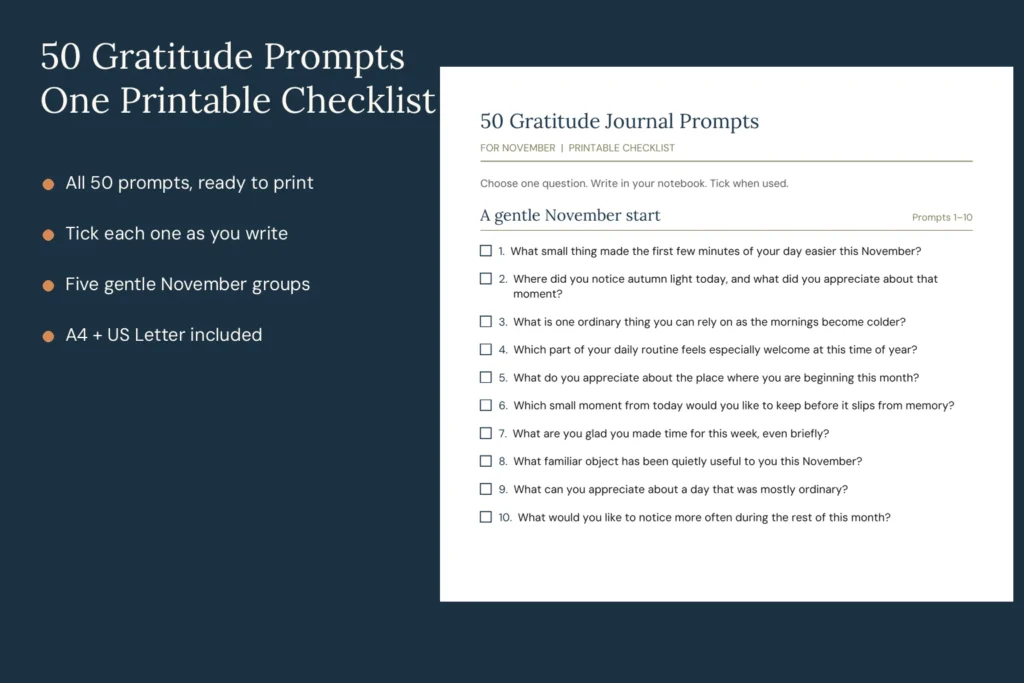
You can keep the checklist beside your notebook, fold it into a journal pocket, or refer to it on a screen. Tick a question after using it if that helps you find a new starting point.
Leave a box empty when you want to return to that question. There is no score attached to finishing the sheet.
Start with one honest sentence tonight
Choose the question that feels easiest to answer, rather than the one that seems most meaningful. Write the date, name one detail, and give yourself permission to stop.
If you want a wider choice beyond November, explore our 150 journal prompts for beginners. You can move between seasonal questions and other topics as your interests change.
For tonight, an ordinary moment is enough: something warm, someone thoughtful, or a small part of the day you would like to remember.
Small pages. Meaningful days.
Frequently asked questions
What are gratitude journal prompts?
Gratitude journal prompts are questions that help you notice and write about something you appreciate. They can focus on people, practical support, small comforts, or everyday experiences. Choose one question and answer it honestly; a single sentence is enough to begin.
How many prompts should I answer each evening?
Start with one. You can write a few sentences during a five-minute pause, then stop. Answering several questions is optional, and you do not need to complete the whole list.
Can I use these November prompts if I do not celebrate Thanksgiving?
Yes. Most questions focus on ordinary November experiences. The final group includes kindness, shared meals, and appreciation, so you can use it without observing Thanksgiving or attending a gathering.
What should I write when I have had a bad day?
Choose something small that genuinely helped, such as a useful item, a quiet pause, or practical support. You can also acknowledge that the day was hard. Skip the entry if writing feels unhelpful.
Is it okay to appreciate the same thing more than once?
Yes. Familiar comforts and dependable people can appear repeatedly. If you want to explore the answer further, describe a different moment or detail. Repetition does not make your appreciation less valid.
How do I get the free printable list?
The full 50-prompt checklist is free in The Small Pages Library, no signup needed, in A4 and US Letter. Open The Small Pages Library and select the version that matches your paper size.
Morning writer instead? Our dream journal for beginners guide has a two-minute morning routine, 30 prompts and a free printable log.
2 Comments