
Monthly Reset Journal: A Gentle Routine to Close One Month and Begin the Next
A monthly reset journal is a simple, paper-based ritual for closing one month and opening the next. You look back at what happened, notice what you learned, let go of what no longer fits, and choose a gentle focus for the month ahead. It is reflection and planning—not a productivity test.
A new month gives you a natural opportunity to pause, take stock, and begin again. You do not need a complicated planner, a perfect journal spread, or a long list of goals. A few thoughtful pages can help you understand where your time went and what you would like to carry into the next month.
In this guide, you will learn what a monthly reset journal is, how to make it different from a chores-and-admin reset, and how to follow a simple 30–45-minute routine using the free Monthly Reset Pack.

What Is a Monthly Reset Journal?
A monthly reset journal is a short, focused journaling practice you do at the end of one month or the beginning of the next.
Think of it as a conversation with yourself on paper.
You might write about:
- Moments you want to remember.
- Things that were harder than expected.
- Small achievements you nearly overlooked.
- Lessons you want to carry forward.
- Habits or commitments you want to change.
- What you hope the next month will feel like.
The purpose is not to judge the month or measure how productive you were. It is to understand your experience and make a little space for the month ahead.
You can write full sentences, short notes, or simple bullet points. There is no correct way to fill a journal page.
How Is It Different from a Chores-and-Admin Reset?
A chores-and-admin reset usually focuses on practical tasks: cleaning, organizing, paying bills, checking appointments, and preparing your home or schedule for the coming month.
A monthly reset journal focuses on something different: your thoughts, experiences, priorities, and intentions.
| Chores-and-admin reset | Monthly reset journal |
|---|---|
| Organize practical tasks | Reflect on the month |
| Review bills and appointments | Notice important moments |
| Prepare the home | Understand what you learned |
| Update schedules | Choose new intentions |
| Make a to-do list | Decide what to leave behind |
Both approaches can be useful. You can even do them on the same day.
The difference is that this guide is about a journaling-led reset. The main activity is writing, reflecting, and planning on paper—not completing a list of household jobs.
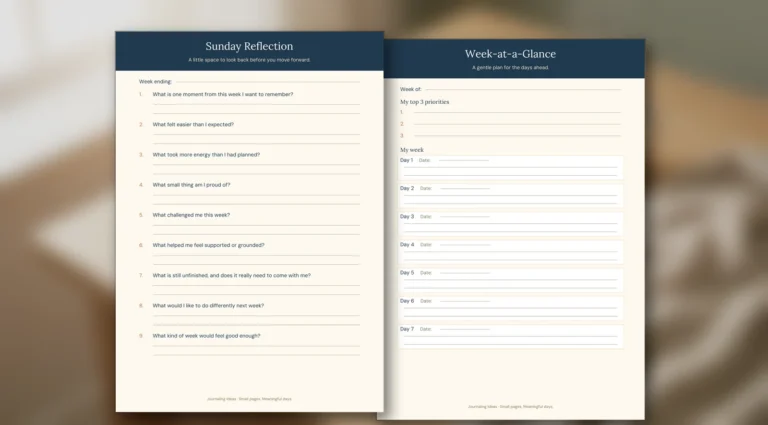
If you enjoy a shorter weekly version of the same gentle ritual, our sunday reset journal guide covers a simple way to close the week and prepare for the next one.
A monthly reset gives you a wider view. Instead of reviewing seven days, you have space to notice patterns across an entire month.
What Is Included in the Free Monthly Reset Pack?
The free Monthly Reset Pack includes six printable journal sheets. Each sheet is available in A4 and US Letter.
That means: 6 sheets × 2 paper sizes = 12 PDF files.
The six sheets are designed to work together, but you do not have to complete every one. Use the pages that help you most.
Free download: Monthly Reset Pack — 6 sheets in A4 + US Letter (12 PDFs)
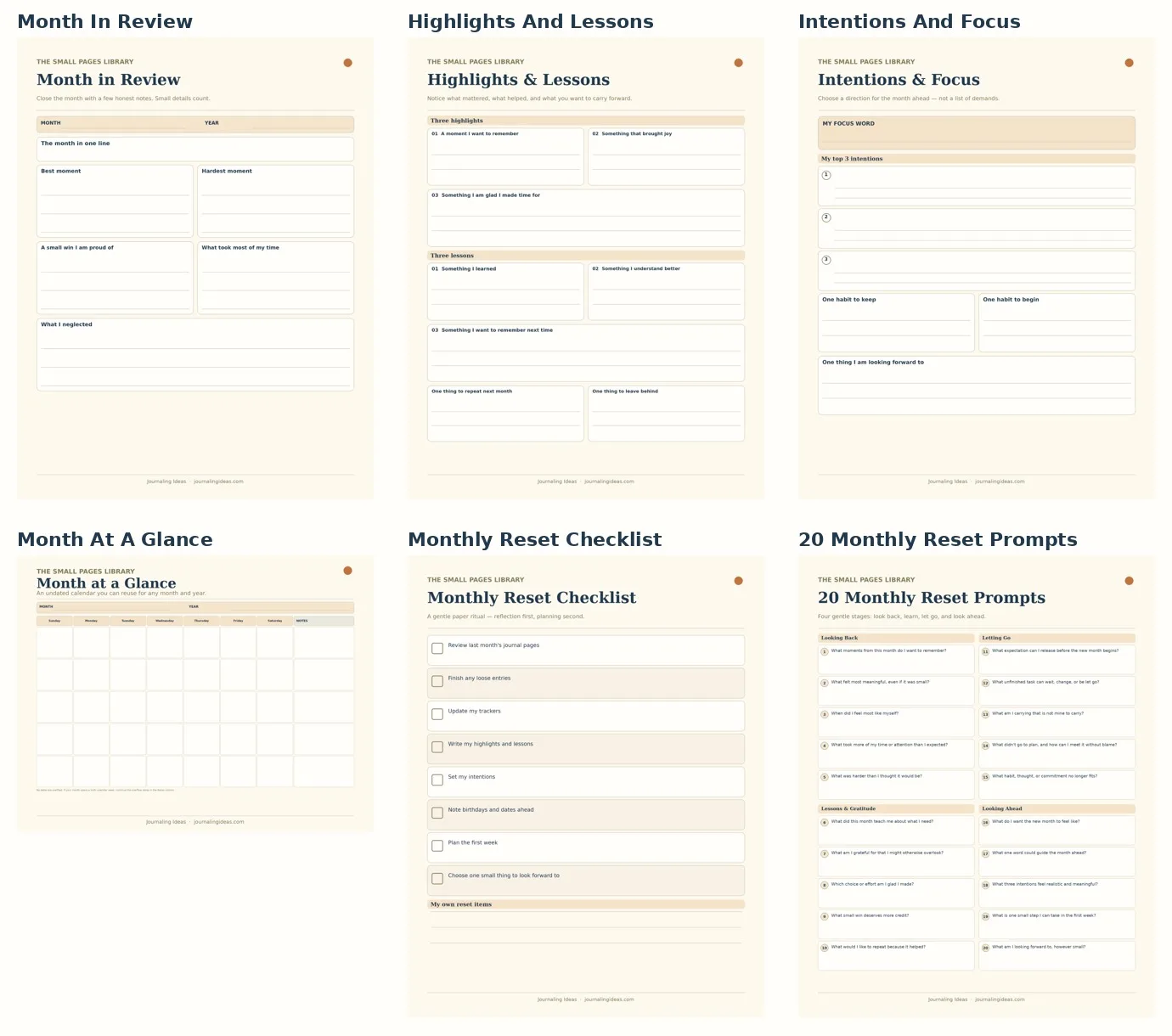
1. Month in Review
Start by looking back at the month you have just experienced.
This page includes space for:
- Month and year.
- The month in one line.
- Best moment.
- Hardest moment.
- A small win I am proud of.
- What took most of my time.
- What I neglected.
You do not need to write a detailed account of every week. A few honest notes are enough.
2. Highlights & Lessons
This sheet helps you notice what you want to remember and what you have learned.
It includes:
- Three highlights.
- Three lessons.
- One thing to repeat next month.
- One thing to leave behind.
A highlight does not need to be a big event. It might be a conversation, a quiet afternoon, a completed task, or a moment when something finally felt easier.
3. Intentions & Focus
Once you have reviewed the month, turn your attention toward the next one.
Use this sheet to choose:
- A focus word for the new month.
- Your top three intentions.
- One habit to keep.
- One habit to begin.
- One thing you are looking forward to.
Keep your intentions realistic. Three meaningful intentions are more useful than a long list that makes the month feel overwhelming.
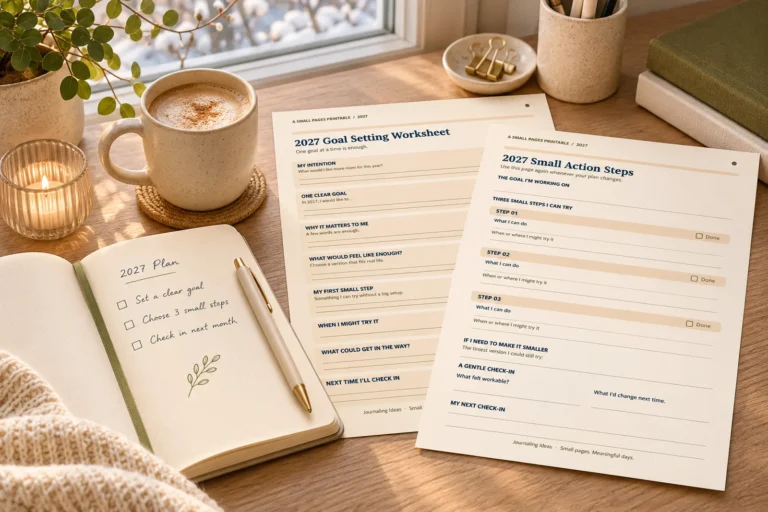
If you want a separate place to work on longer-term plans, our goal setting worksheet can help you organize your bigger goals.
4. Month at a Glance
This is an undated calendar sheet you can reuse for any month and year.
It includes:
- Month and year fill-in fields.
- Sunday through Saturday weekday headings.
- Five blank week rows.
- A notes column.
No dates are preprinted, so you can fill in the calendar yourself.
Some months need a sixth calendar row. If that happens, use the notes column to continue any overflow dates. The sheet is intentionally undated so you can reuse it rather than printing a new dated calendar every month.
Use it to note birthdays, appointments, important dates, and a few things you want to remember.
5. Monthly Reset Checklist
The checklist brings the routine together.
It includes eight simple steps:
- Review last month’s journal pages.
- Finish any loose entries.
- Update my trackers.
- Write my highlights and lessons.
- Set my intentions.
- Note birthdays and dates ahead.
- Plan the first week.
- Choose one small thing to look forward to.
There are also blank lines for your own items.
This is a journaling checklist, not a household cleaning list. It helps you finish your reflection and prepare your pages for the next month.
6. 20 Monthly Reset Prompts
The final sheet contains 20 prompts arranged into four sections:
- Looking Back.
- Lessons & Gratitude.
- Letting Go.
- Looking Ahead.
You can use the prompts in order or choose only the questions that feel relevant. They are also included in the article below, so you can write directly in your journal if you prefer.
How Do You Do a Monthly Reset Journal Routine?
You can complete the full monthly reset in about 30–45 minutes. Choose a quiet time near the end of the month or during the first few days of the next one.
Here is a simple routine using all six sheets.

Step 1: Settle in and prepare your pages
Allow about 2 minutes.
Find a comfortable place, bring your journal and pen, and put the six printable sheets nearby.
You might enjoy a cup of tea or a quiet moment before you start, but you do not need to create a special setup.
Open your previous journal pages if you have them. If you do not keep a regular journal, you can start with what you remember.
Step 2: Review the month
Allow about 7–10 minutes.
Start with the Month in Review sheet.
Write one line that describes the month. Then think about your best moment, hardest moment, and one small win you are proud of.
Consider what took most of your time and what you may have neglected.
Try to be honest without being harsh. You are noticing what happened, not grading yourself.
If you cannot remember everything, that is fine. Write what comes to mind.
Step 3: Notice your highlights and lessons
Allow about 5–7 minutes.
Move to the Highlights & Lessons sheet.
Write three moments or experiences you want to remember. They can be ordinary things that made the month meaningful.
Next, write three lessons. These might relate to your time, energy, routines, relationships, or personal priorities.
Finish by choosing one thing to repeat and one thing to leave behind.
For example, you might want to repeat a small evening journaling habit because it gave you a little quiet time. You might want to leave behind an unrealistic expectation that made your schedule feel too full.
Your answers do not need to sound impressive. They only need to make sense to you.
Step 4: Reflect a little more with the prompts
Allow about 5–8 minutes.
Use the 20 Monthly Reset Prompts sheet if you want help going deeper.
You do not have to answer all 20 questions during the routine. Choose two or three that make you pause.
The four sections move through a natural reflection process:
1. Looking Back helps you remember what happened.
2. Lessons & Gratitude helps you recognize what mattered.
3. Letting Go gives you space to release something that no longer fits.
4. Looking Ahead helps you think about the next month.
If a question feels uncomfortable or unhelpful, skip it. You can return to it another time or choose a different prompt.
Step 5: Set your focus and intentions
Allow about 5–7 minutes.
Open the Intentions & Focus sheet.
Choose one focus word for the new month. It might be calm, space, connection, consistency, or curiosity.
Then write your top three intentions.
Keep them clear and manageable. Instead of writing a broad intention such as “change everything,” choose something you can recognize in everyday life.
For example:
- Make more time for reading.
- Take a short walk when my schedule allows.
- Write a few journal lines before bed.
Choose one habit you want to keep and one you would like to begin.
Finally, write one thing you are looking forward to. It can be a planned event or something small you hope to enjoy.
Step 6: Look at the month ahead
Allow about 4–6 minutes.
Use the Month at a Glance sheet.
Fill in the month and year, then add dates you already know about.
You can include:
- Birthdays.
- Appointments.
- Important deadlines.
- Family or personal events.
- Days you want to keep lighter.
- Activities you are looking forward to.
Do not try to plan every hour. The purpose is to see the month clearly and notice where your attention may be needed.
Step 7: Finish with the checklist
Allow about 2–3 minutes.
Take the Monthly Reset Checklist and review the eight items.
Tick off the steps you have completed. Add any personal items that still need attention.
You can also write down one small thing you want to do during the first week of the new month.
That is your monthly reset. You have reviewed the past, recognized what mattered, and made a gentle plan for what comes next.
How Long Does a Monthly Reset Take?
A full monthly reset usually takes about 30–45 minutes when you use the six sheets and spend a little time reflecting on the prompts.
You can divide the time according to what you need. Some months may require more reflection, while others may only need a quick review and a few intentions.
You do not have to finish every page in one sitting.
If you have more time, you can write longer entries. If you have less time, use the shorter version below.
What If You Only Have 10 Minutes?
A shorter reset can still be meaningful. You do not need to complete all six sheets to make a fresh start.
Try this 10-minute version:
| Time | What to do |
|---|---|
| 2 minutes | Write one line about the month and one small win. |
| 2 minutes | Note one lesson and one thing to leave behind. |
| 2 minutes | Choose your focus word and one intention. |
| 2 minutes | Check the coming month and note important dates. |
| 2 minutes | Choose one small thing to look forward to and check your next steps. |
Use the Month in Review, Highlights & Lessons, Intentions & Focus, and Month at a Glance sheets as needed for this shorter version.
You can leave the other pages for another day.
A short reset is not a failed version of a full reset. It is simply a smaller version that fits the time you have.
How Do You Keep Your Monthly Reset Going?
The easiest way to keep a monthly reset going is to make it simple enough to repeat.
Here are a few ways to make the ritual feel manageable.
Choose a regular time
You might prefer the last evening of the month, the final weekend, or the first quiet morning of the new month.
Choose a time that generally works for your schedule. It does not have to be the same date every month.
Keep the same printable pack
Using the same six sheets each month gives you a familiar structure.
Over time, you may notice patterns in your answers. You might see which habits are helping, which priorities keep returning, and what you want to make more space for.
Do not force yourself to fill every box
Some months you may have a lot to write. Other months you may only have a few words.
Both are fine.
You can use one line instead of a paragraph, skip a prompt, or leave a section empty.
Let your intentions change
Your focus word and intentions are allowed to change as your circumstances change.
A monthly reset is not a contract. It is a chance to decide what feels useful right now.
Restart whenever you are ready
If you miss a month, start again when you can.
You do not need to go back and complete every missed page. You can simply open the current month and begin from there.
A routine that allows you to return without guilt is much easier to keep.
20 Monthly Reset Prompts
These 20 prompts are divided into four sections to help you reflect on the month you are leaving and think about the one ahead.
You can answer them in your regular journal or use the printable 20 Monthly Reset Prompts sheet.

Looking Back
1. What moments from this month do I want to remember?
2. What felt most meaningful, even if it was small?
3. When did I feel most like myself?
4. What took more of my time or attention than I expected?
5. What was harder than I thought it would be?
Lessons & Gratitude
6. What did this month teach me about what I need?
7. What am I grateful for that I might otherwise overlook?
8. Which choice or effort am I glad I made?
9. What small win deserves more credit?
10. What would I like to repeat because it helped?
Letting Go
11. What expectation can I release before the new month begins?
12. What unfinished task can wait, change, or be let go?
13. What am I carrying that is not mine to carry?
14. What didn’t go to plan, and how can I meet it without blame?
15. What habit, thought, or commitment no longer fits?
Looking Ahead
16. What do I want the new month to feel like?
17. What one word could guide the month ahead?
18. What three intentions feel realistic and meaningful?
19. What is one small step I can take in the first week?
20. What am I looking forward to, however small?
You do not need to answer every question. Choose the ones that feel useful, and give yourself permission to leave the rest.
What Mistakes Can Make a Monthly Reset Feel Heavy?
A monthly reset should make reflection easier, not turn it into another obligation.
A few habits can make the process feel more demanding than it needs to be.
Treating the month like a performance review
Your journal is not a report card. You do not have to prove that you achieved enough.
A difficult month is still a month worth acknowledging.
Being too hard on yourself
Avoid using the review to list everything you did not finish or every habit you could not maintain.
You can notice what was difficult without blaming yourself.
Making too many intentions
The purpose is to choose a clear direction, not create a long list of demands.
Start with three intentions or fewer if that feels more manageable.
Trying to answer every prompt
The prompts are there to help you think. They are not homework.
Skip questions that do not fit your experience.
Thinking you must never miss a month
Life changes. You may be busy, tired, traveling, or simply not in the mood to journal.
Skipping a month does not undo your progress. You can return whenever you are ready.
Frequently Asked Questions About Monthly Reset Journals
When should I do a monthly reset journal?
You can do it during the last few days of the month or the first few days of the next one. Choose a time that gives you enough space to reflect without rushing.
How long does a monthly reset take?
The full routine takes about 30–45 minutes. If you are short on time, a 10-minute version can help you review a few key things and set one intention.
Do I need to use all six printable sheets?
No. The six sheets provide a complete structure, but you can use only the pages that are helpful. You might use the Month in Review and Intentions & Focus sheets when you want a shorter reset.
What if I had a hard month?
That is okay. A monthly reset is not a performance review. You can write about what helped you get through the month, recognize one small thing you appreciate, or skip questions that do not feel right.
Can I skip a month and start again?
Yes. You do not have to catch up on missed months. Open your journal when you are ready and begin with the month in front of you.
Is the Monthly Reset Pack free?
Yes. The Monthly Reset Pack is free in The Small Pages Library. It includes six printable sheets in A4 and US Letter, which makes 12 PDF files in total. No email signup or password is required.
Conclusion: A Fresh Start, One Month at a Time
A monthly reset journal gives you a simple way to close one chapter and begin the next with a little more clarity.
You can use it to remember what mattered, recognize what you learned, let go of what no longer fits, and choose a gentle focus for the month ahead.
You do not need to make every month perfect. You only need a little space to reflect and decide what feels important now.
Small pages. Meaningful days.




One Comment