

Quarterly Review Journal: 24 Questions to Close a Quarter Well
A quarterly review journal is a simple way to pause at the end of every three months, notice what happened, and decide what you want to carry into the next season. These 24 questions move from wins and challenges to energy, habits, and next-quarter intentions. Use them at your own pace, with the free four-sheet printable pack if you like having a page to write on.
A quarter can pass quickly, and ordinary days are easy to forget. A gentle review gives you space to look back without turning life into a scorecard. You do not need a perfect record or an impressive list of achievements; a few honest sentences are enough.
This is personal reflection, not a work performance review and not therapy. Skip questions that do not feel useful, change the order, or write a single word. The aim is to notice what matters and make a thoughtful start on the next quarter.
What Is a Quarterly Review Journal?
A quarterly review journal is an entry or set of pages for reflecting on a three-month period. It offers a repeatable structure for remembering meaningful moments, naming challenges, noticing patterns in your energy and habits, and choosing intentions for the months ahead.
A year is divided into four quarters:
| Quarter | Months |
|---|---|
| Q1 | January–March |
| Q2 | April–June |
| Q3 | July–September |
| Q4 | October–December |
You are looking for useful themes, not a complete diary. A few notes may reveal that a routine helped, a commitment took too much energy, or a moment deserves to be remembered.
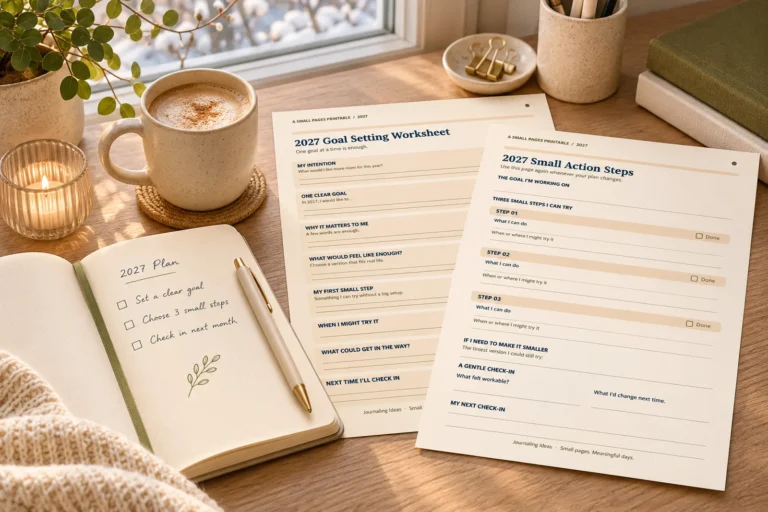
Write in a notebook, use the printable pages, or adapt the questions for a digital journal. If you already use a 2027 goal journal, this review can help you check whether longer-term goals still feel meaningful.
When to Do a Quarterly Review
A useful time for a quarterly review is the last week of a quarter or the first week of the next one. Reviewing before it ends can help you close open loops; reviewing just after gives you a little distance.
For 2027, the quarters are:
- Q1: January 1–March 31
- Q2: April 1–June 30
- Q3: July 1–September 30
- Q4: October 1–December 31
Choose a quiet window that feels realistic; it does not have to be the final day. If you miss the suggested week, review the last three months when you remember. You can answer only the questions that stand out and complete the Next Quarter Plan later. This is a flexible pause, not another deadline.
How to Do a Quarterly Review
Set aside around 30–45 minutes for all four sections, or split the review into shorter sessions. This is a suggestion, not a rule. Put your phone aside if that helps you stay with your thoughts, and keep a drink or a comfortable pen nearby. You can pause whenever you need to. If a question brings up something you do not want to explore right now, leave it blank and move on.
1. Gather a few reminders
Open your journal, calendar, photos, or planner. Look for a few reminders: a finished project, a visit, a difficult stretch, a new habit, or an ordinary day that mattered. Or simply begin with what you remember.
2. Begin with what went well
Start with small wins as well as major milestones: a helpful conversation, a task you began, or a peaceful day. Describe what happened before deciding what it meant.
3. Look honestly at challenges
Consider what felt difficult, disappointing, draining, or unfinished. Be curious rather than harsh; notice what you may want to understand, change, or leave behind.
4. Notice your energy, habits, and values
Notice when you felt most like yourself, which habits supported you, and whether your time reflected what you care about. Patterns matter more than perfect records.
5. Choose a few intentions for the next quarter
Choose one focus, one small first step, and perhaps one thing to welcome and one thing to reduce. Leave room for plans to change. A 2027 goal setting worksheet can hold the bigger picture while this review helps you choose a manageable next step.
6. Close with a note to yourself
Finish with a kind, specific sentence to remember: protect your time, ask for help, keep a small habit, or make room for rest. Treat it as a point of direction, not a promise that everything will go to plan.
24 Quarterly Review Journal Questions
The 24 questions are arranged in four sections. Answer them in order, choose the ones that fit, or use one section at a time.

Section 1 — Looking Back: Wins and Highlights
Start with moments worth remembering. A quiet win can matter as much as a visible milestone.
- What went well this quarter that you want to remember? Name a moment, choice, routine, or experience you would like to keep in view. Add what made it feel worthwhile.
- Which moment from the last three months are you most proud of? Describe what happened and what it took to get there. Your answer can be small, private, or meaningful only to you.
- What small win did you almost overlook? Think of something you handled, tried, finished, or made time for without giving yourself much credit.
- Who or what helped you more than you expected? Write about a person, tool, place, routine, or unexpected source of support. Note what their help made possible.
- Which day from this quarter would you happily live again? Recall a few details: where you were, what you did, who was there, or how the day felt.
- What did you finish that once felt difficult to start? Name the task or change, then notice what helped you move from thinking about it to doing it.
Section 2 — Looking Honestly: Challenges and Lessons
Make room for what was difficult without turning reflection into self-criticism. Skip any question that feels too personal today.
- What was the hardest part of this quarter? Describe the situation in plain language. You do not need to solve it in this entry; begin by naming what made it hard.
- What did a disappointment teach you? Write what you understand now that you did not understand before. Separate the lesson from any unfair judgment about yourself.
- What took more energy than it was worth? Consider a commitment, task, expectation, or repeated worry. What would you like to approach differently next time?
- What did you avoid, and what was underneath the avoiding? Choose one example and gently explore what may have made it difficult: uncertainty, lack of time, fear, confusion, or something else.
- Which mistake would you handle differently now? Focus on the choice or circumstance you can learn from. Write one practical adjustment you might make if a similar situation returns.
- What is one thing you are ready to leave in this quarter? It could be an expectation, an unhelpful routine, a worry you have carried, or a commitment that no longer fits.
Section 3 — Looking Inward: Energy, Habits and Values
Notice what supported your everyday life. You are observing this quarter, not labeling a habit forever.
- When did you feel most like yourself this quarter? Describe the setting or activity. Look for what was present: enough time, a certain person, creativity, quiet, movement, or freedom.
- Which habit quietly helped you most? Think about a small action you repeated. What did it make easier, steadier, or more enjoyable?
- Which habit quietly held you back? Notice a pattern without turning it into a label about who you are. What is one gentle change that could make it easier to shift?
- How did you spend your time, compared with how you wanted to spend it? Name one area where your time matched your priorities and one area where it did not. Consider what influenced the difference.
- What did your body and energy ask for this quarter? Reflect on signals you noticed, such as a need for rest, movement, a slower pace, or a more supportive routine. Keep the answer personal and practical.
- Which value mattered most to you in the last three months? Choose a value such as connection, creativity, honesty, stability, learning, or care. Describe one moment when it shaped a decision.
Section 4 — Looking Ahead: Next Quarter Intentions
Choose a meaningful direction and a first step small enough to begin.
- What would make next quarter feel meaningful? Describe the kind of days, experiences, or progress you hope to make room for. Focus on what matters, not what would look impressive.
- What is one thing you want more of, and one thing you want less of? Write one answer for each. Keep both realistic enough to influence an ordinary week.
- Which unfinished thread is worth carrying forward? Choose something you still care about. Note why it deserves another chance and what can wait.
- What is the smallest first step toward your next goal? Make the action concrete and easy to recognize. If it still feels too large, break it into an even smaller first move.
- What do you want to learn or try in the next three months? It could be a skill, a creative activity, a new routine, or a different way of approaching something familiar. Write what makes you curious.
- If next quarter goes well, what will be true at the end of it? Picture a few signs that would tell you the quarter felt worthwhile. Include how you hope to feel, not only what you hope to finish.

Quarterly Review vs. Monthly Reset
Both create space to pause, but they work at different scales.
| Quarterly review | Monthly reset |
|---|---|
| Looks back across three months | Looks back across one month |
| Notices wider patterns, lessons, and changes | Checks current priorities, routines, and practical needs |
| Helps choose a direction for the next quarter | Helps organize the next few weeks |
| Usually uses broader reflection questions | Often includes a shorter review and a near-term plan |
Use a monthly reset for regular check-ins and small adjustments; use a quarterly review to see what has changed over a longer stretch. A monthly reset journal can support the shorter check-in, while these questions help you notice the bigger picture. If you have only a few minutes, write one thing to remember, one lesson, and one thing to carry forward.
A monthly reset can help with near-term choices such as appointments, routines, and priorities for the coming weeks. A quarterly review is more spacious: it gives you a chance to ask whether those small choices are adding up to a life that feels right to you. You do not have to complete one before you are allowed to do the other.
How to Use the Free Quarterly Review Journal Pack

The free Quarterly Review Journal Pack includes four sheets, each in A4 and US Letter. It is available in The Small Pages Library, with no signup or password.
Print all four or choose only the pages you need:
- Quarterly Review Prompts — all 24 questions, grouped into the four sections in this article. Keep it beside your notebook as a guide, or write directly on the page if you prefer.
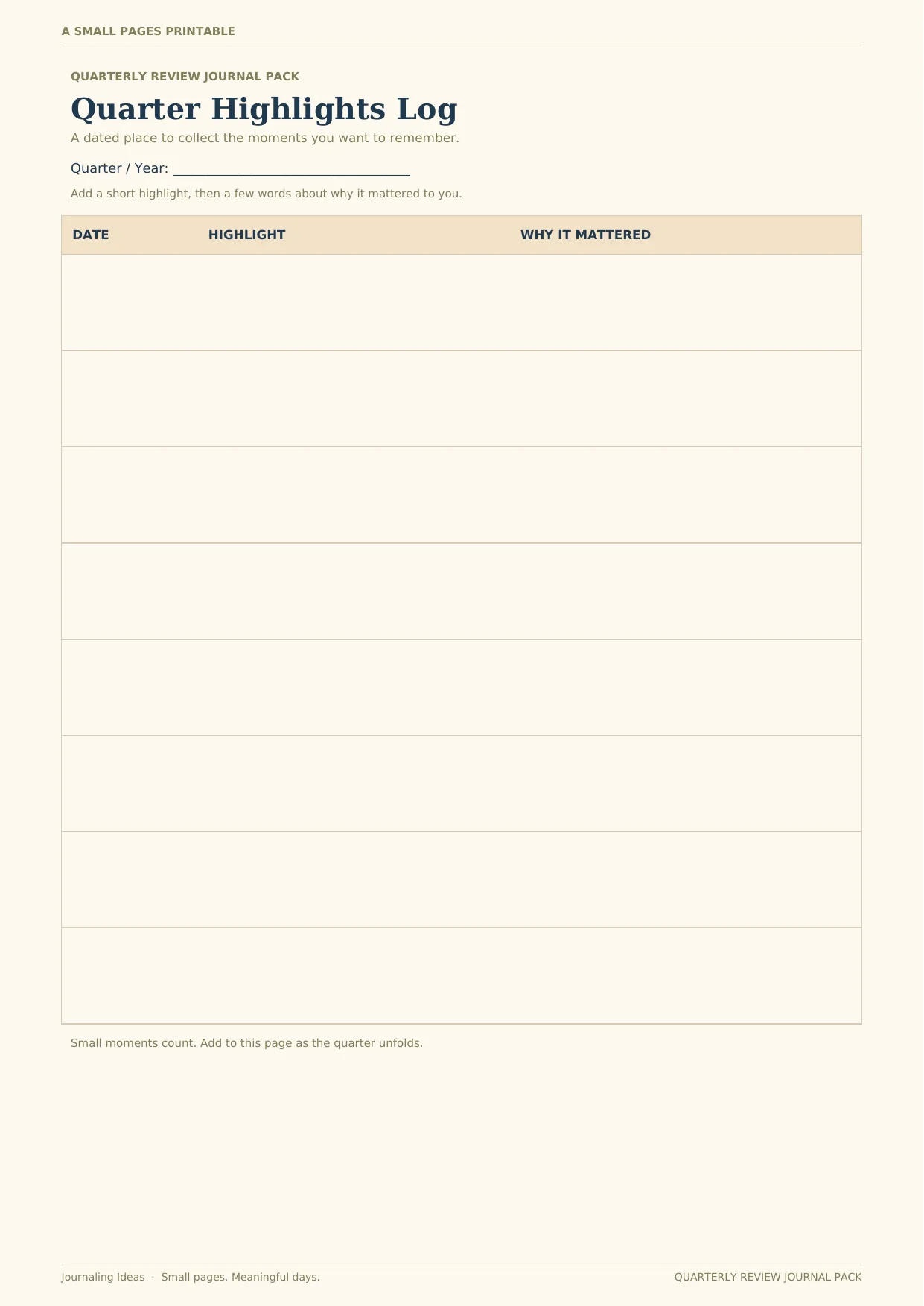
- Quarter Highlights Log — a dated space to record a highlight and why it mattered. Add entries as you remember them, rather than trying to fill the whole page at once.
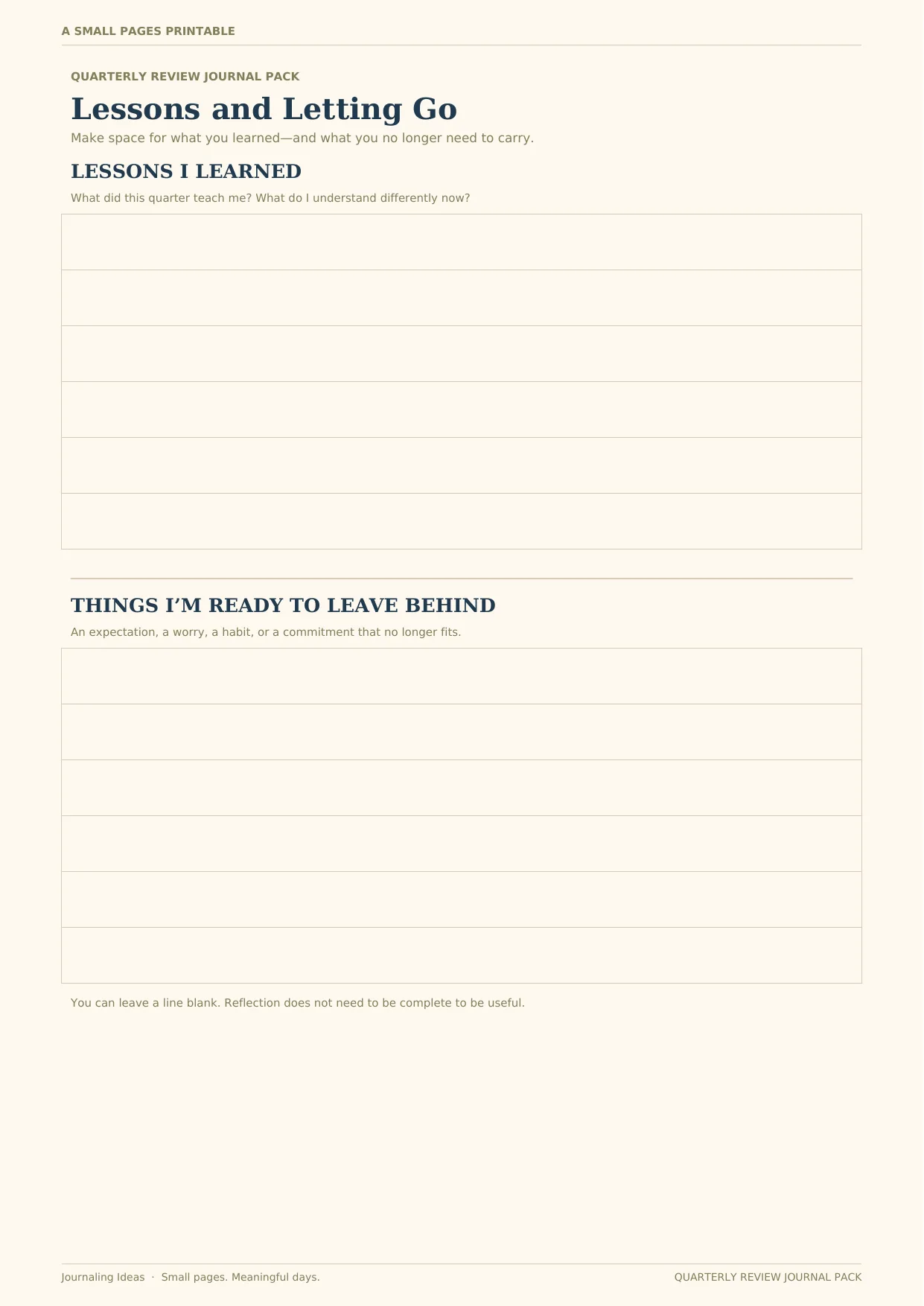
- Lessons and Letting Go — space to write lessons learned and things you are ready to leave behind. Use short phrases or longer notes.
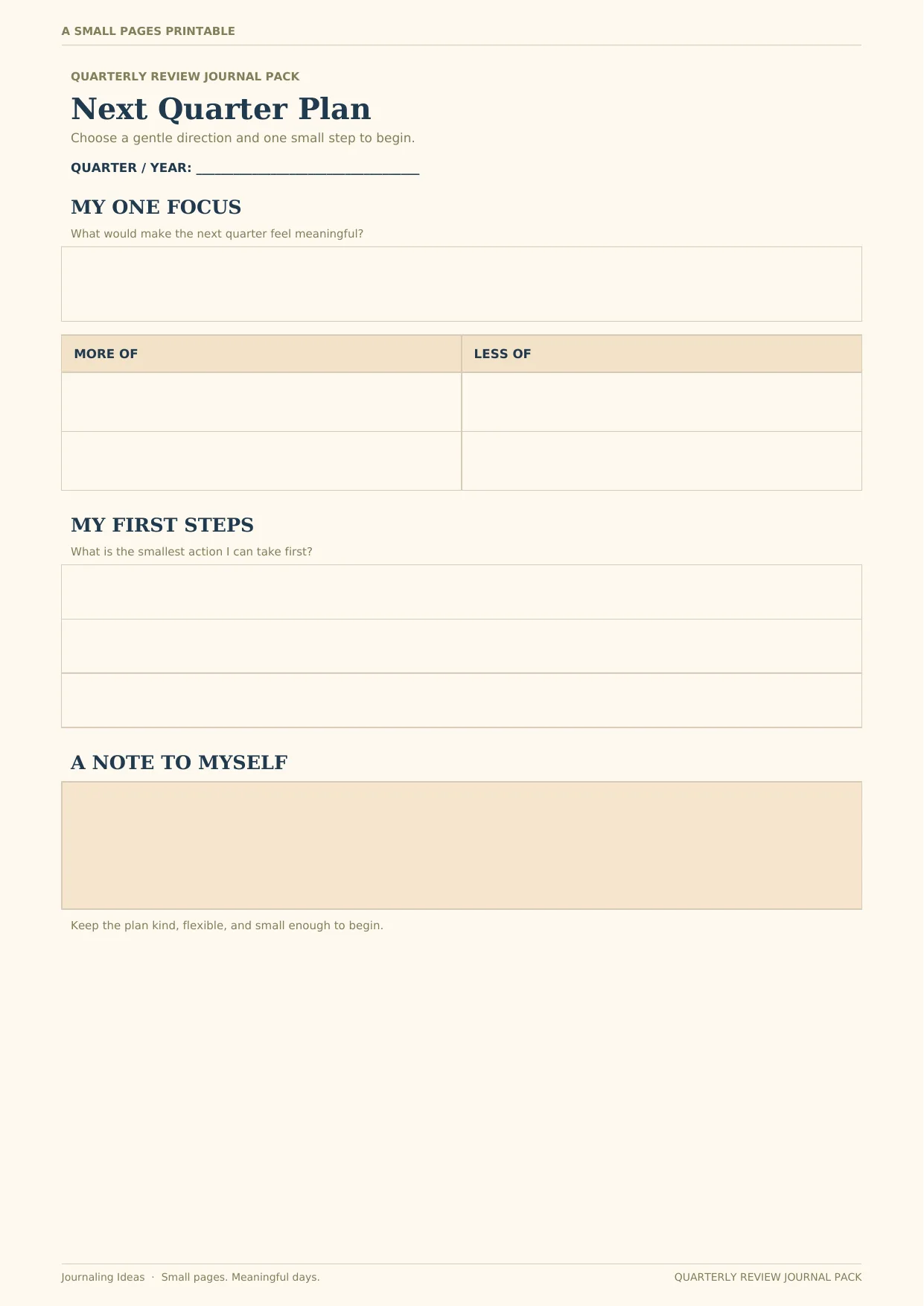
- Next Quarter Plan — a place for one focus, more-of and less-of intentions, first steps, and a small note to yourself.

Download the sheets:
- Sheet 1 — Quarterly Review Prompts — A4 (PDF)
- Sheet 1 — Quarterly Review Prompts — US Letter (PDF)
- Sheet 2 — Quarter Highlights Log — A4 (PDF)
- Sheet 2 — Quarter Highlights Log — US Letter (PDF)
- Sheet 3 — Lessons and Letting Go — A4 (PDF)
- Sheet 3 — Lessons and Letting Go — US Letter (PDF)
- Sheet 4 — Next Quarter Plan — A4 (PDF)
- Sheet 4 — Next Quarter Plan — US Letter (PDF)
Complete the sheets in one sitting or over several days. You can also add dated entries to the Highlights Log throughout the quarter, so you have reminders when review time comes. Use the pages as a prompt guide beside your notebook or write directly on them. If you are short on time, start with Sheet 1 and answer just four questions—one from each section. If you want to capture memories as they happen, keep Sheet 2 somewhere easy to reach and add to it during the quarter. The pack is meant to support your own way of reflecting, not prescribe one perfect routine.
Printing Your Quarterly Review Pages
Choose A4 or US Letter to match your printer. Print at actual size or 100% and check the preview; if the page is cropped, select the correct paper size or use fit to page. Regular printer paper works well, while slightly heavier paper may suit pages you want to keep in a binder. Grayscale printing is fine. Reuse the prompt list and print fresh log or planning pages when needed.
Frequently Asked Questions
What is a quarterly review journal?
It is a structured reflection on the last three months: highlights, challenges, patterns in your habits and energy, and intentions for the next quarter.
When should I do a quarterly review?
Try the last week of a quarter or the first week of the next. If you miss that window, review the previous three months later.
How long does a quarterly review take?
Allow 30–45 minutes for all 24, or answer a few in 10 minutes. You can also split the sections across several sessions.
What should I write in a quarterly review?
Write about wins, challenges, lessons, habits, time, and what you want to focus on next. Use the 24 questions as a starting point and skip what does not fit.
How is a quarterly review different from a monthly reset?
A monthly reset organizes the weeks ahead; a quarterly review looks across three months for broader patterns, lessons, and intentions.
Is the Quarterly Review Journal Pack free?
Yes. All four sheets are free in The Small Pages Library, in A4 and US Letter, with no email signup required.
A quarter does not have to end with a perfect summary. You can close it with a few remembered moments, one honest lesson, and a small next step. Keep the pages that help, leave the rest, and let the next three months take shape one day at a time.
Small pages. Meaningful days.
— Journaling Ideas Editorial Team




One Comment