
January Bullet Journal Ideas: 20 Simple Spreads for a Fresh Start
January can be a gentle place to begin again. Your bullet journal does not need elaborate drawings, a new notebook, or a perfect routine. A few useful pages can help you see the month, remember what matters, and make room for everyday notes. Choose the spreads you will actually use; leave the rest blank.

In this guide: What are January bullet journal ideas? · How to set up your January bullet journal · Making January work in real life · 20 January bullet journal ideas for 2027 · What’s in the free setup pack · How to print the printables
What are January bullet journal ideas?
January bullet journal ideas are simple page layouts that help you organize the new month, record everyday moments, and make space for goals or habits. They can include a monthly calendar, weekly plans, reading and gratitude logs, and a few seasonal pages. Start with the basics, then add only the spreads that make your days easier.
How to set up your January bullet journal
You do not need to build a complete journal in one sitting. Begin with a small setup and let the rest grow as you use it.
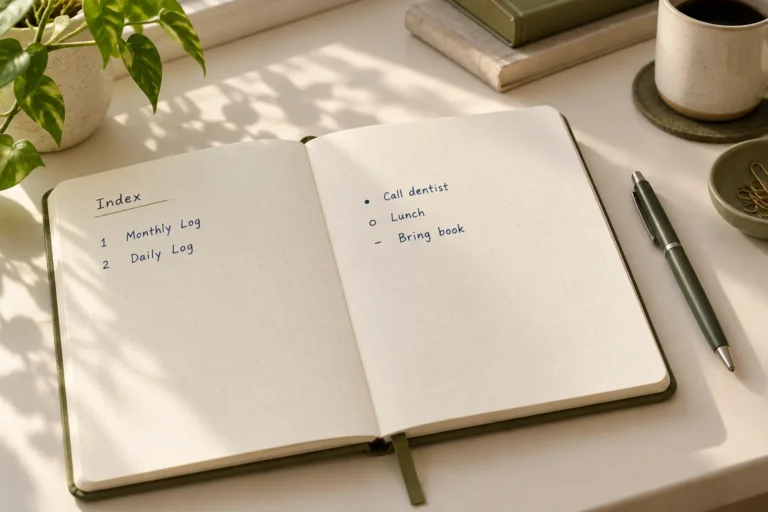
- Choose a notebook and a simple layout. A dotted, lined, or plain notebook can work. Use a ruler if you like straight lines, but it is not required.
- Add the month view first. A monthly log gives you one place for appointments, birthdays, deadlines, and plans.
- Make one weekly spread. Give each day a little space and leave a notes area for anything that does not fit.
- Choose one or two trackers. A habit tracker or mood tracker is enough to start. Skip any tracker that feels like another task.
- Leave room to change your mind. You can add a reading log or reflection page later. A simple setup is easier to keep using.
If you are new to the method, the guide to bullet journal for beginners explains the basic page types and symbols. You can also look back at december bullet journal ideas for a seasonal setup, then use this January layout as a fresh month rather than trying to copy every page.
Making January Work in Real Life
January asks a lot of a notebook. The month carries fresh-start energy, new goals and long winter evenings — and, for many people, a quiet slump somewhere around the third week, when the new routines start to slip. A January setup works best when it is built for that slump in advance: keep the monthly log honest, choose one habit to track instead of six, and let the mood tracker note the dark, cold days without judging them. If you want written prompts to go with the planning pages, our new year journal prompts pair well with the goals spreads in this setup.
Treat Monday, January 18 (Martin Luther King Jr. Day in the United States) as a built-in mid-month reset. It lands just as motivation usually dips, and a single slower morning with your journal — reviewing what is actually working and crossing out what is not — is worth more than a perfect first week followed by an abandoned notebook. January has 31 days; your setup only has to survive them one week at a time.
20 January bullet journal ideas for 2027
These January bullet journal ideas are designed to be simple enough for a first setup. Use all 20 as inspiration, or choose only the pages that suit your month.
1. January Bullet Journal Cover Page
Give the first page a clear January heading and one small winter detail, such as a simple branch, a star, or a few snow dots. Add the year underneath and leave the rest open. A cover page does not need a full illustration to make the month feel like a new chapter.
2. January Monthly Log
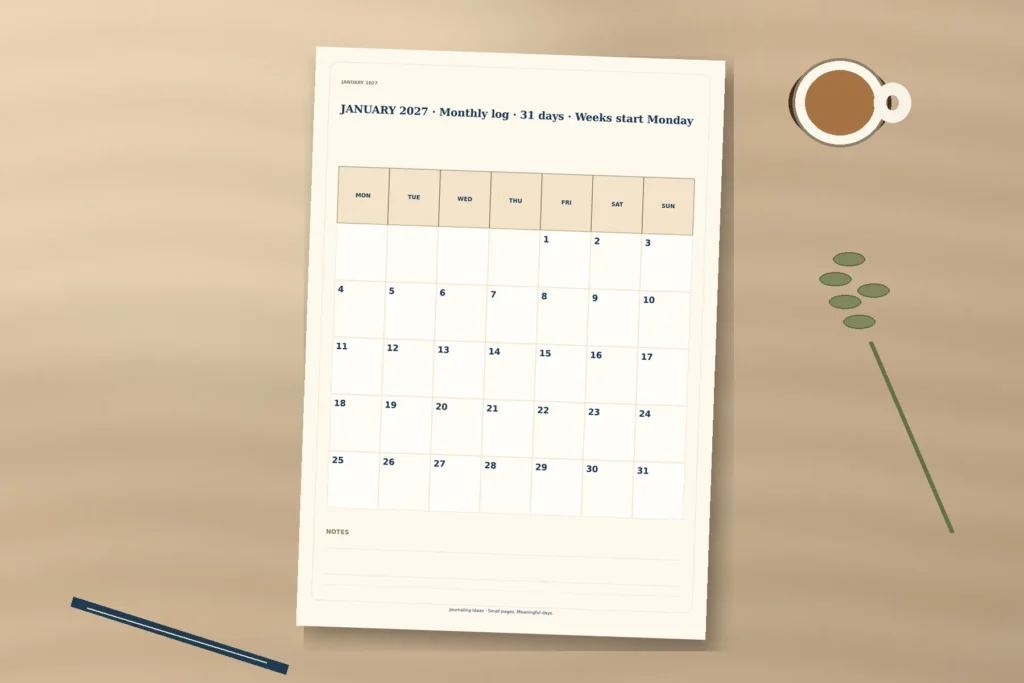
Create a Monday-to-Sunday calendar grid and write the date numbers into the correct boxes. Add birthdays, appointments, school dates, work deadlines, and plans as they come up. Keep the boxes open enough for short notes. The printable pack includes a correctly arranged January 2027 monthly log.
3. 2027 Year-at-a-Glance
Make a compact overview with the 12 month names and a little room beside each one. Use it for trips, seasonal plans, birthdays, or dates you already know. You do not need to fill every month now; the page can grow as the year takes shape.
4. Future Log for 2027
Use a future log for events that are too far away for the January calendar. Divide a page into months or quarters and add appointments, reminders, and plans when you hear about them. Keep it simple so you can scan it without searching through several pages.
5. January Goals Page
Choose a small number of goals that matter to you this month. Write each one as a clear action, then add one first step beside it. Leave room to adjust your plans; a goal page should help you choose what matters, not turn January into a test.
6. Word of the Year
Choose one word that you would like to return to during 2027, such as steady, curious, or gentle. Write it in the center of the page and add a few notes about what it could mean in everyday life. If one word does not feel right, leave the page blank for now.
7. January Habit Tracker
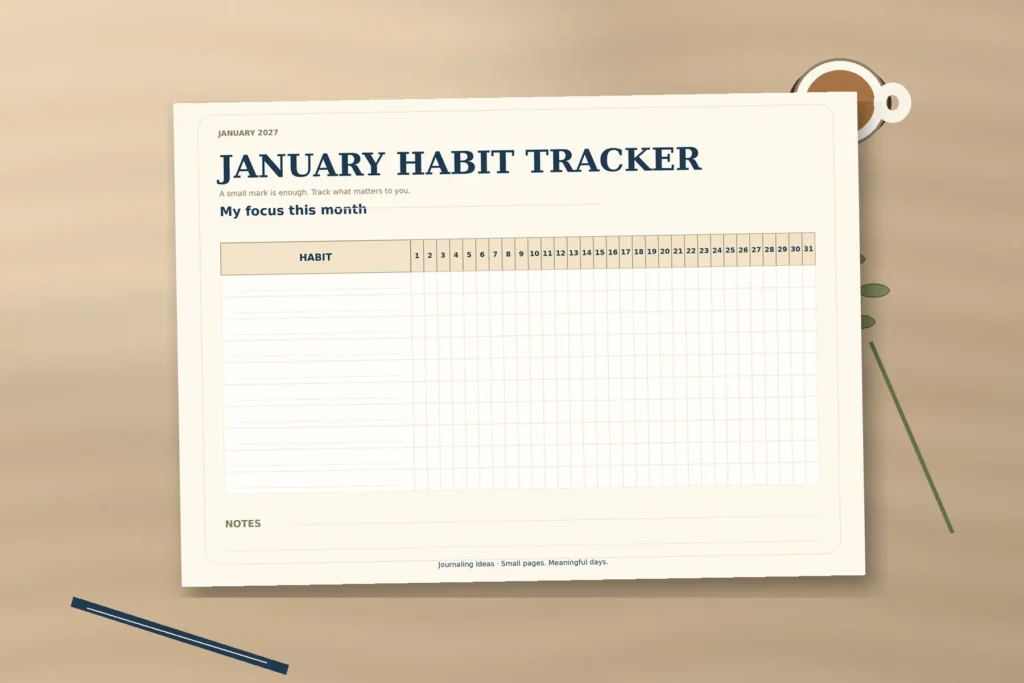
Draw 31 narrow day columns and leave a wide first column for habit names. Track only a few routines you genuinely want to notice, such as reading, stretching, or taking a short walk. A blank square is information too; you do not need to fill every day.
8. January Mood Tracker
Give each day one small marker and add a simple mood key. You might use words such as great, good, okay, low, and heavy, or choose your own labels. The purpose is to notice patterns gently, not to judge how you feel.
9. January Weekly Spread
Set up seven boxes, one for each day, and leave a separate notes area for reminders that do not belong to a particular date. Add appointments and a few priorities, then leave some space for plans to change. The printable pack includes a simple seven-day layout.
10. January Daily Log
Use a daily log when you want more room than the weekly boxes provide. Write the date, then add short notes, tasks, or things you want to remember. Bullets are enough; you do not need to write a full diary entry every day.
11. January Gratitude Log
Keep a short gratitude log with one line for something you appreciated that day. It can be ordinary: a warm drink, a helpful message, a quiet moment, or finishing a small task. If daily writing feels like too much, add a few entries each week.
12. January Reading Log
Make a small list of books you are reading or would like to try. Add columns for the title, author, start date, finish date, or a brief note. You can track pages if that helps, but a simple reading list is useful on its own.
13. Winter Theme Page
Choose one winter detail to repeat across the month, such as bare branches, mittens, stars, or a simple line of snowflakes. Use a small doodle or a few muted colors. Repeating one easy motif can make the pages feel connected without requiring advanced art.
14. January Highlights Log
At the end of the day or week, record one moment you would like to remember. A few words are enough: a conversation, a meal, a place, or something that made you smile. The printable highlights sheet gives you prompts and writing space for the month.
15. Important Dates and Events
Collect dates that are easy to overlook, including birthdays, school events, appointments, renewals, and planned trips. Keep this page as a quick reference or copy the dates into your monthly log. Only add dates you have confirmed.
16. January Brain Dump
Give yourself one open page for thoughts, loose tasks, reminders, and ideas that keep returning. Write first and sort later. When the page is full, move only the useful items into your calendar, weekly spread, or future log.
17. Self-Care Tracker
List a few small actions that help you feel looked after, such as taking a screen break, spending time outside, or making space to rest. Use simple check marks or dates. Keep the list personal and flexible rather than treating it as a daily requirement.
18. Sleep Tracker
If you want to notice your sleep routine, record a bedtime, wake-up time, or a simple note about how rested you felt. Choose one or two details rather than tracking everything. Use the page as a personal record, not as a medical assessment.
19. Monthly Spending Log
Create columns for the date, item, category, and amount if a spending overview would be useful. Keep it factual and simple, and record only the purchases you want to review. This page is an optional awareness tool, not a budgeting rule.
20. End-of-Month Reflection
At the end of January, write what worked, what felt difficult, what surprised you, and what you want to carry into February. You can use the notes to decide which spreads to keep. A fresh setup does not have to mean starting from zero each month.
What is included in the free January Bullet Journal Setup Pack?
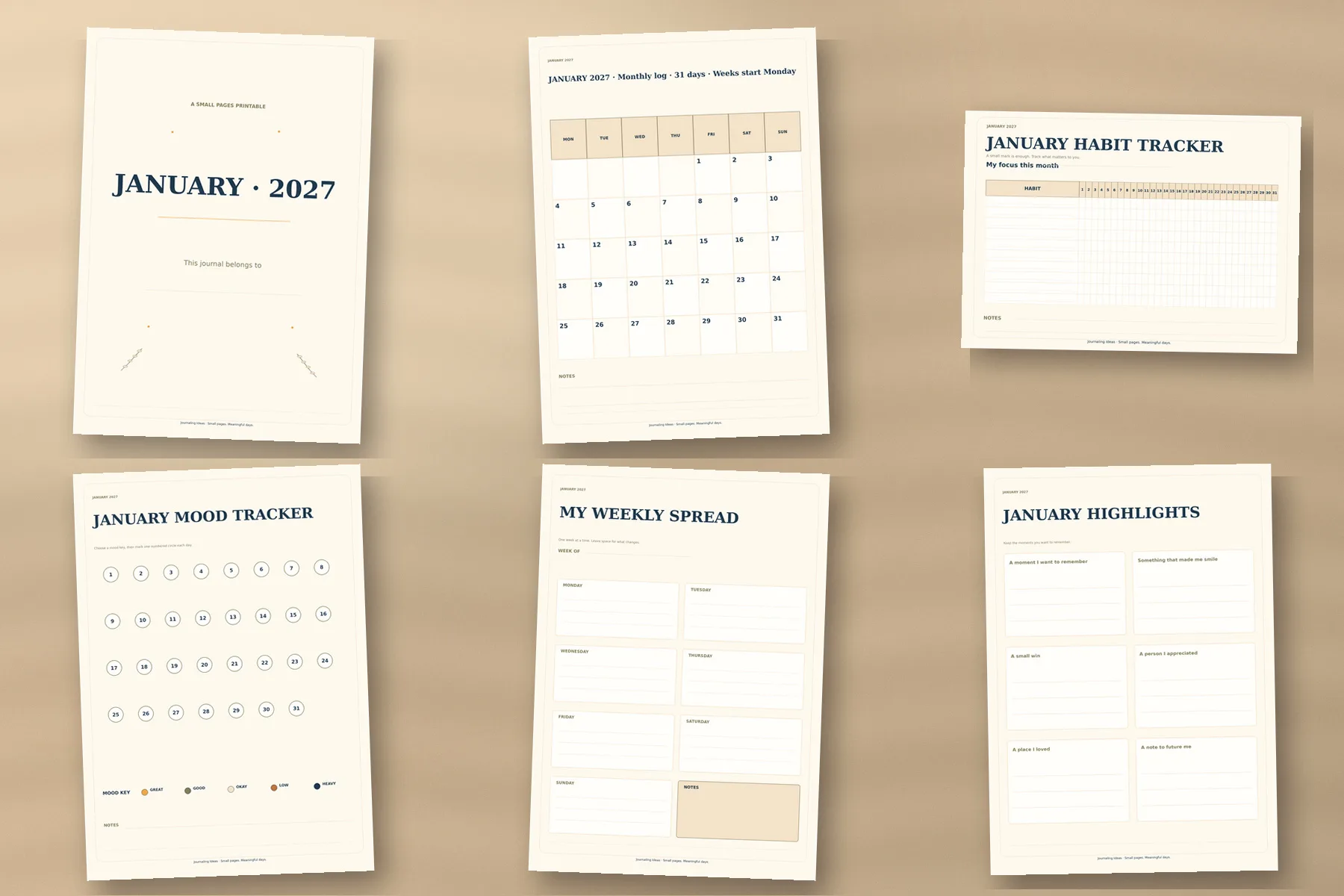
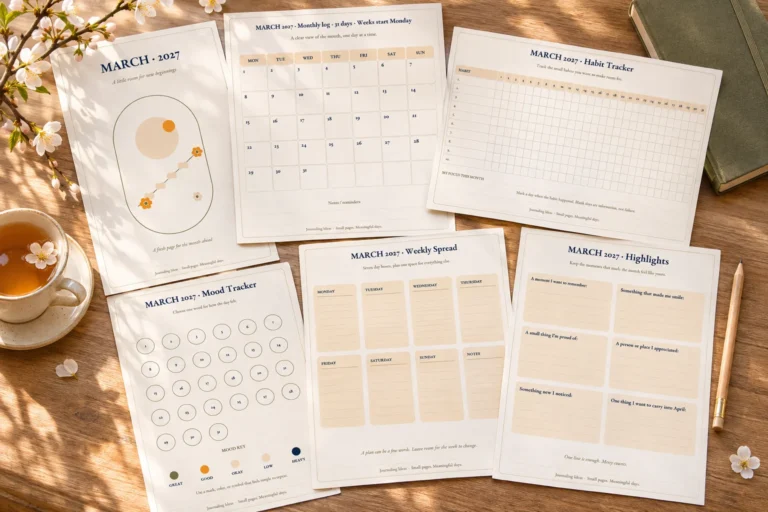
The January Bullet Journal Setup Pack includes six practical printable sheets. Each sheet is supplied as a separate PDF in both A4 and US Letter, for 12 PDFs in total. The pack is free to download, with no signup, email address, or password required. Open The Small Pages Library to find the January pack.
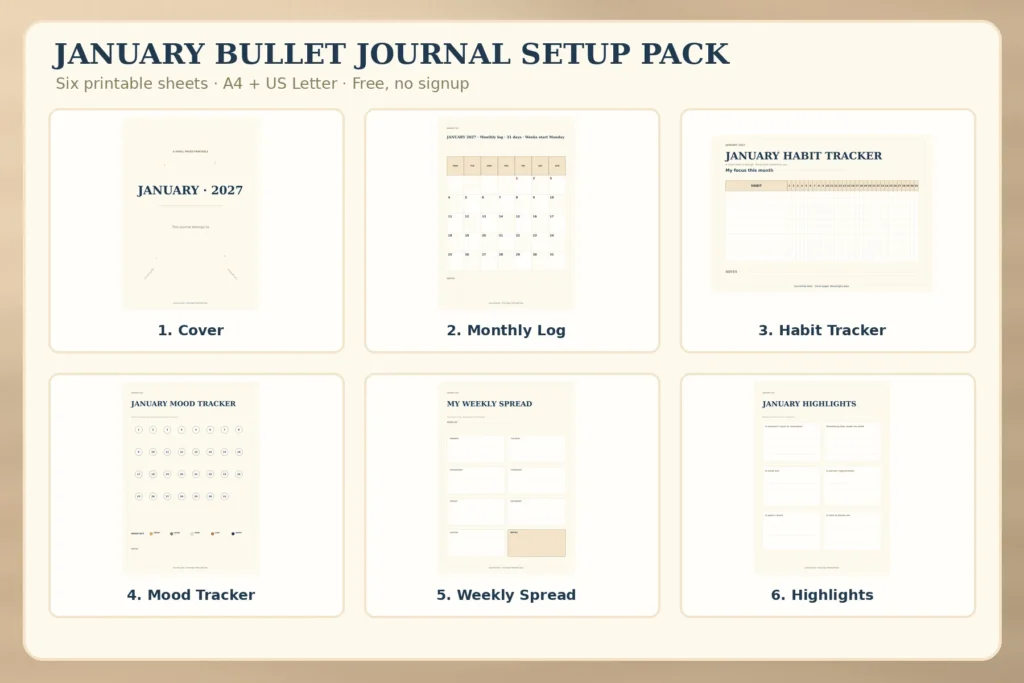
Sheet 1: Cover
A simple month cover with the exact heading JANUARY · 2027 and space to write your name.
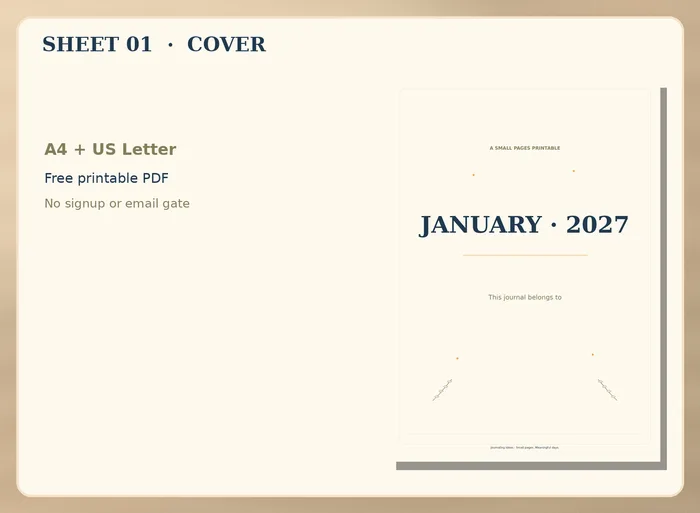
Free download: Cover — A4 PDF · US Letter PDF
Sheet 2: Monthly Log
A Monday-start calendar grid for all 31 days of January 2027. January 1 sits under Friday, and January 31 sits under Sunday.
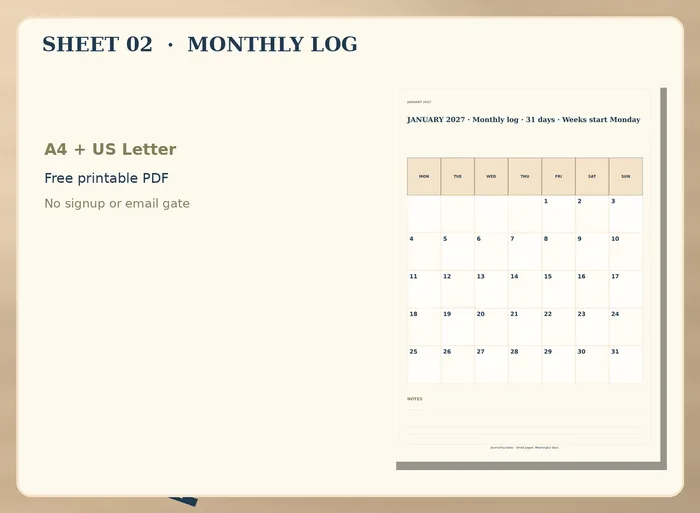
Free download: Monthly Log — A4 PDF · US Letter PDF
Sheet 3: Habit Tracker
A habit tracker with a wide habit-name column and 31 numbered day columns.
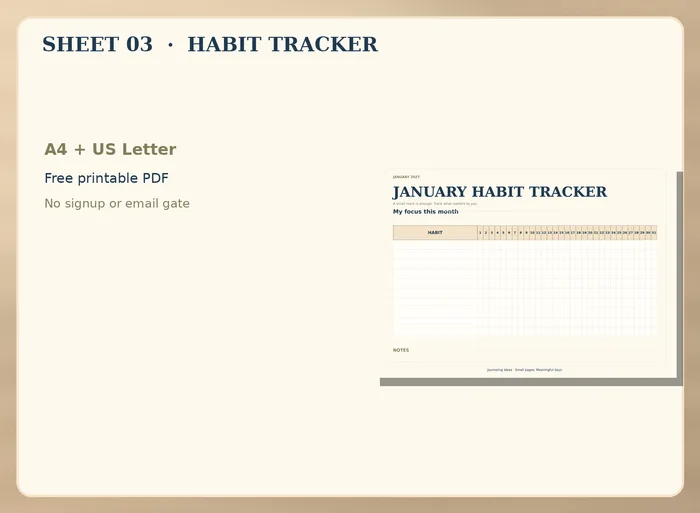
Free download: Habit Tracker — A4 PDF · US Letter PDF
Sheet 4: Mood Tracker
A mood tracker with 31 numbered markers and a five-word mood key.
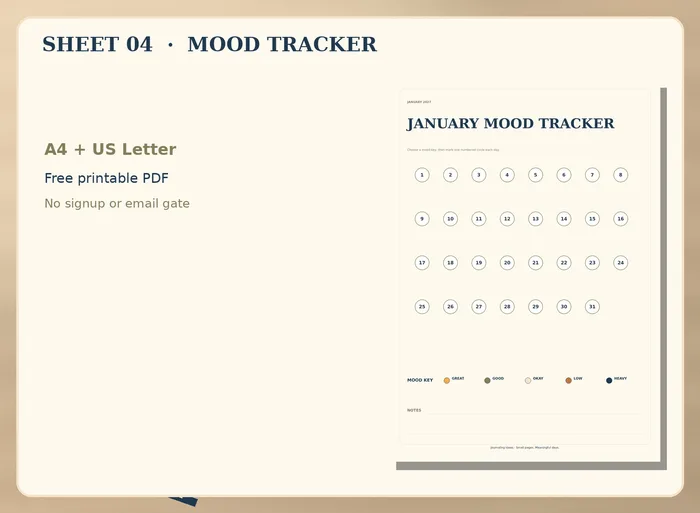
Free download: Mood Tracker — A4 PDF · US Letter PDF
Sheet 5: Weekly Spread
A simple weekly layout with seven day boxes and a separate notes area.
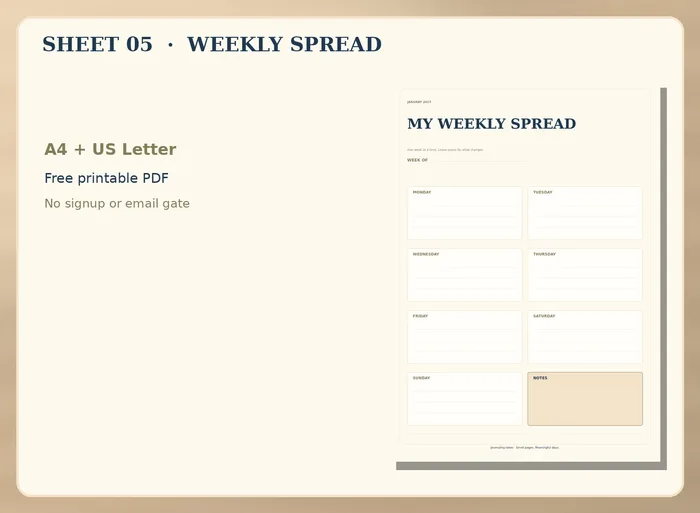
Free download: Weekly Spread — A4 PDF · US Letter PDF
Sheet 6: Highlights
A highlights page with six gentle prompts and room to record the month’ best moments.
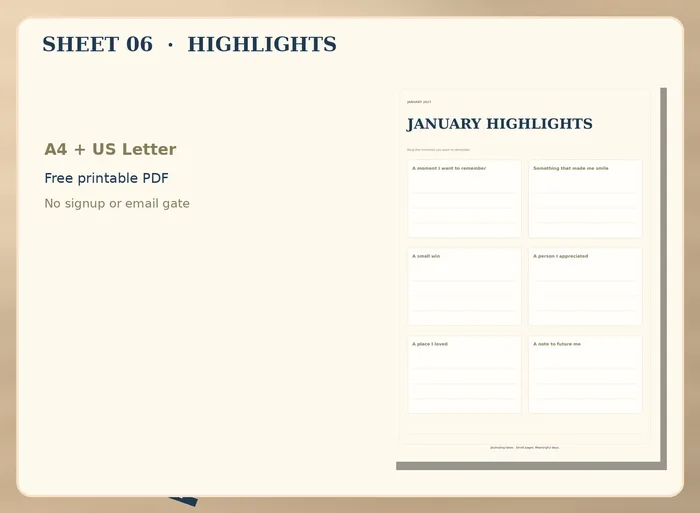
Free download: Highlights — A4 PDF · US Letter PDF
How to print the January bullet journal printables
- Open the PDF for your paper size: A4 or US Letter.
- In the print dialog, select Actual size or 100% if your printer supports it.
- Use portrait orientation for the cover, monthly log, mood tracker, weekly spread, and highlights page. The habit tracker is landscape so its 31 day columns have room.
- Choose a paper weight that works with your pen or marker. Plain printer paper is fine for everyday use.
- If the page looks cropped in the preview, check the paper-size setting before printing.
You can print only the sheets you plan to use. The pages are designed to work as standalone inserts, so you do not have to print the whole pack.
Frequently asked questions
What should I put in my January bullet journal?
Start with a cover page, a monthly log, and one weekly spread. Add a tracker or reflection page only if it will be useful to you.
Does January 2027 have 31 days?
Yes. January 2027 has 31 days. In a Monday-start calendar, January 1 falls on Friday and January 31 falls on Sunday.
Do I need to be good at drawing to start a bullet journal?
No. Simple headings, boxes, lines, and short labels are enough. You can keep every page minimal.
Are the January Bullet Journal Setup Pack printables free?
Yes. All six sheets are free in A4 and US Letter PDF formats. There is no signup, email gate, or password.
Can I use the weekly spread for a week that crosses into February?
Yes. Write the dates beside the weekday names and use the same weekly layout for any seven-day period.
Do I have to use all 20 January bullet journal ideas?
No. The list is a menu of ideas, not a checklist. Choose the pages you are likely to return to and leave the others out.
A simple start is enough
Your January bullet journal can be as small as a calendar and one page for notes. Add more only when you find a reason for them. If you would like a little more writing inspiration, browse january journal prompts and save a few ideas for quiet moments. When February arrives, you can carry forward the pages that helped and explore february bullet journal ideas for the next month.
— Journaling Ideas Editorial Team
Small pages. Meaningful days.

4 Comments