
Sunday Reset Journal: A Simple Weekly Reset Routine + Free Printable Pack
A Sunday reset journal is a simple way to reflect on the past week, clear your mind, and make a gentle plan for the next one. In about 20 minutes, you can review what mattered, write down lingering thoughts, choose three priorities, and prepare for Monday using four printable pages.
You do not need a perfect routine, a decorated planner, or an empty Sunday afternoon.
You just need somewhere to begin.
A little reflection can help you notice what worked. A little planning can help you decide what deserves your attention next.
And if your week was messy? That counts, too.
Free download: The four Weekly Reset sheets from this guide are ready to print in The Small Pages Library (A4 + US Letter). Download the Weekly Reset Pack → Free. No signup.
What Is a Sunday Reset Journal?
A Sunday reset journal is a notebook or printable set of pages you use to review one week and prepare for another.
Instead of planning every hour or writing an enormous to-do list, you take a few minutes to ask yourself:
- What happened this week?
- What felt good, difficult, or unfinished?
- What am I still thinking about?
- What actually needs my attention next week?
- What can wait?
Your answers become a small, realistic plan.
A Sunday reset journal usually combines two helpful activities: reflection and planning.
Reflection helps you understand the week you have just lived. Planning helps you choose where to begin next.
You can do both in a regular notebook, a digital note, or a set of printable pages.
For this routine, we use a free four-page Weekly Reset Pack so that each part has a clear place.
Why Try a Sunday Reset Routine?
Some Sundays are peaceful. Others are full of errands, family plans, work, or everything you did not finish on Saturday.
A reset routine is not supposed to add another task you have to perform perfectly.
Its purpose is to give you a short moment to check in with yourself before the next week begins.
A few minutes with your journal can help you:
- Notice small wins that might otherwise go forgotten.
- Recognize what felt overwhelming.
- Move scattered thoughts onto paper.
- Separate important tasks from less urgent ones.
- Choose a manageable starting point for the week.
- Leave some room for rest, change, and unexpected plans.
There is no guarantee that a weekly reset will make every week easier.
But having a place for your thoughts and plans can make your next steps clearer.
The goal is not a perfectly organized life. It is a little more clarity about the life you are already living.
What Do You Need for a 20-Minute Sunday Reset?
Keep your setup simple.
You will need a pen, a comfortable place to write, and either your regular journal or the four pages in the Weekly Reset Pack.
The printable pack includes:
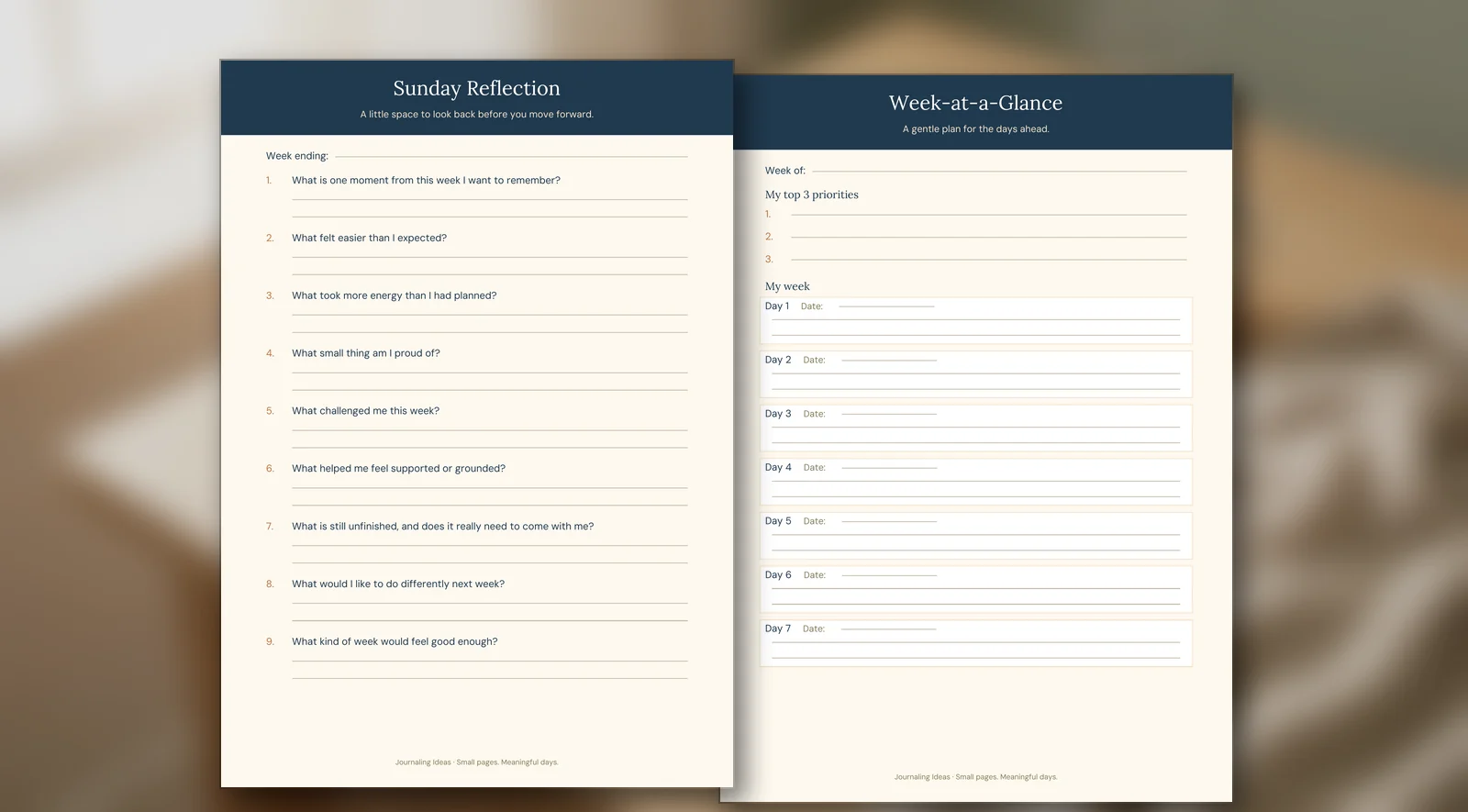
- Sunday Reflection: A page of short prompts for reviewing the past week.
- Brain Dump: A place to collect tasks, worries, reminders, and thoughts.
- Week-at-a-Glance: A seven-day planner with space for three weekly priorities.
- Sunday Reset Checklist: A short list of steps to guide you through the routine.
You can add a warm drink, a quiet playlist, or a few minutes away from your phone if you like.
None of those extras are required.
If you have only 10 minutes, you can still write a few reflections and choose one priority.
If you have more time, you can write longer answers.
The routine should fit your Sunday, not the other way around.
How Do You Do a Sunday Reset in 20 Minutes?
The simplest Sunday reset follows four steps: reflect, empty your mind, plan the week, and finish with a quick check-in.
Your 20-minute Sunday reset — 20 minutes total
| Step | Sheet | Time |
|---|---|---|
| 01 | Sunday Reflection | 5 min |
| 02 | Brain Dump | 5 min |
| 03 | Week-at-a-Glance | 7 min |
| 04 | Sunday Reset Checklist | 3 min |
These times are suggestions, not rules. You can rearrange them around your energy and schedule.
Step 1: Reflect on the Past Week (5 Minutes)
Sheet 1 — Sunday Reflection
Begin with the week you have just finished.
Before making plans, give yourself a chance to notice what actually happened.
Open your Sunday Reflection page and answer whichever questions feel useful.
You might begin with:
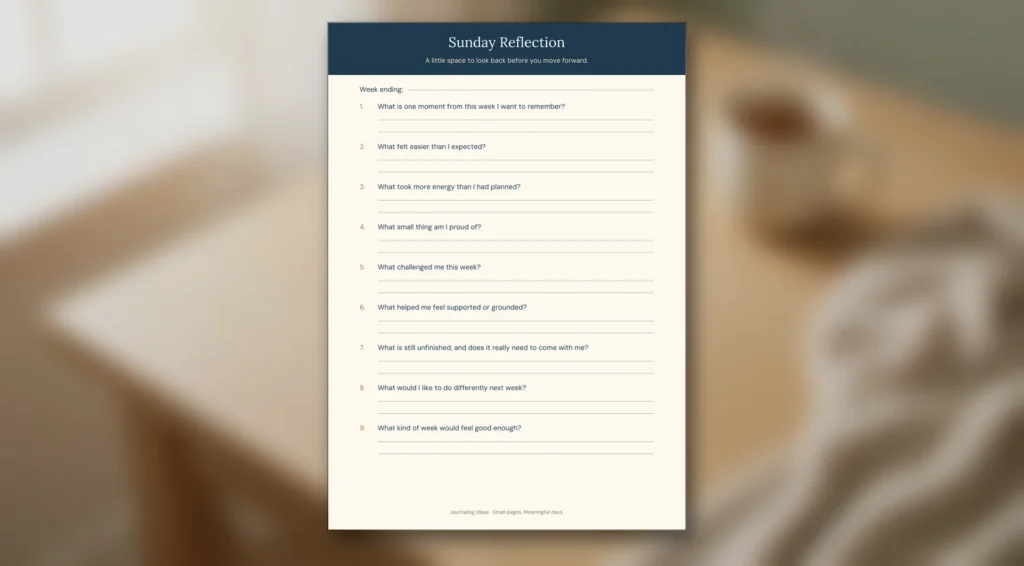
- What is one moment from this week I want to remember?
- What felt easier than I expected?
- What took more energy than I had planned?
- What small thing am I proud of?
- What would I like to do differently next week?
Try to write what is true rather than what sounds impressive.
For example:
“I made time for a walk on Tuesday. I kept putting off one email because I wasn’t sure what to say. I’m glad I called my friend, even though it was a short conversation.”
That is a useful reflection. It notices a win, an unfinished task, and something meaningful.
You do not need to answer every prompt.
If one question helps you understand your week, that may be enough.
How Do You Use the Sunday Reflection Printable?
The Sunday Reflection sheet has nine short prompts and space to write underneath each one.
The questions cover memories, energy, challenges, unfinished tasks, and the kind of week you want next.
Start with the date or week ending, then answer three to five prompts if time is limited.
You can return to the remaining prompts later, or leave them blank.
There is no score for completing the page.
If you have a difficult week, you can keep your answers especially simple:
“This week was tiring. I did what I could. Next week, I need a little more breathing room.”
A Sunday reflection is an observation, not a performance review.
Step 2: Get Your Thoughts Out of Your Head (5 Minutes)
Sheet 2 — Brain Dump
Once you have reflected, move on to the thoughts that are still taking up space.
A brain dump is simply a place to write things down before deciding what to do with them.
Your thoughts do not have to arrive in the right order.
You might be remembering a bill, thinking about a conversation, worrying about a deadline, or realizing you need to buy toothpaste.
Write it down.
The Brain Dump page has three sections:
To do
Use this for tasks and reminders that may need action.
Examples:
- Return a library book.
- Reply to an email.
- Schedule an appointment.
- Buy groceries.
On my mind
Use this for thoughts that do not necessarily need to become tasks.
Examples:
- I feel behind on a few things.
- I keep thinking about a conversation.
- I want more quiet time this week.
- I’m looking forward to seeing a friend.
Can wait
Use this for ideas, projects, or tasks that do not need your attention right now.
Examples:
- Organize old photos.
- Research a new hobby.
- Rearrange the bookshelf.
- Plan a future weekend trip.
The most important part of a brain dump is that not every thought needs to become a task.
Some things just need to be acknowledged.
How Do You Use the Brain-Dump Printable?
Set a timer for five minutes, or write until you feel ready to stop.
Use the lined space beneath each heading to collect your thoughts.
If you are unsure where something belongs, place it under On my mind. You can move it later.
When you finish, look at the To do section and circle anything truly time-sensitive.
Leave the rest where it is for now.
If you enjoy recording patterns in your thoughts or daily activities, a tracking journal can be another useful place to notice what repeats over time.
Your Sunday brain dump, though, has a smaller job: helping you decide what deserves attention this coming week.

Step 3: Make a Gentle Plan for the Week Ahead (7 Minutes)
Sheet 3 — Week-at-a-Glance
Now that your thoughts are on paper, it is time to make a plan.
This is where many weekly routines become too complicated.
You might be tempted to fill every day with tasks, goals, habits, and reminders.
Instead, begin with just three priorities.
Ask yourself:
“If I could make progress on only three things next week, what would matter most?”
Your priorities might include:
- Finish a work assignment.
- Make one important appointment.
- Protect time for rest.
Notice that rest can be a priority.
So can spending time with someone, preparing a simple meal, or finally addressing something you have been avoiding.
Your priorities do not have to be ambitious to be meaningful.
After choosing three, look at the seven-day planner.
Add appointments, commitments, and deadlines you already know about.
Then assign a reasonable starting point to each priority.
For example:
| Day | Example plan |
|---|---|
| Monday | Reply to the important email |
| Tuesday | Work on the assignment for 30 minutes |
| Wednesday | Appointment |
| Thursday | Continue the assignment |
| Friday | Finish and send the assignment |
| Saturday | Flexible time |
| Sunday | Rest and reset |
Leave open space wherever you can.
A weekly planner should help you see your commitments, not make every empty box feel like something you have to fill.
How Do You Use the Week-at-a-Glance Printable?
Write the date for each of the seven day boxes.
Add your three priorities in the section at the top.
Then include only the appointments, deadlines, reminders, and small actions you want to see at a glance.
You can start your week on Monday, Sunday, or any other day that suits your schedule. The page uses blank date spaces rather than fixed calendar dates.
For example, if you begin your reset on a Wednesday, simply date the first box Wednesday and continue through Tuesday.
If you would like to notice one or two consistent routines alongside your weekly plan, our habit tracker printable gives those habits their own separate space.
You do not need to squeeze every part of your life into one planner page.

Step 4: Finish With the Sunday Reset Checklist (3 Minutes)
Sheet 4 — Sunday Reset Checklist
The final step is a quick review.
Take out your Sunday Reset Checklist and check off the actions you completed.
This sheet is not a cleaning checklist or an invitation to start a dozen more chores.
It is a short guide for finishing your journaling routine.
The checklist reminds you to:
- Pause and check in with yourself.
- Notice a small win.
- Write down lingering thoughts.
- Sort what needs action from what can wait.
- Choose three priorities.
- Add known commitments to your weekly plan.
- Leave space for rest or changes.
- Pick one gentle first step.
You can check off the reflection and planning steps you have already done, then finish by choosing one small action for the next day.
For example:
“On Monday morning, I’ll open the document and work on it for 10 minutes.”
That is enough of a starting point.
You do not have to solve the entire week on Sunday evening.
How Do You Use the Sunday Reset Checklist Printable?
Keep the checklist beside your other three pages.
You can glance at it while completing the routine, but save the final three minutes for reviewing it.
Check the boxes that reflect what you actually did.
If you skipped a step, you can complete it now, leave it for later, or decide it was not needed this week.
At the bottom, write your first small step for the coming week.
This gives your routine a natural ending.
Close your journal, put the pages somewhere you can find them, and move on with your Sunday.

Can Beginners Do a Sunday Reset Journal?
Yes. You do not need any journaling experience to try a Sunday reset.
If you have never kept a journal before, begin with just three things:
- Write one sentence about the week you have finished.
- Write down what is taking up space in your mind.
- Choose one thing you want to focus on next week.
You can complete those steps in an ordinary notebook.
You do not need to write neatly, use special pens, decorate your pages, or follow a particular journaling method.
If you want more structure, the Weekly Reset Pack gives you a place for each part of the routine.
If you prefer a less structured approach, copy the headings into a blank notebook and write underneath them.
Either way, start small.
A useful Sunday reset is one you can return to without feeling like you have failed when life gets busy.
What Are the Most Common Sunday Reset Mistakes?
A Sunday reset can be helpful, but it becomes less useful when it turns into another source of pressure.
Here are five common mistakes to avoid.
1. Trying to Plan Every Minute
A detailed schedule may look organized on paper, but real weeks change.
An appointment runs late. Something unexpected comes up. You need a rest day.
Leave some flexibility in your planner instead of filling every available space.
2. Turning Every Thought Into a Task
A brain dump can include worries, ideas, feelings, reminders, and unfinished projects.
Not everything you write needs an action.
Use the On my mind and Can wait sections to give thoughts a place without adding them all to your weekly to-do list.
3. Choosing Too Many Priorities
A long list of priorities can make it hard to decide where to start.
Choose three for the week.
You can still handle daily responsibilities, but three priorities give you a manageable focus.
If one of them takes longer than expected, you can carry it forward.
4. Judging the Week Too Harshly
Reflection is not a test of how productive you were.
A difficult week can still include good decisions, meaningful moments, or things you learned about your needs.
Try asking what helped and what was hard, rather than deciding whether the whole week was a success or failure.
5. Treating the Checklist Like a Requirement
You do not have to use every page every week.
Some Sundays, you might only need the reflection page.
Other times, the brain dump may be the most useful part.
The checklist is there to help you remember the process, not to measure how well you followed it.
How Can You Make Sunday Reset Journaling a Habit?
The easiest place to begin is with a realistic time.
Choose a moment when you usually have a little room to think.
That might be Sunday morning with breakfast, Sunday afternoon before dinner, or Sunday evening after the house becomes quieter.
You can also attach the reset to something you already do, such as making a cup of tea or preparing your bag for the next day.
Try keeping your pages and a pen in the same place so they are easy to find.
A few ideas that may help:
- Print several copies of the pages you use most.
- Keep your journal somewhere visible.
- Start with five minutes when you have a busy Sunday.
- Use the same three priorities section each week.
- Review the previous week’s plan before starting a new one.
- Keep unused pages instead of feeling you must complete them.
If you are building a larger paper planning system, the journal ecosystem can help you think about how different journals and planning pages fit together without duplicating the same information everywhere.
But you do not need a larger system to begin.
One page and a few minutes can be a perfectly good weekly routine.
Should You Use Paper or a Digital Sunday Reset Journal?
Both can work.
A paper journal may suit you if you enjoy handwriting, want to take a short break from screens, or like keeping your weekly reflections together.
A digital journal may suit you if you prefer typing, need access to your notes across devices, or want to move tasks into a calendar.
You can also combine them.
For example, you might write your reflections and brain dump on paper, then transfer time-sensitive appointments into your digital calendar.
The four printable sheets are designed for handwriting, but you can use their headings and questions in any notes app.
Choose the method you are most likely to use.
How Do You Print the Free Weekly Reset Pack?
The Weekly Reset Pack includes four different printable pages, each prepared in two paper sizes:
- US Letter: 8.5 × 11 inches, a common home-printing size in the United States.
- A4: 210 × 297 mm, a common paper size in the United Kingdom and many other countries.
Both versions contain the same reflection prompts, planning sections, and checklist steps.
For a clean print:
- Download the paper-size version that matches your printer.
- Open the PDF using your preferred PDF reader.
- Choose the matching paper size in your print settings.
- Select Actual Size or 100% when your printer supports it without clipping. Otherwise, use the fit-to-printable-area option.
- Print in color or grayscale.
- Check the first page before printing additional copies.
You do not need a color printer. The pages use clear headings, lines, and boxes that also work in grayscale.
Print the entire pack for a complete reset, or reprint only the pages you use regularly.
The pages are undated, so you can reuse the layout every week of the year.
Where Can You Get the Free Sunday Reset Journal Printables?
Free Weekly Reset Pack — 4 printable page designs
The Weekly Reset Pack is part of The Small Pages Library, our collection of free journaling and planning printables.
The pack includes:
- Sunday Reflection — nine prompts to review the week.
- Week-at-a-Glance — seven days and three weekly priorities.
- Sunday Reset Checklist — eight simple steps for your reflection and planning routine.
- Brain Dump — lined sections for To do, On my mind, and Can wait.
Each page comes in A4 and US Letter, giving you eight PDF files in total.
Free to download. No email signup or password required.
Open the Library, find the Weekly Reset Pack, choose your preferred paper size, and download the pages.
You can print a fresh set each week or just the individual sheets you need.

If you enjoy the weekly reset ritual, you might also like our monthly reset journal. It follows the same gentle, paper-based approach on a bigger scale: review the month, notice your highlights and lessons, and choose a clear focus for the next one. The free Monthly Reset Pack includes six printable sheets in A4 and US Letter (12 PDFs), with no signup required. You can read the guide here: monthly reset journal
If you already use a Sunday reset to close the week on paper, you might also enjoy a shorter evening close-down on ordinary days. Our evening journal prompts guide includes 30 gentle questions, a simple 10-minute wind-down, and a free four-sheet Evening Pages Pack with a Day Review, Let It Go List, and Tomorrow’s Top 3. The pack is available in A4 and US Letter (8 PDFs total) in The Small Pages Library, with no signup required.
Sunday Reset Journal FAQs
How long does a Sunday reset journal routine take?
About 20 minutes is a practical starting point. You might spend five minutes reflecting, five minutes on a brain dump, seven minutes planning, and three minutes reviewing your checklist. A shorter five- or ten-minute version is fine, too.
What if I miss my Sunday reset?
You have not ruined your routine. Try it on Monday, Tuesday, or whenever you have time. The purpose is to review and plan, not to complete the pages on a specific day.
Do I need to use all four printable pages every week?
No. You can use one, two, or all four sheets. The reflection and brain-dump pages can be especially useful when you do not have time for a complete planning session.
Can I start a Sunday reset journal in the middle of the week?
Yes. You can start on any day. Add dates to the blank weekly planner boxes, reflect on the days that have passed, and use the remaining space for your upcoming plans.
What should I write if nothing interesting happened this week?
Ordinary moments count. You can write about something you noticed, a small task you finished, a conversation, your energy level, or something you want to change. A reflection does not need an extraordinary event.
Is a Sunday reset journal the same as a weekly planner?
Not quite. A weekly planner mainly organizes upcoming tasks and commitments. A Sunday reset journal also includes reflection and space to process thoughts. Combining them can help you review the past week before planning the next one.
A Small Sunday Reset Is Enough
Your Sunday does not need to become a long list of things to fix before Monday.
You can take a few minutes to remember what mattered, write down what is weighing on your mind, and choose a gentle direction for the days ahead.
Some weeks, you might fill every page.
Other weeks, you might write three sentences and stop.
Both can be useful.
Your journal is there to support your life, not to give you another standard to meet.
Small pages. Meaningful days.
— Journaling Ideas Editorial Team




2 Comments