
Book Club Journal: How to Keep One (With 24 Prompts + a Free Companion Pack)
A book club journal is a personal notebook where you record your thoughts about the books your group reads, the conversations you share, and the ideas you want to remember. It gives you a place to prepare before meetings, capture interesting points during discussions, and reflect after finishing each book.
Keeping one can make your book club experience feel more meaningful. Instead of letting a good conversation fade by the time you get home, you have a place to keep the moments, questions, and discoveries that made it worth having.
You don’t need a special notebook, beautiful handwriting, or a complicated system. A few honest lines after each reading session are enough to get started.
What Is a Book Club Journal?
A book club journal is a notebook dedicated to your reading group’s books and meetings. It helps you keep track of what you read, what you thought about it, what other members noticed, and how your opinions developed throughout the discussion.
Think of it as a personal record of your book club journey rather than a formal reading assignment.
You might use it to:
- Write down your first impressions before a meeting.
- Remember characters, ideas, or moments you want to discuss.
- Record interesting comments from other members.
- Keep track of books your group has finished.
- Note which books you enjoyed and which ones weren’t quite your taste.
- Collect recommendations for future meetings.
- Look back at your group’s reading choices throughout the year.
The difference between a regular reading journal and a book club journal is its focus.
A reading journal usually follows your individual reading life. You might record book titles, authors, reading dates, favorite passages, and personal ratings. A book club journal includes those things but also makes room for the shared experience: meeting notes, different opinions, group decisions, and the books you choose together.
If you’d like to explore more ways to record your reading life, our Reading Journal guide has ideas for keeping track of books, collecting reading memories, and creating a simple personal reading record.
You can keep both journals separately, or combine everything in one notebook. There isn’t a single correct way to organize your reading.
The most useful book club journal is the one you actually enjoy opening.
How Do You Keep a Book Club Journal?
The easiest way to keep a book club journal is to follow a simple cycle: write a few lines before the meeting, capture a few thoughts during the discussion, and spend a little time reflecting afterward.
You don’t need to write every day or fill an entire page for every book. Your notes can be short and informal.
Here is a simple routine you can repeat for each book.
1. Before the Meeting: Prepare Your Thoughts
Before your group meets, take five minutes to look back at what you’ve read.
Write down the book’s title and author, then consider what stood out to you. Perhaps a particular character surprised you, an idea made you think, or a chapter left you with questions.
You could include:
- Your first impression of the book.
- A moment you particularly enjoyed.
- Something you didn’t understand.
- A question you’d like to bring to the discussion.
- Your overall feeling about the book so far.
If you haven’t finished reading, that’s fine. Write about where you are rather than trying to catch up on everything before the meeting.
The purpose is to arrive with a few thoughts of your own, not a prepared speech.
2. During the Discussion: Catch the Interesting Moments
You don’t have to write constantly while everyone is talking. Your attention belongs in the conversation, too.
Keep your notebook nearby and make short notes when something catches your attention.
For example, you might record:
- A different interpretation of an important moment.
- A comment that made you reconsider your opinion.
- A detail another member noticed.
- A question that started an interesting conversation.
- A recommendation someone mentioned.
You can use short phrases rather than complete sentences. You’ll remember the context when you read your notes later.
One particularly useful habit is to mark anything that changes your perspective. Sometimes another reader notices something you missed, and that becomes the most interesting part of the meeting.
3. After the Last Page: Give Yourself Time to Reflect
Once the book and meeting are finished, return to your notes for a short reflection.
Ask yourself what you thought about the book overall. Did the discussion change your opinion? Was there a moment you appreciated more after hearing someone else’s thoughts? Would you recommend the book to another reader?
You can also record your final rating if your group uses one.
Here is a small example of what a completed entry might look like. The book title and entry below are fictional.
Example book club journal entry
Book: The Salt Road
I expected this story to be about the journey, but I found myself thinking more about the people along the way.
Someone in the meeting noticed a small detail I had completely missed.
I liked the quieter ending more after hearing everyone’s interpretation.
I’d recommend this book to someone who enjoys thoughtful, character-focused stories.
That’s enough. A few lines can preserve an entire reading experience without turning your notebook into another task on your to-do list.
24 Book Club Journal Prompts
Sometimes you know you want to write about a book but aren’t sure where to begin. These 24 book club journal prompts give you gentle questions to use before meetings, during discussions, after finishing a book, and when choosing your group’s next read.
You can answer one question at a time or work through a whole section. Choose whichever question feels most interesting.
Before the Meeting
- What made you curious about this book when you first picked it up?
- What are you hoping to discover or experience as you read this book?
- Which moment, idea, or detail has stayed with you most so far?
- What feelings or thoughts have you noticed while reading, and have they changed along the way?
- Is there anything about the book that you find confusing, surprising, or difficult to connect with?
- If you could bring one question about the book to your next meeting, what would you want to ask?
During the Discussion
- Which comment from another reader made you see the book in a different way?
- What did someone notice that you had completely overlooked?
- Was there a moment when your opinion differed from someone else’s, and what did you learn from that difference?
- Which part of the conversation made you want to revisit a particular page or passage?
- What feeling or reaction did you find yourself sharing with the other readers?
- What new thought about the book would you like to remember after the meeting?
After the Last Page
- What was your overall feeling when you finished this book?
- Which moment, idea, or detail do you think you will remember longest?
- Did the ending leave you satisfied, surprised, unsettled, or something else?
- Has anything in this book changed the way you think about a person, situation, or part of everyday life?
- What did you enjoy most about reading this book, and what did you enjoy least?
- If you could keep just one thought from this book in your notebook, what would it be?
Choosing the Next Book
- What kind of book are you in the mood to read with your group next?
- Which subjects, settings, or stories would you like to explore that you haven’t tried before?
- What did you enjoy about this group’s reading experience that you would like to find in the next book?
- Would you prefer something familiar and comforting or something completely different from your usual reading?
- Is there a book you’ve been wanting to read that you would love to suggest to the group?
- What would make your next book club read feel especially enjoyable or meaningful?
You don’t have to answer every prompt. Some questions might take only one sentence, while others might inspire a full page.
You can also return to the same question after a few days and see whether your thoughts have changed. Your first reaction and your final opinion don’t always have to match.
How to Use the Book Club Companion Pack
If you prefer having a little structure on the page, a printable companion pack can make your book club journal easier to maintain.
We’ve put together a free Book Club Companion Pack with four practical sheets. You can print the pages and keep them in a binder, slip them into a folder, or place them inside your regular notebook.
The pack includes:
Sheet 1: 24 Discussion Journal Prompts
This sheet brings all 24 questions together in one convenient place. It is organized into the four stages of your book club experience: Before the Meeting, During the Discussion, After the Last Page, Choosing the Next Book. Keep it nearby when you’re not sure what to write. Choose a question that matches where you are in the reading process and use the space in your own notebook to answer.
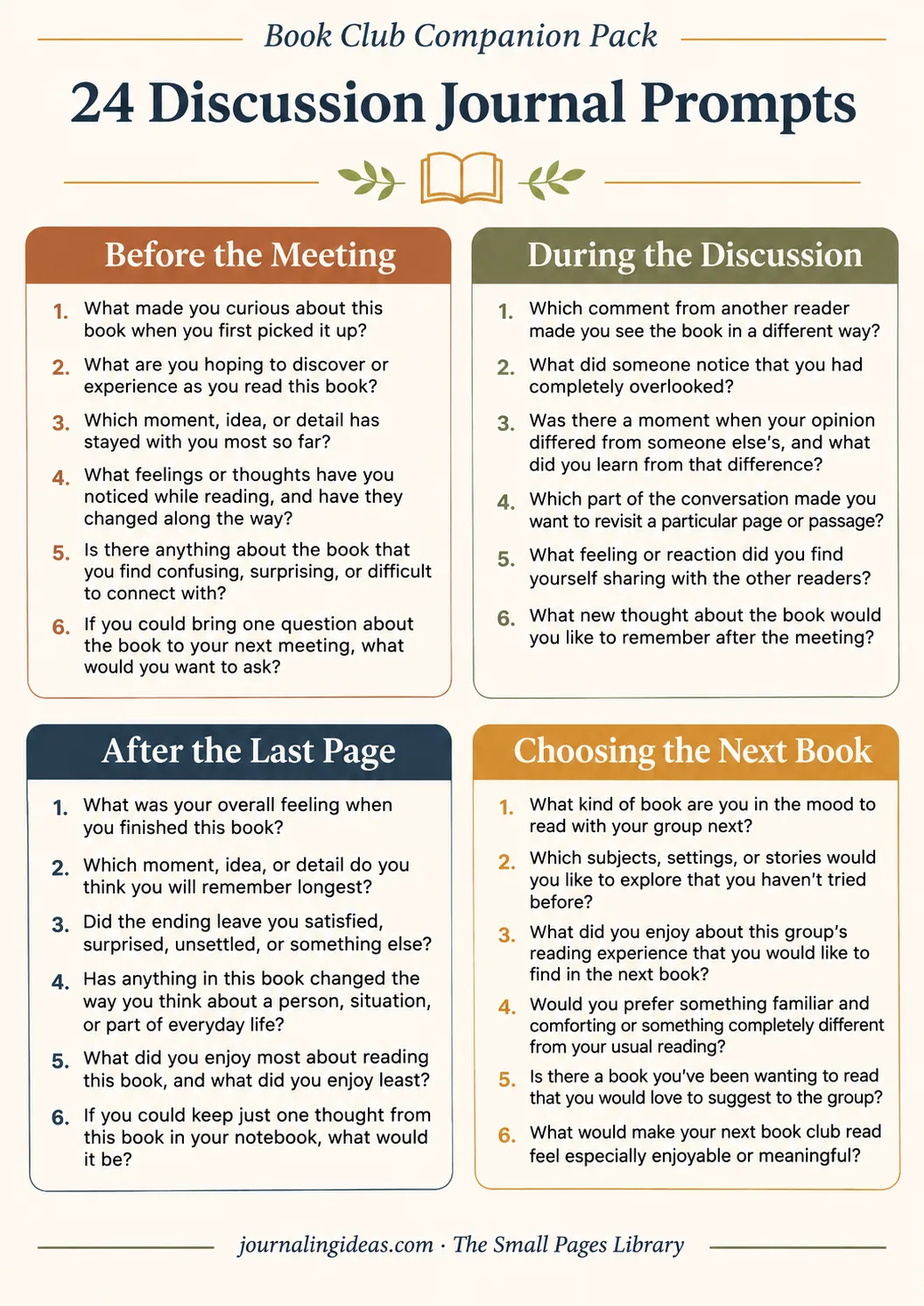
Download: 24 Discussion Journal Prompts — A4 · US Letter
Sheet 2: Meeting Notes
Use this sheet to record the details of each book club gathering. It includes spaces for: Book (the title of the book being discussed), Date (when your group met), Who Came (the members who attended), The Best Point Made (a comment or observation you found especially interesting), and One Thing That Changed My Mind (something you reconsidered after hearing another perspective). This page is particularly useful when you look back at older meetings. You may remember the book but forget the conversation that made it special. A few notes help you keep both.
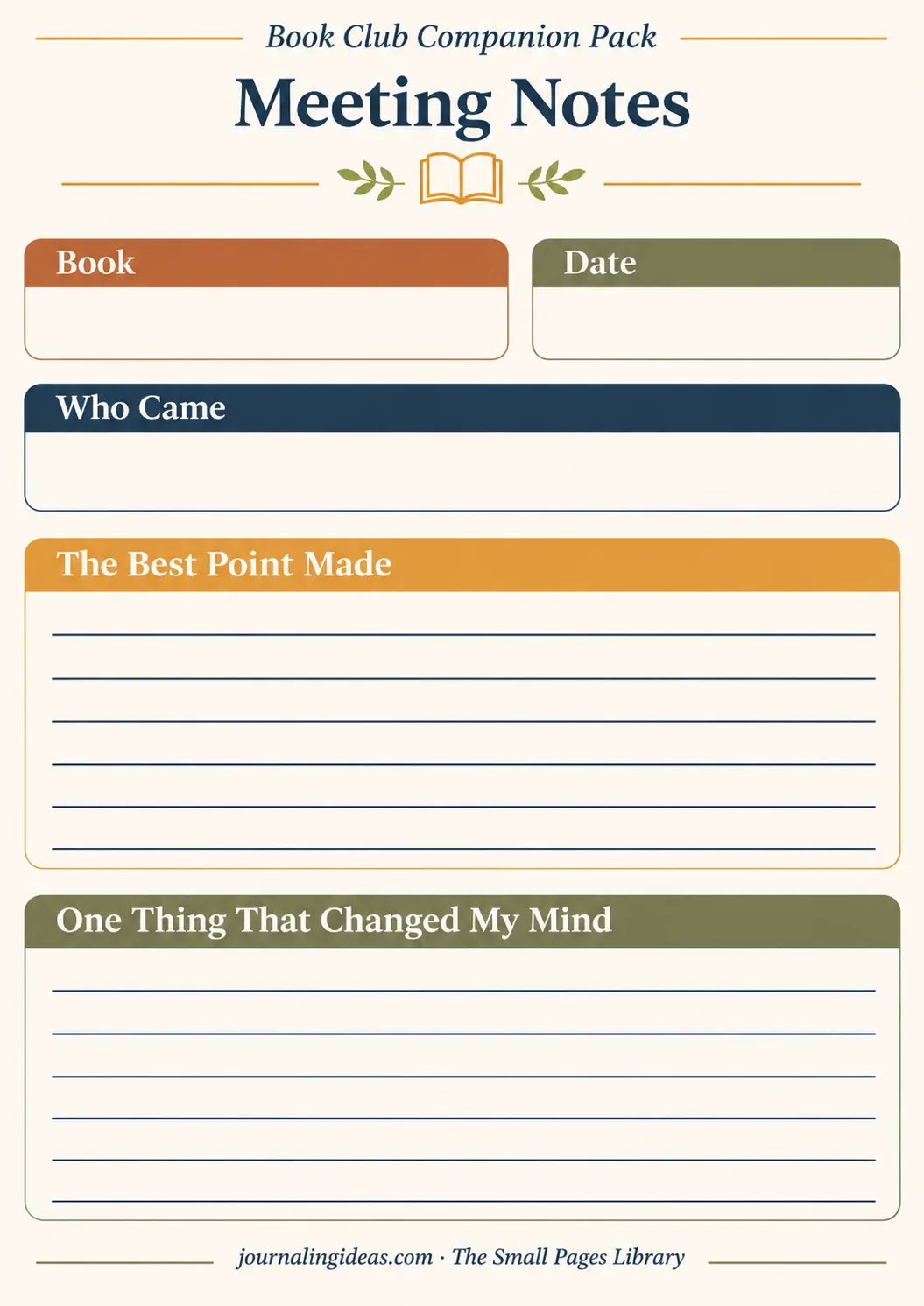
Download: Meeting Notes — A4 · US Letter
Sheet 3: Our Club’s Year
This sheet gives your group a simple overview of its reading year. It includes 12 rows, one for each month, with four columns: Month, Book, Host, Group Rating. Fill in a row whenever your group finishes a book. By the end of the year, you’ll have a simple record of your reading choices, hosts, and group ratings. It’s also a lovely way to remember which books brought everyone together.
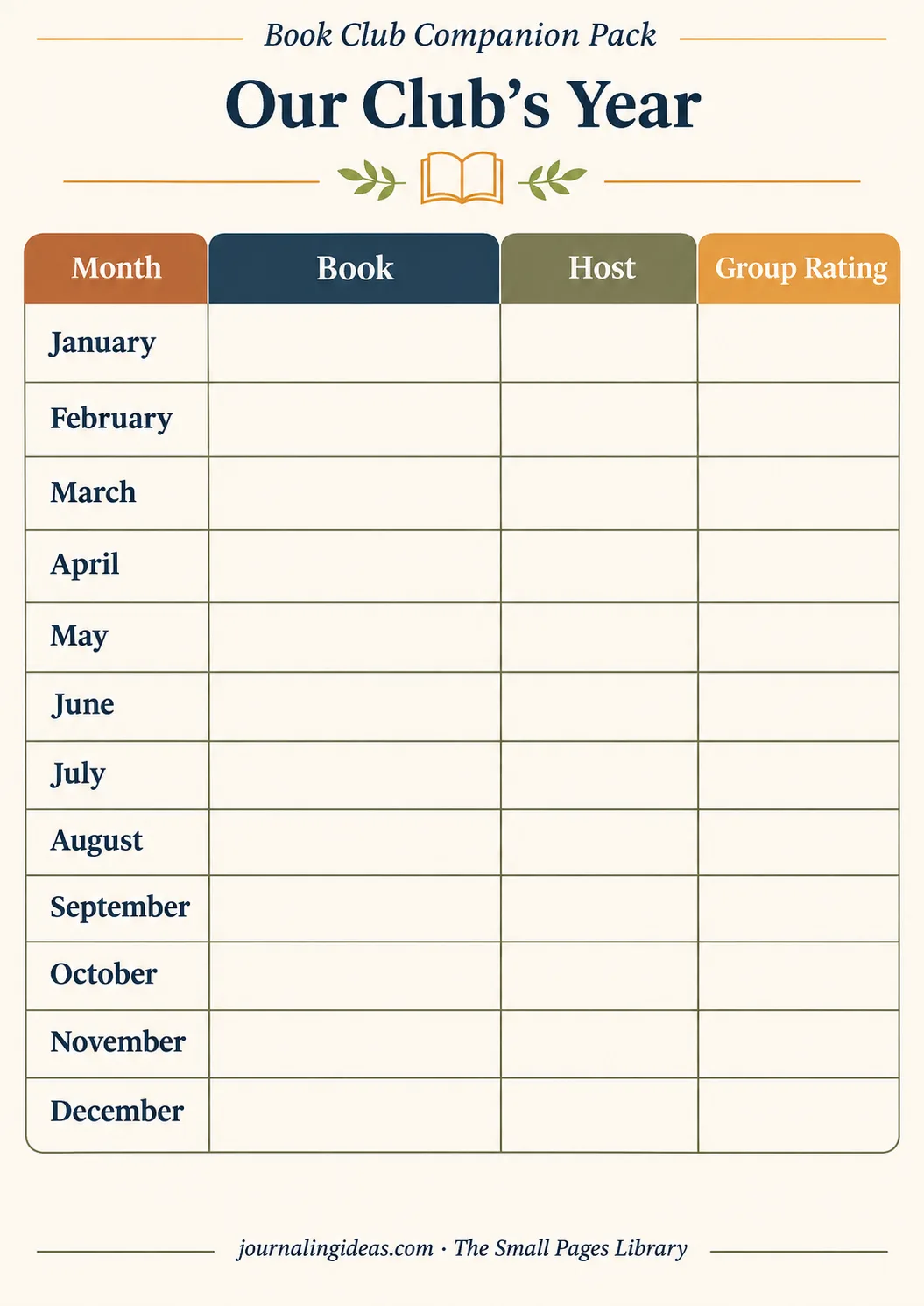
Download: Our Club’s Year — A4 · US Letter
Sheet 4: Next Book Ballot & Picks
Choosing the next book can be one of the most enjoyable parts of a book club, but it can also take a little time. This sheet gives your group a place to collect suggestions and organize its next choice. Use it to write down proposed titles, compare the options, and record the final selection. Everyone gets a chance to contribute ideas, even members who prefer to think before sharing their suggestions aloud. You can bring the sheet to an in-person meeting or share it with members before an online discussion.

Download: Next Book Ballot & Picks — A4 · US Letter
Printing Your Companion Pack
All four sheets are available in both A4 and US Letter sizes, so you can choose the format that suits your printer. The complete Book Club Companion Pack is free, requires no email signup, and is available through The Small Pages Library on journalingideas.com.
Print all four sheets together if you’d like a complete system, or start with just the discussion prompts and meeting notes. You can print fresh copies of the meeting pages whenever you need them. The year overview can stay in your binder throughout the year. There is no need to use every page perfectly. The printables are simply there to make keeping your book club notes a little easier.
Simple Ways to Make It a Habit
A book club journal works best when it fits naturally into something you’re already doing. You don’t need a strict writing schedule or a complicated organization system.
Here are a few small ways to make it part of your reading routine.
Keep your journal with your current book. Place your notebook or printed pages somewhere you can easily reach them. If you usually read beside your bed or in your favorite chair, keep your journal nearby.
Use the same simple layout for every book. Start with the title, author, and meeting date. Add your thoughts underneath. Repeating a familiar layout means you won’t have to decide how to organize every new entry.
Write while your thoughts are fresh. You don’t need to wait until the meeting is over to record something interesting. A quick note during the discussion can help you remember it later.
Don’t worry about writing beautifully. Your journal is for you. Use incomplete sentences, arrows, crossed-out words, or quick lists. You don’t need to turn your thoughts into polished paragraphs.
Leave room for different opinions. One of the nicest parts of a book club is discovering that other readers can experience the same book differently. You can disagree with someone and still appreciate their interpretation. Record the perspectives that made you think.
Give yourself permission to miss a page. If you forget to write before a meeting, start afterward. If you miss a meeting, add a short note when you return. You don’t have to recreate every conversation or fill in every blank space.
Look back at the end of the year. Read through your Our Club’s Year sheet and revisit a few meeting notes. Notice which books surprised you, which ones started the best conversations, and what kinds of stories your group enjoyed most.
The goal isn’t to create a perfect record. It’s to keep the parts of reading and sharing books that you would otherwise forget.
Frequently Asked Questions About Book Club Journals
What do you write in a book club journal?
You can write the book title, author, reading dates, first impressions, favorite moments, questions, meeting notes, and final thoughts. You can also record recommendations and ideas for your next group read. Short, honest notes are perfectly fine.
Do I need a separate notebook for my book club?
No. You can use a separate notebook, a binder with printable pages, or a dedicated section in your existing reading journal. Choose whichever option is easiest to keep with your books and meeting notes.
What if my club meets online?
You can use exactly the same journal for an online book club. Keep your notebook nearby during the video call, write down interesting comments, and record the meeting date and attendees afterward. If you prefer, you can print the meeting notes sheet before the call.
What if I did not finish the book?
You can still participate and keep notes. Write down how far you read, what you thought of the sections you completed, and any questions you have. You don’t need to pretend you’ve finished or avoid recording your honest experience.
How much time does it take before a meeting?
About five minutes is enough to prepare a few notes before a meeting. You can spend longer if you want to explore a particular question, but there is no required writing time. Even three short observations can give you something to reflect on.
Can I use a book club journal on my own, without a club?
Absolutely. You can use the same prompts to reflect on books you read independently. Write your own questions, record your changing opinions, and use the next-book section to plan your personal reading list. You don’t need a group to enjoy the process.
The Conversation Stays With You
A book club meeting might last an hour or two, but the thoughts you take away from it can stay with you much longer.
Sometimes it’s a small detail you hadn’t noticed. Sometimes it’s a different opinion that makes you reconsider a character or an idea. And sometimes it’s simply remembering how much you enjoyed talking about a book with people who were reading it alongside you.
A book club journal gives those moments somewhere to live. It doesn’t need to be elaborate, and it doesn’t need to become another responsibility. A few lines before a meeting, a handful of notes during the conversation, and a short reflection afterward are enough.
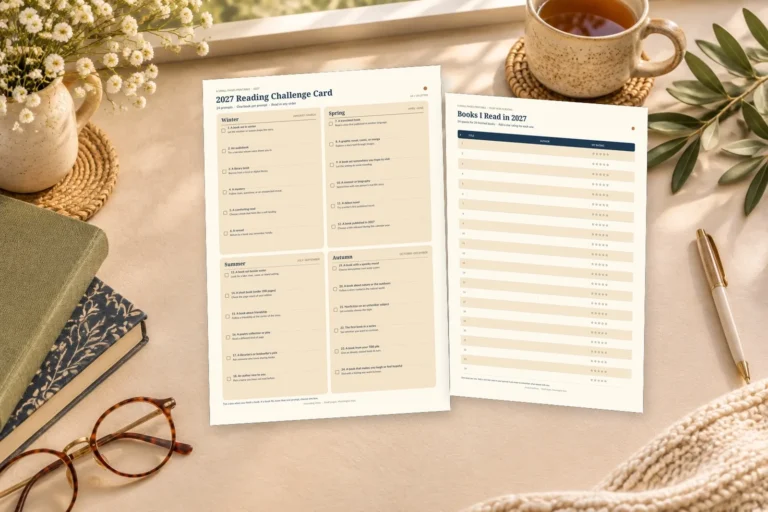
If your group enjoys setting reading goals together, you might also like our 2027 Reading Challenge. It’s another simple way to bring a little structure to your reading year and discover books you might not otherwise pick up.
Start with one book, one page, and one thought you’d like to remember.
Small pages. Meaningful days.
Happy journaling,
The Journaling Ideas Editorial Team