

Music Journal: How to Log the Songs You Love (With 48 Prompts)
A music journal is a personal record of the songs and albums you listen to. It can be a notebook or a few printable pages where you note what you played, why you pressed play, what caught your attention, and what the music meant to you. You do not need music knowledge or a review score to begin.
Some songs become part of ordinary life. You play them on the way to work, while cooking dinner, during a quiet evening, or whenever you need a familiar sound. Others bring back a memory you haven’t thought about in years.
But how often do you remember exactly which songs you were listening to during a particular season of your life?
A music journal gives those listening moments somewhere to go. Instead of trying to remember every favorite song, you can keep a simple record of them, one entry at a time.
In this guide, we’ll explore what to write in a music journal, how to record individual songs and full albums, and how to use 48 original prompts to get started. You’ll also find a free five-sheet Music Journal Starter Pack, with every sheet available in A4 and US Letter.
You don’t need to know anything about music. You just need a song you want to remember.
What Is a Music Journal?
A music journal is a notebook or collection of pages where you record the music you listen to and your personal response to it.
Think of it as a reading journal, but instead of recording books, authors, and reading experiences, you record songs, artists, albums, and listening moments.
A music journal can include:
- Songs you keep returning to.
- Albums you listen to from beginning to end.
- The reason you chose a particular song.
- Details you noticed during listening.
- Music connected to memories or particular seasons.
- New discoveries you want to explore further.
There is no required format. You can use a notebook, a digital document, a notes app, or printable journal pages.
The important thing is that the journal belongs to you.
How Do You Start a Music Journal?
The simplest way is to begin with one song you’ve listened to recently.
Choose a song. It can be something you discovered today or a familiar favorite.
Record the basics. Write the date, song title, and artist.
Add one personal observation. Note why you played it, what caught your attention, or how you felt while listening.
That’s your first entry.
You don’t need a decorated notebook, a carefully organized playlist, or a long reflection. One or two sentences are enough.
You can add more detail when you feel like it.
Why Keep a Music Journal?
A music journal doesn’t need a grand purpose. It can simply be a pleasant way to remember the music that accompanies everyday life.
Here are four reasons you might enjoy keeping one.
- Remember the Songs You Loved — It’s easy to forget the songs you played repeatedly during a particular month or season. A song log gives you somewhere to record those discoveries and favorites. Later, you can look back and remember what you were listening to at different points in your life. Your entries don’t have to be important or unusual. Sometimes remembering an ordinary listening moment is enough.
- Notice How Your Music Taste Changes — Your musical preferences might change over time. You may find yourself exploring a different genre, returning to older favorites, or discovering an artist whose work you want to hear more of. A journal lets you notice these changes without trying to categorize your taste or give every song a score. You might look back and find that the music you enjoyed during one season sounds quite different from your current listening choices.
- Connect Music With Everyday Memories — Music often becomes associated with places, routines, people, and particular moments. You might remember a song from a long journey, an evening at home, a celebration, or a quiet afternoon. Writing down those connections gives you more than a list of titles. It gives you a personal record of why certain music mattered to you.
- Notice Your Listening Mood — Sometimes you choose music because it matches how you feel. Other times, you press play because you want a different atmosphere. A music journal can help you notice these small patterns. For example, you might find that you often choose familiar albums when you want a quiet evening, or that you save unfamiliar music for times when you feel curious. There’s no need to analyze your behavior. Just record what you notice.
What Should You Write in a Song Log Entry?
A song log is the simplest page in a music journal. It gives you a consistent place to record the basic details of something you’ve listened to.
Our Song Log uses six fields:
- Date — The date you listened to the song.
- Song — The song title.
- Artist — The artist’s name.
- Why I pressed play — What made you choose the song that day.
- A line that stayed with me — Your own sentence about a detail, thought, or feeling that stayed with you.
- Mood (1–5) — A number representing how you felt while listening.
You can fill in every field or keep an entry particularly short when you’re busy.
A Simple Filled-In Example
Here’s an illustrative example using placeholders rather than a real song or artist:
- Date — November 7
- Song — A familiar favorite
- Artist — Artist’s name
- Why I pressed play — I wanted something familiar while tidying.
- A line that stayed with me — The steady rhythm made the room feel less hurried.
- Mood (1–5) — 4
Notice that the entry isn’t a review. It doesn’t explain whether the song is technically good, whether the production is impressive, or whether someone else would enjoy it. It simply records one listening experience.
A note about the mood field: The number is about your mood, not the quality of the music. You can use your own interpretation of the 1–5 scale. It isn’t a rating system you have to follow.
And when writing your own observation, you don’t need to copy song lyrics. Describe the detail or feeling in your own words.

What If You Don’t Know What to Write?
Try completing just one of these sentences:
I pressed play because…
The part I noticed most was…
This song reminds me of…
I would like to hear this again when…
Today, this music made me feel…
Choose whichever feels natural. You don’t have to answer all five.
How Do You Take Album Notes Without Writing a Review?
Listening to an entire album can feel different from listening to individual songs.
An album gives you a collection of tracks to experience together. You might notice a particular song, a change in atmosphere, or how the final track affects your impression of the whole album.
You can record these observations without becoming a music critic.
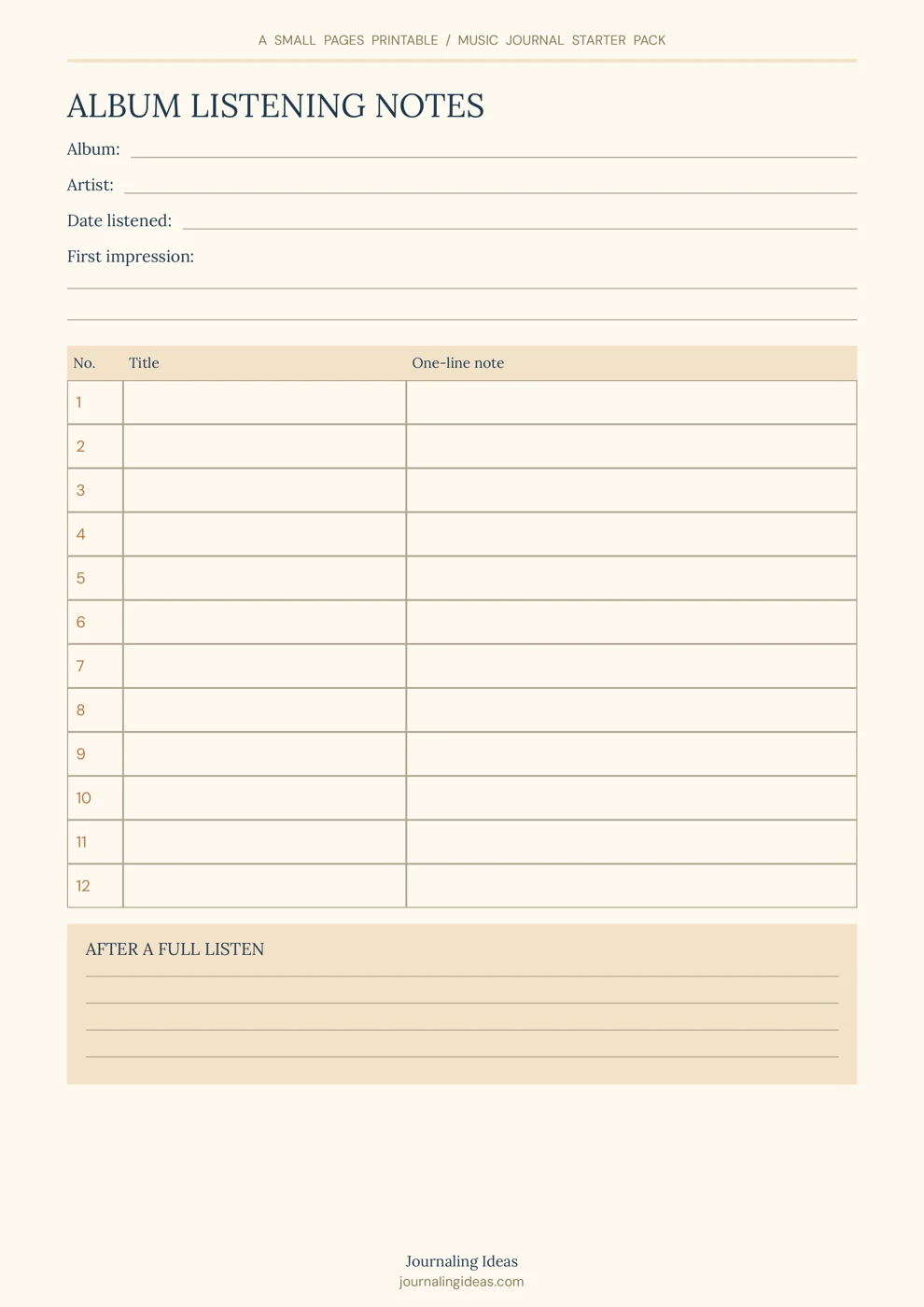
Our Album Listening Notes sheet gives you three simple stages.
- Write Your First Impression — Start with the album title, artist, and date listened. Then write your first impression. You could describe: the overall mood; whether you enjoyed the opening; what kind of listening experience you expected; whether anything immediately caught your attention. A short sentence is enough.
- Add One Note for Each Track — The printable has room for 12 tracks. For each track, write its number, title, and one-line note. Your note might describe something you noticed, how the track made you feel, or whether you wanted to hear it again. For example: A quieter track than I expected. The rhythm caught my attention. This one became my favorite. I want to listen to this again. You don’t need to write something about every musical element. You don’t even need to understand why a particular track appeals to you.
- Reflect After a Full Listen — Once you’ve finished the album, use the final reflection box. Ask yourself: Did my first impression change? Which track stayed with me? Was there anything I didn’t expect? Would I listen to the album again? The purpose is to remember your experience, not to produce a professional album review.
48 Music Journal Prompts to Help You Get Started
Sometimes you know you want to write about music, but you don’t know where to begin.
These 48 prompts are organized into eight sections. You can work through them in order, choose one that catches your attention, or return to the same prompt whenever you have a new listening experience.
Jump to a section: Songs on Repeat · Albums from Start to Finish · Music and Memory · Taste and Discovery · Music and Mood · Live Music and Shared Moments · Lyrics That Stay With You · Seasons, Places and Playlists
Songs on Repeat
- Which song have you played more than once lately, and what keeps bringing you back?
- What do you notice on a repeat listen that you missed the first time?
- Is there a song you reach for when you need a familiar sound? What does it give you?
- Which song has become part of an ordinary routine, and when do you usually hear it?
- What small detail in a favorite song catches your attention—a rhythm, voice, instrument, or change?
- If you made a three-song playlist for the mood you’re in today, what would you include and why?
Albums from Start to Finish
- Which album have you listened to from beginning to end recently, and what made you choose it?
- How did your first impression of the album change by the final track?
- Which track stood out most, and what made it stay with you?
- Did any track surprise you or change the direction you expected? How?
- What kind of mood or atmosphere connects the album’s tracks for you?
- When would you like to listen to this album again, and what would you want to notice?
Music and Memory
- What song takes you back to a particular place, season, or time in your life?
- Who, if anyone, do you associate with a certain song, and what makes the connection meaningful?
- What music reminds you of a routine you used to have?
- Which song helps you remember a day more clearly? What detail returns first?
- What sound or song brings back a memory you had almost forgotten?
- If you could add one song to the soundtrack of this year, which would it be and why?
Taste and Discovery
- What is one song or artist you discovered recently and want to explore further?
- Which music style, mood, or sound have you been curious to try?
- What is a song you would recommend to someone who knows your taste well? Why?
- What makes a new song feel worth saving for another listen?
- Which song sounds different to you now than it did a few years ago?
- What would you like your future self to remember about the music you are listening to right now?
Music and Mood
- What feeling is easiest for you to notice after listening to music for a few minutes?
- Is there a kind of sound that helps you slow down when your thoughts feel busy?
- What music suits a day when you have energy to spare, and what makes it fit?
- When your mood shifts during the day, do you notice your music choices shifting too?
- What does silence offer you that music sometimes cannot?
- If your mood had a volume setting today, would you turn the music up, down, or leave it off? Why?
Live Music and Shared Moments
- What is the first thing you tend to notice when music begins in a room full of people?
- Have you ever joined in singing or clapping without planning to? What made it feel natural?
- What makes listening to music with someone else different from listening alone?
- If you could spend an evening hearing music performed nearby, what kind of place would you choose?
- What small detail can make a live performance feel welcoming, even from the audience?
- When music plays at a gathering, how does it shape the way people spend time together?
Lyrics That Stay With You
- What makes a line in a song feel honest to you?
- Have you ever found yourself thinking about the meaning behind a song’s words long after listening?
- What kind of words do you find yourself drawn to in songs: simple, playful, hopeful, or something else?
- When a song tells a story, which part do you usually pay attention to first?
- Is there a lyric that gives you a new way to describe something you have felt?
- What do you think makes certain words easier to remember when they are sung?
Seasons, Places and Playlists
- What kind of music would feel right for a slow morning where you live?
- Which sounds would you choose for a long journey, and what would you want the trip to feel like?
- What music fits the atmosphere of a rainy afternoon for you?
- If you made a playlist for a place you visit often, what would its overall sound be like?
- What kind of music would you put on while exploring somewhere unfamiliar?
- How would the music around you change between a bright summer day and a quiet winter evening?
You don’t have to complete all 48 prompts. One thoughtful answer can be enough for a whole journaling session. You can also write a short answer today and return to the same question months later.
How to Use the Music Journal Starter Pack
The free Music Journal Starter Pack contains five sheets, with each sheet available in A4 and US Letter. That means ten PDF files in total. Each page has a different purpose, so you can use the complete pack or print only the pages you need.
Sheet 1: Song Log — Best for everyday listening. Use the Song Log whenever you want to remember an individual song. Write the date, title, artist, and reason you pressed play. Add one personal observation and your listening mood. There are 10 rows, so you can record 10 listening moments on one sheet. You don’t have to fill all 10 rows in a day. Keep the page somewhere accessible and add entries whenever you want.
Sheet 2: Album Listening Notes — Best for full-album listening. Use this sheet when you listen to an album from beginning to end. Fill in the album information and first impression, then add a short note for each of the 12 track spaces. Finish with the After a full listen box. If the album has more than 12 tracks, you can continue on another sheet or in your notebook.
Sheet 3: 24 Music Journal Prompts — Best for reflection and inspiration. Print this page when you want ideas for what to write. The prompts cover four areas: songs you return to; albums you listen to in full; music connected to memories; your changing taste and new discoveries. Choose one prompt at a time. You can answer it in the space in your notebook or use a separate page for longer reflections.
Sheet 4: My Year in Music — Best for looking back. This page is designed to be completed gradually throughout the year. Each month has one line for a song or album that marked that period. At the end of the year, fill in your top five. Your choices don’t need to be the most popular songs or the most critically acclaimed albums. They are simply the five you want to remember.
Sheet 5: More Music Journal Prompts — Prompts 25 to 48 in four new groups, for when the first sheet feels familiar.
Simple Ways to Keep Your Music Journal Going
The easiest music journal to maintain is one that doesn’t demand too much from you. Here are three simple approaches.
- Record One Song a Day — Choose one song you listened to that day and write a short entry. You could record just the title, artist, and one sentence about why you played it. Some days you’ll have more to say. Other days, a few words will do. You can skip days without falling behind.
- Make Album Fridays — Choose one day of the week to spend a little more time with an album. Listen from beginning to end when it suits your schedule. Use the Album Listening Notes page to record your first impression, individual track notes, and final thoughts. If Fridays don’t work for you, choose another day. The routine should fit your life.
- Keep Notes After Concerts — A live music experience can give you something different to record. After a concert or live performance, you could write: the date and venue; the artist or performers; your favorite moment; something you noticed about the atmosphere; how you felt afterward; one thing you want to remember. You don’t need to write a complete account of the event. A few details can help you remember it later.
Make It a Small, Flexible Habit
If you enjoy keeping different records of your everyday life, you might also enjoy our tracking journal, which explores simple ways to keep track of personal routines and activities.
The same principle applies here: keep the process small enough that you actually enjoy returning to it.
How to Print Your Music Journal Pages
The Music Journal Starter Pack includes five sheets in two paper sizes: A4 and US Letter. There are ten PDF files altogether.
Here’s how to get started: Open The Small Pages Library. Find the Music Journal Starter Pack. Choose the A4 or US Letter version that matches your paper. Download the sheets you want to use. Open the PDF and print at its intended size.
A few printing tips: Select the correct paper size before printing. Use the actual-size or 100% setting where available. Check the page orientation, especially for the landscape Song Log. Print one test copy before printing multiple pages. Use ordinary printer paper for everyday entries.
You don’t need to print all five sheets at once. You can begin with the Song Log and add the other pages whenever you want.
Download the Free Music Journal Starter Pack
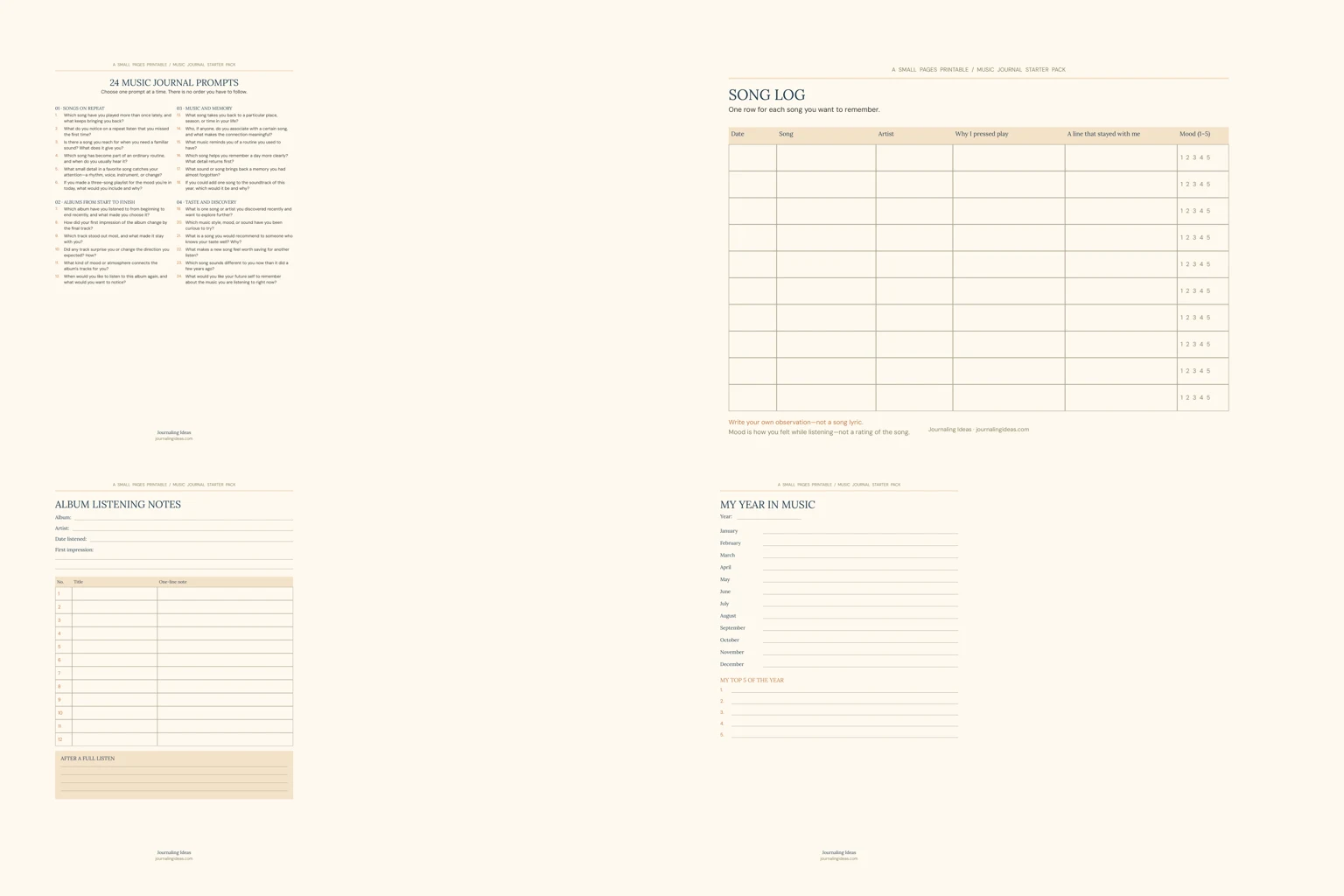
Four useful pages for recording songs, exploring albums, answering prompts, and remembering your year in music.
Included: Song Log — 10 entries. Album Listening Notes — 12 tracks. 24 Music Journal Prompts. My Year in Music — 12 months + top five.
Formats: A4 + US Letter · 10 PDFs
Free access. No email signup or password required.
Find the Music Journal Starter Pack in The Small Pages Library.
If you write poems as well as song entries, our Poetry Journal Prompts article has 24 prompts for your own poems, plus a free printable pack with a poem draft page and a poems log.
Frequently Asked Questions About Music Journals
Do I need music knowledge to keep a music journal?
No. A music journal is about your personal listening experience, not music theory. You don’t need to understand instruments, musical notation, production, or genres. You can simply record what you listened to and what you thought or felt.
Should I keep a music journal on paper or in an app?
Either works. A paper notebook or printable gives you a physical place to write and revisit your entries. A notes app or digital document can be convenient when you want to record something immediately. Choose the format you are most likely to use.
What if I keep listening to the same songs?
That’s perfectly fine. You can record the same song again if you notice something different, listen to it in a different mood, or simply want to remember another occasion when you played it. A music journal doesn’t need a new discovery every time.
Should I rate the songs I listen to?
No. There is no requirement to rate songs or albums. The Mood (1–5) field in our Song Log is about your own mood while listening, not a score for the music. You can leave it blank if you prefer.
How often should I write in a music journal?
Whenever you want. You might record one song each day, make notes once a week, or write only when an album or listening experience stays with you. There is no required schedule, and missing a few days doesn’t matter.
Can kids use a music journal?
Yes. The basic idea is simple enough to adapt for children. They can record a song title, artist, favorite part, and how the music makes them feel. Younger children can draw a picture instead of writing a longer response. It can be a relaxed activity for exploring the music they enjoy.
Keep a Little Record of the Music You Love
A music journal doesn’t need to become another project to manage.
It can be a few lines in a notebook, a collection of favorite albums, or a small record of the songs that accompanied different parts of your life.
Start with one song. Write down why you pressed play and what you want to remember. The next entry can wait until another day.
Use the prompts when you need inspiration, the album notes when you want to remember a full listen, and the yearly page when you feel like looking back.
There is no perfect way to keep one. It is your listening life, recorded in your own words.
Small pages. Meaningful days.
— Journaling Ideas Editorial Team


One Comment