
Reading Journal: A Simple Book Log to Remember Every Book You Read
A reading journal is a place to record the books you finish, what you thought about them, and the details you want to remember. The simplest way to keep one is with a one-page book log: write the title, author, date finished, a short summary, and your honest opinion. That’s enough to begin.
Maybe you finish a lovely book, recommend it to a friend, and then realize you can’t quite remember the main character’s name. Or you find yourself looking at a bookshelf and wondering which stories you enjoyed most last winter.
A reading journal helps you hold on to those small details without turning reading into another task.
You don’t need to write long reviews, count every page, or create a beautiful notebook. You can jot down a few lines after finishing a novel, record a quote you loved, or make a quick note about a book that wasn’t for you.
And when you want to look back, those notes are waiting.
In this guide, you’ll learn what to include in a reading journal, how to set up a simple book log, how to rate books, and how to keep a monthly reading tracker. You’ll also find 20 reflection prompts, a complete made-up example, and a gentle seven-day plan for starting.
Want the pages ready to print? The free Reading Journal Book Log includes book log pages and a monthly reading tracker in US Letter and A4. Find it in The Small Pages Library. The Library is open access, so no signup is needed.
What Is a Reading Journal?
A reading journal is a notebook, printable, or digital document where you record the books you read and your thoughts about them. It can include titles, authors, ratings, summaries, favorite moments, quotes, and personal reflections.
The simplest reading journal is just a list of books with a sentence about each one.
A more detailed journal might include a separate page for every finished book, a monthly reading tracker, and a collection of memorable quotes.
Both count.
Think of a reading journal as a little record of your reading life. It doesn’t need to be a record of how quickly you read or how many books you finish. It’s there to help you remember what the experience was like.
Reading Journal vs. Reading Log vs. Book Journal: What’s the Difference?
A reading log usually tracks what you read. A reading journal adds what you thought and felt. A book journal is another common name for a reading journal, especially one focused on book reviews and reflections.
| Format | What you record | Best for |
|---|---|---|
| Reading log | Book title, author, reading dates, pages, completion | Keeping a simple record |
| Reading journal | Book details plus ratings, memorable scenes, quotes, and personal responses | Remembering and reflecting on books |
| Book journal | Reviews, favorite books, reading lists, character notes, personal reflections | Building a more detailed record of your books |
| Monthly reading tracker | Reading days, books finished, and short monthly notes | Seeing your reading activity at a glance |
You don’t have to choose just one.
A book log page can be the heart of your reading journal. A monthly tracker can sit beside it, giving you a quick overview without replacing your reflections.
If you have never kept any kind of journal, start with the log page. You can add other sections when you discover what you actually enjoy recording.
Does a Reading Journal Have to Be a Physical Notebook?
No. A reading journal can be a paper notebook, printed pages, a notes app, or a digital document.
Paper is lovely if you enjoy handwriting and keeping books on a shelf. A digital journal is useful if you want to search for titles or type while traveling.
You can also use both: a printable book log for your favorite reads and a short digital list for everything else.
Choose the option you’ll actually return to.
How Does a Reading Journal Help You Remember Books?
A reading journal helps you remember books by keeping a short record of their stories, standout moments, and your personal reactions. When you look back later, those notes give you something more specific than a title or cover to recognize.
You may not remember every detail of a book you finished months ago. But reading a note such as “I loved the setting, but the ending felt rushed” can bring back your experience of it.
Here are a few ways a reading journal can be useful.
Remember the Books You’ve Already Read
A title alone sometimes isn’t enough.
Add a one-line summary and a favorite moment, and you’ll have a little reminder of the story.
For fiction, that might be the main conflict, the setting, or the scene you kept thinking about.
For nonfiction, it might be the central idea you found useful.
You aren’t trying to recreate the entire book. You are leaving a note for your future self.
Make Better Book Recommendations
Have you ever wanted to recommend a book but struggled to explain why someone might like it?
Your reading journal can help.
A field labeled “Who I’d recommend it to” encourages you to describe the sort of reader who might enjoy the book.
For example:
- Someone who loves gentle mysteries and small-town settings.
- A reader who enjoys short chapters and quick pacing.
- A friend looking for thoughtful nonfiction without a dense writing style.
- Someone who likes character-driven stories more than dramatic endings.
These notes are often more helpful than a star rating alone.
Notice What You Actually Enjoy Reading
Over time, your entries may show patterns.
Perhaps you regularly enjoy books with warm friendships, quiet settings, or interesting narrators. Maybe you like mysteries but prefer them without very dark scenes.
You don’t need to analyze your preferences. Just notice them.
A short personal verdict after each book makes it easier to choose what to read next.
Keep the Little Reading Moments
A quiet Thanksgiving weekend with a paperback and a cup of tea can become a lovely memory. So can the book you read on a train, the story you finished during a winter break, or the novel that made a rainy Sunday feel cozy.
Those ordinary moments belong in a reading journal too.
Try noting where you were reading or why you chose a particular book.
A sentence is plenty.
Make End-of-Month Recaps Easier
At the end of a month, it can be difficult to remember what you read and how you felt about each book.
With a few completed book logs, you already have the details.
You can look back at your ratings, choose a favorite, and make a short recap without trying to reconstruct every story from memory.
This is especially nice for a December reading recap or a quiet New Year look back at the books you enjoyed.
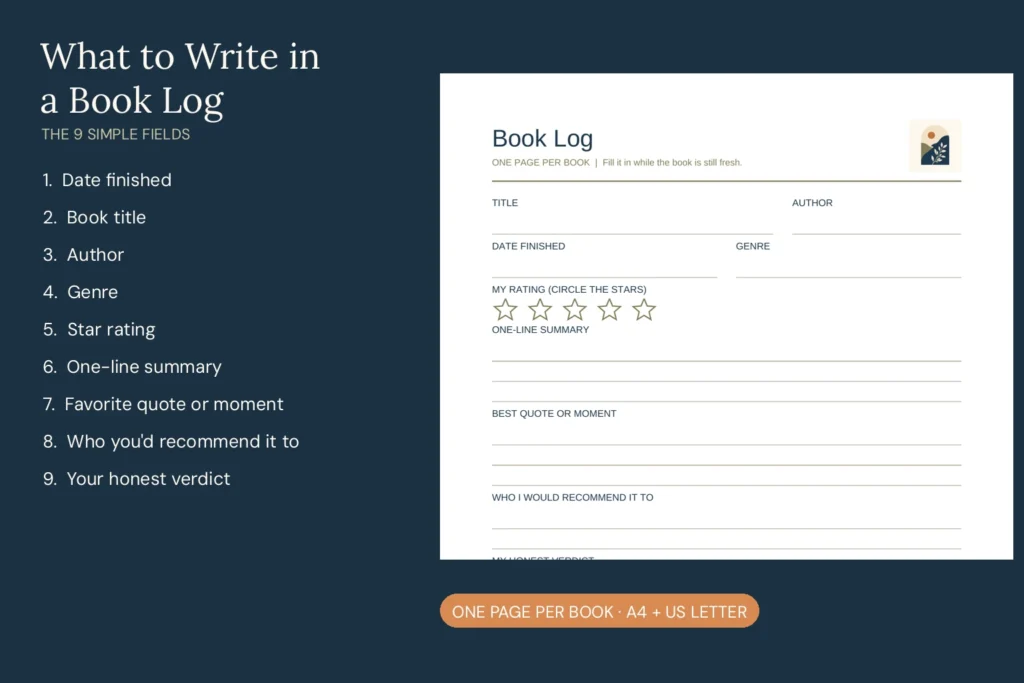
What Should You Write in a Book Log? 9 Simple Fields
A beginner book log needs just nine useful fields: date finished, title, author, genre, star rating, one-line summary, favorite quote or moment, who you’d recommend it to, and your honest verdict.
You can fill in these fields on one page. None requires a long answer.
1. Date Finished
Write the date you completed the book.
For example: November 14.
You can include the year if you want a journal you’ll use for several years.
If you don’t remember the exact date, write the month instead. Approximate is fine.
The point is to create a useful record, not to turn your memory into a test.
2. Book Title
Write the full title of the book.
You can also include a series name or volume number if you’re working through several related books.
If you read different editions, you don’t need to record the edition unless it matters to you.
A clear title is usually enough to find the book again.
3. Author
Add the author’s name.
This makes it easier to find other books by the same writer and to see which authors you’ve enjoyed more than once.
For books with multiple authors, you can list them together or use the name that helps you recognize the book.
4. Genre
Use a broad genre or description that makes sense to you.
Examples include romance, mystery, literary fiction, fantasy, memoir, history, or personal essays.
You can also write phrases such as “cozy mystery” or “short nonfiction.”
There’s no need to decide on a perfect category.
If a book fits more than one genre, write both.
5. Star Rating
Give the book a rating from one to five stars, if ratings are helpful to you.
A five-star rating system can be a quick reminder of how much you enjoyed the experience.
But stars are optional. You can leave the field blank if you prefer writing a few words.
Your rating doesn’t have to agree with anyone else’s review.
6. One-Line Summary
Write one sentence that reminds you what the book was about.
This is not a school assignment or a formal book report.
Try one of these sentence starters:
- “A story about…”
- “The main character wants…”
- “This book explores…”
- “The central idea is…”
For fiction, focus on the basic situation rather than every plot twist.
For nonfiction, record the main subject or question.
Avoid spoilers if you want to use the journal later when recommending books.
7. Favorite Quote or Moment
Record a short quote you loved, a scene that stayed with you, or a particular idea you want to remember.
You don’t have to find the book’s most important passage.
Maybe a character said something funny. Perhaps an ordinary scene felt especially comforting. Or you simply loved the description of a garden, café, or snowy street.
If you’d rather not copy a quote, describe the moment in your own words.
That’s often easier and more personal.
8. Who You’d Recommend It To
Write who might enjoy the book.
You can name a reading preference rather than a particular person.
For example:
“Someone who likes gentle stories about friendship.”
Or:
“Readers who enjoy practical, short nonfiction chapters.”
If you wouldn’t recommend the book, you can say that too.
The field is there to help you explain your reaction, not to require a positive opinion.
9. Your Honest Verdict
Finish with your real opinion in one or two sentences.
What worked for you? What didn’t? Would you read something similar again?
You can write:
“I loved the characters but wanted a slower ending.”
Or:
“Not my favorite, but the setting was memorable.”
This is the most personal part of your book log.
You don’t have to make every entry thoughtful or eloquent. Some books deserve an enthusiastic paragraph. Others get “This one wasn’t for me.”
Both are valid.
Should You Add Extra Fields?
Only if you want them.
Some readers like recording the date started, number of pages, reading format, where they found the book, or whether it was borrowed from the library.
Those details can be useful, but they’re not essential.
Start with the nine fields above. Use them for a few books before adding more.
A small journal you enjoy is more useful than an elaborate journal you feel obligated to maintain.
What Does a Filled-In Reading Journal Look Like? A Made-Up Example
A filled-in reading journal entry can be very short: basic book details, a one-sentence summary, a favorite moment, and an honest opinion. You don’t need multiple pages of notes to make the entry meaningful.
Here is a fictional example to show how the nine fields fit together.
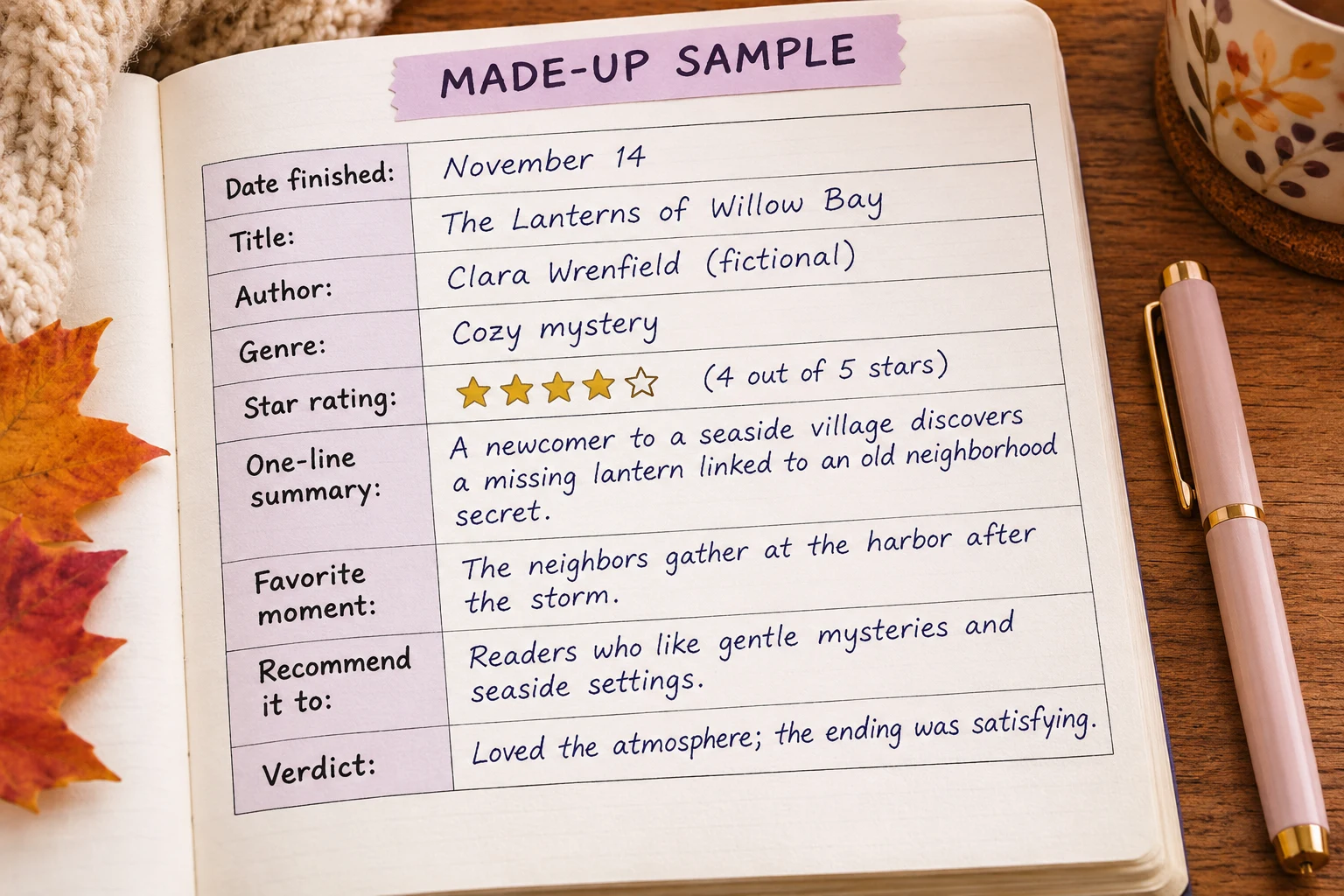
MADE-UP SAMPLE ENTRY — FOR ILLUSTRATION ONLY
The book title, author, and entry below are fictional examples, not a review of a real published book or a real person’s reading experience.
| Book log field | Sample entry |
|---|---|
| Date finished | November 14 |
| Book title | The Lanterns of Willow Bay |
| Author | Clara Wrenfield (fictional) |
| Genre | Cozy mystery |
| Star rating | ★★★★☆ — 4 out of 5 |
| One-line summary | A newcomer to a seaside village discovers that a missing lantern is connected to an old neighborhood secret. |
| Favorite quote or moment | The scene where the neighbors gather at the harbor after the storm. |
| Who I’d recommend it to | Readers who like gentle mysteries, seaside settings, and warm community stories. |
| Honest verdict | I loved the atmosphere and the characters. The mystery was a little predictable, but I enjoyed the ending. |
That’s a complete entry.
You could write even less and still have something worth keeping.
For example, if you were especially busy, your verdict might be just three words: “Cozy, funny, satisfying.”
Or your favorite moment might be “the final chapter.”
You aren’t being graded.
How Do You Write a Book Review in a Reading Journal?
Start by answering three questions:
What was the book about? Give yourself a one-sentence reminder.
What stood out? Mention a character, idea, scene, or feeling.
What did you think? Give your honest reaction.
You can combine the answers into a short paragraph:
“This was a quiet story about starting over in a seaside town. I loved the friendship between the two main characters and the descriptions of the harbor. I wished the ending had more room to breathe, but I’d still recommend it to readers who enjoy gentle fiction.”
That is enough to make a useful personal review.
You can always write more when you feel like it.
What Are Good Reading Journal Prompts? 20 Ideas to Try
Good reading journal prompts help you notice what stayed with you after reading. Start with a question about the story, the characters, your reaction, or your reading habits, and answer in your own words.
These 20 prompts work with fiction or nonfiction, although you may want to adapt a few to fit the type of book.
You don’t need to answer all 20 for every book. Choose one or two that feel interesting.
Review the Book
- What is the one thing you want to remember about this book?
- How would you describe the book to a friend in two sentences?
- What surprised you most while reading?
- Did the ending feel satisfying to you? Why or why not?
- What would you change about the book if you could?
Characters and Scenes
- Which character, person, or perspective stayed with you the longest?
- What moment would you like to experience again as a reader?
- Did your opinion of anyone in the book change as you read?
- Which setting, scene, or description felt especially vivid?
- What choice or decision in the book made you stop and think?
Ideas and Quotes
- What line, passage, or idea would you like to remember?
- Did the book make you curious about something new?
- What question did the book leave unanswered for you?
- Which idea did you agree or disagree with most strongly?
- How would you describe the mood of the book in three words?
Your Reading Life
- Why did you choose this book at this particular time?
- Where did you most enjoy reading it?
- How did this book compare with something else you’ve read?
- Who might enjoy this book, and what would you tell them about it?
- What kind of book are you in the mood to read next?
How Many Prompts Should You Answer?
One is enough.
If you feel inspired, choose several. If the book didn’t leave you with much to say, stick to the basic log fields.
You might enjoy answering question 17 after a cozy fall reading weekend, or question 20 when you’re building a Christmas reading list.
The prompts are there to make remembering easier, not to make finishing a book feel like extra work.
If you like the idea of reflective questions beyond reading, explore our 150 journal prompts for beginners. You can use a general journaling prompt when a book brings up a thought you’d like to explore separately.
How Do You Rate a Book? A Simple 5-Star Reading Journal System
To rate a book, choose a score from one to five stars based on your own reading experience. Think about how much you enjoyed it, whether you’d recommend it, and how strongly it stayed with you.
A five-star rating is a personal shorthand, not an objective measurement of a book’s quality.
Here’s one simple way to use the scale.
| Rating | What it can mean in your reading journal | A short note you could write |
|---|---|---|
| ★★★★★ 5 stars | You loved it and would happily recommend or reread it. | “A new favorite.” |
| ★★★★☆ 4 stars | You enjoyed it a lot, with a few small reservations. | “Really lovely, just a slow middle.” |
| ★★★☆☆ 3 stars | You liked parts of it, but it wasn’t a standout for you. | “Good moments, mixed feelings.” |
| ★★☆☆☆ 2 stars | It wasn’t quite right for you, although something worked. | “Interesting idea, but I struggled with it.” |
| ★☆☆☆☆ 1 star | You didn’t enjoy the experience. | “Not for me.” |
You can adjust the descriptions to suit your preferences.
Maybe five stars means “I’d reread this.” Maybe it means “I couldn’t stop thinking about it.”
What matters is that the system feels natural to you.
Should You Use Half Stars?
You can, but you don’t need to.
Half stars may help if you enjoy making fine distinctions between books. A simpler whole-star system is easier to use quickly.
If you find yourself spending too much time choosing between 3.5 and 4 stars, just write a short verdict instead.
The words often tell you more.
What If You Loved Parts of a Book but Didn’t Love the Whole Book?
Write both thoughts.
You might give a book three stars and still record a favorite chapter, memorable character, or beautiful passage.
A reading journal doesn’t have to flatten an interesting experience into a single number.
You could write:
“Three stars overall, but five stars for the setting.”
That’s a perfectly useful note.
What About Books You Don’t Finish?
You can record those too if you want.
Write the title, where you stopped, and a brief reason such as “not in the mood,” “too slow for me,” or “might try again.”
You don’t have to assign a star rating to an unfinished book.
You also don’t have to finish every book simply to earn a completed journal entry.
How Does a Monthly Reading Tracker Work?
A monthly reading tracker gives you a quick overview of when you read and which books you finished. You can mark reading days from 1 through 31, then list completed titles and write a small monthly reflection.
It works alongside your book log rather than replacing it.
The book log remembers individual books. The monthly tracker shows the shape of your reading month.
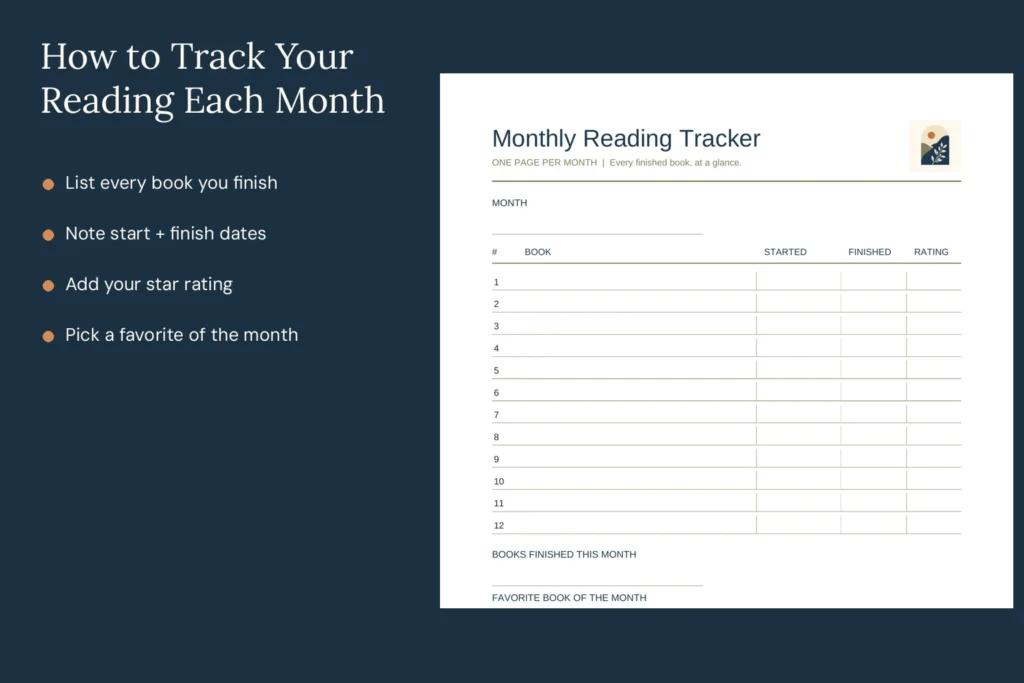
What Should a Monthly Reading Tracker Include?
A beginner-friendly monthly tracker can have these areas:
Month: Write the month and year.
Reading days: Mark the dates when you spent time reading.
Books finished: List completed titles.
Favorite book: Choose one if you’d like.
Monthly notes: Write a sentence about what you enjoyed or what you want to read next.
You don’t need a separate system for pages, minutes, chapters, reading speed, and book counts unless you genuinely like tracking those things.
For many readers, a simple mark on a calendar is enough.
How Do You Use a Tracker in a 30-Day or 31-Day Month?
Use numbered day spaces from 1 to 31, with no fixed weekday labels.
At the beginning of the month, write the month and year.
Mark the dates on which you read. For a shorter month, leave the unused dates blank.
This keeps the same printable usable throughout the year, whether you’re tracking November, December, February, or another month.
A reading day can mean whatever you decide. You might mark a day when you read a chapter, a few pages, or listened to part of an audiobook.
Define the habit gently and consistently enough that the tracker makes sense to you.
What If You Miss Reading Days?
Nothing happens.
Leave those boxes empty and continue when you feel like reading.
Your tracker is a record, not a streak you must protect.
Sometimes your month is full of family visits, work, travel, celebrations, or other things that matter.
A month with just a few reading days is still part of your reading life.
How Can You Make a Monthly Reading Recap?
At the end of the month, look at your tracker and completed book logs.
You can write a recap in four short lines:
Books I finished: List the titles.
My favorite: Choose the book you enjoyed most.
A moment I remember: Note one scene, quote, or idea.
Next month I’d like to read: Write one title or genre.
For late fall, you might finish a book before Thanksgiving weekend and add it to your November recap.
In December, your recap might include a favorite holiday read, a book received as a Christmas gift, or a story you finally made time for during a quieter week.
When New Year arrives, you can glance at those recaps and make a fresh reading list without trying to remember everything at once.
Do You Need a Reading Goal?
No.
You can keep a reading journal without setting a target number of books.
If goals are enjoyable for you, choose one that’s flexible. It might be “try more nonfiction” or “visit the library more often,” rather than finishing a particular number of books.
If goals feel like pressure, skip them.
Your reading journal can simply be about enjoying stories and remembering them.
If you enjoy marking small daily habits in addition to reading, you may also like our free habit tracker printable. Keep reading as one optional habit, rather than turning your entire reading life into a checklist.
How Do You Start a Reading Journal? A Gentle 7-Day Plan
To start a reading journal, choose a notebook or printable, make one entry for a book you’ve already finished, and build from there. You don’t need to wait for a new month or complete a complicated setup.
This seven-day plan spreads the process into a few small steps.
| Day | Small step | What to do |
|---|---|---|
| Day 1 | Choose your format | Pick a notebook, digital note, or printable book log. |
| Day 2 | Add one book | Write the title, author, and date finished for a recent read. |
| Day 3 | Write a summary | Add one sentence about what the book was about. |
| Day 4 | Add your opinion | Choose a star rating or write a short personal verdict. |
| Day 5 | Keep one detail | Record a favorite scene, moment, or idea. |
| Day 6 | Set up the monthly tracker | Write the month and mark any reading days you’d like to record. |
| Day 7 | Make it yours | Decide which fields you want to keep using. Remove any that feel unnecessary. |
This isn’t a challenge you need to complete on schedule.
You can do all seven steps on one quiet afternoon, or spread them across several weeks.
If you already have a book beside you, start with that one.
What If You Haven’t Finished a Book Recently?
Choose a book you remember well enough to describe.
Maybe it’s a favorite from last year, something you read on vacation, or a novel that stayed with you.
Write down whatever you remember.
The date can be approximate. The summary can be short.
There’s no need to begin your journal with a perfectly documented entry.
What If You Have Several Books Going at Once?
That’s fine.
You can keep a small “currently reading” list on a separate page or simply wait until you finish a book to complete its log.
If you’re reading fiction, nonfiction, and an audiobook at the same time, you don’t need three separate journals.
One reading journal can hold them all.
How Do You Keep a Reading Journal Going?
Keep the next step small.
After finishing a book, give yourself a minute to write the title and one thought. Add the other fields later if you want.
Store your printable pages near your books or keep your digital note easy to find.
It’s okay to fill in several entries together.
The goal is not perfect consistency. It’s having a comfortable place to return to whenever you want to remember a book.
What Reading Journal Mistakes Should Beginners Avoid?
The most common reading journal mistakes are making the layout too complicated, expecting long reviews, and treating every blank page or missed day as a problem. A simple log with a few honest notes is enough.
Here are some easy adjustments.
| Common mistake | Why it becomes frustrating | Try this instead |
|---|---|---|
| Creating too many sections at once | You spend more time planning than recording books. | Begin with one book log page and one monthly tracker. |
| Writing a full review for every book | The journal starts feeling like homework. | Use a one-line summary and short verdict. |
| Forgetting to record personal reactions | You remember the title but not what you thought. | Write one honest opinion before moving to the next book. |
| Using complicated rating rules | Choosing a score becomes an unnecessary task. | Keep a simple five-star scale or skip stars. |
| Trying to catch up on every missed day | Blank spaces can feel discouraging. | Continue from today; leave earlier spaces blank. |
| Copying someone else’s elaborate setup | Their system may not fit your reading habits. | Keep only the sections you actually use. |
| Tracking more than you enjoy | Reading begins to feel measured instead of enjoyed. | Track books and reading days only if they feel useful. |
| Waiting for a beautiful first page | You postpone starting. | Begin with an ordinary entry. Messy counts. |
Do Reading Journal Pages Have to Look Aesthetic?
No.
A reading journal can be visually beautiful, but it doesn’t need decorations, stickers, illustrations, or carefully lettered headings.
If you enjoy making pretty pages, that’s lovely.
If you prefer a black pen and a straightforward template, that’s just as good.
The journal’s value comes from what you remember and record, not from how it looks in a photo.
Should You Rewrite Old Entries?
Only if you’d enjoy doing it.
You might want to update a rating after thinking about a book for a few weeks, or add a note when a story comes up in conversation.
But you don’t need to make every entry polished.
A slightly messy note can still remind you exactly how you felt when you finished reading.
What If You Forget the Plot?
Write down the detail you do remember.
Maybe you can picture a particular setting or recall that the book made you laugh.
That’s enough to start.
You can leave the one-line summary blank if you’re unsure. Avoid filling the journal with guesses merely to complete every box.
A reading journal should feel useful, not demanding.
Where Can You Get a Free Printable Reading Journal Book Log?
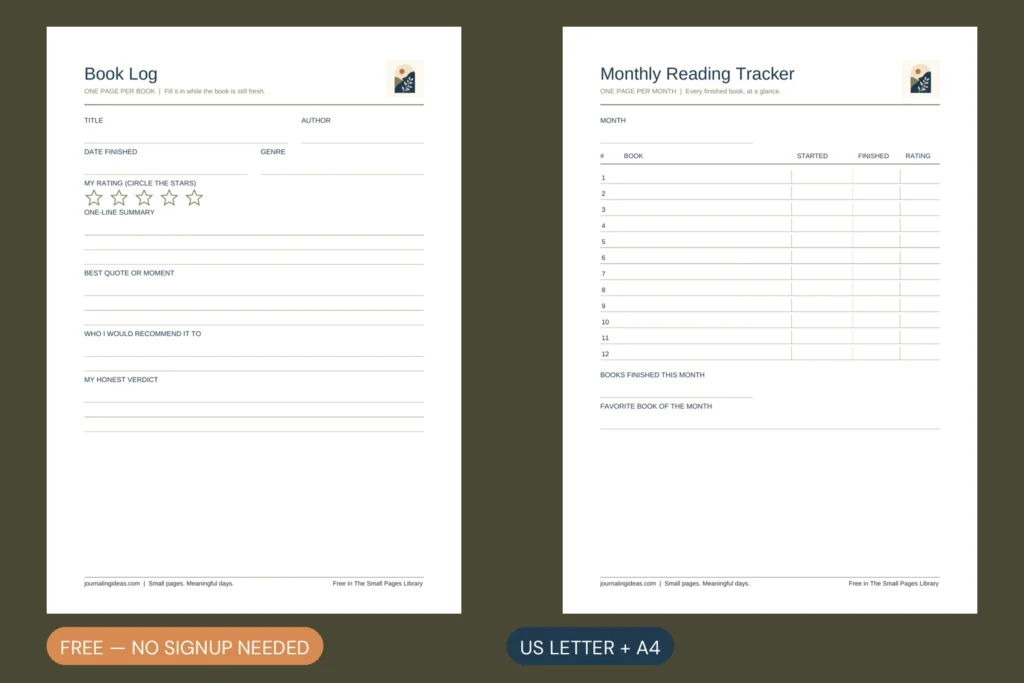
You can get the Reading Journal Book Log free in The Small Pages Library at Journaling Ideas. It includes book log pages for individual books and a monthly reading tracker page, with US Letter and A4 versions. The Library is open access, and no signup is needed.
Get the Free Reading Journal Book Log — The Small Pages Library
The printable gives you a simple place to begin without drawing a layout yourself.
What’s Included in the Free Reading Journal Printable?
Book log pages: Use these to record details about individual books, including your rating, short summary, memorable moment, and honest verdict.
Monthly reading tracker page: Use this to keep a quick record of reading days and the books you finish during the month.
US Letter and A4 formats: Choose the version that matches the paper you use.
The book log works for novels, memoirs, nonfiction, short books, or any other reading you’d like to remember.
The monthly tracker can be used for a fall reading list, a December recap, a January restart, or any ordinary month.
There’s no need to wait for a seasonal reset.
Download the free printable: Reading Journal Book Log — A4 | Reading Journal Book Log — US Letter
How Do You Print the Reading Journal Pages?
Follow these steps:
Choose your paper size. Use US Letter if you’re printing on 8.5 × 11-inch paper, or A4 if you’re printing on 210 × 297 mm paper.
Open the matching PDF. Use the US Letter file for US Letter paper and the A4 file for A4 paper.
Check your print settings. Select the correct paper size. Use “Actual size” or 100% scale when your printer and page settings support it. If the preview shows any content outside the printable area, use your printer’s fitting option instead.
Print the pages you need. You can begin with a small set of book log pages and one monthly tracker.
Keep them together. Store the pages in a binder, folder, or another spot near your books.
You don’t need special paper, expensive stationery, or a full binder system.
Start with what you have.
Can You Use the Printable for a Christmas or New Year Reading List?
Yes. The same undated book log pages can record books at any time of year.
You might keep a short list of books you’d like to read over the Christmas break, add gifted books to a “to read” note, or fill in a December tracker.
For a New Year reading list, choose a few titles you’re genuinely interested in. You don’t need to turn it into a strict resolution.
One good book is a lovely place to begin.
Is the Printable Really Free Without an Email Signup?
Yes. The Small Pages Library is open access, and the Reading Journal Book Log is offered free without requiring an email signup.
You can visit the Library, choose the printable, and use the available PDF files.
If you prefer making your own journal pages, that’s fine too. The nine-field format in this guide is enough to create a simple book log by hand.
The printable is an easy starting option, not a requirement.
Ready to Start Your Reading Journal?
Start with one book and one honest sentence about it. That’s all you need to begin a reading journal worth keeping.
You don’t have to remember every plot point or write an impressive review.
Just record the details that matter to you.
Maybe you’ll use it to remember a cozy fall mystery, collect thoughts from your holiday reading, or look back on your favorite books at the end of the year. Maybe you’ll use it for a single book this month and return to it whenever you finish another.
That all counts.
If you’re ready to begin, pick up the free Reading Journal Book Log in The Small Pages Library. It includes book log pages and a monthly reading tracker in US Letter and A4, with no signup needed.
And if a book leaves you with a strange or memorable dream, you might enjoy keeping a separate dream journal for those morning notes, too.
Small pages. Meaningful days.
Frequently Asked Questions About Reading Journals
What is the difference between a reading journal and a reading log?
A reading log usually records basic details such as titles, dates, and pages read. A reading journal also includes personal reflections, ratings, favorite moments, and opinions. You can combine both in one notebook or printable.
What should I write in a reading journal?
Start with the date finished, title, author, genre, star rating, one-line summary, favorite quote or moment, who you’d recommend the book to, and your honest verdict. You can keep each answer short.
How do I start a reading journal as a beginner?
Choose a notebook or printable book log and make one entry for a book you’ve recently finished. Record the basic details and write one or two sentences about what you thought. Add more sections only if you want them.
Do I need to write in my reading journal every day?
No. You can write whenever you finish a book or have a thought worth remembering. A reading journal doesn’t require daily entries, and missing days doesn’t mean you have to start over.
How do I track the books I read each month?
Use a monthly reading tracker to mark reading days and list completed books. Keep separate book log entries for summaries, ratings, and reflections. The tracker gives you an overview while the book log holds the details.
Is there a free printable reading journal book log?
Yes. The Reading Journal Book Log, including book log pages and a monthly reading tracker page, is free in The Small Pages Library at Journaling Ideas. The Library is open access, with no signup needed.
One Comment