
March Journal Prompts: 31 Dated Questions for the First Month of Spring
March journal prompts are dated writing questions for every day of March 2027. This list includes 31 prompts, moving from the end of winter toward the spring equinox and the first days of a new season. Use the date as a gentle starting point, write for a few minutes, and skip or return whenever you need to.
March can feel like a threshold: some days still belong to winter, while other days offer a little more light and room to begin again. These prompts follow that gradual change. They are arranged in five movements, so the month has a shape without asking you to make every page perfect.
How to Use a Dated Journal Prompt List
You do not need a special journal or a long writing session. Keep the list somewhere easy to reach, choose the prompt for the day, and write in whatever notebook or notes app you already use. A few honest sentences are enough. If you have more to say, keep going; if you have only one sentence, that counts too.
A dated list gives you a small decision already made. Instead of spending time wondering what to write, you can begin with the question in front of you. The dates also create a loose record of the month: when you look back, you may notice a thought that returned, a change you had not named, or a small detail you would otherwise have forgotten.
Try this simple rhythm:
- Read the prompt once. Notice the first detail, memory, or feeling that comes to mind.
- Set a small limit. Write for five minutes, fill half a page, or stop after three sentences. A limit can make starting easier.
- Stay specific. Use a real detail from your day—a sound outside, a drawer you opened, a plan you changed—rather than searching for a perfect answer.
- Leave the page open. You can return later, add a sentence, or let the thought rest. The prompt is an invitation, not homework.
If a date has passed, simply continue with today’s question. You can also choose a prompt by its theme. The order is useful, but it is not a rule you have to obey.
How These March Prompts Are Built
March is two months wearing one name — it starts in winter and ends in spring — and these 31 prompts follow that arc. The early questions are inward and clearing: what winter left behind, what you are done carrying. Around the middle of the month, when daylight saving time begins (Sunday, March 14, 2027) and the evenings stretch, the prompts turn outward: energy, plans, people, fresh air. The spring equinox on Saturday, March 20 marks the turn in the list, and the final week is about beginnings you can start now rather than someday.
Answer them in order if you can; the sequence is the point. Each prompt assumes you wrote the ones before it, so the month builds a small argument about what is changing in your life. The matching March bullet journal ideas give that same reset a home in your monthly spreads and trackers.
Waking the Year Up
The first week of March is a place to take stock without turning the month into a project. These questions begin with possibility, then move toward noticing what winter has left behind and what the changing season is already showing you. Let the answers be ordinary. The point is to pay attention to the life you are in, not to produce a polished account of it.
March 1 (Monday): What would you like this month to make possible?
Let the answer be a direction, not a demand.
March 2 (Tuesday): Which part of winter are you still carrying, and what would setting it down look like?
Name what feels ready to soften, without rushing it.
March 3 (Wednesday): What has changed since January 1 that you have not stopped to notice?
Small changes count, even when they happened quietly.
March 4 (Thursday): Describe this morning honestly — the light, the weather, your mood, your first thought.
Stay with the details before trying to make meaning of them.
March 5 (Friday): What is one small thing you keep meaning to start — and why this month?
Choose a beginning small enough to meet you where you are.
March 6 (Saturday): Write about a sound, a smell, or a sight that tells you the season is turning.
Use sensory details to bring the moment onto the page.
March 7 (Sunday): Rest counts too. What did you do this week that asked nothing of you?
Give ordinary rest the same space you give achievement.
Clearing Space
This movement is about making room, both on the page and in the places and plans that hold your attention. Clearing space does not have to mean a full reset. It might be naming an old expectation, looking honestly at one shelf, or noticing where a habitual yes no longer fits. Choose the smallest useful truth.
March 8 (Monday): It is International Women’s Day. Write about a woman whose example quietly shapes how you live.
Focus on the specific quality or action you carry with you.
March 9 (Tuesday): Open one drawer, shelf, or folder you have been avoiding. What is actually in there?
Describe what you find before deciding what to do with it.
March 10 (Wednesday): Which plan from January deserves a kind ending rather than more effort?
An honest ending can make room for something more fitting.
March 11 (Thursday): What is taking up space in your head that you could put on paper and leave there?
Write it down plainly; you do not have to solve it today.
March 12 (Friday): Which small corner of your home would change how your days feel if it were clear?
Picture one manageable space, not an entire-room makeover.
March 13 (Saturday): What have you been saying yes to out of habit?
Notice the automatic yes without judging yourself for it.
March 14 (Sunday): The clocks spring forward this weekend in many places. Where else in your life is it time to move forward?
Think about one gentle shift, rather than a dramatic leap.
First Green
The middle of March turns toward signs of growth. Some of these prompts look outward—to plants, places, weather, and evening light—and some look inward at plans and energy. You do not have to feel full of spring. A first sign can be subtle, and a new beginning can still be very small.
March 15 (Monday): What is the first green or growing thing you have seen this year?
Let one small sign of growth be enough for today.
March 16 (Tuesday): Which seed of a plan are you ready to take seriously now?
Write the first practical step beside the idea.
March 17 (Wednesday): It is St. Patrick’s Day. When have you been luckier than you realized at the time?
Look back with curiosity, not pressure to feel grateful.
March 18 (Thursday): What does your energy do on the first mild days — rise, scatter, or settle?
Describe your own rhythm instead of comparing it with anyone else’s.
March 19 (Friday): Write about a place outdoors you want to return to this spring.
Bring the place close with details of sound, color, and air.
March 20 (Saturday): Spring begins today, on the equinox. What is beginning in you, however quietly?
A beginning can be a thought, a boundary, or a little hope.
March 21 (Sunday): Spend a few lines on light: how does the longer evening light change what your days feel like?
Notice what the light makes possible at the end of the day.
Growing Days
The questions in this section are about care that continues. They ask what is taking root, what needs attention, and who helps you along the way. Instead of measuring progress by a big result, look for evidence in the small things you repeat, protect, appreciate, and allow to develop at their own pace.
March 22 (Monday): Which habit is actually taking root? Write the evidence, not just the hope.
Look for what you have done, however small or uneven.
March 23 (Tuesday): If your days were a garden this week, what would you water more?
Choose one thing that deserves your attention and care.
March 24 (Wednesday): Who helps things grow in your life — and have you told them?
A short note of appreciation can be enough.
March 25 (Thursday): What is allowed to grow slowly in your life right now?
Give this part of your life permission to take its time.
March 26 (Friday): Describe a recent small pleasure in as much detail as it deserves.
Stay with the pleasure instead of brushing past it.
March 27 (Saturday): What would a kind day off look like this month — and can you take one?
Make the picture realistic for your actual time and energy.
March 28 (Sunday): What did this week teach you that February could not have?
Let the answer be specific, even if it is still unfinished.
Looking Toward April
The final three prompts give March a gentle close. Rather than judging the month as successful or unsuccessful, notice what stayed with you and decide what you want to carry forward. A short note to your future self can be a quiet way to mark the season without needing a grand conclusion.
March 29 (Monday): Look back over March: which of this month’s prompts stayed with you, and why?
Follow the prompt that keeps returning; it may point to something useful.
March 30 (Tuesday): What do you want April to continue — and what should it leave behind in March?
Carry forward only what still feels relevant.
March 31 (Wednesday): Write a short note to yourself, to read again on the last day of spring.
Write with the kindness you would offer someone you care about.

Make the Prompts Fit Your Real Days
A daily prompt list works best when it bends around your life. You might write at breakfast, on a lunch break, after a walk, or just before bed. There is no ideal time that makes a page more meaningful. If you tend to forget, leave the printable beside your journal, place a bookmark on the current date, or add a quiet reminder to a routine you already have.
You can answer in more than one form. Write a paragraph if the question opens up a story. Make a short list if that feels clearer. Draw a simple shape, add a few words, or tape in a small paper reminder if writing feels difficult that day. The prompt gives you a direction; it does not prescribe the shape of the page.
Some questions may bring up a memory or feeling that needs more room. You can pause, change the subject, or write only what feels comfortable. Journaling is not a test of how much you can reveal. You are allowed to keep parts of your life private, leave a question unanswered, and come back when you feel ready.
If you miss several days, resist the urge to catch up on all of them. Choose the current date, or pick the question you most want to answer. A month of writing does not need 31 completed pages to be worthwhile. Even a handful of entries can help you notice what has been changing.
The March Journal Prompts List (Free Printable)
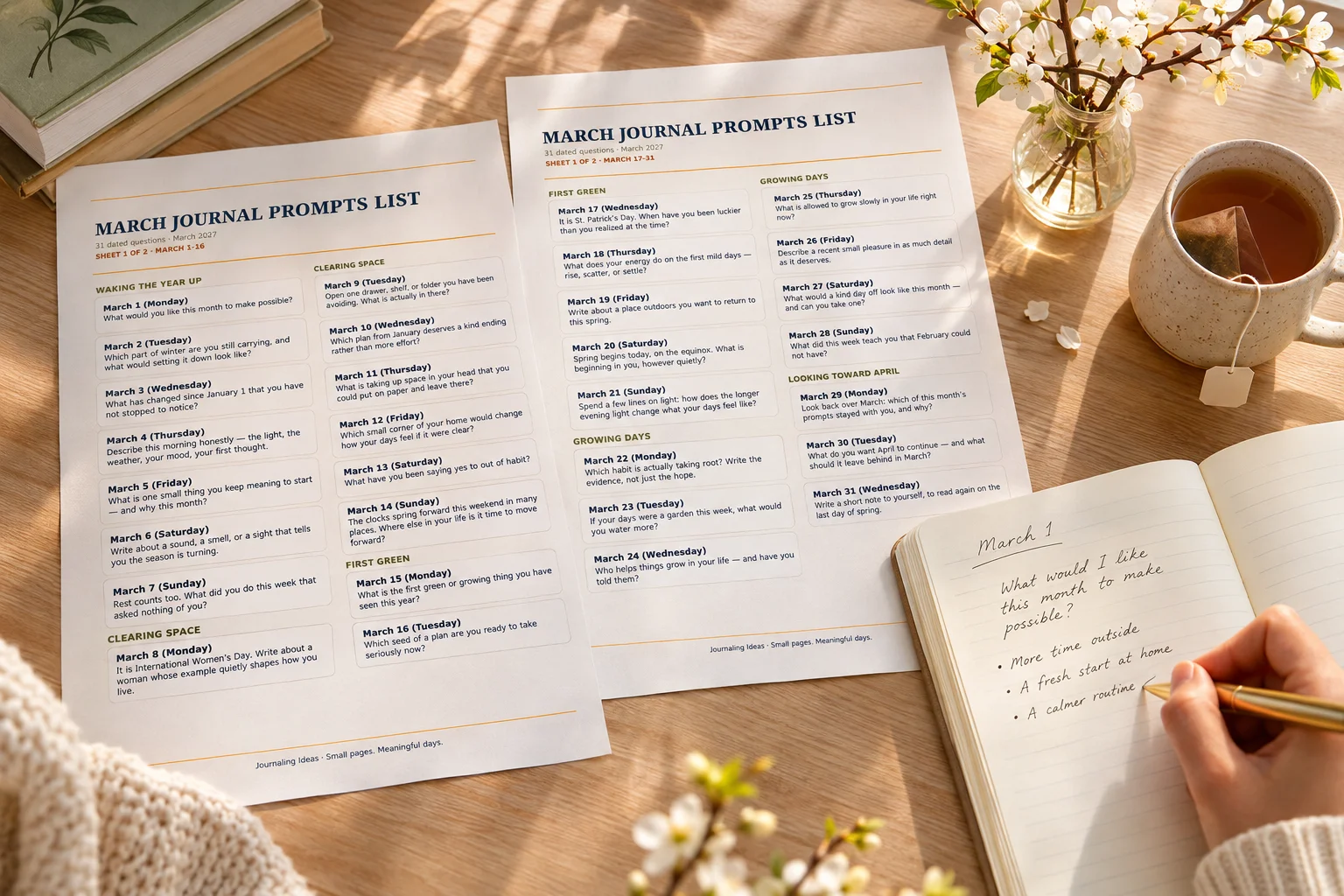
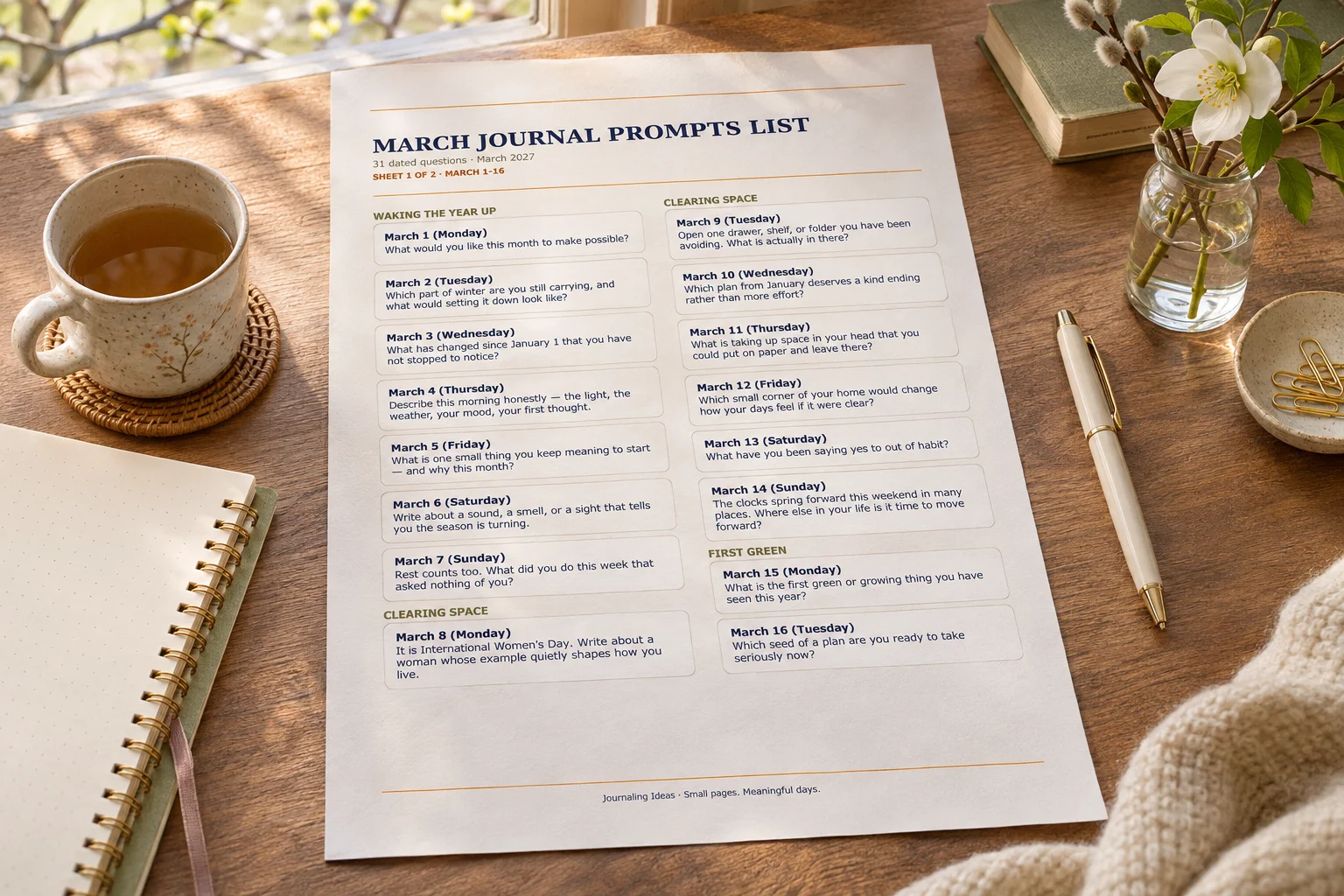
If you would rather keep the questions beside your notebook, print the two-page March Journal Prompts List. Sheet 1 covers March 1–16, and Sheet 2 covers March 17–31. The list keeps each date, weekday, and prompt together, so you can find the day’s question at a glance.
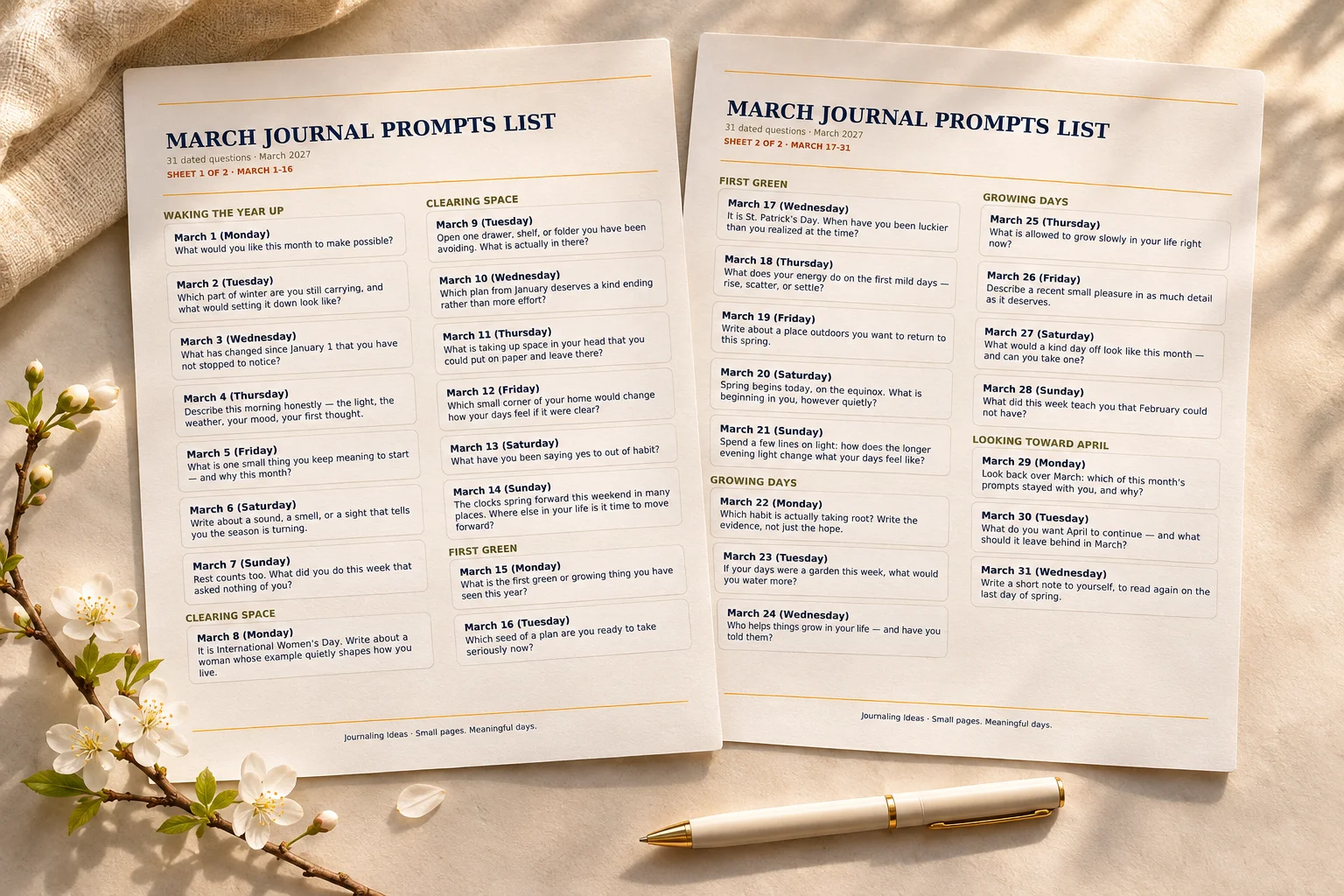
- March Journal Prompts List — Sheet 1
- March Journal Prompts List — Sheet 2

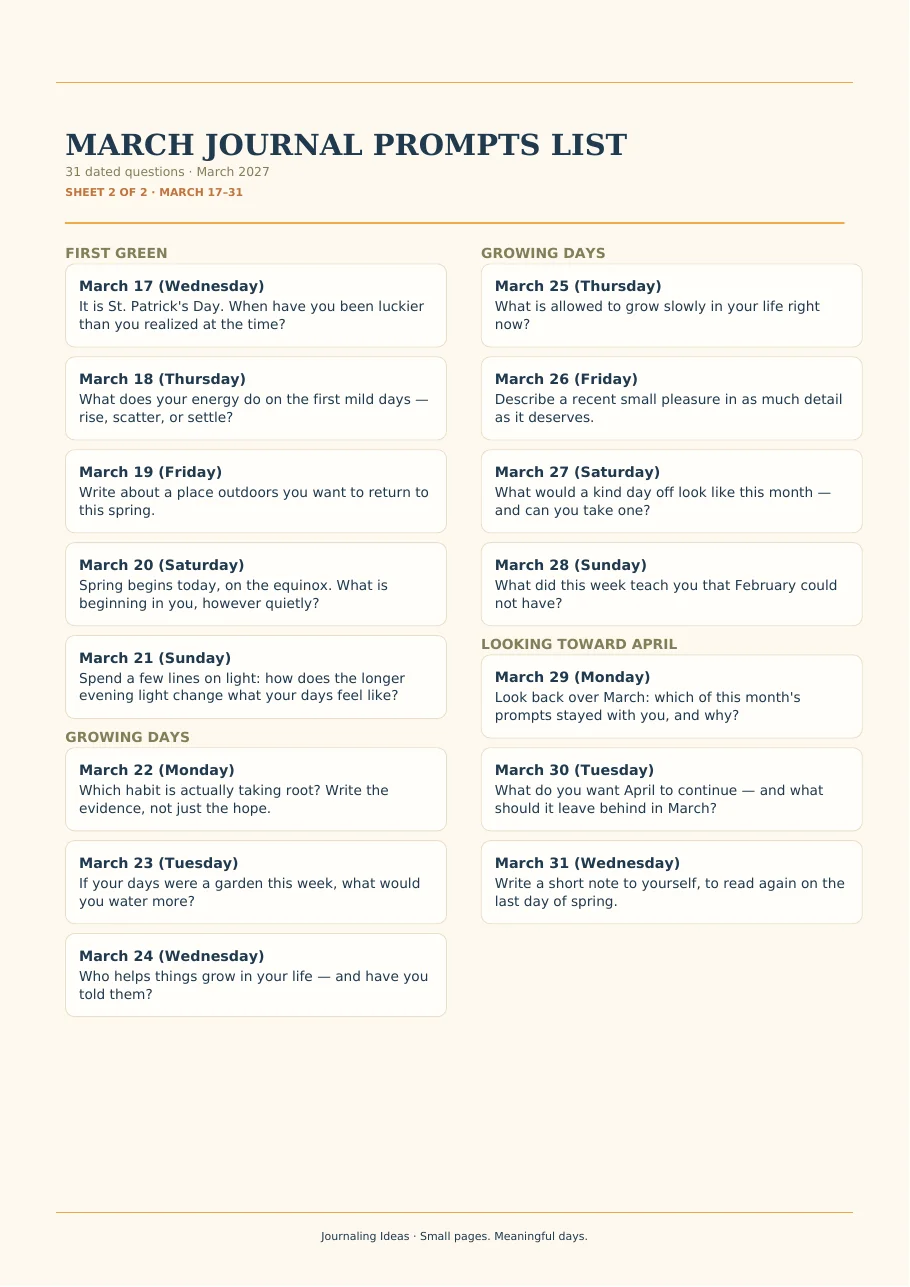
The free pack is available in The Small Pages Library. Each design is provided in both A4 and US Letter sizes, so you can print the format that fits your home printer. No signup is needed. Print one sheet at a time, keep both pages in a folder, or tuck the current page into your journal.
Free download — March Journal Prompts List, Sheet 1: A4 PDF · US Letter PDF
Free download — March Journal Prompts List, Sheet 2: A4 PDF · US Letter PDF
For a little more seasonal writing after the dated list, explore these spring journal prompts. If you are building a year-long rhythm, you can also revisit the earlier january journal prompts and february journal prompts to see what you wrote at the start of the year.
If you have finished the March list, keep your daily writing going with april journal prompts, a dated question for every day from April 1 through April 30, 2027. The two-sheet printable list is free in A4 and US Letter, with no signup required.
March Journal Prompts FAQs
What are March journal prompts?
March journal prompts are writing questions designed around the month. This list follows the shift from winter toward spring, with questions about noticing, clearing space, growth, and looking ahead.
How many prompts are in this list?
There are 31 prompts—one for every day of March 2027. Each prompt is dated and includes the weekday.
When does spring start in March 2027?
The March equinox is March 20, 2027. The prompts mark that seasonal turning point, while recognizing that local weather and the feeling of spring can arrive at different times.
Do I have to start on March 1?
No. Start on any day. The dates are a gentle guide, not a schedule you must catch up with. You can begin with today’s prompt or choose the question that feels most useful.
Can I print the March journal prompts?
Yes. The free list is available as a two-sheet PDF pack in A4 and US Letter sizes. There is no signup required.
Are these prompts suitable for beginners?
Yes. Each question can be answered in a few sentences, and you do not need a particular journaling method. Start small, write what is true for you, and let a short entry be enough.
A Small Page for the Month Ahead
March does not have to become a dramatic fresh start. It can be a month of noticing: what is changing, what needs less space, what is beginning, and what deserves patient care. Keep the questions close, choose one at a time, and let your pages reflect the days as they actually are.
Small pages. Meaningful days.
— Journaling Ideas Editorial Team




4 Comments