

Commonplace Book: A Beginner’s Guide to Starting One (With a Free Starter Kit)
A commonplace book is a personal notebook for collecting passages, ideas, observations, questions, and useful words you want to keep. You give each entry a theme, note where it came from, and record its page number in a simple index. Unlike a daily journal, it is organized around ideas worth returning to, not the events of one day.
You might find something worth remembering in a book, an article, a conversation, a walk, or an ordinary moment. A commonplace book gives those discoveries somewhere to live.
You do not need beautiful handwriting, a complicated system, or a new entry every day. A notebook, a few themes, and a simple index are enough to begin.
This beginner’s guide explains what to collect, how to organize your pages, and how to build a small weekly habit. It also includes a free four-sheet Commonplace Book Starter Kit to make your first pages easier.
Free download: The Commonplace Book Starter Kit — index page, entry page, starter ideas list and weekly review page (A4 + US Letter), free in The Small Pages Library. No signup needed.
What Is a Commonplace Book?
A commonplace book is a personal collection of information and ideas that you want to remember and revisit.
It is different from a notebook where you simply write whatever happened during the day. Instead, you collect things that catch your attention and organize them by subject.
An entry might contain:
• A short passage from a book that made you think.
• An interesting idea from an article.
• A useful lesson from an experience.
• A question you want to explore.
• A new word or expression.
• A kind thing someone said to you.
• An observation about nature or everyday life.
• An idea of your own that you do not want to forget.
Over time, these entries become a personal reference collection. You can return to a subject months later, connect two ideas from different sources, or find something useful when you need inspiration.
The important part is not how much you collect. It is whether the things you keep are meaningful enough to revisit.
How Is a Commonplace Book Different From a Daily Journal or Reading Journal?
These notebooks can look similar, but they serve different purposes.
• Daily journal — Record your life: experiences, feelings, events and reflections.
• Reading journal — Remember what you read: book notes, reading progress, reactions and reading reflections.
• Commonplace book — Collect ideas worth keeping: passages, questions, observations, lessons and ideas from different sources.
A daily journal is usually organized around dates. You open it and write about your day.
A reading journal is organized around your reading life. You might record books, memorable sections, characters, personal reactions, and reading goals.
A commonplace book is organized around subjects rather than a single activity. One page might contain an idea from a book, while another might hold an observation from a conversation or a question about something you noticed.
You can keep all three without making them compete. If you keep different notebooks for different parts of your life, our journal ecosystem guide explains how they can work together as one simple system.
Where Did Commonplace Books Come From?
Commonplace books have been used for centuries as a way to collect and organize useful knowledge.
Readers, writers, and thinkers kept personal collections of passages, observations, and ideas. Rather than relying on memory alone, they recorded useful material so they could return to it later.
One notable development was John Locke’s indexing method, published in 1706. Locke’s method offered a practical way to organize entries by subject and locate them again through an index. The central idea was simple: collect information under meaningful topics and create a system that makes it easy to find.
That principle still works in a modern notebook. You do not need to reproduce an old historical system exactly. A few subject headings and page numbers can give you the same practical benefit.
What Can You Put in a Commonplace Book?
There is no single correct subject for a commonplace book. You can collect anything that feels useful, interesting, thoughtful, or worth remembering. Here are seven useful categories to consider.
1. Quotes and Passages. Keep brief passages from books, essays, or other reading that you want to revisit. Record the author, title, and page number or source. Keep copied excerpts within applicable copyright limits. If a longer section interests you, summarize the main idea in your own words instead.
2. Book Notes and Ideas. A book can leave you with more than a reading-progress update. Record a concept you want to remember, a subject you want to research, or an idea that connects with something else you have learned.
3. Life Lessons. Some of the most useful things you collect come from your own experiences. Write down a lesson from a difficult decision, something you learned while trying something new, or a reminder you want to carry into the future.
4. Questions Worth Exploring. Not every entry needs to contain an answer. Keep questions that make you curious. You can return to them when you find more information or develop a different perspective.
5. Kind Words Received. Record encouraging feedback, thoughtful gestures, or kind things people have said. You can summarize the moment in your own words rather than feeling that every entry needs to be a copied passage.
6. Overheard Wisdom and Observations. Everyday conversations and ordinary surroundings can give you something interesting to think about. Record the underlying idea in your own words, respecting people’s privacy. You might also collect observations about places, nature, habits, or the way people interact.
7. Your Own Ideas. Give unfinished thoughts a place to stay. These might be creative projects, possible solutions, questions about your interests, or connections between two subjects. An idea does not need to be fully developed before it deserves a page.

How Do You Set Up a Commonplace Book?
Starting is easier when you keep the organization simple. You can build a useful system in a few steps.
Step 1: Choose a Notebook. Pick a notebook you enjoy writing in. It can be lined, dotted, blank, or a simple spiral notebook. A smaller notebook is convenient to carry, while a larger one provides more room for longer notes. You do not need special stationery or an expensive journal.
Step 2: Number the Pages. Number the pages in order, starting at the front. This makes it possible to create an index and find individual entries later. If your notebook already has numbered pages, you can skip this step.
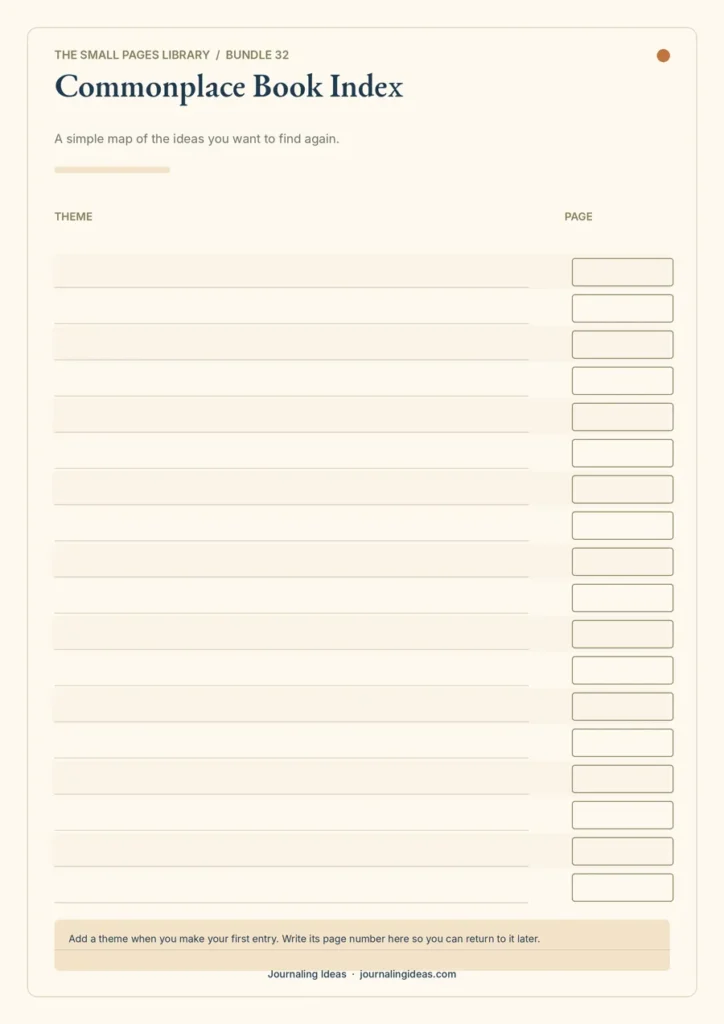
Step 3: Leave Space for an Index. Reserve the first two to four pages for your index. You will use this space to record your themes and the page numbers where related entries appear. For example, if you begin collecting notes about books on page 8, add that page number beside Books & Reading in your index. When you add another related entry on page 23, add that number too. You can use additional index lines when a theme needs more room.
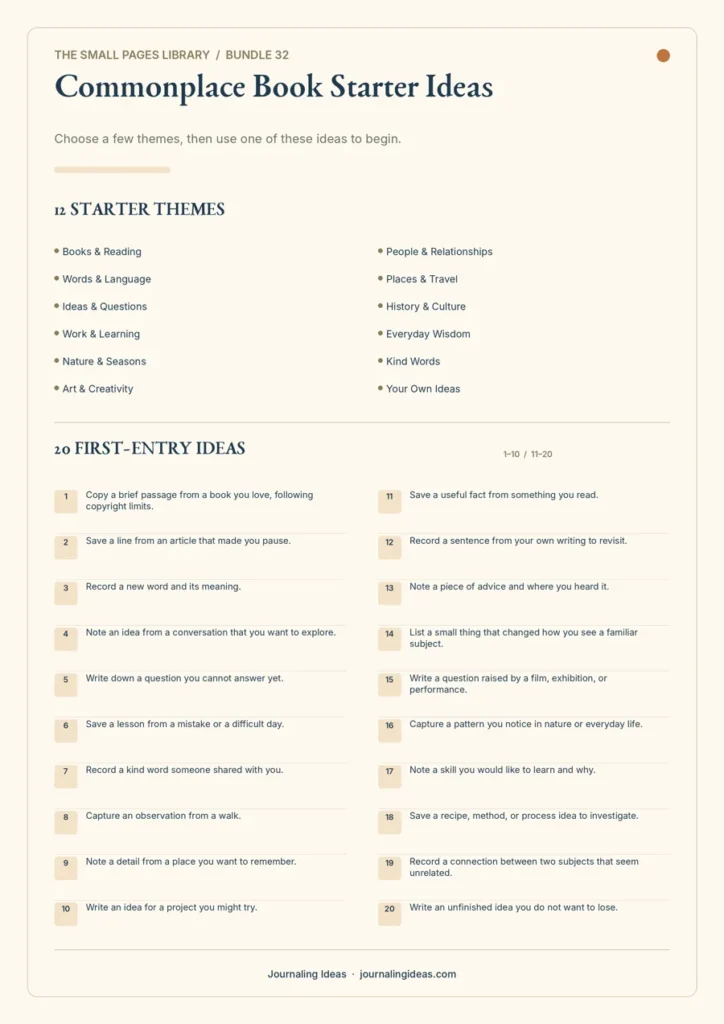
Step 4: Choose Five to Eight Starter Themes. You do not need to organize everything before you begin. Start with five to eight subjects that genuinely interest you. You can add more as your collection grows. Here are 12 possible themes: Books & Reading · Words & Language · Ideas & Questions · Work & Learning · Nature & Seasons · Art & Creativity · People & Relationships · Places & Travel · History & Culture · Everyday Wisdom · Kind Words · Your Own Ideas. Choose the ones that feel useful now. You can change or expand them later.
Step 5: Start Adding Entries. When something catches your attention, write it down. Use one page for each entry, or use a smaller section if the note is brief. Give it a theme and record its source. Then add the page number to your index. That is the basic system. You can begin with one entry today.
What Should Each Commonplace Book Entry Include?
A consistent entry layout makes your notebook easier to use. The Commonplace Book Entry Page in the free Starter Kit uses six simple fields.
1. Theme — What subject does this entry belong to? Choose a theme from your index. If the subject is new, you can create a new category later.
2. Date — When did you record the entry? The date helps you understand when you collected the material, even if you return to it much later.
3. Source — Where did the idea come from? You might record a book title, author, article, page number, conversation, place, or your own reflection.
4. The Passage or Idea — Write the brief passage or summarize the idea you want to keep. This is the main part of your entry. Leave enough space to explain the idea clearly, but do not feel that you need to fill the whole page.
5. Why It Matters to Me — Add a short personal reflection. What caught your attention? How does the idea connect with something you already know? Is there something you want to remember or explore?
6. See Also — Connect this entry to related pages. For example, a note about creativity might also relate to an earlier entry about learning or problem-solving. Add the relevant theme or page number. These connections make your notebook more useful over time.
The layout is deliberately simple. You can use it for a full page or adapt it for a small entry.
How Can You Keep a Commonplace Book Useful Without Overthinking It?
The easiest way to maintain a commonplace book is to avoid turning it into another task you have to complete. A few practical habits help:
• Do not force daily entries. Add something when you find something worth keeping.
• Keep themes broad at first. You can divide a subject into smaller categories when you have enough entries.
• Write short notes. A useful paragraph is better than filling a page just to make it look complete.
• Record sources. You will appreciate knowing where an idea came from when you want to find the original material.
• Use your index regularly. Update it when you add an entry instead of trying to reconstruct everything later.
• Allow unfinished ideas. A question or incomplete thought can be a useful entry.
Your commonplace book does not need to look like a finished collection of perfect pages. It should be useful to you.
How Do You Do a 10-Minute Weekly Commonplace Book Review?
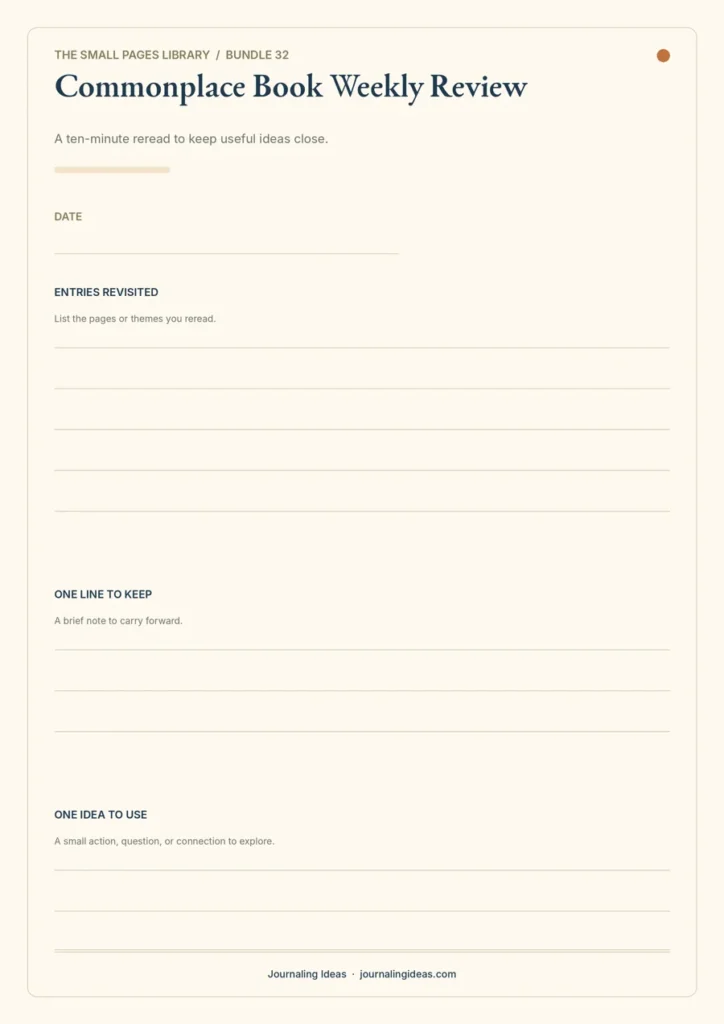
A commonplace book becomes more useful when you return to what you have collected. Set aside about ten minutes once a week. You do not need to review every page. Choose a few recent entries and look for ideas that still feel useful.
Try this simple routine:
• Minute 1–3: Revisit a few entries — Open your notebook and reread three to five entries. Notice recurring subjects, interesting connections, or ideas you had forgotten.
• Minute 4–6: Choose one line to keep — Select a thought, short passage, or observation that you particularly want to remember. Record it in the One Line to Keep section of your weekly review sheet.
• Minute 7–8: Choose one idea to use — Is there an idea you could put into practice, research further, or connect with another subject? Write it in the One Idea to Use section.
• Minute 9–10: Update your index — Add any missing page numbers or cross-references. This small step makes future searches much easier.
Your weekly review does not need to produce a long list of actions. Sometimes rereading one useful entry is enough.
What Are 20 First-Entry Ideas to Get You Started?
Starting with an empty notebook can feel surprisingly difficult. You might have plenty of things you want to remember but not know which one deserves the first page. Here are 20 simple ideas. Choose whichever feels interesting rather than trying to complete the list in order.
Ideas 1–10:
1. Copy a brief passage from a book you love, following copyright limits.
2. Save a line from an article that made you pause.
3. Record a new word and its meaning.
4. Note an idea from a conversation that you want to explore.
5. Write down a question you cannot answer yet.
6. Save a lesson from a mistake or a difficult day.
7. Record a kind word someone shared with you.
8. Capture an observation from a walk.
9. Note a detail from a place you want to remember.
10. Write an idea for a project you might try.
Ideas 11–20:
11. Save a useful fact from something you read.
12. Record a sentence from your own writing to revisit.
13. Note a piece of advice and where you heard it.
14. List a small thing that changed how you see a familiar subject.
15. Write a question raised by a film, exhibition, or performance.
16. Capture a pattern you notice in nature or everyday life.
17. Note a skill you would like to learn and why.
18. Save a recipe, method, or process idea to investigate.
19. Record a connection between two subjects that seem unrelated.
20. Write an unfinished idea you do not want to lose.
You can use these ideas to fill your first few pages or keep them nearby for days when nothing immediately comes to mind. There is no need to make every entry meaningful to someone else. Your commonplace book is a collection for you.
Where Can You Get the Free Commonplace Book Starter Kit?
To make setting up your notebook easier, we created a four-sheet Commonplace Book Starter Kit for The Small Pages Library. The kit has four designs and eight PDF files:
• Index Page: Theme lines and page-number spaces to organize your notebook.
• Entry Page: A repeatable six-field layout for collecting passages and ideas.
• Starter Ideas List: 12 starter themes and 20 first-entry ideas.
• Weekly Review Page: A simple reread log with space for entries revisited, one line to keep, and one idea to use.
Every sheet is available in A4 and US Letter. That means four designs multiplied by two paper sizes, giving you eight free PDF files.


The Small Pages Library is open access. There is no email signup and no password required. The Library now holds 503 free PDF files across 70 bundles.
Start your commonplace book — download the four-sheet Starter Kit from The Small Pages Library. Free — A4 + US Letter · No signup.
How Can You Make Your Commonplace Book a Habit?
A commonplace book does not need a strict routine. Keep it somewhere you can reach when you read, learn something interesting, or notice an idea worth remembering.
Start with one entry. Give it a theme, record its source, and add the page number to your index.
When you have more entries, spend a few minutes looking through them. You may discover connections between subjects you would not have noticed otherwise.
A commonplace book is a simple, flexible way to keep the ideas that matter to you. Start with the free Starter Kit, choose a few themes, and let your collection grow naturally.
Small pages. Meaningful days.
Frequently Asked Questions About Commonplace Books
Do I need a special notebook for a commonplace book?
No. Any notebook with enough writing space will work. A lined, dotted, or plain notebook is fine. Numbered pages are helpful because they make indexing easier.
How many themes should I start with?
Start with five to eight broad themes. This gives you enough structure without making the notebook difficult to organize. Add more categories when you notice new subjects appearing regularly.
Can I include my own thoughts, not just copied passages?
Absolutely. Your own observations, questions, reflections, and unfinished ideas belong in a commonplace book. It does not have to be a collection of material written by other people.
How often should I add new entries?
There is no required schedule. Add an entry whenever you find something worth keeping. Some weeks might produce several pages, while other weeks might produce none.
Is it better to keep a commonplace book on paper or digitally?
Both approaches can work. A paper notebook offers a simple, screen-free place to collect ideas, while a digital notebook can make searching and reorganizing easier. Choose the format you are most likely to use.
Can I use a commonplace book alongside my other journals?
Yes. It can work alongside a daily journal, reading journal, planner, or other notebooks. Each can serve a different purpose, while the commonplace book keeps useful ideas from different parts of your life together.
— Journaling Ideas Editorial Team



One Comment