
Dream Journal for Beginners: A Simple Way to Remember Your Dreams
A dream journal is a notebook or printable log where you record dreams shortly after waking. The simplest habit is to write within minutes, while details are still available: a place, a person, a feeling, even one image. Start with fragments, then add anything else you remember.
You do not need vivid dreams, beautiful handwriting, or an explanation for every strange scene. A few words can hold something you would otherwise forget before breakfast.
This guide gives you a two-minute morning routine, a reusable dream log template, a clearly labeled sample, and 30 questions for mornings when you want a little direction. There is also a gentle seven-day plan.
Prefer a ready-made page? The free Dream Journal Log comes in A4 and US Letter in The Small Pages Library. Access is open, with no signup needed.

What is a dream journal?
A dream journal is a place to record what you remember dreaming, ideally right after waking, before the details fade. It can be a small notebook, loose paper in a folder, or a printable page used once per dream.
An entry might describe a complete scene. It might also contain only “yellow stairs, unfamiliar station, felt relieved.” Both belong.
You are recording a remembered experience, so gaps are allowed. If you cannot recall how a scene began or why someone appeared, leave that part uncertain. You do not need to repair the story.
A dream journal usually centers on dream content and feelings. A sleep diary centers on information such as sleep times and waking periods. You can keep either, but a dream entry does not replace a sleep record requested by a healthcare professional.
For this beginner method, the task is simple: notice what remains, put it on the page, and continue your morning.
Why do people keep a dream journal?
People keep dream journals for different reasons. Choose the reason that feels useful to you; there is no required outcome and no number of dreams you must collect.
To practice remembering dreams
Writing gives you a place to preserve the fragments you do recall. With practice, you may find it easier to notice and describe them.
That is a possibility, not a promise. Some mornings will still be blank, and longer entries do not automatically mean better results. Judge the habit by whether it feels manageable and interesting.
To notice recurring themes and feelings
After several entries, you might notice that certain settings, people, or emotions appear more than once.
Keep observations plain: “I wrote about being late twice” or “Several entries mention feeling welcome.” These describe your notes. They do not establish what a dream means or why it happened.
A repeated image is an invitation to curiosity, not proof of a hidden message.
To make space for quiet morning reflection
A short entry can offer a pause before messages, chores, or work. You might simply name the feeling you woke with and then close the notebook.
This does not have to become a full morning routine. Two minutes may be enough, and a rushed day can have a shorter version.
To collect creative inspiration
An unusual room, a line of dialogue, or an unexpected color combination might become a starting point for a story, drawing, or poem.
Keep the original memory separate from later inventions. Label added ideas as “creative notes” so you can tell what you remembered from what you developed afterward.
Dream journaling here is a personal reflective practice. It is not fortune-telling, and this guide does not treat dream interpretation as established fact.
What do you need beside your bed?
Keep a small kit within arm’s reach so getting started requires very little effort.
- A notebook and pen, or a printed Dream Journal Log on a clipboard.
- A dim light that lets you read your page comfortably.
- A steady place to rest the notebook or clipboard.
- Your phone put away, so opening messages is not the first step.
Use a pen that works without testing several times. Open the notebook to a fresh page before bed, or place one printable sheet on top of the stack.
A small notebook is easy to keep nearby. If you prefer more writing room, the printable gives each dream its own page. Neither option needs decoration.
Choose the setup you can reach and use comfortably. If bedside space is limited, a slim notebook tucked into an accessible bedside pocket may be enough.
Keep privacy in mind, too. Dreams can include personal details. Store pages somewhere you feel comfortable, and use initials instead of names if you prefer. Sharing your entries is optional.
There is no need to buy a special journal before trying the habit. Ordinary paper is a perfectly useful beginning.
How do you start a two-minute morning routine?
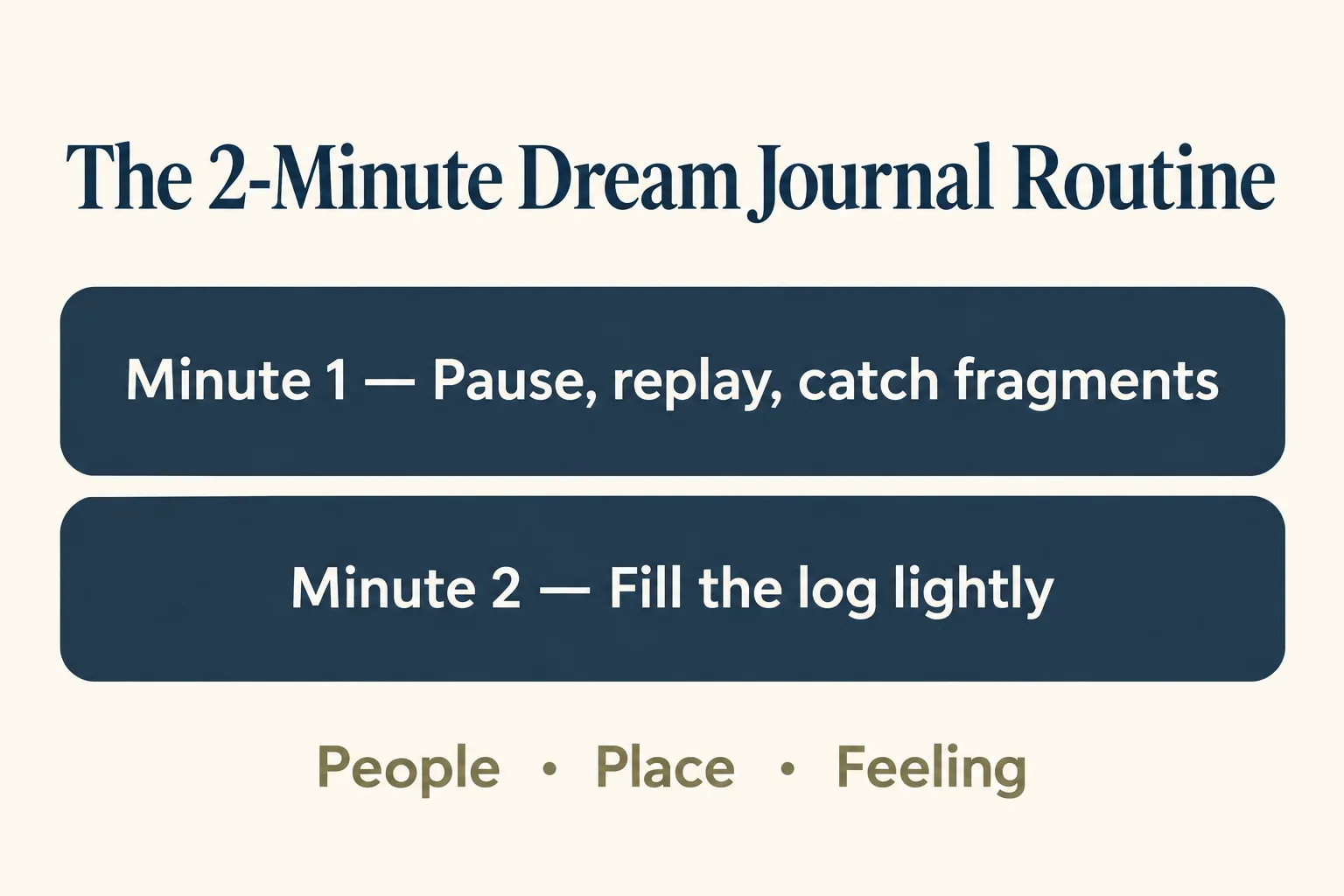
Try this after your normal waking time. The timing is a practical guide, not a test, and you do not need to watch a clock.
Minute one: pause, replay, and catch fragments
For the first few moments, stay still if comfortable and let the last scene come back to you. Notice what is already there instead of searching for a complete story.
Then reach for your pen. Write three anchors:
- People: who was there, even if you cannot name them.
- Place: where the scene seemed to happen.
- Strongest feeling: what you felt in the dream or on waking.
“Someone familiar / empty café / curious” is enough to begin. Add an object, action, or short phrase if it is especially clear.
If replaying the dream brings nothing back, write “No dream recalled” and stop. You have checked in without inventing anything.
Minute two: fill the template lightly
Add the date and a quick title. Put the remembered events in order as far as you can, then complete the other fields with short phrases.
You do not need a paragraph in every space. A single feeling word or one standout detail can carry the entry.
Finish with a one-line summary. If the story section needs more room, you can continue later, but keep your first notes intact. Mark later additions so they do not blur into the original record.
On a busy morning, write only the date and three fragments. That shorter version still counts. On a slower morning, keep writing if you want to, without making longer entries tomorrow’s requirement.
Do not set extra overnight alarms or sacrifice sleep to collect material. The journal fits around rest.
What should you write in a dream log?
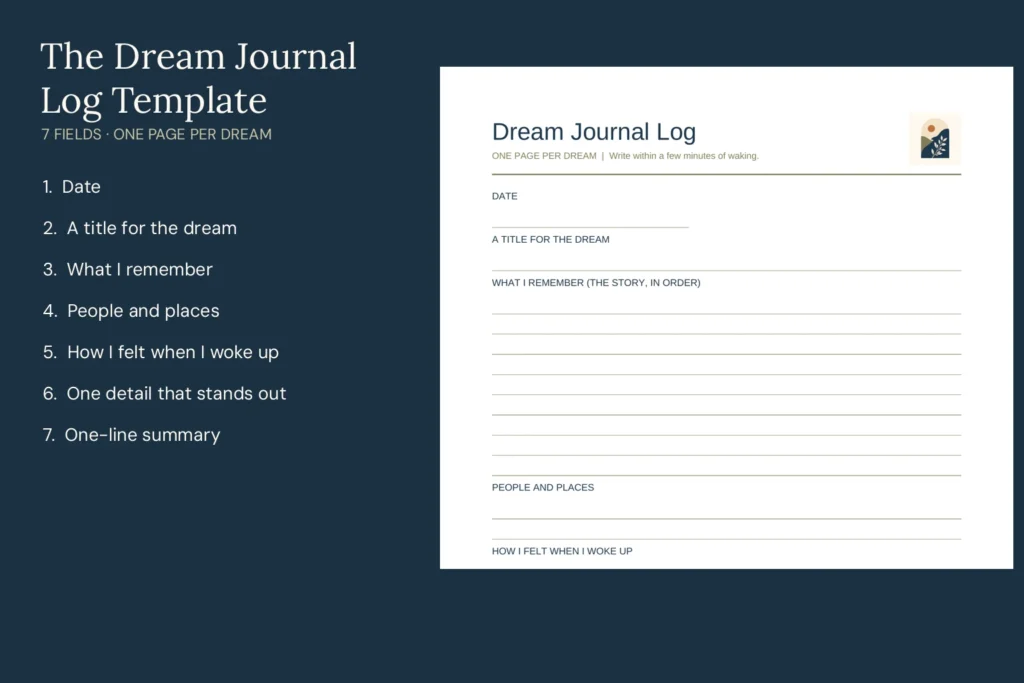
Use the same seven fields each time. A familiar layout means you can begin without deciding how to organize the page.
Date
Use the date you woke up, even if the dream seemed connected to the previous evening. Consistency makes entries easier to find later.
If you remember more than one dream, give each one a separate page with the same date. Add a simple label such as “second dream” if helpful.
A title for the dream
Choose a short, concrete title: “The Quiet Station,” “A Kitchen Full of Plants,” or “Looking for My Bag.”
The title is a memory cue. It does not need to explain the dream or sound clever. You can add it last if nothing comes immediately.
What I remember (the story, in order)
Write the scenes in the order you recall them. Short sentences, arrows, or bullets are all fine.
Use honest gaps: “I do not remember how I got there” or “The next part is unclear.” If you are unsure about a detail, write “maybe” rather than choosing a version that makes the story smoother.
People and places
List anyone who appeared and the settings you remember. Descriptions such as “an unfamiliar person” or “a room that looked like school” are useful.
Record familiarity without forcing identification. Someone can feel familiar in a dream even when you cannot connect them to a person you know.
How I felt when I woke up
Name your waking feeling: calm, puzzled, amused, sad, relieved, unsettled, or something else.
You can also note a contrast: “Worried in the dream; relieved when I woke.” This separates the dream’s emotion from your present feeling.
One detail that stands out
Choose one image, sound, object, action, or phrase you can still picture clearly.
You might note a blue cup, a door without a handle, or a sentence someone said. It does not need to be meaningful to deserve a place on the page.
One-line summary
Describe the dream’s main event in one sentence.
“I searched a station for a platform and found a quiet garden” records the experience. “This predicts a life change” adds a claim the entry cannot establish. Stay with what happened in the remembered dream.
SAMPLE: a completed dream journal entry
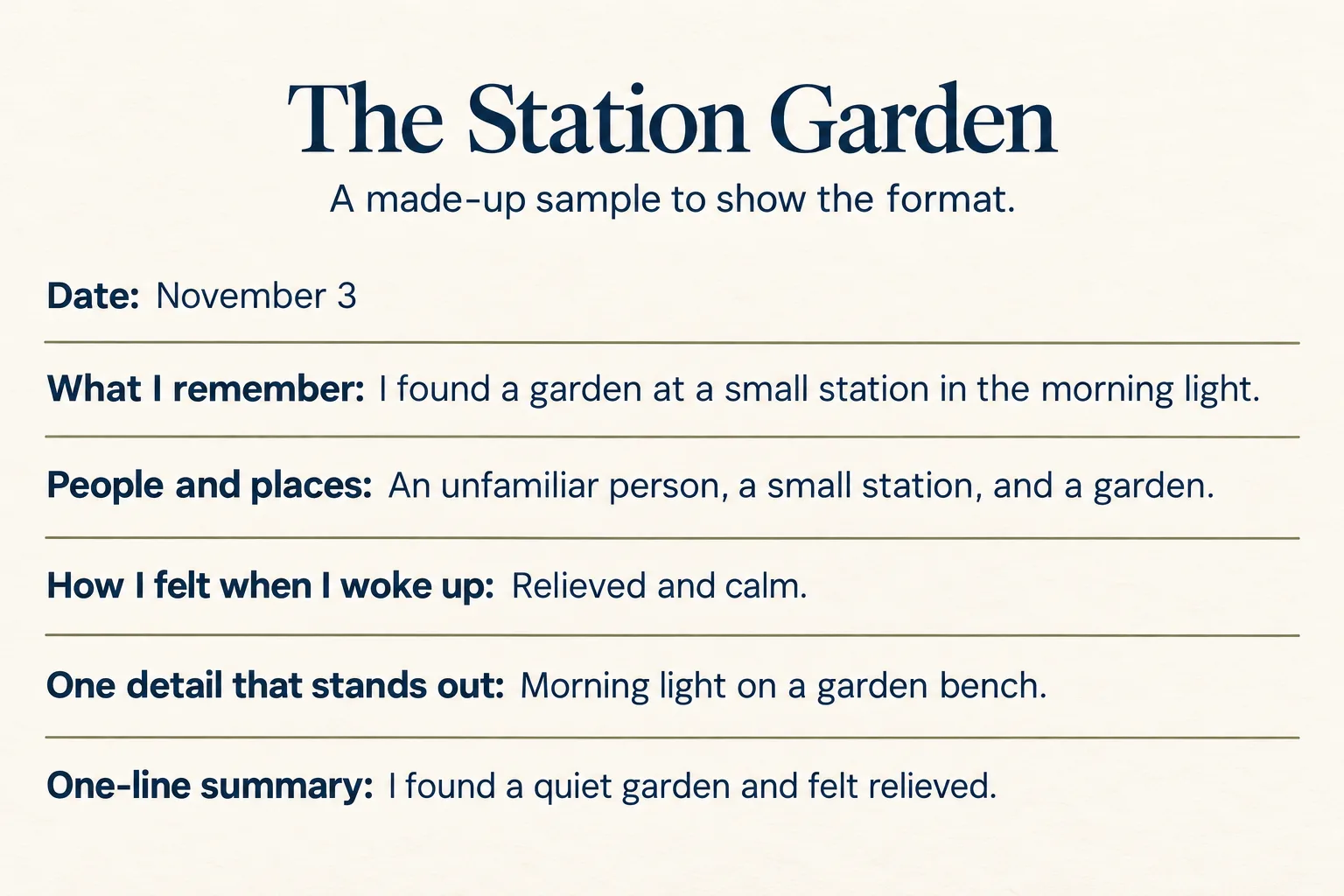
A made-up sample to show the format
The entry below is fictional. It demonstrates the fields; it is not a reader story or a dream with an assigned meaning.
Date: November 3
A title for the dream: The Station Garden
What I remember (the story, in order): I was standing in a quiet train station with a paper ticket. I could not find a platform number. An unfamiliar person pointed toward a green door. When I opened it, there was a small garden with benches instead of tracks. I sat down beside a blue watering can. I do not remember anything after that.
People and places: Me; an unfamiliar person near the ticket desk; a train station; a garden behind a green door.
How I felt when I woke up: Puzzled, then calm. I had felt hurried at the beginning of the dream.
One detail that stands out: The blue watering can beside the bench.
One-line summary: I looked for a train platform and found a quiet garden instead.
Notice that the sample leaves the ending open. It does not explain the stranger, assign a meaning to the color green, or turn the station into a prediction.
Your entry can be shorter. Its purpose is to preserve your own recollection, including the uncertain parts.
30 dream journal prompts for beginners
Use these questions after your first notes, or choose one when you remember only a fragment. You do not need to answer all 30 about one dream.
Skip anything you cannot remember or do not want to explore. “I’m not sure” is a useful answer.
Start with the basics
- What is the first scene I can remember?
- What was happening just before the dream ended?
- Where did the dream seem to begin?
- What was I doing in the dream?
- Was I trying to reach, find, or finish something?
- What changed between the beginning and the last scene I recall?
- Which part of the sequence is unclear?
- Did I observe the scene or take part in it?
- What words or conversation do I remember?
- What short title would help me recognize this dream later?
People, places and feelings
- Who appeared, and did they seem familiar or unfamiliar?
- How did I interact with the people in the dream?
- Who was nearby without speaking or taking part?
- Did any setting resemble somewhere I know while differing in a noticeable way?
- What could I see beyond the main scene?
- What feeling was strongest during the dream?
- How did that feeling change as events unfolded?
- How did I feel immediately after waking?
- Did I feel comfortable, uncomfortable, or neutral around anyone in the dream?
- Which interaction would I like to describe more clearly?
Details and patterns
- Which object caught my attention most?
- What colors, textures, or lighting do I remember?
- Was there a sound, smell, taste, or physical sensation I can describe?
- Which detail seemed ordinary in the dream but unusual after waking?
- Did a room, object, or person change appearance?
- What detail resembles something in an earlier journal entry, if anything?
- What feeling appears in both this entry and another one?
- Does anything remind me of a recent waking experience, without proving a connection?
- Which remembered detail could inspire a drawing, story, or other creative idea?
- What remains uncertain that I want to leave uncertain?
For your first week, try one question per entry. The list is a menu, not homework.
If you later use question 26 or 27, compare the actual pages rather than relying only on a general impression. “Both mention a corridor” is a clearer observation than “I always have the same dream.”
You can also stop after the template. Prompts are optional support, and an entry does not become more valuable because you answered more questions.
For regular journaling too, see our 150 journal prompts for beginners — a full list with a free printable.
A gentle seven-day dream journal starter plan
Begin whenever you like. The days below describe small tasks, not milestones you must reach on schedule.
| Day | Tiny task |
|---|---|
| 1 | Put your notebook or printable, pen, and dim light within reach. On waking, add the date and anything you recall. |
| 2 | Try the first-minute pause. Capture a person, place, or feeling; one fragment is enough. |
| 3 | Give one entry a simple title, even if the entry is only a few words. |
| 4 | Use the seven template fields. Leave any field blank when you have nothing to add. |
| 5 | Choose one prompt from “Start with the basics” and answer briefly. |
| 6 | Note your waking feeling separately from the feeling inside the dream. |
| 7 | Read the week’s pages once. Keep the parts of the routine that felt easy and adjust anything awkward. |
A blank morning does not move you backward. You can write “No dream recalled,” skip the page, or simply return the next day.
At the end of the week, ask whether your kit was easy to reach and whether the routine fit your mornings. Those practical questions are more useful than scoring your recall.
If seven consecutive days feels like too much, spread the plan out. There is no catch-up assignment. You are building a place for occasional memories, not maintaining a perfect attendance record.
What beginner mistakes are easy to avoid?
Most early difficulties come from asking too much of a sleepy moment. Make the first step smaller.
| Common mistake | A gentler adjustment |
|---|---|
| Waiting until later to begin | Capture a few words within minutes of waking, then expand later if useful. |
| Trying to write a polished story | Use fragments and keep the gaps visible. |
| Filling in missing details | Mark uncertainty or leave the field blank. |
| Opening messages before writing | Leave the notebook ready and check it first when practical. |
| Searching for a fixed meaning in every image | Describe what you remember and any personal association as a possibility. |
| Treating blank mornings as failure | Record “No dream recalled” or skip the entry. |
| Making the routine longer every day | Keep the two-minute version available. |
| Interrupting sleep to get more entries | Write after your normal waking time and protect rest. |
Another easy trap is comparing your notebook with someone else’s elaborate pages. You only see what they chose to share, and your journal has a different job: holding your own recollections.
A crooked line, crossed-out word, or unfinished sentence does not need fixing. Messy counts.
An honest note about nightmares and sleep
A dream journal is a reflective habit, not therapy or medical advice. It cannot diagnose a condition, establish the cause of a dream, or replace professional support.
If recurring nightmares trouble you, or poor sleep affects your daily life, talk with a medical professional. The NHS specifically advises seeking medical advice for regular nightmares that affect sleep and everyday life.
You do not have to write a detailed account of an upsetting dream. Leave the entry brief, skip it, or pause the practice if writing feels unhelpful. There is no requirement to revisit distressing scenes for the sake of completing a page.
Use this guide for ordinary personal reflection. Questions about persistent sleep problems deserve individual advice from a qualified professional.
Get the free Dream Journal Log printable
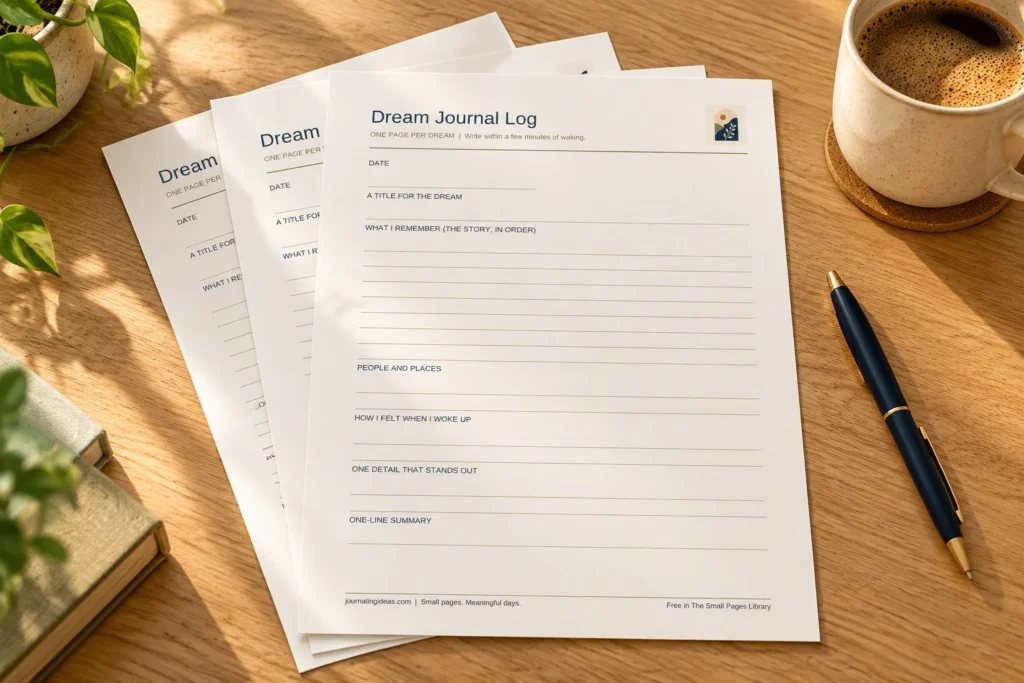
If you prefer a page that is already organized, use the free Dream Journal Log in The Small Pages Library.
The printable uses one page per dream and includes the same seven fields explained above:
- Date.
- A title for the dream.
- What I remember (the story, in order).
- People and places.
- How I felt when I woke up.
- One detail that stands out.
- One-line summary.
Choose A4 or US Letter to match your paper. The Library is open access, with no signup needed.
Download the matching size, preview it in your PDF viewer, and print one copy to check the layout before making a stack. Use actual size or 100% when the preview fits your printer’s printable area; adjust the scaling if your printer needs more margin.
Put one sheet on a clipboard beside your bed. Store completed pages in a folder or binder if you want to keep them together.
Start with a few copies. You do not need a thick printed journal before you know whether you enjoy the habit.
Find the free Dream Journal Log in The Small Pages Library — A4 and US Letter, open access, no signup needed.
Start with the piece you remember
Tonight, place a pen beside a notebook or one printable page. Tomorrow, give yourself a quiet moment before the day gathers speed.
Write the detail that remains: a doorway, a familiar face, a feeling, a sentence. Let it be incomplete.
You can build a useful dream journal from these small pieces without solving them or turning them into something impressive.
Save this guide for your next morning, or choose one prompt to keep beside your bed.
Small pages. Meaningful days.
Dream journal FAQs
How do I start a dream journal if I rarely remember dreams?
Keep paper and a pen within reach. After waking, pause and note any image, place, or feeling that remains. If nothing comes back, write “No dream recalled” or skip the entry. Recall may vary; improvement is not guaranteed.
What should I write when I remember only a small fragment?
Record the fragment exactly as it comes: a color, object, person, action, or feeling. Add the date and leave other fields blank. You do not need to create a full story.
How long should I spend on a dream journal each morning?
Try about two minutes after waking. A few words are enough on busy mornings. Write longer only if you want to and have time; the suggested timing is a practical starting point.
Can a dream journal tell me what my dreams mean?
It can help you record personal associations and recurring details, but it cannot establish a universal meaning, predict events, or diagnose a condition. Treat interpretations as personal possibilities rather than facts.
Should I keep writing if my dreams are upsetting?
You can pause or skip upsetting entries. Detailed recording is optional. If recurring nightmares trouble you or sleep problems affect daily life, speak with a medical professional instead of relying on journaling alone.
Where can I get the free Dream Journal Log printable?
Find the free Dream Journal Log in The Small Pages Library. Choose A4 or US Letter, with one page per dream. Access is open, with no signup needed.
You may also find these useful:
- 50 gratitude journal prompts for November — a gentle evening routine with a free printable checklist.
- Bullet journal for beginners — five simple pages and a free starter pack.