

Tracking Journal: What It Is, What to Track, and How to Start

A tracking journal is a notebook or set of printable pages where you record small details over time so you can notice patterns. You might track sleep, moods, spending, reading, routines, or creative projects. Unlike a journal that asks you to write a full entry each day, a tracking journal can work with a few words, numbers, or check marks.
You do not need to track your whole life to make one useful. In fact, a tracking journal often works best when it is small enough to keep on an ordinary Tuesday, a busy holiday weekend, or a day when your plans change.
Maybe you want to understand why some weeks feel more settled than others. Maybe you are trying to remember which books you finished, where your household spending goes, or how often you make space for a quiet walk. A tracking journal gives those scattered details somewhere to live. It does not have to grade your days or turn your life into a project.
This guide explains what a tracking journal is, how it differs from a habit tracker, what you can record, and how to begin without making the process complicated. Later, you will find 25 ideas, a filled-in sample, and a gentle seven-day starting plan. You can use a notebook you already own or a free printable tracker; there is no special equipment or perfect layout required.
What Is a Tracking Journal?
A tracking journal is a simple, repeatable place to record information about your days, weeks, or activities. Its purpose is to help you see what happened over time, rather than rely on memory alone. You decide what matters, how often to write it down, and whether to do anything with the patterns you notice.
Some tracking journals look like calendars with tiny checkboxes. Others have a table with dates down one side and notes across the page. A reading tracker might list book titles and the dates you finished them. A mood tracker might use a word or color for each day. A home tracker might show bills paid or household tasks completed. Each is a tracking journal when the entries build into a record you can look back on.
There is no single correct design. The most useful format is one you can understand at a glance and fill in without needing a fresh burst of motivation.
What Do You Write in a Tracking Journal?
You write down one or more details you want to remember or compare over time. That might be a check mark for a completed routine, a number such as minutes read, a brief feeling word, or a note about something that affected your day.
For example, a simple daily page could have four columns: date, sleep hours, afternoon energy, and a short note. A weekly page could list walks, books read, and spending categories. The entries do not need to be elaborate to be meaningful. “Tired after late night” can tell you more about your week than a carefully decorated square left blank.
Choose details that answer a question you actually have. If your question is “Am I making time to read?”, record reading days or minutes. If it is “Where does my grocery budget go?”, record grocery purchases. If you have no reason to use a measurement, you can leave it out.
For personal wellbeing notes, keep the journal descriptive rather than diagnostic. You can record how you feel, what you noticed, and any questions you want to remember. A journal is not a medical test or a substitute for professional advice.
Why Keep a Tracking Journal?
A tracking journal can help you notice patterns, remember progress, and make everyday decisions with a little more context. The value is not in creating a perfect streak. It is in seeing what your days actually look like.
Without a written record, the loudest or most recent day can take over your memory. One difficult afternoon might make a whole week feel difficult. A few small entries may show that most afternoons were calm, with one exception. Or you might notice that the weeks when you plan meals in advance feel less rushed. Those observations are personal clues, not proof that one thing caused another.
A tracker can also preserve good things that are easy to overlook: a few pages read before bed, a quiet morning outside, an afternoon spent drawing, or another small contribution to a long project. Progress does not always look dramatic on a calendar. Sometimes it looks like returning after a gap.
And sometimes the journal tells you a particular tracker is not useful. You are allowed to stop recording it. The point is to support your life, not create another task to manage.
Who Is a Tracking Journal For?
A tracking journal is for anyone who wants a clearer picture of a routine, interest, or part of daily life without writing long diary entries. Beginners can start with a single row per day. People who already keep a bullet journal can add a tracking page alongside their usual notes. If you prefer printed sheets, you can use one page at a time without setting up an entire notebook.
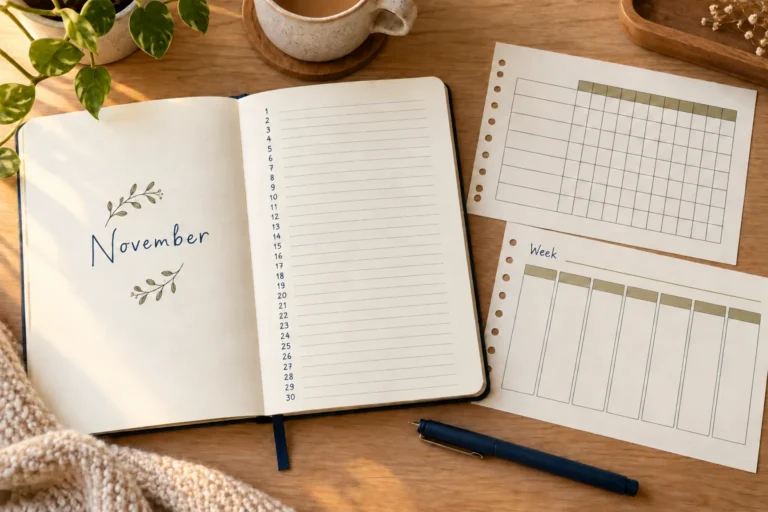
It can be especially helpful when your schedule changes. A student might note study sessions and reading. Someone working from home might record breaks and project time. A family might keep a shared home-maintenance log. Someone entering a busy November or December might choose a short weekly tracker rather than try to maintain an elaborate daily spread.
You do not need to be naturally organized, artistic, or consistent. A missed day is an empty cell, not a failed experiment. Start again on the next line. Messy counts.
How Is a Tracking Journal Different From a Habit Tracker?
A tracking journal records information over time, while a habit tracker focuses on whether you did a particular action. A habit tracker is one kind of tracking journal, but a tracking journal can include much more than repeated habits.
For example, “Did I stretch today?” is a habit-tracker question. “How was my energy today, and what was different?” is a broader tracking-journal question. You can answer both on the same page if that helps, but they serve slightly different purposes.
| Feature | Tracking journal | Habit tracker |
|---|---|---|
| Main purpose | Notice patterns and keep a record of daily life or activities | See how regularly you complete a chosen action |
| What you record | Numbers, check marks, words, dates, short notes, or observations | Usually a yes/no mark, count, or frequency for each habit |
| Common examples | Mood notes, spending, sleep, books finished, project progress | Reading each day, drinking water, taking a walk, tidying for ten minutes |
| Typical layout | Flexible tables, logs, lists, calendars, or mixed pages | Repeated rows or boxes for habits across days or weeks |
| How to use the results | Look back for context, patterns, memories, or questions | Notice consistency and decide whether a routine needs adjusting |
Neither one is better. A habit tracker may be exactly what you need when you want to remember a specific routine. A broader tracking journal is useful when your goal is to understand what is happening, rather than check off what you intended to do.
Can a Tracking Journal Include a Habit Tracker?
Yes. A tracking journal can include a habit tracker, and the two often work well together. One page might have checkboxes for reading and taking a walk, plus a small area for a mood word or a note about the day. The checkboxes show whether something happened; the notes add a little context.
Imagine you want to track an evening reading routine. You could mark each evening you read, then jot down the book or the number of pages. After a couple of weeks, you would have a habit record and a small reading log. You would not need separate notebooks unless you liked keeping them separate.
Keep the page readable. Combining trackers is useful only when the extra fields give you something you want to know. If a page has so many boxes that you dread opening it, remove a few. A simple system you actually use offers more than an elaborate one that stays blank.
Should You Start With a Tracking Journal or a Habit Tracker?
Start with a habit tracker if you mainly want to remember one repeated action. Start with a tracking journal if you want to understand a broader pattern or record details that cannot be reduced to yes or no.
Ask yourself what you hope to learn from the page. “Did I make time to read?” points toward a habit tracker. “What did I read, how long did I spend, and what did I enjoy?” points toward a tracking journal. “Why do some evenings feel less rushed?” might call for a short daily log with a couple of observations.
If you are unsure, begin with one week and only two fields: a date and the detail you care about most. You can add checkboxes or notes later. There is no need to commit to a full year of pages before you know whether the layout works for you.
The simplest starting point is often the best: one page, one question, and enough space to be honest about an ordinary day.
What Can You Track in a Tracking Journal? 25 Simple Ideas
You can track anything you genuinely want to remember, understand, or make room for: how you feel, what you spend, which routines help, or where a creative project stands. A useful tracking journal does not need 25 trackers at once. The ideas below are a menu, not an assignment. Choose one or two that answer a question you have about your own days.
Each idea includes a simple way to record it. You can use a notebook grid, a dated list, or a printable page. A check mark is enough for some topics; for others, a word or short note is more useful. If a tracker starts to feel like another obligation, make it smaller or leave it behind.
Body and Energy
Body and energy tracking can be a place for personal observations about your own routine, not an attempt to measure whether you are doing life correctly. Record only what feels useful and comfortable to you. Tracking mood, sleep, or symptoms is for personal reflection only; it is not a diagnosis or treatment.
1. Sleep and wake times. Write down roughly when you went to bed and when you got up. You could use two small columns labeled “Bedtime” and “Wake time,” with an optional note such as “late movie” or “early start.” This can help you remember what your schedule actually looked like during a busy week. There is no need to calculate a score or make judgments about a single night.
2. Daily energy levels. Choose a simple description such as “low,” “steady,” or “high” for the time of day that matters to you. You might add “energy after lunch” as one column if afternoons are what you want to understand. A word is often easier to write honestly than a detailed rating scale. Look for broad patterns over time rather than expecting every day to match.
3. Water intake. Record glasses or bottles of water if keeping track helps you remember what you drank. Make sure the unit is clear: “glasses” is less confusing when you use roughly the same glass each time. Alternatively, use a small note like “water bottle refilled.” Do not treat someone else’s target or an arbitrary number of checkboxes as a personal requirement.
4. Movement and outdoor time. Note walks, stretching, time spent gardening, or simply minutes outside. You could use entries such as “short walk,” “park,” or “sat outside after breakfast.” Tracking this way recognizes different kinds of movement without turning every activity into a workout. If the day was spent indoors, the row can simply say so.
5. Personal symptom notes. If you want a record to refer back to, write brief factual notes about sensations or changes you noticed, including the date and any context you remember. A neutral entry might read “headache in the afternoon” rather than guessing at a cause. Keep these notes private, and speak with an appropriate healthcare professional about medical concerns. A notebook cannot determine what symptoms mean or tell you how to treat them.
Mind and Mood
Mind and mood entries work best as brief, nonjudgmental check-ins, not a daily test of whether you felt positive. One word or one honest sentence is enough. You can skip questions that do not feel supportive.
6. Daily mood. Pick a feeling word—”calm,” “restless,” “hopeful,” “flat,” or something else—and write it beside the date. If your day included several feelings, you can list two. You do not need to squeeze a complicated day into a smiley face. Over time, the words may help you remember the texture of a week that would otherwise blur together.
7. Stressful moments. Record one moment that felt demanding and, if helpful, what was going on around it. You might write “rushed before appointment” or “too many errands at once.” Keep the entry descriptive, without turning it into a verdict about yourself. If reviewing stressful moments feels unhelpful, this is a tracker you can stop using.
8. Gratitude moments. Write one thing you appreciated, however ordinary: a kind message, a quiet bus ride, or a meal you enjoyed. This is a record of moments you want to remember, not a rule that every day must feel cheerful. “Couldn’t think of one today” is also an honest entry. You are allowed to let the page reflect real life.
9. Screen-free breaks. Mark whether you stepped away from a screen for a little while, or jot down what you did instead. A short entry could be “tea on the balcony” or “read before bed.” Avoid defining the break so strictly that it stops being restful. This tracker is most useful when it reminds you of an experience, not when it polices your time.
10. Personal reflection check-ins. Answer the same gentle question once a day or once a week, such as “What felt manageable today?” or “What would I like more space for?” A few words will do. If daily reflection feels repetitive, try a weekly check-in instead. The goal is to hear your own thoughts, not produce a polished diary entry.
Money and Home
Money and home trackers help you keep everyday details together so you do not have to remember them all. Use neutral labels and categories that fit your household. These pages are records, not a measure of how well you are managing your life.
11. Everyday spending. Write down small purchases with the date, amount, and a category like groceries, transport, or coffee. You do not need a complicated budget spreadsheet to notice what you bought. One line per purchase is enough. If a purchase does not fit a category, write what it was rather than forcing it into the wrong one.
12. No-spend days. Mark days when you did not make optional purchases, if that is a question you want to track. Define “no-spend” for yourself before starting: necessary bills, groceries, and other responsibilities do not need to be treated as mistakes. This is an optional observation, not a challenge to deny yourself essentials or compete for an unbroken streak.
13. Household cleaning tasks. List a few recurring tasks, such as changing sheets, wiping the counters, or cleaning the bathroom, and record when you last did them. A simple “Task / Last done / Next reminder” table can be more helpful than daily checkboxes. If other people share the work, you can use a shared page without assigning blame for empty boxes.
14. Pantry and grocery restocks. Keep a running list of items you regularly run out of, along with a note when you add them to the shopping list. You might track coffee, rice, dish soap, or whatever matters in your home. This works particularly well as a reusable checklist near the kitchen, where the information is easiest to update.
15. Home maintenance reminders. Record the date you completed or scheduled an ordinary maintenance task, such as replacing a filter, checking a smoke alarm according to its instructions, or arranging a repair. Include a space for the next reminder if one is useful. For safety-related work, follow the relevant product guidance or professional advice rather than relying on a journal as a technical checklist.
Habits and Routines
Habits and routines are easy to track with a check mark for what happened and a small note when the context matters. You are recording real days, including interruptions. The purpose is not to make every row perfectly filled.
16. Morning routine. Choose one or two things that help you begin the day, such as opening the curtains, preparing breakfast, or writing a short plan. Instead of listing ten ideal habits, record the parts you genuinely want to remember. A simple mark beside “morning page” or “breakfast before work” may be enough.
17. Evening wind-down. Track a small end-of-day ritual, perhaps putting your phone away, laying out clothes, or reading for a few minutes. If your evenings change from day to day, leave space for a word like “late shift” or “out with friends.” The note gives an empty box context without making it an excuse you have to defend.
18. Journal writing. Mark days when you wrote anything at all: a full page, three lines, or a quick list. You might add the type of entry—”gratitude,” “brain dump,” or “dream note”—if that is interesting to you. Counting only long entries can make a good habit feel smaller than it is. Messy counts.
19. Weekly planning sessions. Record whether you spent a few minutes looking ahead to appointments, meals, priorities, or household plans. You do not have to plan every hour. A one-line note about the week’s main focus can make the tracker useful when you look back, especially during the fall holidays or the start of a new year.
20. Small decluttering sessions. Make a mark when you tidy one drawer, clear a surface, or put a few things back where they belong. Record the area if you want to avoid forgetting what you already handled. “Five minutes by the entryway” is a complete entry. A quiet reset is not less valuable because it was small.
Reading, Work and Creativity
Reading, work, and creativity trackers give unfinished projects and enjoyable interests a place on the page, even when you can only return to them occasionally. Use dates and brief descriptions rather than demanding daily progress.
21. Books and reading progress. Record the book title and pages read, minutes spent reading, or the date you finished. You could keep a small list for books in progress and another for those completed. If reading is about enjoyment, a note such as “favorite chapter” can mean more than a page count. An unfinished book belongs in the journal too.
22. Study sessions. Note what you worked on and roughly how long you spent, whether you were reviewing vocabulary, practicing a skill, or preparing for a course. A simple entry like “history notes, 25 minutes” is enough. You can include one question to revisit next time. Focus on having a record you can use, not accumulating the largest total.
23. Work project milestones. Track meaningful steps on a project, such as “outline finished,” “draft sent,” or “feedback reviewed.” Dates help you see where work stands without recreating an entire task-management system. If a deadline moves, update the note. A milestone tracker is a record of changing work, not a promise that every step will happen on the original date.
24. Creative practice. Mark time spent drawing, knitting, taking photographs, writing, making music, or exploring another creative interest. You can note the activity, the materials used, or what you tried. “Sketched for ten minutes” is as valid a record as “finished a painting.” If a practice session did not produce a finished piece, it still happened.
25. Ideas and inspiration collected. Keep a short list of images, phrases, questions, or observations that caught your attention. Add a date and a few words about where the idea came from, when useful. This is not a requirement to act on every idea. It is simply a place to keep interesting things from getting lost before you are ready to return to them.
How Do You Choose What to Track?
Choose what to track by starting with one question you want your journal to answer. If you want to know whether you are making time to read, begin with reading days or pages. If your evenings seem unusually busy, a brief evening-routine note may be more useful. Avoid adding categories just because they look attractive in someone else’s notebook.
Try this small decision test: Can you explain why you want the information? Can you record it in less than a minute? Will looking back at it help you remember something, make a choice, or appreciate a moment? If the answer to all three is yes, it is a good candidate for your first page.
For the first week, choose no more than two or three fields, including the date. Some ideas pair naturally: sleep times and a daily energy word, or reading time and book title. Other ideas are better kept apart. You can track grocery restocks on a running list without also asking yourself to enter them in a daily grid.
Give yourself permission to change your mind. A tracker might be useful for a holiday season, a short personal project, or a particular week and then have no further purpose. An empty cell is not a failure, and stopping a tracker you do not need is a sensible choice.
How Do You Set Up a Tracking Journal Page?
To set up a tracking journal page, choose one purpose, draw a small dated layout, and decide how you will record each entry. You can do this in an ordinary notebook or on a printable tracker. Start with a week rather than preparing months of pages before you know what works.
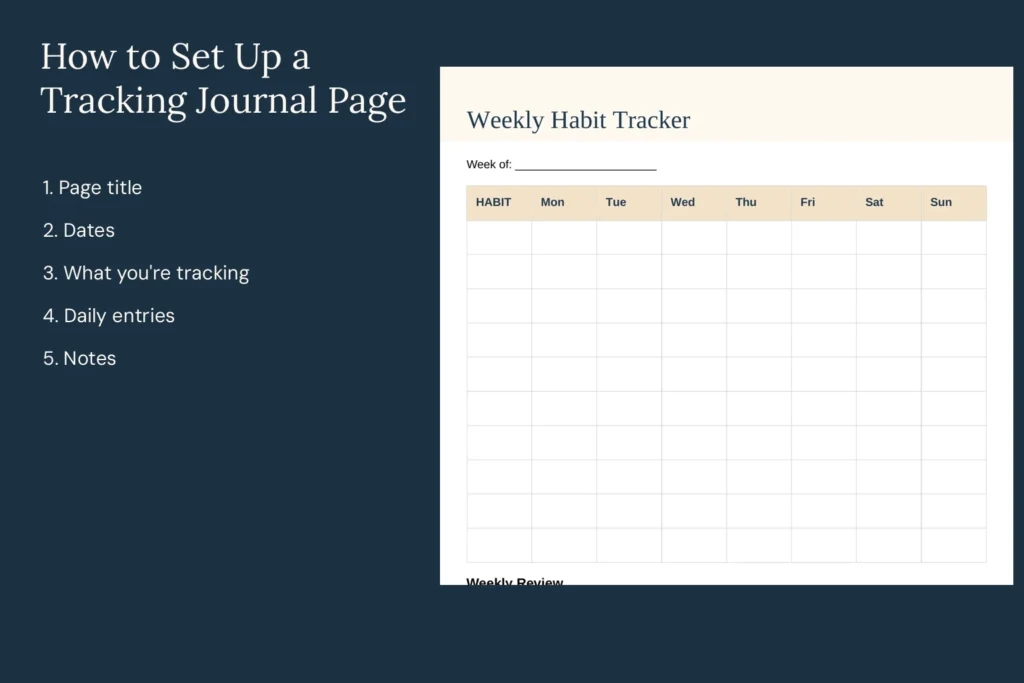
Step 1: Write Down the Question Your Page Will Answer
Give the page a purpose in plain language, such as “When do I find time to read?” or “Which household items need restocking?” This helps you leave out fields that are interesting in theory but not useful to you. Write the question at the top or keep it in mind as you build the layout.
Step 2: Choose One or Two Things to Record
Pick a small number of fields. For a reading log, you might choose “Book” and “Minutes read.” For an everyday check-in, try “Energy word” and “Short note.” The date is your anchor, so you do not have to count it as an extra goal. If you cannot imagine filling a field on a tired day, simplify it.
Step 3: Choose a Time Frame
A seven-day page is a friendly place to begin. Daily columns work well for short habits, mood words, or routine notes. A weekly list may be better for home tasks, spending, and project milestones. For an ongoing collection such as books finished or ideas saved, a dated running list might make more sense than calendar boxes.
Step 4: Draw a Simple Grid or List
Use a ruler if you enjoy straight lines, but you do not need one. Put dates down the left side and your chosen fields across the top, or use a short list with the same labels repeated. Leave enough room for the kind of answer you expect. A word needs less space than a sentence; a spending entry needs room for an amount and description.
Step 5: Decide What Your Marks Mean
Choose a recording method you can recognize later: a check mark for “done,” a number for minutes or dollars, a word for a feeling, or a brief sentence for context. If you use colors or symbols, write a tiny key on the page. Consistency makes the entries easier to read, but you can still write a note when the usual symbol does not fit.
Step 6: Put the Page Where You Will Use It
Keep the tracker with the activity it belongs to when possible. A reading log might stay inside your book or journal; a grocery list might sit near the kitchen; a daily check-in could live beside your usual evening notebook. You do not need reminders everywhere. One convenient place is often enough.
Step 7: Fill In One Entry, Then Review After a Week
Write today’s entry to make sure the page actually works. At the end of seven days, look over what you recorded without grading yourself. Ask whether the fields helped, whether any were difficult to fill, and whether you want to keep the same layout. Cross out unnecessary columns next week, add a note field, or switch to a list. A tracker is allowed to evolve.
Here are the core fields you can use to build a simple page. You do not need all of them; the first two are usually enough to begin.
| Field | What to enter | Example | When it helps |
|---|---|---|---|
| Date | The day or week the entry belongs to | Nov. 4 | Keeps entries in order |
| Item or topic | The habit, observation, or activity you are tracking | Reading | Makes the purpose clear |
| Mark or value | A check mark, number, time, or short word | 15 minutes | Records what happened |
| Context note | A few words that add meaning | Read on the train | Explains an unusual day or detail |
| Category | A label for entries with different types | Groceries | Helps organize a mixed log |
| Next action or reminder | A small follow-up, only when needed | Add to shopping list | Makes a practical log easy to use |
For example, your first page could have just three columns: Date | Reading minutes | Note. Fill in what actually happened, including days when you did not read. If you miss two days, leave those rows blank or write “not recorded”; do not guess later to make the grid look complete.
The page does not have to be decorative to be worth keeping. A few honest entries, easy-to-read headings, and enough space to write are a good start. You can always change the layout once you know what your ordinary week needs.
What Does a Filled-In Tracking Journal Week Look Like?
A filled-in tracking journal week is simply a page that shows what you chose to notice over seven days, including the days when a box stayed empty. You do not need perfect attendance or a colorful spread to learn something from it. A small grid can tell you which routines fit comfortably into your week and which ones may need adjusting.
Completely fictional example: The following is a made-up sample for illustration, not a real person’s journal or a record of actual results. In the table, ✓ means completed and — means not marked. An unmarked box does not tell us why something did not happen; it simply means no completion was recorded.
| What to track | Mon | Tue | Wed | Thu | Fri | Sat | Sun |
|---|---|---|---|---|---|---|---|
| Read for 10 minutes | ✓ | ✓ | — | ✓ | ✓ | ✓ | — |
| Write one journal sentence | ✓ | — | ✓ | ✓ | — | ✓ | ✓ |
| Tidy one small area | — | ✓ | — | ✓ | — | ✓ | — |
| Prepare for tomorrow | ✓ | ✓ | ✓ | — | ✓ | — | ✓ |
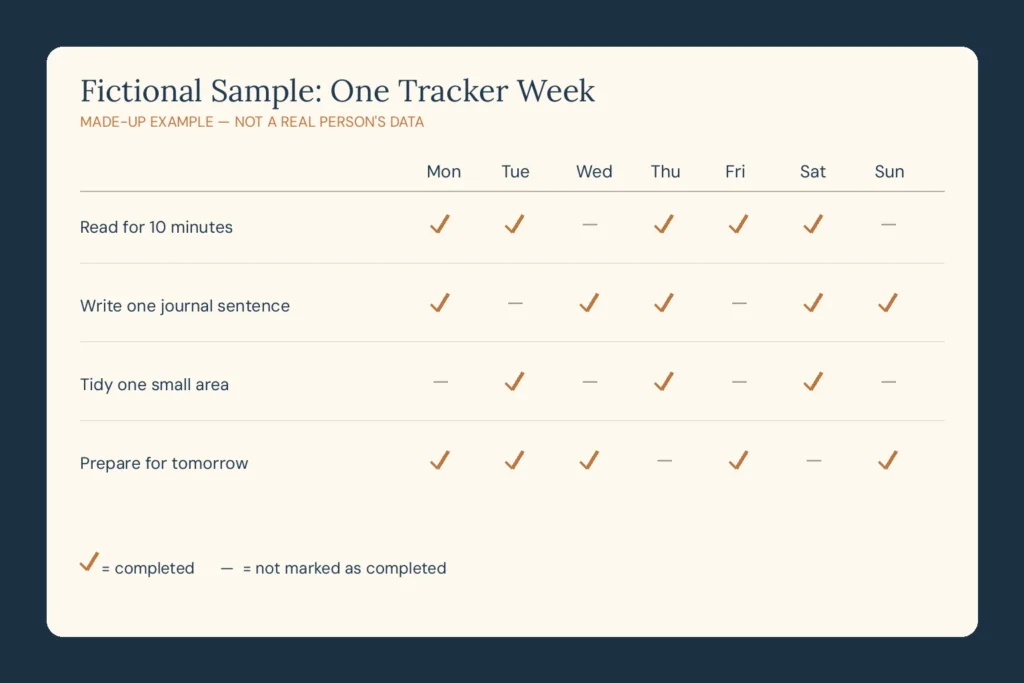
Notice what this grid does not include: an overall grade, a streak score, a punishment for missed days, or a promise that the routines caused a particular outcome. It records four small actions and gives the writer a starting point for reflection. That is enough.
You could make an equivalent page on lined paper by writing the days across the top and your activities down the left. Alternatively, print a weekly tracker and fill in the rows by hand. Leave enough room for clear labels: “Prepare for tomorrow” is far more helpful six weeks later than an unexplained abbreviation such as “PFT.”
What can you learn from a week like this?
You can learn which actions you recorded regularly and where the week had gaps, but you cannot know the reasons from check marks alone. In this fictional example, reading and preparing for tomorrow are marked on five days each. The one-sentence journal is also marked on five days. Tidying appears on three days, roughly every other day.
That does not mean tidying was unsuccessful. Perhaps three small sessions were exactly the amount the writer wanted. Perhaps weekends were different from weekdays, or the task was simply less relevant on the other days. The check marks show what was recorded, not what should have happened.
To make the page more meaningful, add a brief reflection underneath it. You might ask: “Which routine felt easiest to return to?” “Did I set a task that was too large?” or “What changed about my schedule?” One or two honest sentences can tell you more than a complicated total.
For instance, a fictional note beneath this sample might read: “Reading felt easiest when my book was beside the sofa. Tidying every other day was enough for me. Next week I’ll keep the same rows.” That is a useful observation without turning the journal into a performance report.
If you prefer numbers, you may count your check marks. Just remember that a count is a description of the tracker, not a measure of your worth or a complete picture of your day. An empty box can sit beside a day full of important, unrecorded things.
What should you write when you miss a day?
When you miss a day, leave the space blank, use a dash, or add a short factual note. You do not need to fill it from memory or start the entire tracker again. A tracking journal is more trustworthy when it reflects what you actually recorded.
Choose one simple convention and put it in a tiny key. For example, ✓ could mean “completed,” — could mean “not marked,” and “N/A” could mean “not relevant today.” In the sample grid above, every dash means not marked; it is not automatically a failure or proof that the action did not happen.
If your journal includes topics such as sleep, mood, or energy, consider using words rather than forcing a check mark. “Tired,” “restless,” or “not sure” might be more accurate than a yes-or-no box. You are allowed to skip private information, too. Your page does not owe anyone a complete explanation.
A useful weekly reset is to look at the page once, decide whether the same rows still serve you, and turn to a fresh page. There is no need to rewrite missed entries simply to make the grid look finished. Messy counts.
Is It Better to Track on Paper or in an App?
Paper is better when you enjoy writing by hand and want a quiet, flexible page; an app is better when reminders, searching, or tracking on the go make life easier. Neither is universally better. The right format is whichever you can use comfortably without adding stress to your routine.
A tracking journal can be an ordinary notebook, a printed grid, a notes app, or a dedicated tracker. The method matters less than whether the information is easy to record and useful to revisit. If you already keep a paper journal, a small tracker inside it may be the simplest option. If your phone is always nearby, a quick digital entry may be more realistic.
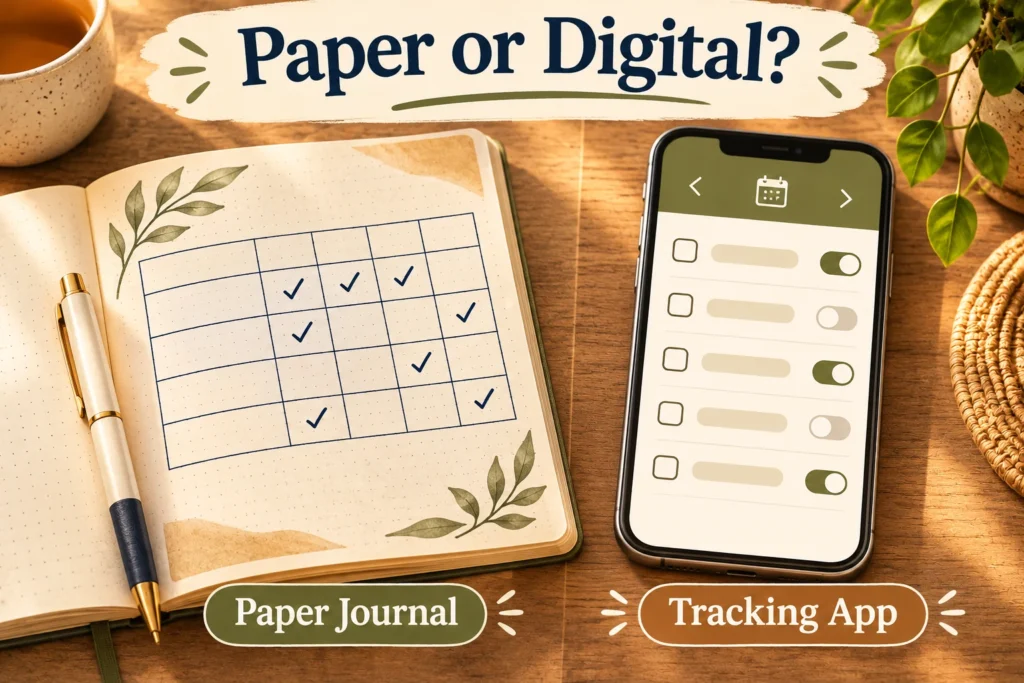
| Feature | Paper tracking journal | Tracking app or digital note |
|---|---|---|
| Getting started | Draw a few rows or use a printable page | Create a list or set up fields in an app |
| Daily entry | Write a word, number, or check mark by hand | Tap, type, or select an entry |
| Customization | Easy to sketch, annotate, and change mid-page | Varies by app; templates and settings may help |
| Reminders | Requires your own cue or routine | May offer notifications if you want them |
| Reviewing past entries | Flip through dated pages | May offer search, filters, or charts |
| Distractions and privacy | No screen required; store the notebook somewhere suitable | Convenient on the go; review app permissions and data settings |
When does a paper tracker make more sense?
A paper tracker makes sense when the act of sitting down to write helps you pay attention. It can live beside your morning coffee, inside your bullet journal, or next to the book you are reading. A pen and one page can be enough; no special supplies are required.
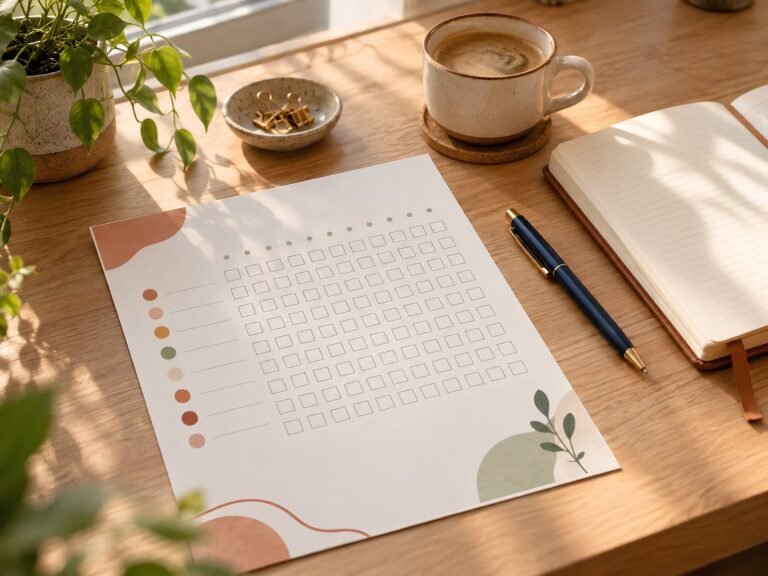
Paper is also forgiving. You can draw an arrow, cross out a label, change a goal halfway through the week, or add a note in the margin. If your tracking style changes as you discover what matters, these little adjustments can be an advantage rather than a flaw. A printed weekly sheet works especially well when you want a ready-made structure without drawing all the boxes yourself.
The main trade-off is that paper will not automatically send reminders or calculate totals. For many people, that is fine. If you want to review your week, the page is already there. Keep it in a consistent place so you can find it, but do not turn a missed entry into another task to catch up on.
When is a tracking app more useful?
An app can be useful when you want quick entries away from your desk, optional reminders, or an easier way to search older records. A simple phone note with dates can serve as a tracker; you do not necessarily need a subscription or a specialized product.
Before adding a new app, ask whether its features solve a problem you actually have. Automatic charts can be interesting, but they may be unnecessary for tracking one sentence of journaling each evening. Notifications can be helpful if you choose them, but you can also switch them off if they feel demanding.
For private reflections, review where information is stored and who might be able to access it. Apps differ in their settings and data practices, so avoid assuming that every digital tracker offers the same protections. If you would not feel comfortable recording something in an app, you can keep that detail off the tracker altogether.
Can you combine paper and digital tracking?
Yes. A hybrid tracking journal can use paper for reflection and a digital tool for quick reminders or entries. You might jot down a book title in your phone while out, then copy it to your reading journal at the end of the week. Or you might use a calendar reminder to open your paper journal without logging any personal information digitally.
The important part is avoiding duplicate work. If copying every check mark between a notebook and an app starts to feel tiring, choose one place as your main record. You do not need two perfectly synchronized systems. A small notebook plus a simple reminder can be a complete setup.
Try either format for one week before buying stationery or committing to a new service. The most useful test is not how impressive the tracker looks; it is whether you find yourself returning to it and understanding the entries later.
How Do You Start a Tracking Journal in Seven Days?
You can start a tracking journal in seven days by choosing one useful topic, making a small page, recording simple entries, and reviewing what worked. This is a gentle introduction, not a seven-day challenge you must complete perfectly. You can repeat a day, skip a step, or keep the same page for longer.
| Day | Small action | What you will have by the end |
|---|---|---|
| Day 1 | Pick one thing you want to notice | A clear, personal reason for tracking |
| Day 2 | Choose paper or a simple digital note | A place for your entries |
| Day 3 | Make a seven-day layout | A dated row or small grid |
| Day 4 | Record your first honest entry | One usable observation |
| Day 5 | Adjust anything that feels awkward | A tracker that fits real life better |
| Day 6 | Add a little context if it helps | A more meaningful record, without extra pressure |
| Day 7 | Review the week and decide what comes next | One small insight and an optional next step |
Day 1: Choose one thing you actually want to notice
Start with one question that matters to your everyday life, such as “When do I make time to read?” or “Which evenings do I remember to plan tomorrow?” The question should come from curiosity, not from a belief that you need to improve every part of your routine.
Choose one item from the 25 ideas above, or write your own. If you are tempted to start with ten rows, try one or two first. You can always add more later, once you know that tracking feels helpful.
Day 2: Choose the easiest place to record it
Pick a notebook, printed sheet, or digital note you can reach without fuss. The best location is often one you already use: inside your current journal, on your desk, or in an existing notes app.
If you like printable pages, use a simple weekly layout. If you prefer blank paper, draw only the lines you need. You do not need to shop for markers, set up a complicated spreadsheet, or choose a permanent system today.
Day 3: Make a small seven-day layout
Create seven clearly labeled spaces and one easy way to record your chosen topic. Write Mon through Sun if you are starting at the beginning of a week, or use actual dates if your week begins on another day. Either choice works as long as it is clear to you.
For a yes-or-no action, write the activity beside a row of seven boxes. For a feeling or observation, leave a little room for words. Add a title such as “Reading this week” and a short key if you plan to use symbols. Keep the page simple enough to understand at a glance.
Day 4: Make one honest entry
Record what happened today, not what you wish had happened. Mark a completed action, write down a number if you are measuring something straightforward, or add a few descriptive words. If you forgot to track yesterday, begin with today.
An entry like “read on the bus” or “too busy for a journal sentence” can be more useful than a box filled in to make the page look tidy. Accuracy matters more than a streak. You are learning how the tracker works in your real routine.
Day 5: Make the tracker easier to use
Adjust one thing that makes the page feel inconvenient. Maybe the label is too long, the boxes are too small, or you chose a moment of day when you rarely have your notebook. Change the layout or move your check-in to a more natural time.
You can also reduce the activity itself. “Read for 10 minutes” might become “Open my book,” or “Write a journal page” might become “Write one sentence.” The point is to create a record you want to return to, not to protect the first version of your plan.
Day 6: Add context only if it helps
Try one short note alongside your mark, such as “busy evening,” “read during lunch,” or “felt calmer after the walk.” Context can help explain why days looked different without demanding a full diary entry.
If you find extra notes useful, leave a small margin for them. If they make the tracker feel like homework, stop adding them. A row of honest check marks can still be enough. Your page should serve your curiosity, not compete for your attention.
Day 7: Review gently and decide whether to continue
Take a few minutes to look at the week without grading yourself. Notice what was easy to record, what you missed, and whether the information answered your original question. A useful review might be as short as “I read more often when the book was already nearby.”
Then choose one of three perfectly reasonable next steps: keep the same tracker, simplify it, or stop. You can begin a new week on a fresh page, switch from paper to digital, or try a different topic. If the journal did not help, that is useful information too.
The first seven days are not a test of consistency. They are a chance to find a small, workable way of paying attention to your days. Start where you are, and let the page change with you.
What Are the Most Common Tracking Journal Mistakes?
The most common tracking journal mistakes are tracking too much, making the page difficult to use, and treating incomplete entries as failure. A tracker is supposed to help you notice everyday patterns, not give you another set of rules to follow. Most problems can be solved by making the page smaller, simpler, or more flexible.
Here are eight common stumbling blocks and kinder ways to handle them.
| Common mistake | Why it gets in the way | A simpler alternative |
|---|---|---|
| Tracking too many things at once | A crowded page takes longer to fill in and harder to understand | Begin with one to three things you genuinely want to notice |
| Choosing goals that are too vague | A label such as “be better” does not tell you what to record | Use a specific observation, such as “read for 10 minutes” |
| Making the layout too complicated | Extra colors, symbols, and calculations can make daily entries feel like a project | Start with dates, a few rows, and one small notes space |
| Filling in forgotten days from guesses | Recreated entries can make the record less trustworthy | Leave a blank, add “not recorded,” and continue today |
| Treating empty boxes as failures | A blank may mean the activity was skipped, forgotten, or simply irrelevant | Define what your marks mean and avoid attaching a judgment to them |
| Comparing your page with polished examples | Someone else’s layout may not fit your time, needs, or handwriting | Design for your actual days, even when the result looks messy |
| Never looking back at what you tracked | A page full of marks can become busywork if you never use it | Ask one useful question during a quick weekly review |
| Continuing a tracker that is no longer helpful | Old categories can take up space without answering anything important | Change, pause, or retire a tracker whenever your needs change |
What if you keep forgetting to fill in your tracking journal?
Make the entry easier to remember and quicker to complete. Put the journal somewhere you already pause, such as beside your evening book or near the place where you plan tomorrow. You can pair the entry with an existing routine, but you do not need an elaborate reminder system.
Try reducing the check-in to a single mark or word. A tracker that takes 20 seconds may feel more inviting than one that asks you to rate five categories and write a paragraph. If mornings are unpredictable, use evenings. If every day is unrealistic, record something a few times a week instead.
You can also choose a weekly tracker that allows you to fill in several observations at once, provided you actually remember them. Do not invent marks for days you cannot recall. “Not recorded” is an honest entry.
How do you stop a tracking journal from becoming stressful?
Give yourself permission to skip, simplify, and stop. You do not need to collect data about every part of your life. Start with topics that feel neutral or useful, and leave out anything that makes you feel watched or judged.
Avoid turning the page into a scorecard unless scoring genuinely serves your purpose. A week with fewer check marks might have included rest, family obligations, illness, travel, or priorities that never appeared in your rows. The tracker cannot tell the whole story.
For personal topics such as mood, energy, sleep, or symptoms, use plain observations rather than attaching a moral label to a number. If recording a topic increases worry or feels intrusive, it is fine to remove that row. The page belongs to you.
When should you change or restart your tracker?
Change your tracker as soon as it stops fitting your routine; you do not have to wait for a new month. If the boxes are too small, the categories are confusing, or you no longer care about the question you started with, make a new version on the next page.
A restart can be tiny. Cross out one unhelpful row, shorten a label, or switch from daily recording to a weekly check-in. You can keep what worked and leave the rest behind.
An unfinished tracking page is not wasted paper. It may have shown you that the activity was difficult to measure, that a different format would work better, or that you simply had other things to do. Those are reasonable reasons to change course.
How Can You Use a Tracking Journal Through the Seasons?
You can use a tracking journal year-round by changing its focus to match your routines, weather, and plans. You do not need a new notebook or an elaborate seasonal theme. Often the only change is a different row or two.
In fall, you might notice reading time, time outdoors, evening routines, or small home tasks as daylight and schedules shift. A simple autumn page could include “read before bed,” “take a walk,” and “prepare tomorrow’s bag.” These are observations, not a checklist of things everyone should be doing.
During the holiday season, consider tracking the practical details that help you feel organized: gifts already wrapped, meals you want to make, family activities, or days you set aside for a quiet break. In the United States, Thanksgiving might prompt a short gratitude or meal-planning log. Around Christmas, a tracker could hold a few holiday preparations alongside reminders to rest. If you do not celebrate either holiday, use the same page for the plans and traditions that matter to you instead.
At the New Year, a tracking journal can be a gentle place to explore one new routine without making sweeping resolutions. Choose a specific, manageable action and try it for a week. Your notes may help you decide whether to keep it, change it, or let it go. There is no need to begin with 12 months of boxes or promise yourself a perfect streak.
In Australia, the seasons fall at different times of year: December is summer rather than winter. The same flexible journal approach still works; adapt seasonal ideas to your local weather, holidays, and daily life instead of copying a Northern Hemisphere calendar.
A tracking journal can also stay entirely nonseasonal. If tracking reading, laundry, or your evening wind-down is useful in February, it can be just as useful in October. Seasonal pages are an option, not a requirement.
Where Can You Get Free Tracking Journal Printables?
You can find free printable tracking pages in The Small Pages Library. The existing Free Tracker Set includes 12 PDF files: six layouts supplied in both A4 and US Letter sizes. It covers five tracker types: monthly, weekly, daily, kids’, and 30-day challenge trackers. These are the existing designs, not a separate new tracking journal product.
The library is open access. You can browse the printables and choose a file without setting up an account. Print the page size that suits your paper, then write in the labels or activities that matter to you.
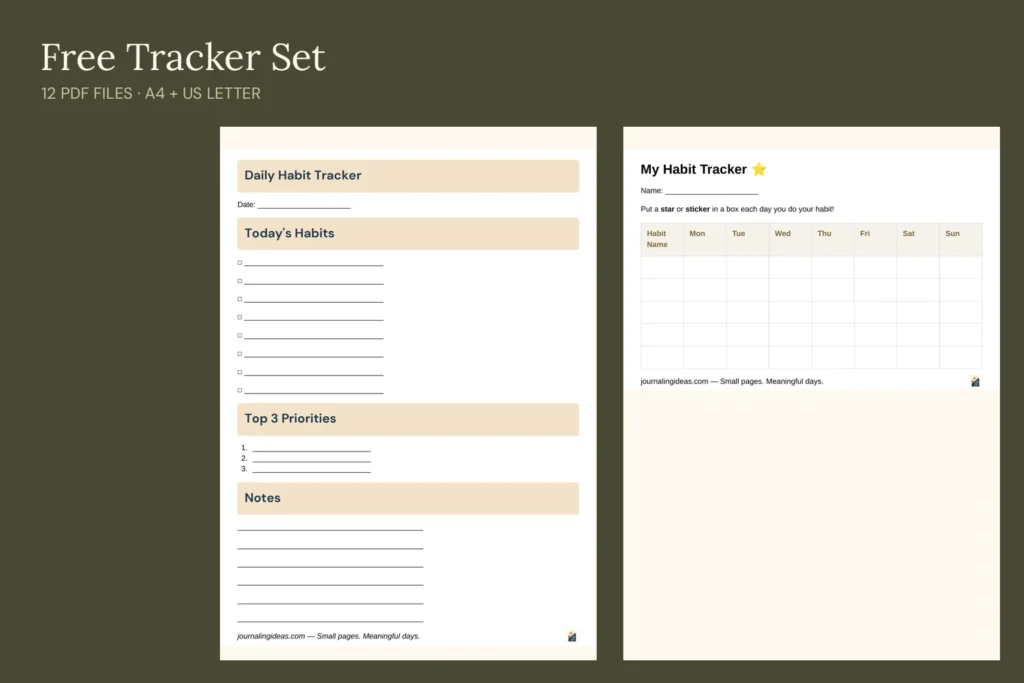
If you want a quick starting point, a weekly layout works well for the four-row example earlier in this guide. Write your activities down the left, add the days across the top, and decide what each check mark means. A monthly page may be more useful if you want a wider view of one or two habits. The daily layout can make room for more immediate notes; the kids’ and 30-day challenge options are there for readers who prefer those formats.
There is no need to use every page in the set. Choose a single layout, print one copy, and see whether it suits your routine. If you prefer to draw a tracker in a notebook, the printable can simply give you an idea for the columns and spacing.
For more help choosing and using these pages, visit the free habit tracker printable guide. You can also go directly to The Small Pages Library to explore the available printables.
A printer is helpful but not essential to begin tracking. A piece of lined paper, a notebook, or a basic digital note can hold the same kind of simple record. Use the format you already have.
Start Small, and Let Your Journal Grow With You
The easiest tracking journal to keep is one that asks only for information you actually want to notice. Pick a subject, make a small space for it, and record what happens without trying to make the page perfect.
Maybe you start by marking the days you read, noting whether an evening routine helped you wind down, or writing down small household tasks as you complete them. After a week, you might decide the tracker is useful exactly as it is. You might also realize that you would rather write about your days than count them. Both outcomes are fine.
If books are the part of life you want to explore more deeply, our reading journal guide offers another way to keep notes about what you read. And if you would rather capture the stories you remember on waking, the dream journal guide can help you make space for those memories. Neither requires turning your life into a collection of check boxes.
A tracking journal is allowed to be useful for a season and then quietly change shape. Keep what helps. Skip what doesn’t. Start again on any ordinary Tuesday, even if the last page is unfinished.
Small pages. Meaningful days.
Tracking Journal FAQs
What is a tracking journal used for?
A tracking journal is used to record small details over time, such as habits, routines, reading, spending, or everyday observations. Looking back at those entries can help you notice patterns and decide what you want to keep or change. You can track one thing or several, depending on what feels useful.
Is a tracking journal the same as a bullet journal?
No. A tracking journal focuses on recording information over time, while a bullet journal is a broader system that can include tasks, plans, notes, and collections. You can add tracking pages to a bullet journal, but you do not need a bullet journal to start tracking.
What should a beginner track first?
Start with one easy-to-describe activity or observation you are curious about, such as reading for 10 minutes or writing a journal sentence. Use a simple daily check mark or a few words, then look back after a week. Add more only if the first tracker feels helpful.
Do I need to fill in my tracking journal every day?
No. You can record information daily, a few times a week, or whenever it is relevant to your goal. If you miss a day, leave it unmarked rather than guessing what happened. Consistency can be useful, but a perfect streak is not required.
Can I make a tracking journal without buying a notebook?
Yes. You can draw a grid on scrap paper, use a notebook you already own, or make a simple note on your phone. Free printable tracker pages are another option if you have access to a printer. You do not need special supplies or decorative materials.
Where can I find free tracking journal printables?
You can browse the existing Free Tracker Set in The Small Pages Library. It includes monthly, weekly, daily, kids’, and 30-day challenge tracker types across six layouts, with A4 and US Letter PDFs. The library is open access, so you can choose the pages that fit your needs.
2 Comments