Reading Log Printable
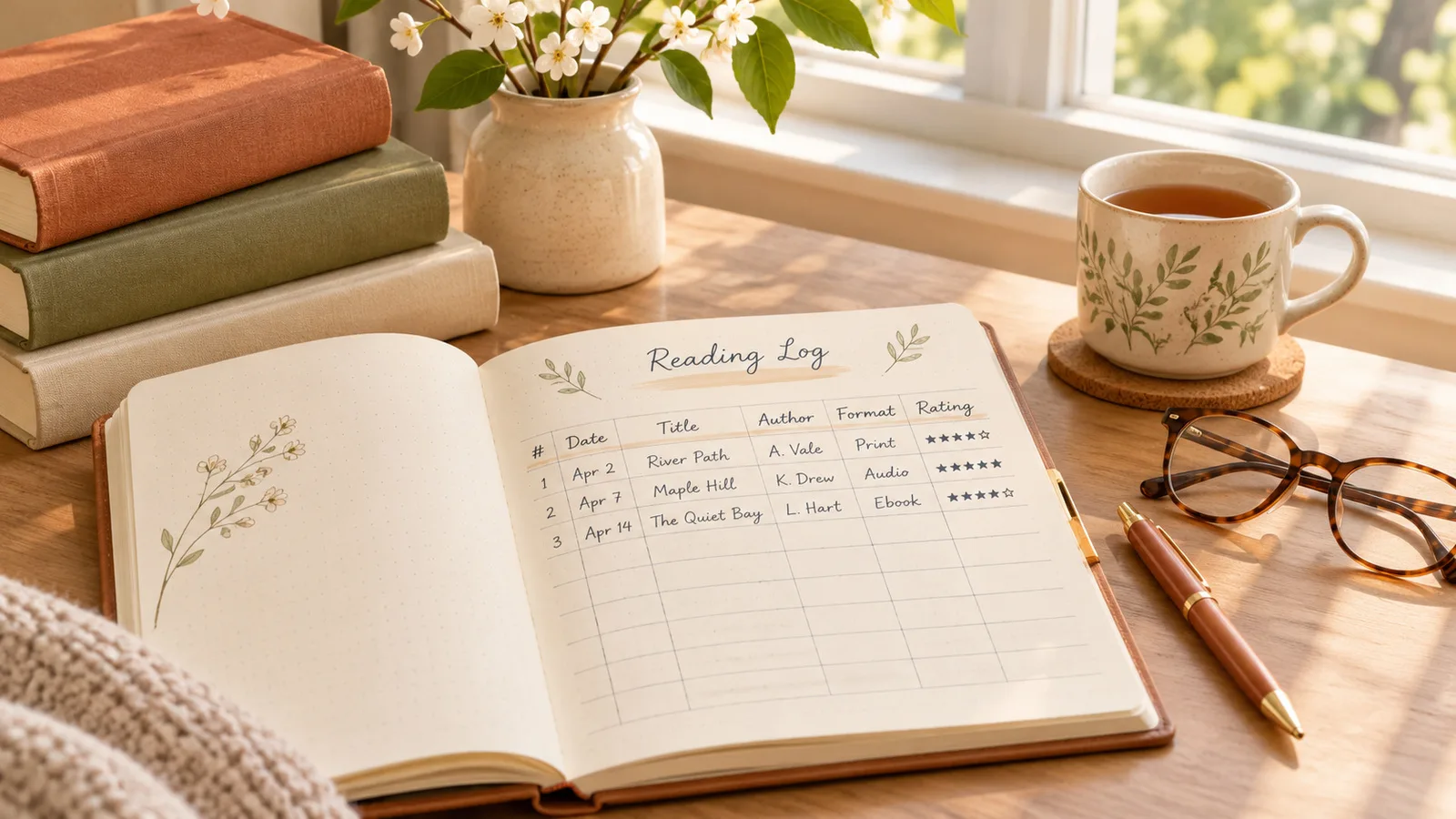
A reading log is a simple record of the books you finish, with one line for each book: the date, title, author, format, and your rating. This free reading log printable is designed for adult readers who keep a personal reading journal, not children completing school assignments or homework reading logs. It gives you one easy place to see everything you’ve read without searching through months of journal pages.
Think of your reading log as the index of your reading life.
A reading journal is the full notebook system where you collect your reading lists, thoughts, favorite passages, and reflections. A book review page gives one book the space it deserves for a deeper response.
Your reading log does something different. It keeps the essentials together, so you can look back at a whole season of reading in a few seconds.
And you don’t need to create a complicated tracking system to enjoy it.
Our free Reading Log Pack includes four printable sheets: a book log, a To Be Read list, a series tracker, and a lending record. Each comes in A4 and US Letter sizes, with no signup required.
Why Keep a Reading Log?
Reading is often about the moments we spend inside a story. A reading log helps us remember those moments later without turning a favorite hobby into another task.
Here are four reasons to keep one.
1. Remember the Books You’ve Read
Have you ever recognized a book cover but couldn’t remember whether you’d already read it?
A reading log gives you a quick answer.
Instead of trying to recall the title of a mystery you loved last spring or searching through old notes, you can scan your list and find it.
The date and rating might even remind you how you felt about the book.
You don’t have to remember every plot detail. Sometimes seeing a familiar title is enough to bring back the experience.
2. Notice Your Reading Patterns
A reading log becomes more interesting as it fills up.
You might discover that you finish more audiobooks during busy months, tend to give contemporary fiction higher ratings, or return to the same genre whenever you need something familiar.
Our printable includes a format column and a five-star rating column, making those patterns easy to spot.
For genre patterns, you can jot a small genre note beside a title or use the information from your individual review pages.
These details aren’t targets to improve. They’re simply little discoveries about the books you enjoy.
3. Stop Losing Track of Book Series
Starting a series is exciting. Remembering which installment comes next can be less exciting, especially if you read several series at once.
A separate series tracker keeps the book titles in order and gives you a checkbox for each one you’ve read.
You can return to an unfinished series months later and know where to begin.
No need to guess whether you’ve read book three or book four.
4. Make Choosing Your Next Book Easier
A To Be Read list is more useful when it contains more than just titles.
Recording why you want to read a book helps you remember what attracted you to it.
Was it recommended by a friend? Did the description sound comforting? Did you love another book by the author?
Add a priority, and the next time you finish a book, you already have a few possibilities waiting.
Your list can still change whenever your mood changes.
What’s Included in the Free Reading Log Pack?
The free Reading Log Pack contains four different printable sheets, each designed for one part of your reading life.
Every sheet comes in two sizes: US Letter (8.5 × 11 inches) and A4 (210 × 297 mm). That means four printable designs and eight PDF files altogether.
You can use the sheets individually or keep them together at the front of your reading journal.
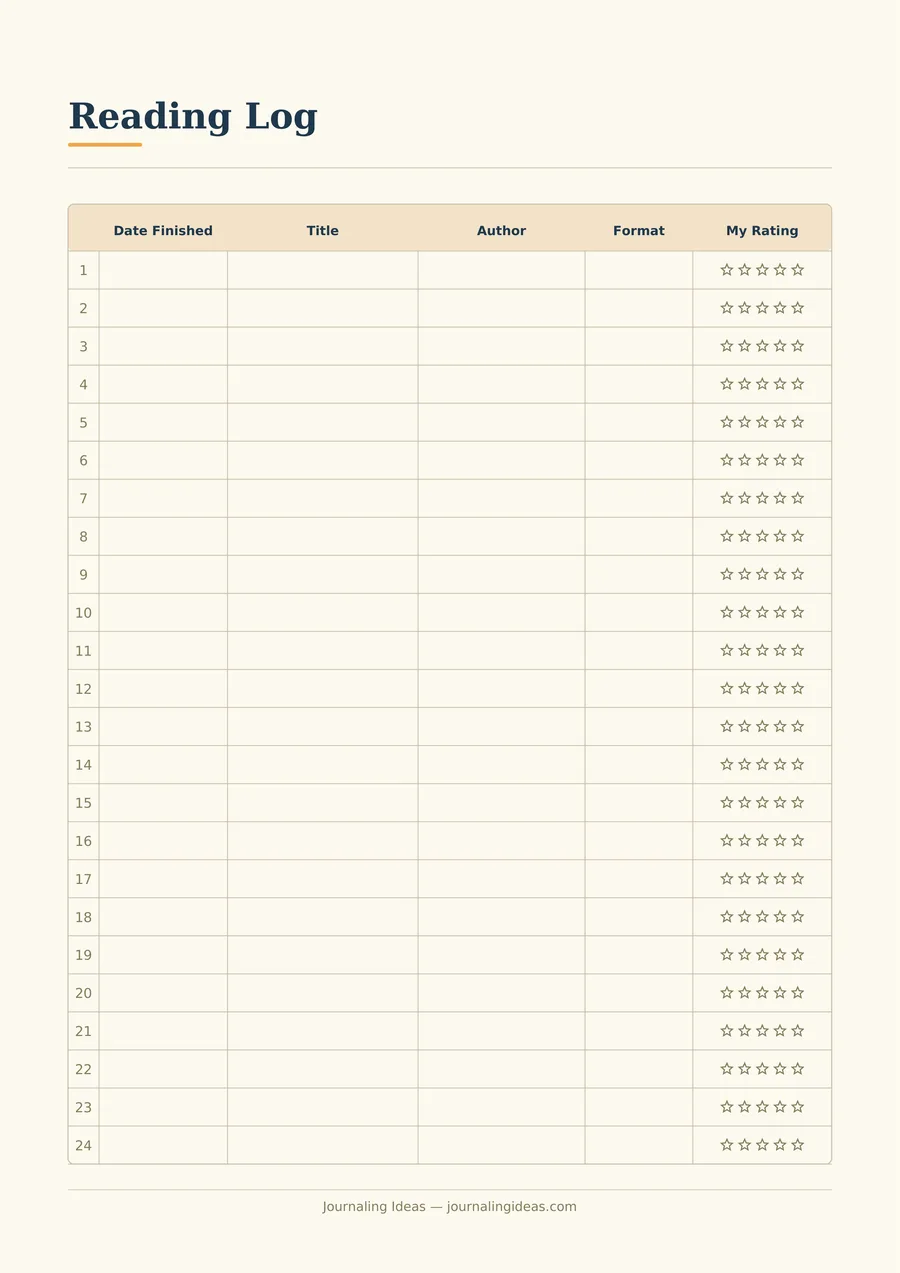
Sheet 1: Reading Log — 24 Books
The first sheet is the heart of the pack. It contains 24 numbered rows, with one row for each book you finish.
Every row has five fields: Date Finished (the day you completed the book), Title, Author, Format (print, ebook, or audio), and My Rating out of five stars.
That’s all you need for a quick record. When you finish a book, write down its information while it’s still fresh in your mind. You don’t need to summarize the plot or explain your rating. If a book was a three-star read, write three stars and move on. You can always return to your journal for a longer reflection.
The numbered rows also make it easy to see how many books you’ve completed on that sheet. If you finish more than 24 books, simply print another page and continue. There’s no need to fit a year’s reading into a single sheet.
Best for: Keeping a chronological record of finished books, comparing ratings, and looking back at your reading year.
Reading Log — A4 (PDF)
Reading Log — US Letter (PDF)
Sheet 2: To Be Read — 24 Books
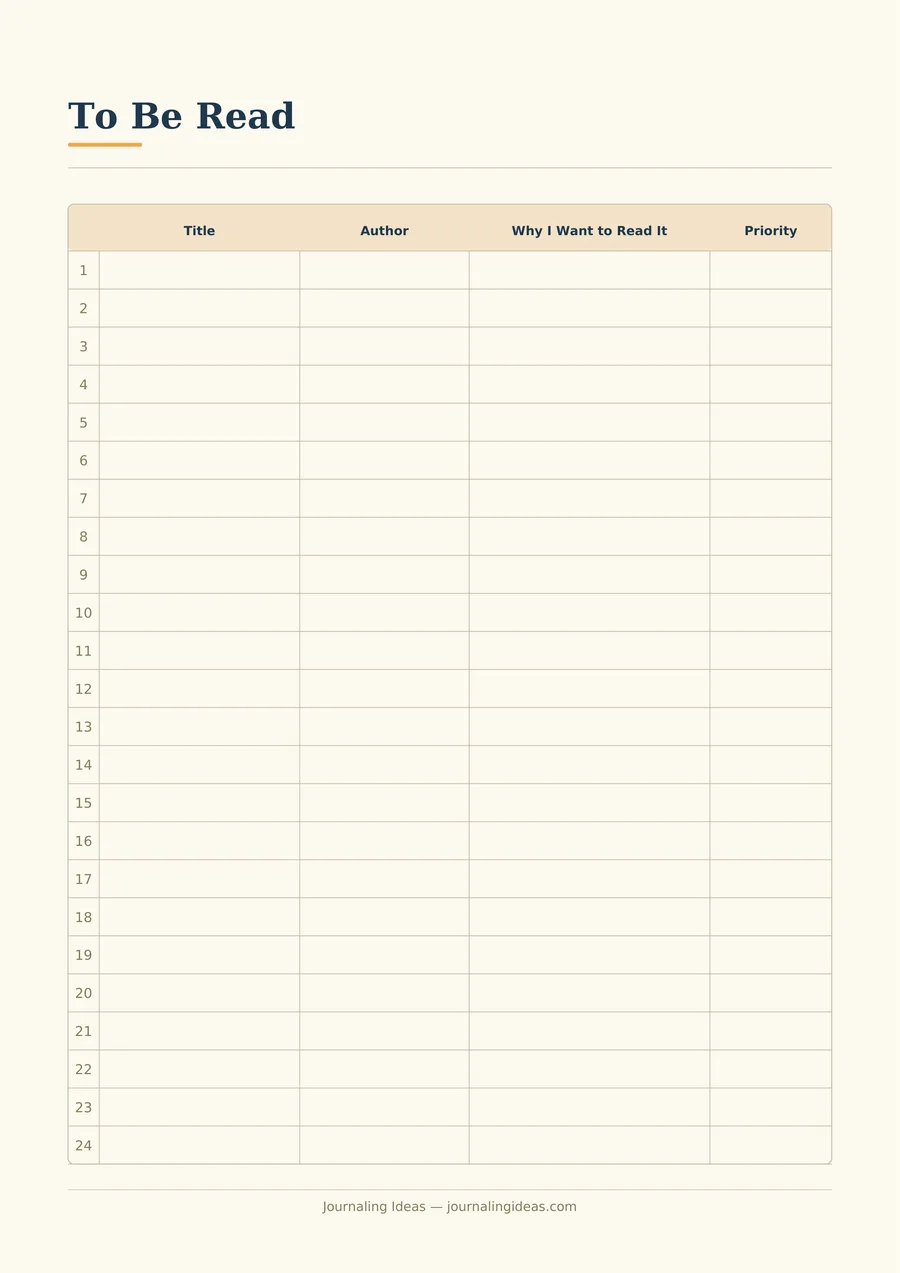
The second sheet is your To Be Read (TBR) list. It includes 24 numbered rows and four fields: Title, Author, Why I Want to Read It, and Priority (High, Medium, or Low).
This page is for books you’re interested in, whether they’re already on your shelves, sitting in your library holds, or still waiting on a wish list.
The most useful part is the reason column. A title alone might not mean much six months from now, but a quick reminder such as “recommended by my sister” or “short mystery for a rainy weekend” brings the original interest back.
Priorities help you narrow your choices. You might mark a book High because you want to read it soon, Medium because it sounds interesting, or Low because you’re curious but not in a hurry. These aren’t deadlines. A Low-priority book can become your next read overnight, and a High-priority book can wait until you’re in the right mood.
Best for: Remembering recommendations, reducing the time spent choosing a new book, and keeping your reading wish list manageable.
To Be Read — A4 (PDF)
To Be Read — US Letter (PDF)
Sheet 3: Series Tracker — Two Series
Some books are easier to track individually. Others belong to a larger story. The third printable helps with the second kind.
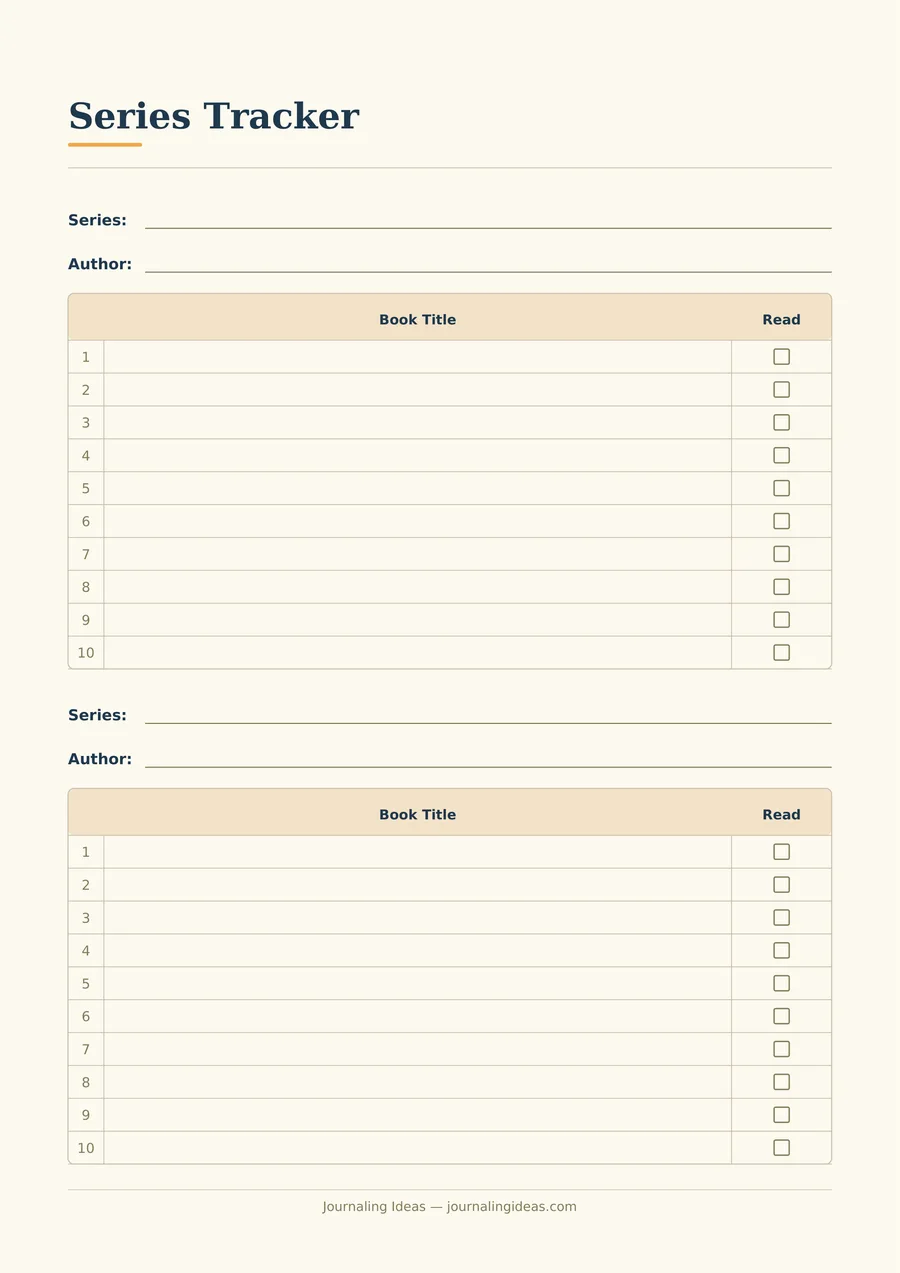
The Series Tracker contains two separate series blocks on one sheet. Each block includes a Series name line, an Author line, 10 numbered rows for Book Title, and a Read tick box beside every title.
You can track two series on a single page, with space for up to ten books in each series. Start by writing the series name and author. Then list the books in their proper reading order. As you finish each installment, tick its box. For a series still being published, you can leave later rows blank until new titles are announced. If a series has more than ten books, continue on another printed sheet.
This page works especially well for mystery series, fantasy collections, romance series, and any set of connected books you revisit over time. You don’t need to read the whole series in one stretch. The tracker simply remembers where you stopped.
Best for: Following reading order, keeping several series organized, and avoiding accidentally skipping an installment.
Series Tracker — A4 (PDF)
Series Tracker — US Letter (PDF)
Sheet 4: Lent & Borrowed — 12 Books
Books have a way of traveling between friends, family members, and neighbors. Sometimes a favorite paperback goes out on loan, and months later, neither person remembers who has it.
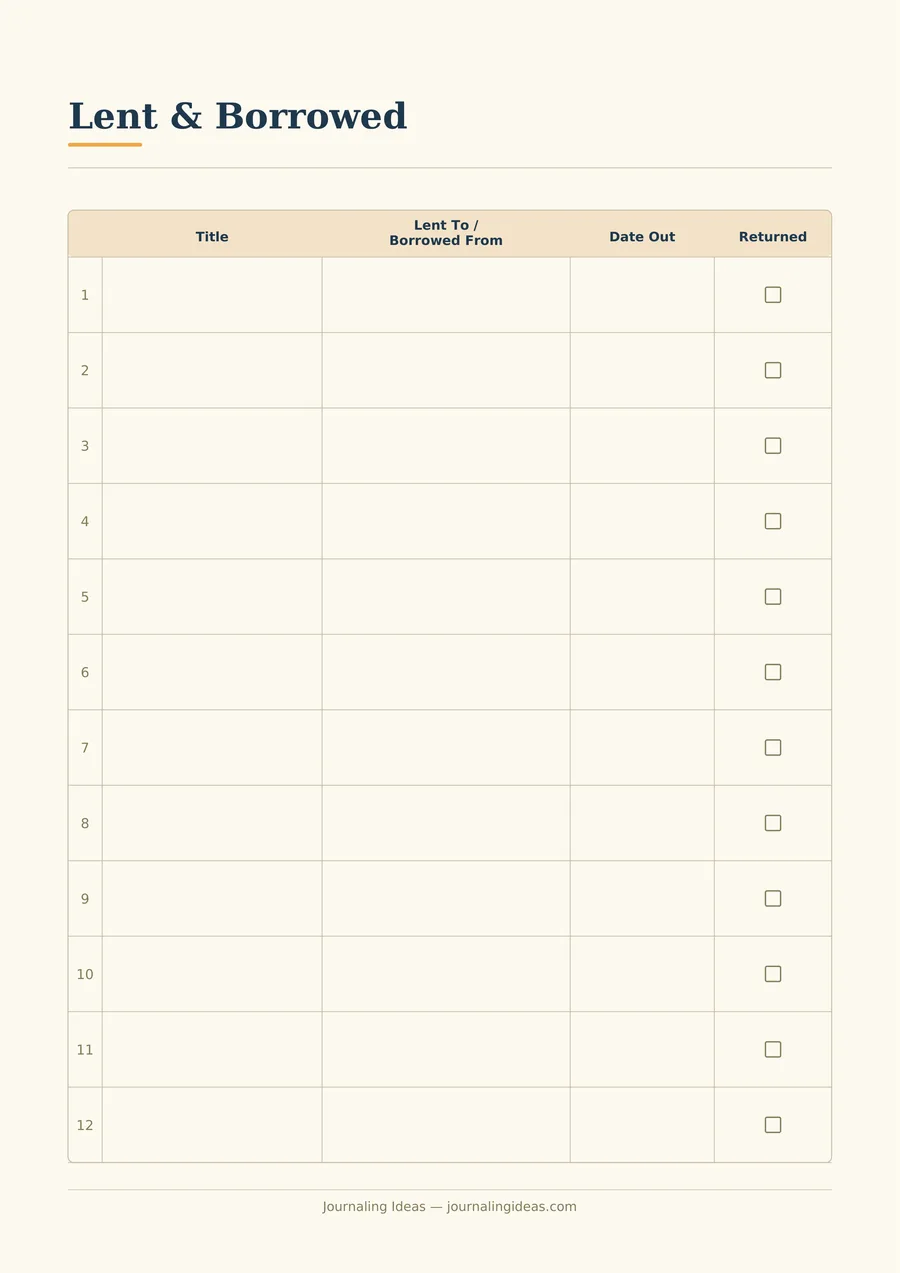
The fourth sheet is a small solution for that. The Lent & Borrowed printable has 12 rows, with these fields: Title, Lent To / Borrowed From, Date Out, and a Returned tick box.
Use it for books you’ve lent to someone else or borrowed from another person. Write the name in the shared column and keep the direction clear. For example, you could write “Lent to Maya” or “Borrowed from Alex.” Record the date the book changed hands and tick Returned when it comes back.
This is a personal lending record, not a library checkout system. It simply saves you from having to remember every exchange. If you borrow books from your public library, you can use this sheet for those too, though it doesn’t replace the library’s official due-date reminders.
Best for: Keeping track of shared books, remembering borrowed titles, and making sure favorite copies find their way home.
Lent & Borrowed — A4 (PDF)
Lent & Borrowed — US Letter (PDF)
How to Keep a Reading Log That Actually Lasts
The best reading log is the one you can maintain without thinking too much about it. A beautiful system that takes twenty minutes after every book may become another unfinished journal project. A simple one-line habit is much easier to return to.
Follow the Two-Minute Rule
When you finish a book, take two minutes to record it. Open your Reading Log sheet and fill in the next available row. Add the date, title, author, format, and rating. Done.
If you’re not ready to decide on a rating, leave that field blank and return to it later. You don’t need to review every character, analyze the ending, or write a paragraph about what the book meant to you. Those thoughts can live elsewhere in your journal. The log only needs to answer one question: What have I read?
Keep Your Log at the Front of Your Reading Journal
Place your printed reading log near the beginning of your notebook or binder. This makes it easy to find whenever you finish a book.
A useful order is: Reading Log, To Be Read, Series Tracker, Lent & Borrowed, then your individual reading journal and review pages.
You can attach the sheets with removable tape, keep them in a clear folder, or place them behind a tab in a binder.
If you enjoy writing longer reviews, our free book review template gives you a dedicated page for recording what stood out about an individual book. The short log and longer review complement each other without repeating the same work.
Print a Fresh Reading Log Each Year
Starting a new sheet at the beginning of the year makes it easier to look back at your reading history. Write the year in a blank margin or on a small tab. Then use one row for each finished book.
If you fill all 24 rows before December, print another copy and label it as a continuation. At the end of the year, keep the completed sheets together. Over time, you’ll build a simple archive of the books you’ve read, even if you change notebooks or journaling styles.
You can start halfway through the year, too. There’s no reason to reconstruct months of reading unless you genuinely want to.
Don’t Turn Your Log Into a Reading Competition
Your reading log is a record, not a scorecard. Some months you might finish several novels. Other months you might spend weeks with one long book. Both belong in your reading life.
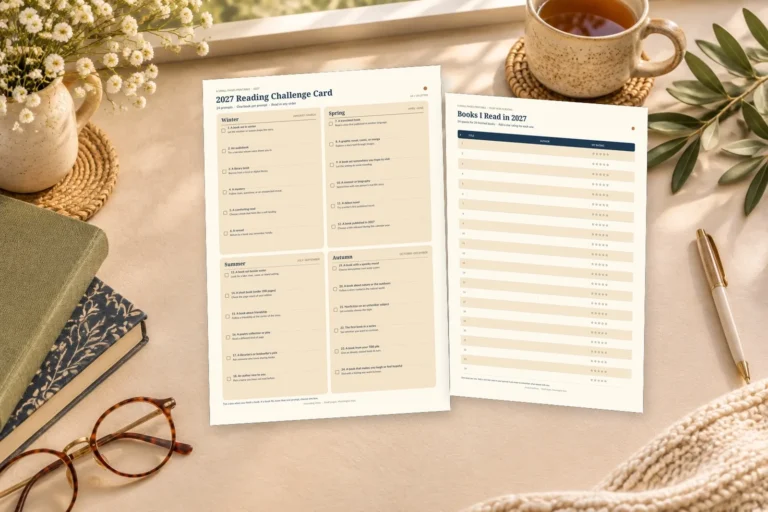
You don’t need to fill a certain number of rows or maintain a particular monthly average. If you enjoy setting a personal reading goal, our 2027 reading challenge offers another way to explore books with a little more structure. But the log itself works perfectly well without any goal at all.
What Does a Filled-In Reading Log Look Like?
Here’s a small example showing how five completed books could appear on the Reading Log sheet. All five book titles and author names below are invented for demonstration.
| Date Finished | Title | Author | Format | My Rating |
|---|---|---|---|---|
| Sep 2, 2026 | The Lanterns of Briar Cove | Elara Fenwicke | Audio | 4/5 |
| Sep 6, 2026 | A Spoonful of Starlight | Mira Vosslyn | Audio | 5/5 |
| Sep 11, 2026 | Moss Between the Pages | Talia Renswick | 3/5 | |
| Sep 18, 2026 | The Clockmaker’s Garden Path | Selene Hartrow | Audio | 4/5 |
| Sep 26, 2026 | When the Rain Turned Amber | Junia Pellmont | Audio | 5/5 |
What does this example tell us? Four of the five books were audiobooks, and the highest ratings went to audio reads, suggesting that listening was an especially enjoyable format that September.
That’s the kind of small observation a reading log makes possible. You didn’t need extra charts or complicated calculations. The pattern appeared naturally as the rows filled up. You can make similar observations at the end of a month, season, or year.
How to Use Your Reading Log With a Book Club
A reading log can also be helpful when you’re part of a book club. Record your club’s monthly selection when you finish it, then use your individual journal pages for discussion questions, favorite passages, and opinions. Your log will become a chronological record of the books your group has read together.
You can also add upcoming club selections to your To Be Read sheet and mark them High priority when the meeting is approaching.
For a dedicated space to collect discussion notes and shared reading experiences, see our book club journal.
You don’t have to merge every reading activity into one page. Let the log handle the recordkeeping and your other pages hold the conversations.
A Few Small Mistakes to Avoid
A reading log should make your reading life easier, not create more work.
One common mistake is adding too much information to every entry. If you find yourself wanting to record the plot, favorite quotes, character names, and personal reflections, give those thoughts their own page instead.
Another is waiting until the end of the month to fill everything in. It’s easy to forget exact finishing dates or ratings when several books pile up. Writing one line immediately after finishing is usually simpler.
Finally, don’t worry about a perfectly accurate record of every book you’ve ever read. You can begin with the next book you finish. If you miss a few entries, add what you remember and leave the rest. A messy log still counts.
Where Can You Get the Free Reading Log Printable?
The four-sheet Reading Log Pack is available through The Small Pages Library. The pack includes the Reading Log (24 numbered book entries), the To Be Read list (24 numbered TBR entries), the Series Tracker (two series, ten book entries each), and Lent & Borrowed (12 lending entries). Each sheet is provided in A4 and US Letter, for eight PDF files in total.
The pack is free, with no email signup or password needed. Choose the paper size that matches your printer, download the sheets you want, and print them at actual size or 100% scale when your printer supports it.
Ordinary printer paper is fine. If you prefer a sturdier page for a binder you’ll use throughout the year, slightly heavier paper is an option. You don’t need to print every sheet immediately. Start with the Reading Log and add the others when they’re useful.
Frequently Asked Questions About Reading Logs
Is a reading log the same as a reading journal?
No. A reading log is a short list of books you’ve read, usually with dates, authors, formats, and ratings. A reading journal is the larger notebook where you can also keep reviews, quotes, reflections, and reading plans. The log can be one section of your journal.
How many books fit on one sheet?
The Reading Log sheet has 24 numbered rows, so it holds 24 book entries. The To Be Read sheet also holds 24 titles. The Series Tracker holds two series with ten book rows each, and the Lent & Borrowed sheet holds 12 entries.
Should I log books I did not finish?
Yes, if you want to remember them. Write DNF (Did Not Finish) in the rating column instead of giving a star rating. You can use the date you stopped reading in the Date Finished field. This keeps the book on record without counting it as a completed read.
Can I use the log for audiobooks?
Yes. The Format column includes print, ebook, and audio. Record the audiobook’s title, author, finishing date, and rating just as you would for a printed book. Audiobooks belong in your reading record too.
What paper size should I print?
Choose US Letter (8.5 × 11 inches) for standard US printer paper or A4 (210 × 297 mm) for A4 paper commonly used in the UK. Both versions contain the same fields and number of rows.
Is the pack free with no signup?
Yes. The Reading Log Pack is completely free, and no email signup or password is required. You can access the printable PDFs through The Small Pages Library and choose the sheets and sizes you need.
Start With Your Next Finished Book
You don’t need a carefully planned reading journal or a collection of fancy stationery to start keeping a book log. Print the Reading Log sheet, place it somewhere easy to reach, and write down the next book you finish.
As your list grows, add the To Be Read page, a series tracker, or the lending record whenever you need them.
One line becomes a month of reading. A few sheets become a little history of the stories that stayed with you.
Small pages. Meaningful days.
— Editorial Team