

Book Review Template for Your Reading Journal (With a Free Printable Pack)
A book review template is a set of simple questions and spaces that helps you record what you thought and felt about a book. In a reading journal, it gives you a place to keep the details, a favorite moment, and the parts you want to remember long after you finish reading.
A private journal review is different from a public review. You do not have to persuade anyone to read the book, explain every plot point, or avoid spoilers. You can be honest about what worked, what did not, and how you felt at the time. The page is written for future-you, not for an audience.
What Is a Book Review Template?
A book review template is a repeatable page you can use whenever you finish a book. Instead of staring at a blank notebook and wondering what to write, you have a few prompts to guide you. You can note the basic details, give the book a rating, and save the parts that made the reading experience memorable.
A personal reading-journal review is not a school assignment, and you do not need literary terms. It is a record of your experience: what the book was like, how it affected you, and whether you would recommend it.
A few specific details can bring a book back more clearly than a page of general praise: a character you still think about, a scene you remember, or a sentence you copied into the margin. The same page works for novels, memoirs, poetry, nonfiction, and audiobooks. Skip any question that does not fit. The template is there to help you remember, not to give you another task to complete perfectly.
What Should a Book Review Include?
A useful reading-journal review balances quick facts with a little reflection. The full review page in this pack brings together these parts:
Book details: Record the title and author, along with any other detail that will help you identify the book later. You might add the format or the date you finished it.
Overall star rating: Choose the rating that best matches your experience. It is a quick way to scan your reading year, but it is only the beginning of the review.
Three small scales — Story, Characters, Writing: Mark each one separately. This helps you remember what you responded to. You might have loved the characters even if the plot felt slow, or enjoyed the writing more than the story itself.
In One Sentence: Describe the book in your own words, without trying to make the sentence sound like a published blurb. This is the short description you will want when you look back through your journal.
Favorite Quote: Copy a line that stayed with you, or write down the moment you wish you could revisit. If you are using an audiobook, note the words as accurately as you can and add a chapter or timestamp if helpful.
What I’ll Remember: Save a detail that might otherwise fade: a scene, a question, a feeling, a setting, or something the book made you notice.
Who I’d Recommend It To: Think of the kind of reader who might enjoy it. You can describe a mood or interest rather than naming a particular person.
Would I Read It Again — and why: Record whether you would return to the book and what might make you pick it up again.
Why include more than one rating? An overall score compresses a whole reading experience into one small mark. Months later, a four-star rating may tell you that you liked a book, but it will not explain whether you loved the characters, found the story uneven, or admired the writing. Two books can receive the same number of stars for completely different reasons.
The smaller scales help you keep those differences. They are not a test of the book or your taste; they simply make your notes more useful. If you cannot decide on a rating, leave it blank and write a sentence instead.
12 Questions to Answer in Any Book Review
Use these questions as a gentle guide after you finish a book. You do not have to write a paragraph for every one; a sentence or two is enough.
- If you had to describe this book in one honest sentence, what would you say?
- What made you choose this book, and did it turn out to be what you expected?
- How did it feel to read this book from beginning to end?
- Did your feelings about the book change as you read, and at what point?
- Which moment, scene, idea, or quote would you most like to keep, and why?
- What did this book leave you thinking about after you closed it?
- Was there anything you struggled with, skipped over, or wished had been different?
- Which character, person, or idea did you connect with most, and what drew you to it?
- What small detail about this book would you like to remember months from now?
- Who do you think would enjoy this book, and why would it suit them?
- What, if anything, do you want to carry from this book into your everyday life?
- Would you read this book again, and what might bring you back to it?
Answer in order or begin with the question that brings a thought to mind. Some books leave you with a vivid image or one useful idea rather than a lot to say. Both are worth recording. If you are short on time, choose three questions and come back later if you want.
A Filled-In Example
Here is a short example using a made-up book, The Lighthouse Keeper’s Daughter. The details and favorite line are invented for illustration.
In one sentence: A young woman returns to the island where her father kept a lighthouse and discovers how much of her family story she never knew.
Overall rating: ★★★★☆ — 4 stars.
Story / Characters / Writing: A steady, atmospheric story; the daughter felt believable; the writing was quiet and vivid.
Favorite quote: “Even the smallest light can help someone find the shore.”
What I’ll remember: The storm scene, the empty kitchen, and the way the island seemed to hold its own memories.
Who I’d recommend it to: Readers who enjoy gentle family stories, coastal settings, and secrets that unfold slowly.
Would I read it again? Yes. I would like to return to the island and notice the early clues now that I know the ending.
Your review can be shorter or more personal. Use a few words in the scales, write more under the quote, or leave a section empty. This example is a starting point, not a standard to match.
How to Use the Book Review Pack
The free Book Review Pack includes four sheets for different reading habits. Each sheet is available in A4 and US Letter, so you can choose the paper size that fits your printer. The pack is free, with no signup required, and is available from The Small Pages Library on journalingideas.com.
Sheet 1: Full Book Review
Use this page when you want to give one book more space. It includes book details, an overall star rating, the Story, Characters, and Writing scales, plus In One Sentence, Favorite Quote, What I’ll Remember, Who I’d Recommend It To, and Would I Read It Again. Fill in the sections that matter to you after finishing, or add a note the next day.

Download — A4 | Download — US Letter
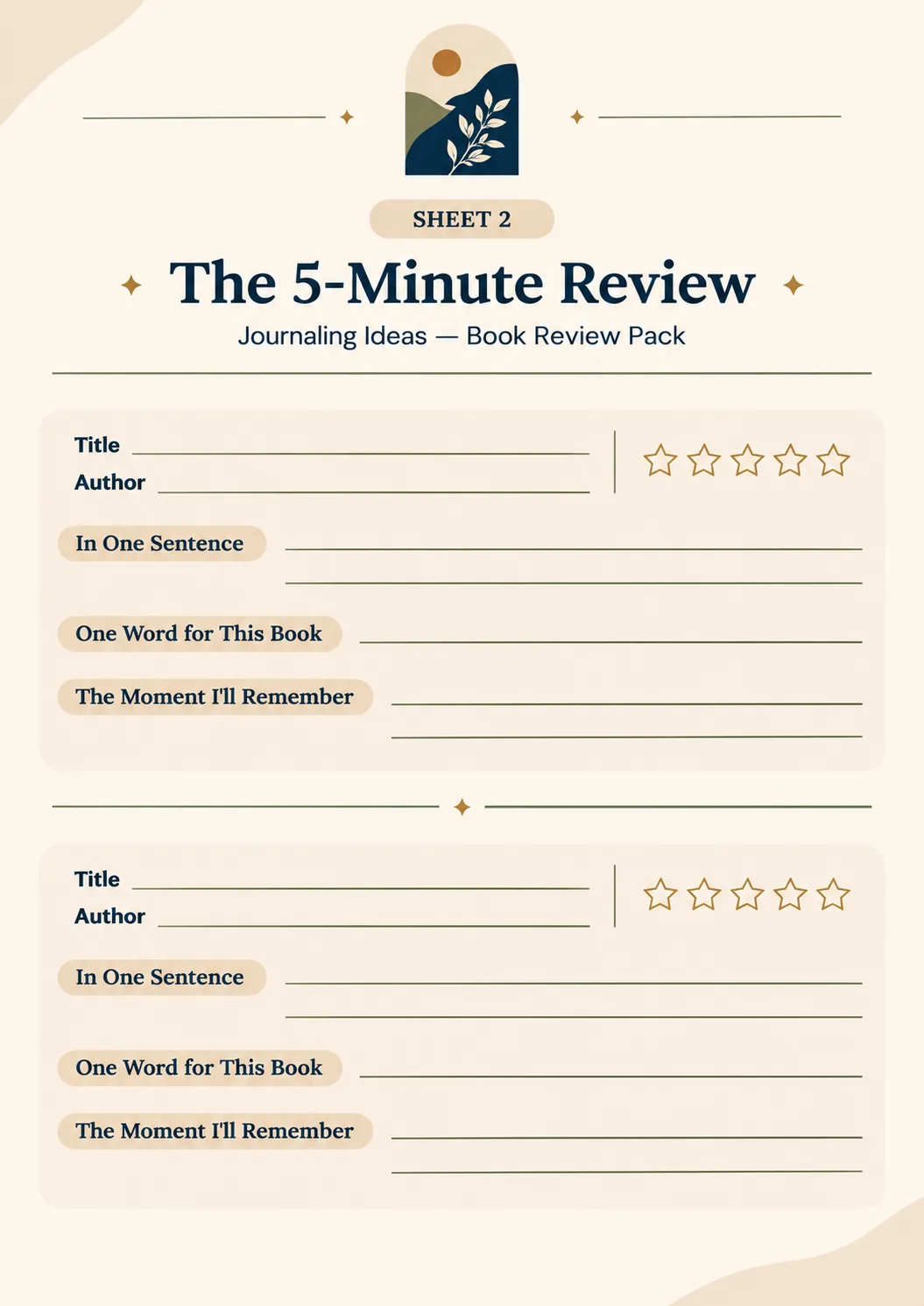
Sheet 2: The 5-Minute Review
For busy weeks, this sheet has two compact reviews on one page. Add the essential details, a quick rating, and one thought you want to keep. It is a simple way to record two books without writing a full page for each.
Download — A4 | Download — US Letter
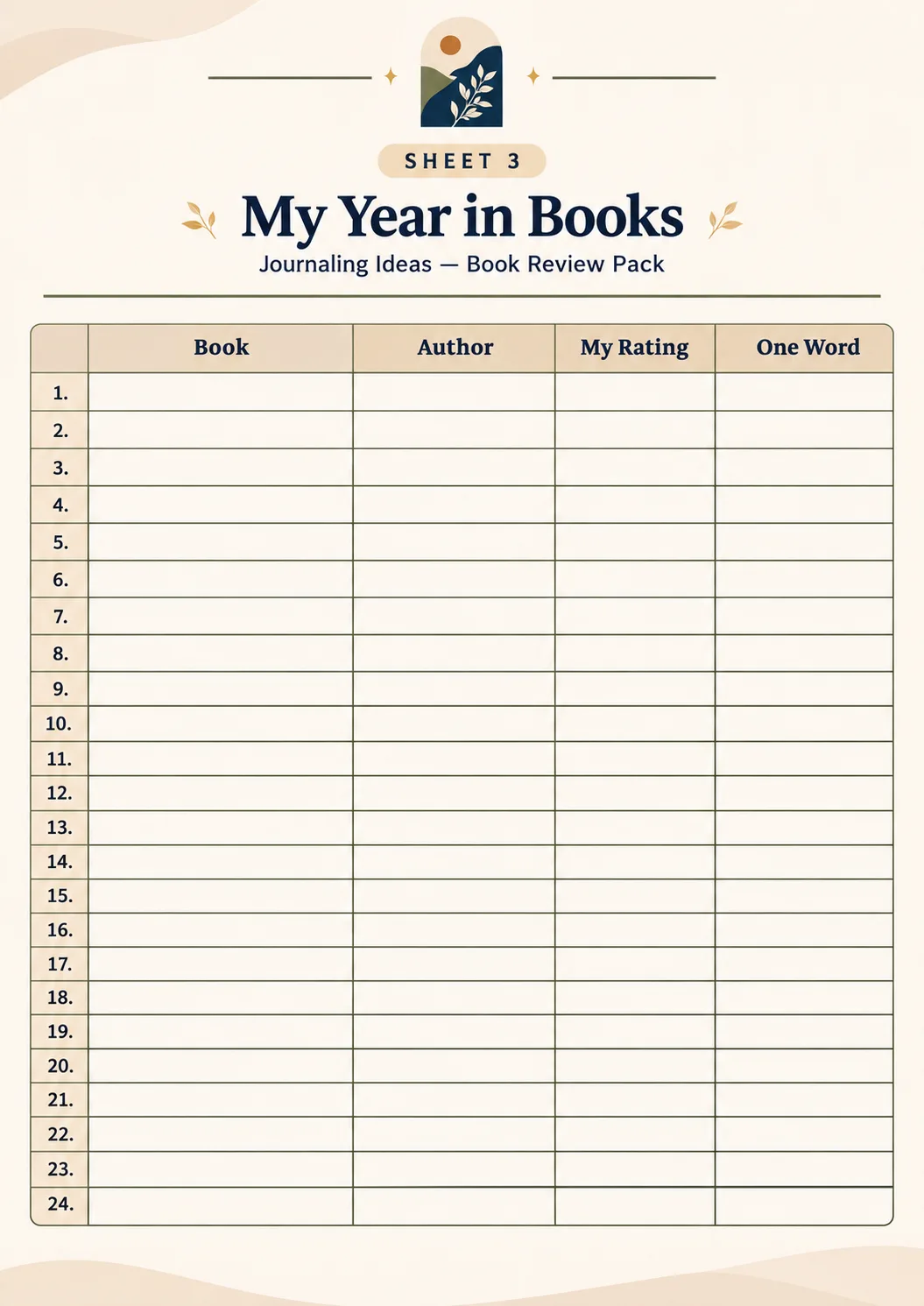
Sheet 3: My Year in Books
This year-at-a-glance ratings grid has 24 rows. For each book, record the book, author, my rating, and one word. A note such as “comforting,” “strange,” “hopeful,” or “slow” becomes a small memory cue when you scan your reading year.
Download — A4 | Download — US Letter
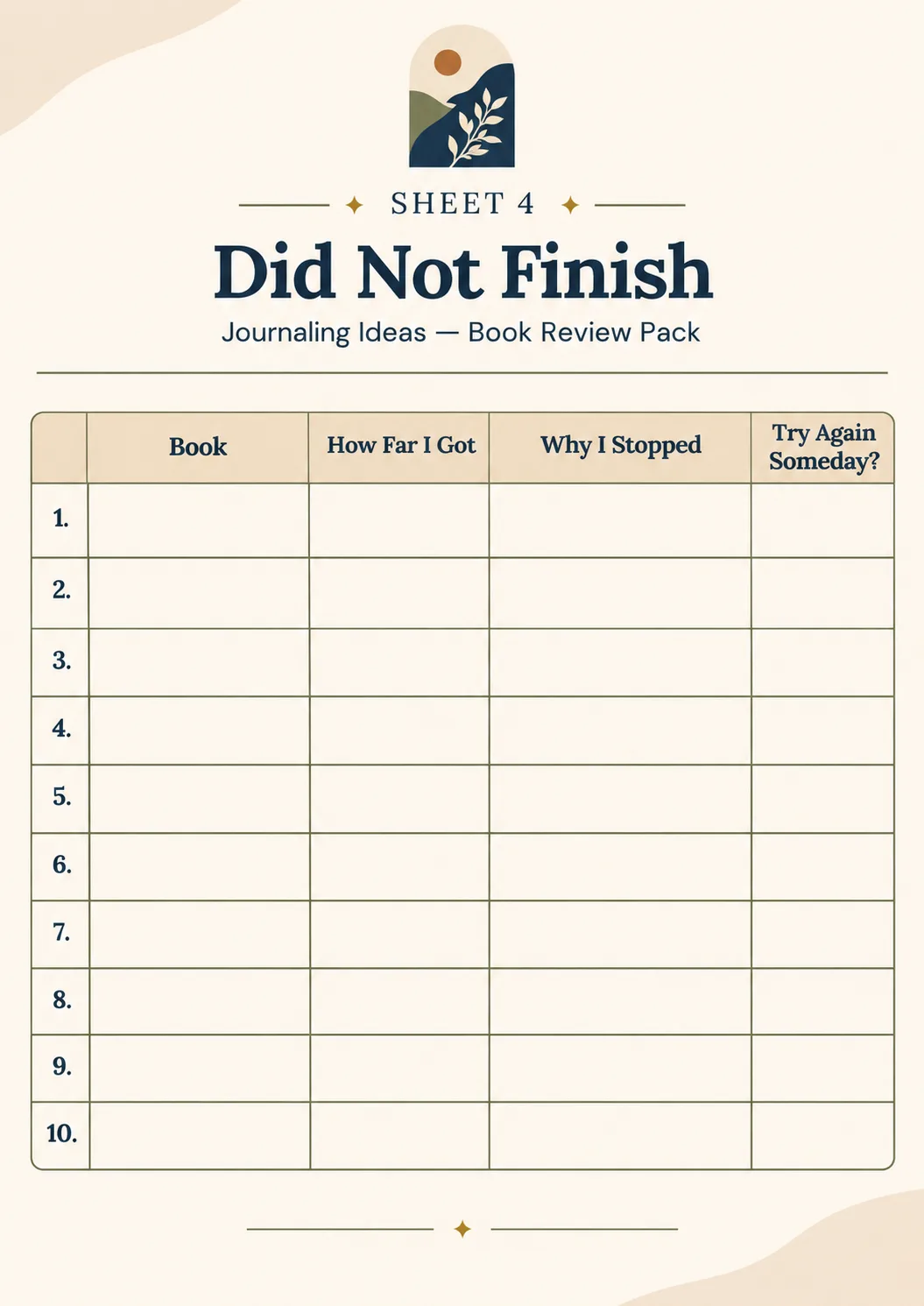
Sheet 4: Did Not Finish
A book you stop reading can still belong in your journal. Note the book, how far you got, why you stopped, and “Try again someday?” Perhaps the timing was wrong, the style did not suit you, or you lost interest. Recording the reason helps you decide whether you might return to it.
Download — A4 | Download — US Letter
Choose the sheet that matches the moment: a full page for a book you want to explore, a compact review when time is short, the year grid for an overview, or the Did Not Finish page when you stop before the last chapter. You do not need every sheet for every book.
Book Review vs Reading Log: Which Do You Need?
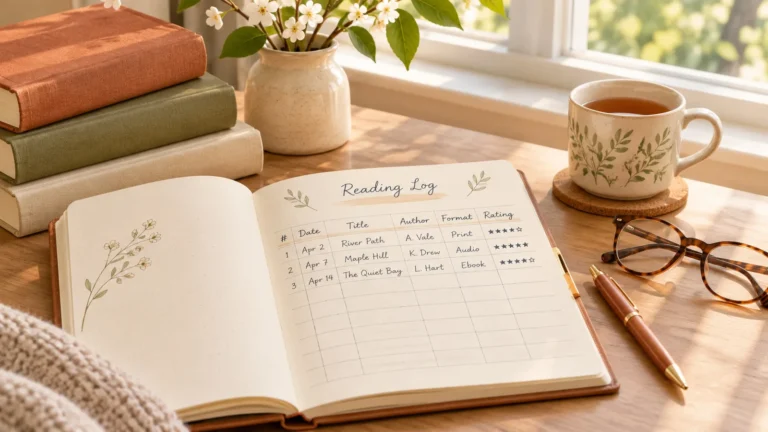
A reading log remembers every book in one list. It is useful for recording titles, authors, dates, page counts, or quick ratings so you can see what you have read across a month or year.
A book review page gives one book room to be remembered properly: what you thought of it, which detail stayed with you, who might enjoy it, and whether you would read it again. It is less about keeping a count and more about keeping the experience.
Most readers can use both. Add each finished book to your log, then write a fuller review for the titles you want to remember in more detail. For a place to keep your reading records and related pages together, see our Reading Journal guide.
Frequently Asked Questions About Book Review Templates
How do you write a simple book review?
Write the title and author, then one honest sentence about the book. Add a rating, a moment or quote you want to remember, and who might enjoy it. You do not need to summarize the whole plot.
What is the difference between a book review and a book report?
A book report usually explains a book’s main events, characters, or ideas to show understanding. A personal review records your response: spoilers and dislikes are welcome, and you can focus on what mattered to you.
How long should a journal book review be?
As long as it needs to be. Three or four sentences may be enough, while a book that moved you may deserve a full page. Record one specific detail rather than aiming for a word count.
Should I review books I did not finish?
Yes, if you want to remember why you stopped. Note how far you got and what made you put it aside. It may not be for you, or it may simply be the wrong book for this moment. Neither choice needs an apology.
What do I do if I have nothing to say about a book?
Keep it small: write one sentence, choose a rating, or name one thing you remember. You can even note that the book left little impression. An honest short entry is better than forcing a long review.
Can I use this template for nonfiction and audiobooks?
Yes. For nonfiction, note the most useful idea, what you questioned, or what you might put into practice. For an audiobook, record the narrator if it shaped your experience and add a chapter or timestamp beside a favorite passage.
The Review Is a Letter to Future You
When you look back months or years later, a review can remind you not only of the book but of the version of yourself who read it: what you were curious about, what made you pause, and what you needed from a story then.
If you read with a group, our Book Club Journal offers a place for shared notes and conversation. If you are choosing what to read next or keeping a gentle goal for the year, explore the 2027 Reading Challenge.
You do not have to fill every box. Keep the line that mattered, the thought you want to remember, or the reason you would pass the book to a friend. Small pages. Meaningful days.
— Editorial Team

One Comment