
Christmas Planner Printable: Gift Lists, Budget Tracker and Holiday Checklists
Christmas planning can feel like a dozen small lists scattered across your phone, shopping bags, and kitchen counter. This free Christmas planner printable brings the essentials together: who you are buying for, what you are spending, and what needs doing before the holiday.
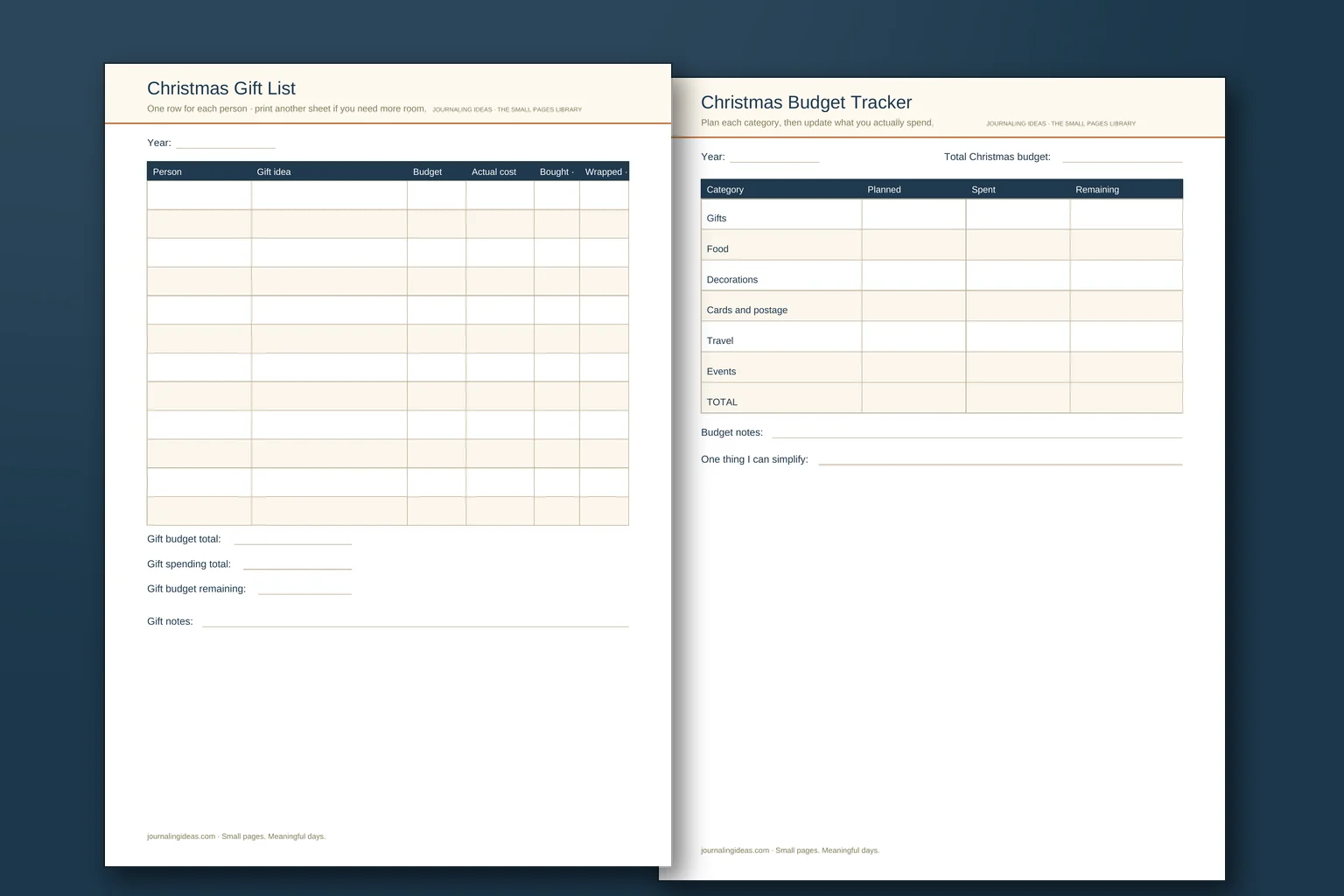
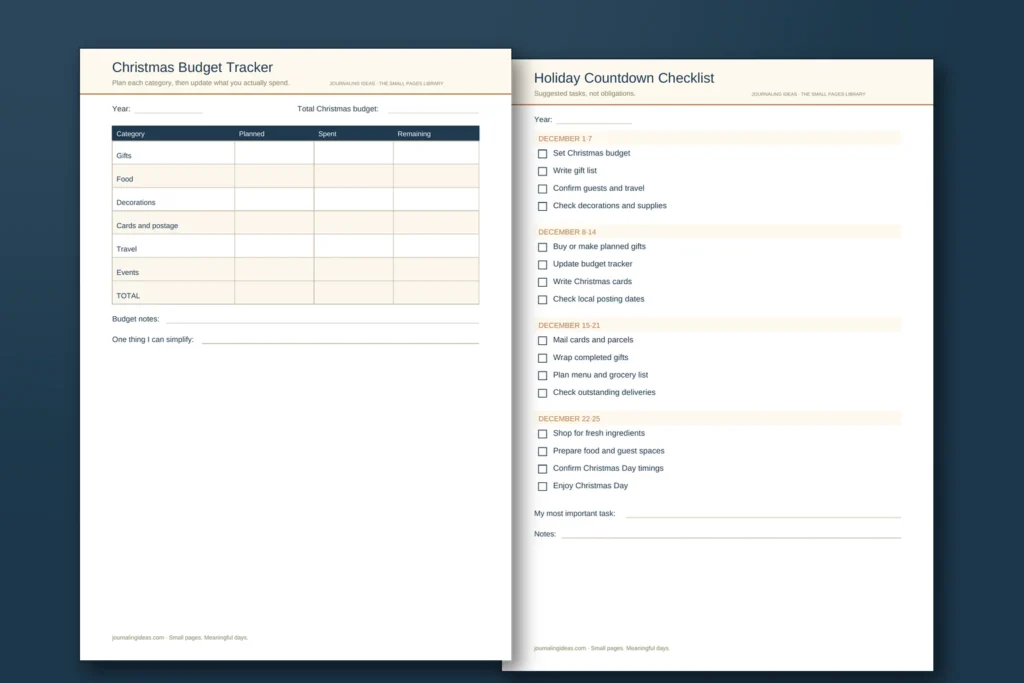
The Christmas Planner Pack contains three sheets in A4 and US Letter: a Christmas Gift List, a Christmas Budget Tracker, and a Holiday Countdown Checklist. That is six free PDF files, with no signup or password required. Use the pages you need, skip the rest, and make the season your own.
If you are planning from the USA, UK, Canada, or Australia, the same pages work with your local currency and paper size. Below, you will find practical examples, a flexible December timeline, and an exact look at what is included in the printable pack.
What is a Christmas planner printable, and what should it include?
A Christmas planner printable is a set of paper worksheets that keeps your holiday decisions in one place. A useful starter pack needs a gift list, a spending tracker, and a countdown checklist. Together, those pages help you remember who you are shopping for, what you can afford, and what still needs doing before Christmas Day.
You do not need a thick binder, expensive stationery, or an elaborate December routine. Three pages can cover the decisions that cause the most last-minute confusion. The gift list holds names and present ideas. The budget page shows what you planned to spend and what you actually spent. The countdown page gives small tasks a place to live outside your head.
Start by printing one copy of each page. Write the year at the top, then add what you already know. Perhaps your family has agreed to a gift exchange. Perhaps you are traveling, hosting lunch, or keeping Christmas quiet at home. Your planner should reflect your plans rather than an imaginary perfect holiday.
A Christmas planner is especially helpful when different tasks happen at different times. A gift might be ordered in November, arrive in December, and need wrapping days later. A card may be written but not mailed. A food item may be on the menu but not on the shopping list. A single checkmark cannot describe all of those steps, which is why separate fields matter.
You can keep the sheets on a clipboard, in a folder, or tucked inside a notebook. If you enjoy a broader paper planning routine, the 2027 Journal Ecosystem guide explains how different notebooks and planning pages can work together without duplicating everything.
A simple way to begin: Fill in the total Christmas budget, list the people you plan to give gifts to, and circle the first countdown task. Leave the rest blank until you need it. An incomplete planner that you use is more helpful than a beautiful one you avoid.
How do I organize a Christmas gift list by person?
Organize a Christmas gift list with one row per recipient and separate spaces for the gift idea, spending limit, actual cost, and whether it has been bought and wrapped. Grouping gifts by person helps prevent duplicates and makes it easier to spot unfinished shopping. Keep the list somewhere private if recipients might see it.

Begin with the people you genuinely intend to shop for. That might include immediate family, a partner, friends, a teacher, or someone in a gift exchange. Do not add names simply because you feel you should. If a group has agreed not to exchange gifts, respect that choice and remove the expense from your plan.
Next, write one realistic idea beside each name. A book, homemade treat, shared experience, useful household item, or thoughtful letter can all count. You can also write “ask for ideas” rather than buying something random. The list is a place to think, not a promise to purchase every idea.
Set a limit for each person before shopping. A limit is not a target you must reach. Spending less than planned is perfectly fine. If you are sharing a present with siblings or friends, record only your contribution in the cost column so the totals stay meaningful.
Use the Bought checkbox only after you have actually purchased or finished making the gift. Use Wrapped after the gift is ready to give. Those two separate marks are useful because something can be bought but still need batteries, a gift bag, or a label.
For online orders, keep order numbers and delivery information in your usual email or shopping account rather than squeezing sensitive details onto the printable. You can pencil a small reminder next to the gift idea, such as “arriving soon,” then erase it once the package is safely at home.
If you have more recipients than the rows allow, print another gift-list sheet. If one person will receive several gifts, use additional rows for that person and check the combined cost against their limit. This is easier than writing tiny notes in a margin.
Example: Your list could say “Aunt Maya | cookbook | limit 25 | spent 19 | bought ✓ | wrapped □.” The figures are only an illustration; use your own currency and amounts. For UK readers, that might mean pounds; for US readers, dollars; and similarly for Canadian and Australian dollars.
Keep your gift list flexible. If someone mentions they would rather spend time together than exchange presents, change the plan. The best list supports thoughtful choices without turning kindness into a competition.
How do I plan Christmas gifts without overspending?
To plan Christmas gifts without overspending, choose your total gift allowance first, divide it among recipients, and record each purchase immediately. Include small extras such as wrapping, shipping, and stocking fillers in the overall Christmas budget. If one gift costs more than expected, reduce another planned expense rather than quietly increasing the total.
Before browsing stores, decide what you can comfortably spend after essentials and regular bills. Christmas spending should not depend on money you need for rent, groceries, debt payments, or next month’s necessities. If the available amount is small, a smaller celebration is a valid choice.
Write each recipient’s spending limit in the gift list. Add the limits together and compare them with the gifts category on the budget tracker. If the sum is too high, adjust the limits now, before emotional last-minute purchases make the decision harder.
Consider three questions for each gift: Will this person enjoy or use it? Can I pay for it comfortably? Is there a simpler alternative? A handmade card, favorite recipe, secondhand book in good condition, or shared afternoon may be more meaningful than a rushed expensive purchase.
Shopping early can spread the work across several weeks, but early shopping is not automatically cheaper. Compare the final price, including delivery and any taxes or fees that apply. A discount only helps if you intended to buy the item and the final cost fits your budget.
Watch for the little expenses that do not look like gifts: tissue paper, tape, gift tags, postage, batteries, and extra trips to the store. Some belong in your gifts budget; others may fit your cards-and-postage category. Choose one place for each cost and record it only once.
If you share household finances, agree on the overall limit and who is paying for what. If you exchange gifts with a group, suggest a spending cap or a name-draw arrangement. You can also ask whether people would prefer no gifts this year. A calm conversation before shopping often helps more than a complicated spreadsheet.
When you reach a limit, pause. Check whether there is an unused item you can return within the store’s policy, an alternative gift idea, or another category with money you genuinely no longer need. Avoid moving money away from essentials just to make a holiday list look complete.
Try this: Give yourself one brief shopping review each week. Update the spent amounts, check the remaining allowance, and choose only the next needed purchase. You do not need to monitor your budget every hour to stay aware of it.
How do I make a Christmas budget tracker that actually works?
A Christmas budget tracker works when it starts with one affordable total, divides that total into clear categories, and compares planned spending with actual spending. Use categories for gifts, food, decorations, cards and postage, travel, and events. Update the actual amounts as purchases happen, then check what remains before agreeing to anything new.

First, write the total amount you can spend on Christmas without disrupting essential expenses. This is your ceiling, not a challenge. Next, assign a planned amount to each category. The six category amounts should add up to no more than the total budget.
Gifts covers presents, gift exchanges, and any wrapping supplies you decide to include there. Food covers the holiday meal, snacks, baking ingredients, and drinks for your celebration. Decorations includes lights, ornaments, candles, or supplies for homemade decorations. Cards and postage covers cards, envelopes, stamps, and mailing costs. Travel includes transport, fuel, tickets, or other holiday travel expenses. Events covers outings, tickets, seasonal activities, or hosting-related activities not already counted under food.
These categories work in the United States, United Kingdom, Canada, and Australia, even though prices and holiday customs vary. Write amounts in your own currency. You do not need to convert them unless you are actually paying in another currency.
The printable uses one row for each category and columns labeled Planned, Spent, and Remaining. For each category, calculate remaining as planned minus spent. A negative number means that category has gone over its allocation; it does not mean you have failed. It is information to use before the next purchase.
At the bottom, add the category totals. Your total planned amount should match or fall below your Christmas budget. Your total spent amount is the sum of what you have actually paid. Your total remaining amount is total planned minus total spent. Keep receipts or transaction details in your normal records; the planner needs only the amounts.
For a simple illustration, imagine a budget of 300 in your local currency. You might plan 140 for gifts, 80 for food, 20 for decorations, 20 for cards and postage, 20 for travel, and 20 for events. That is an example of arithmetic, not a suggested holiday spending level. Your real plan could be much smaller or larger.
If you discover that food will cost more, consider reducing an optional decoration or event allocation before increasing the total. If you do not travel, leave the travel category at zero and put that amount elsewhere if you want. Blank or zero categories are allowed.
For shared meals, record only what you are paying. If a relative brings dessert, you do not need to estimate its value. If you buy groceries that serve both ordinary meals and Christmas dinner, choose a consistent way to count the holiday portion rather than counting the full bill twice.
Make updates at a regular, comfortable time. A five-minute review after shopping or once a week is enough for many households. If tracking spending is a habit you want to practice beyond December, the free habit tracker printable offers a separate way to mark the days you checked in.
The budget page should reduce uncertainty, not shame you for changing your mind. Cross out an old amount, write the new one, and keep going. Messy counts.
When should I start planning Christmas?
Start planning Christmas whenever you have enough information to make a few useful decisions. Late October or November can be convenient for setting a budget and discussing travel, but early December is still a perfectly workable starting point. Begin with time-sensitive tasks, then use a short weekly countdown to handle the rest.
If you are reading this in November, decide your spending ceiling, ask about gift exchanges, and check whether you need to book transport or accommodation. You can also note any family traditions that require advance preparation. There is no need to buy everything at once.
If December has already begun, do not try to catch up on an imaginary ideal schedule. Write down what is genuinely necessary. Gifts for people you will see in person may have more flexibility than packages that must travel. A simple menu may be easier than an elaborate one. Your planner should help you make those distinctions.
For people who work shifts, travel, share custody arrangements, or celebrate on a different date, Christmas Day may not be the main gathering. Use the countdown as a guide and move tasks to the dates that fit your life. The goal is to prevent avoidable surprises, not to follow a universal timetable.
Check deadlines for anything outside your control: postal services, event bookings, delivery estimates, and workplace leave. Those can change by location and year. Put confirmed dates on your calendar once you have checked the relevant provider rather than relying on last year’s schedule.
You can make the season gentler by deciding what you will not do. Perhaps you will skip handmade wrapping, host a potluck, or send fewer cards. A good planner has room for boundaries as well as activities.
What should I do each week before Christmas?
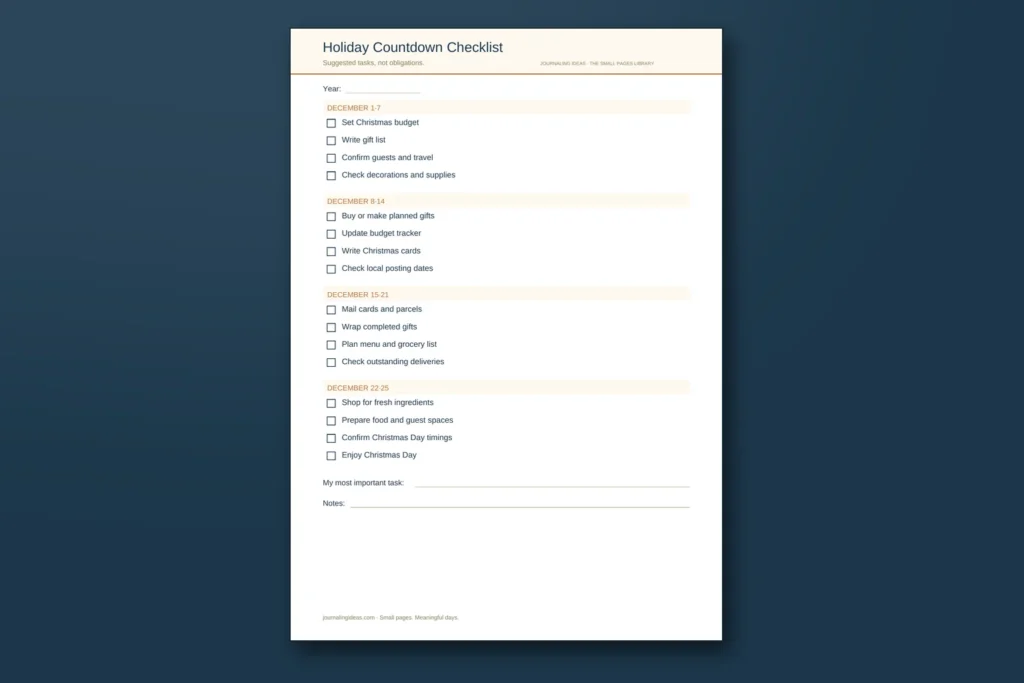
A simple Christmas countdown divides December into four manageable stages: confirm plans in the first week, shop and prepare in the second, finish deliveries and practical details in the third, and focus on food and final preparations during Christmas week. Treat these as flexible checkpoints rather than strict deadlines, and check off only tasks that apply to you.
December 1–7: Decide and organize
Review your total budget and complete your gift list. Confirm where you will celebrate, who is attending, and whether anyone has dietary needs or accessibility requirements. Check travel arrangements if you are going away. Look at the decorations and wrapping supplies you already own before buying more.
This is also a good week to make a first menu outline. You do not need a final grocery list yet; simply decide whether you are cooking, sharing dishes, ordering food, or keeping things low-key. If you are sending gifts or cards, check your local delivery options now.
December 8–14: Shop and prepare
Buy or make the gifts you have chosen within your limits. Record each actual cost on the budget sheet. Begin wrapping items that are already complete, especially gifts you need to carry or mail. Write cards and confirm recipients’ current addresses before posting anything.
Review your menu and identify items that need ordering ahead. If you have guests, ask what they can bring instead of assuming you must provide everything. Check opening hours for any services you expect to use near the holiday.
December 15–21: Check what is unfinished
Look for gifts that are bought but not wrapped and tasks that have been started but not completed. Confirm delivery status for outstanding orders. Check food supplies and make a realistic shopping list. If travel is involved, review tickets, routes, and packing needs.
Keep this week focused on essentials. If a decorative project is still unfinished, ask whether it matters enough to spend time on it. You can choose to leave it. A relaxed evening is part of the holiday too.
December 22–24: Prepare for your celebration
Shop for fresh food when appropriate, prepare dishes that keep safely, tidy the areas guests will use, and set aside gifts or cards for the right people. Check the cooking plan and make sure you have the equipment and ingredients needed. Charge devices or prepare travel bags if relevant.
If you are hosting, write a short list of what must happen on Christmas Eve and what can wait until Christmas morning. If you are a guest, confirm arrival times and what you are bringing. Leave some open space for rest.
Christmas Day: Use the plan, then enjoy the day
Check the meal timing, guest arrangements, and any important travel details. After that, let the page support you rather than control the celebration. If lunch is late or the wrapping is uneven, the day can still be meaningful.
In the UK and Australia, many households also make plans for Boxing Day on December 26. If you have visits, travel, leftovers, shopping, or a quiet day planned, add a note to your personal calendar. The three-sheet countdown is centered on Christmas Day, so it is fine to keep Boxing Day details separately.
How early should I send Christmas cards and parcels?
Send Christmas cards and parcels early enough to allow for sorting, transit, and possible seasonal delays. Exact last posting dates depend on the country, carrier, service, and destination, so check the current holiday guidance from your local postal provider. International mail usually needs more planning than local delivery; do not assume a standard delivery estimate is a guarantee.
Begin by confirming addresses, including postal codes or ZIP codes and apartment details. Check whether the recipient will be away. For international parcels, review customs forms, prohibited items, packaging requirements, and any charges that may apply. A correctly addressed parcel can still be delayed, so avoid leaving essential gifts to the last moment.
For US readers, check the current holiday information from USPS or the private carrier you intend to use. In the UK, check Royal Mail or your chosen courier. In Canada, check Canada Post or your courier. In Australia, check Australia Post or the relevant delivery company. These services may publish different cutoffs for domestic, international, express, and economy options.
If a last posting date has passed, consider a digital greeting, a phone call, or telling the recipient their gift will arrive later. You do not need to pay for costly expedited delivery just to preserve the appearance of perfect timing.
Use the countdown sheet’s “Check local posting dates” and “Mail cards and parcels” tasks as reminders. Write any confirmed deadlines on your own calendar. The checklist intentionally does not print a carrier-specific date that could become inaccurate next year.
For cards you plan to hand over in person, keep them with the corresponding gifts. For mailed cards, mark them complete only after they have been posted. That small distinction can save you from discovering an addressed stack in a drawer after Christmas.
How do I make a simple Christmas Day schedule?
A simple Christmas Day schedule needs only a few anchor times: when people arrive, when food preparation starts, when the meal is served, and when guests leave or travel onward. Work backward from the meal, allow extra time for cooking and cleanup, and leave gaps for conversation, rest, and unexpected changes.
Start with the one time that matters most. If guests are coming for lunch, decide roughly when you want to eat. Then check the actual cooking instructions for your ingredients and equipment. Different dishes need different preparation, cooking, resting, and storage times, so avoid copying a generic timetable without checking your menu.
A sample day might look like this: 9:00 a.m. for a relaxed breakfast; 10:30 a.m. to prepare food; noon for guest arrivals; 1:30 p.m. for lunch; 3:00 p.m. for a walk, games, or quiet time; and late afternoon for leftovers and tidying. Those times are only an illustration. A household with young children, shift work, evening celebrations, or long-distance travel may need a completely different rhythm.
Write a short food plan with the main dish, sides, dessert, drinks, and any dietary alternatives. Decide which items can be prepared the day before and which need attention on the day. Follow reliable food-safety guidance for cooking, cooling, and storing dishes; a planner is not a substitute for safe preparation instructions.
If you have guests, ask them to contribute where appropriate. One person might bring a side dish, another might handle drinks, and someone else could help clear the table. Sharing the work makes it easier for the host to enjoy the gathering.
Consider comfort as well as logistics. Is there a place for coats and bags? Does anyone need step-free access, a quiet space, or a particular mealtime? Will children need a break between activities? These details can matter more than a decorative table setting.
The Christmas Planner Pack does not include a separate daily timetable sheet. You can write a few anchor times on the back of your countdown checklist or in your phone calendar. Keep the printable focused on its three promised purposes: gifts, spending, and holiday tasks.
Where can I get the free Christmas Planner Pack?
You can get the free Christmas Planner Pack in The Small Pages Library. It includes three printable designs: a Christmas Gift List, a Christmas Budget Tracker, and a Holiday Countdown Checklist. Each design comes in A4 and US Letter, for six PDF files in total. The library is open access: no signup or password is required.
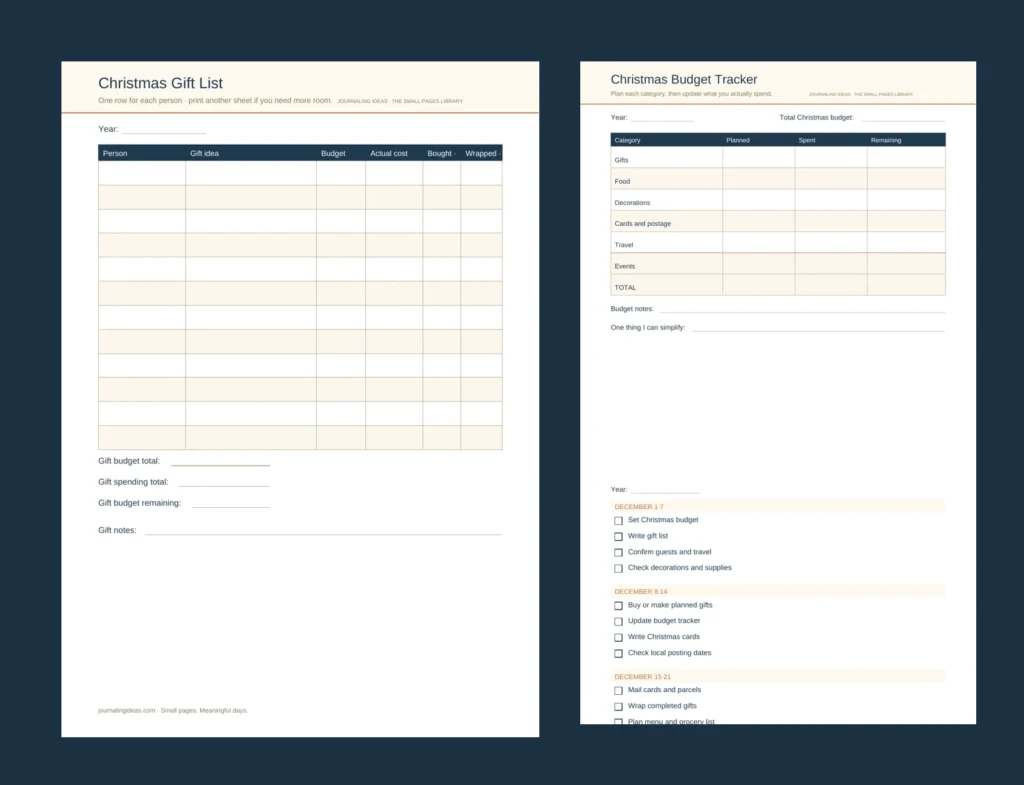
Choose A4 if that is the paper you normally use, including in many UK and Australian homes. Choose US Letter if your printer uses 8.5 × 11-inch paper, common in the United States and Canada. Both versions contain the same fields and checklist items.
Sheet 1: Christmas Gift List
At the top: Christmas Gift List and Year: ______. The table has exactly 12 blank recipient rows and six columns: Person, Gift idea, Budget, Actual cost, Bought □, and Wrapped □. Under the table are three summary fields: Gift budget total: ______, Gift spending total: ______, and Gift budget remaining: ______. A final line reads Gift notes: __________________.
Use one row for each recipient or gift. If you need more space, print the page again. The Bought and Wrapped checkboxes stay separate so you can see which presents still need attention.
Sheet 2: Christmas Budget Tracker
At the top: Christmas Budget Tracker, Year: ______, and Total Christmas budget: ______. The table has exactly six category rows: Gifts, Food, Decorations, Cards and postage, Travel, and Events. Its four columns are Category, Planned, Spent, and Remaining. Beneath the six rows is a TOTAL row with the same three amount columns. At the bottom are Budget notes: __________________ and One thing I can simplify: __________________.
Write a planned amount in each category, then update the spent and remaining columns. You can use your own currency without changing the page.
Sheet 3: Holiday Countdown Checklist
At the top: Holiday Countdown Checklist and Year: ______. There are four groups with exactly four checkbox items each:
December 1–7
- □ Set Christmas budget
- □ Write gift list
- □ Confirm guests and travel
- □ Check decorations and supplies
December 8–14
- □ Buy or make planned gifts
- □ Update budget tracker
- □ Write Christmas cards
- □ Check local posting dates
December 15–21
- □ Mail cards and parcels
- □ Wrap completed gifts
- □ Plan menu and grocery list
- □ Check outstanding deliveries
December 22–25
- □ Shop for fresh ingredients
- □ Prepare food and guest spaces
- □ Confirm Christmas Day timings
- □ Enjoy Christmas Day
At the bottom: My most important task: __________________ and Notes: __________________. These are suggested tasks, not obligations. Cross out anything that does not apply to your celebration.
To print, open the PDF that matches your paper size, select actual size or 100% in your printer settings, and check the preview before printing. If your printer adds margins, use its appropriate fit option if necessary. Print in color or grayscale according to your preference; the checkboxes and lines should remain usable either way.
You can keep the three sheets in a folder, clip them to a board, or fold them into a notebook. If you would rather begin with only one page, start with the gift list or budget tracker. There is no required order.
Ready to begin? Visit The Small Pages Library, choose your A4 or US Letter files, and print the pages you will actually use.
How can I make Christmas planning less stressful?
Make Christmas planning less stressful by choosing fewer priorities, sharing responsibilities, and treating your printable as a reminder rather than a rulebook. Pick the tasks that genuinely affect your celebration, set a spending limit you can live with, and leave space for rest. You are allowed to simplify traditions that no longer fit your time or energy.
Start by writing down what matters most to you. It might be a meal with family, a video call with a friend, a quiet morning, a favorite film, or a walk. Once those priorities are clear, it becomes easier to let go of activities that only add pressure.
Try separating tasks into three groups in your mind: must do, would be nice, and can skip. Mailing an important parcel may be time-sensitive. Buying another decorative cushion probably is not. The countdown checklist can hold the essential reminders, while optional ideas can stay in your notebook until you decide whether you want them.
If the season brings complicated feelings, make room for that too. Christmas is not equally joyful or easy for everyone. You can set boundaries around gatherings, gifts, travel, and social expectations. A smaller or different celebration is still a celebration.
When you feel overloaded, choose one task that takes a few minutes: write two names on the gift list, check one expense, or confirm one guest’s arrival time. Then stop if you need to. Progress does not have to look dramatic.
For a quieter creative break, you could collect a ticket, a piece of wrapping paper, or a handwritten note and explore the junk journal guide. Or use one question from the 150 journal prompts for beginners to reflect on what you want this season to feel like.
The planner is there to make space for the people and moments you care about. It is not a scorecard for how festive your home looks.
How do I reuse my Christmas planner next year?
Reuse your Christmas planner by keeping this year’s completed pages as a reference and printing fresh copies for the next holiday season. Note what you spent, which gifts were appreciated, which tasks took longer than expected, and which traditions you want to repeat. Review those notes before setting next year’s budget.
After Christmas, spend a few minutes looking over the gift list. Did you forget anyone? Did you buy something that was not needed? Was there a simple gift that worked especially well? You do not need to record private details about recipients; a few useful reminders are enough.
Next, check the budget tracker. Compare your original plan with what you actually spent in each category. The point is not to criticize past choices. You are gathering information so next year’s plan can be more realistic. If travel cost more than expected, allow for that next time. If you barely used the decorations budget, you may not need to allocate as much again.
Look at the countdown checklist. Circle any task that needed to happen earlier, such as ordering a personalized gift or checking international postage requirements. Cross out traditions that no longer feel worthwhile. This becomes your starting note for the following year.
Store the completed sheets in a labeled envelope or folder, or scan them if you prefer digital records. Keep them private if they include gift information or personal spending. When the next holiday season begins, print a fresh set in your preferred size and use the old pages only as a reference.
The same three-sheet structure works every year because it does not depend on a fixed weekday calendar or a carrier’s dated shipping schedule. You can adapt it to a different gathering date, a smaller budget, or a different guest list without redesigning the whole system.
You may also discover that you do not need every sheet next year. Perhaps the gift list is enough, or the budget tracker is the page that made the biggest difference. Keep what helps and leave the rest.
Planning the creative side of the season too? The Christmas journal prompts article gives you 50 gentle prompts for December reflection, and the Christmas junk journal ideas show you how to turn tickets, cards and wrapping scraps into keepsake pages.
Frequently asked questions about the Christmas planner printable
Is the Christmas Planner Pack really free?
Yes. The three printable designs are free in The Small Pages Library, with A4 and US Letter versions. The library is open access and does not require signup or a password.
Can I print the Christmas planner on A4 or US Letter paper?
Yes. Each of the three sheets has an A4 PDF and a US Letter PDF. Choose the version that matches your printer paper and check the print preview.
Does the planner include a Christmas gift budget?
Yes. The gift list includes a budget and actual cost for each gift, and the separate budget tracker covers gifts plus five other holiday spending categories.
Can I use the planner if I am not hosting Christmas?
Yes. Use the gift list and budget tracker as needed, and cross out countdown tasks that do not apply. You do not need to host a meal to use the pack.
Does the countdown include Boxing Day?
The printed checklist runs through Christmas Day. UK and Australian readers can add Boxing Day plans to their own calendar or the notes area.
Can I reuse these Christmas printables every year?
Yes. The pages use a blank year field and flexible task groups. Print fresh copies next year and keep this year’s completed pages as a reference.
Small pages. Meaningful days.
Before the new year begins, work through these New Year journal prompts to reflect on 2026 and plan 2027 with a clear head.
A Christmas planner can hold your lists and dates, but you may also want a little space for what the season means to you. Our Christmas journal prompts include 50 reflective questions for adults about memories, gratitude, relationships, simpler celebrations, and the year ahead, plus a free printable list in A4 and US Letter. Pick one question when you have a quiet moment—there’s nothing to catch up on.
5 Comments